

Software Engineering 3.0: Human Roles When Agents Own the Development Lifecycle
The article outlines a practical framework for human–agent collaboration in software engineering: humans confirm business rules and trade-offs, platforms enforce permissions and checks, agents execute continuously within agreed boundaries, each iteration verifies results against expectations, and teams must define stopping conditions, leave handoff-ready versions, and measure success by total investment and runtime quality.
Reading font
Human Thinks, Agent Writes — Too Simple a Split
Previously I often said: clarify requirements and design, then hand coding to the model. Now I see that division can move earlier. Agents can join before the solution is fixed — investigating existing systems, finding rule conflicts, comparing architectures, running experiments — without waiting for humans to think through every detail.
Humans cannot just write a design and step aside. When test results are puzzling, when the UI says success but data doesn't match, when commit and rollback issues appear, humans must still inspect code and run experiments to verify.
The key distinction is: who does the work, and who decides when important disagreements arise.
Take a hypothetical bulk customer import feature. The agent can propose synchronous vs. background processing, comparing response time, task recovery, and maintenance cost. But whether the customer can accept waiting, whether the site has ops capacity, whether the team wants to maintain another background mechanism — these require confirmation from the relevant people.

Humans can also misjudge; the agent may surface issues we missed. Research and verification cannot be skipped just because "I'm the lead."
Beyond Human and Agent, You Need an Engineering Platform
Some things cannot rely on repeated human reminders or on the agent's self-discipline. For example, a conversation says "no production data writes," yet the tool's account can write to the production DB; tests are required before merge, but the repo allows bypassing checks. Writing stricter prompts has limited effect.
So I view the division of labor together with the engineering platform. The diagram shows responsibilities, not necessarily new roles — small teams can have one person wear multiple hats.
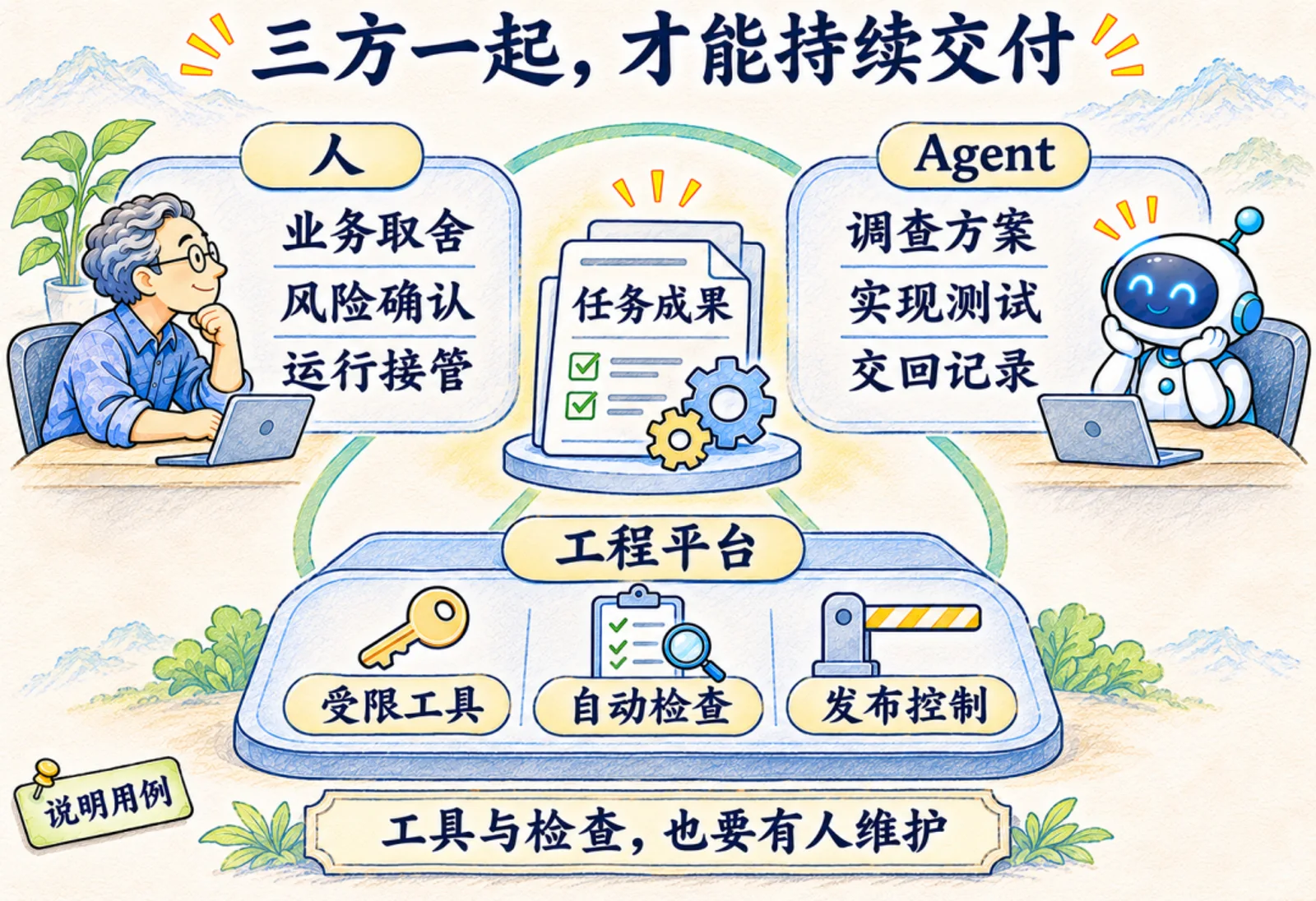
This includes the harness — tools, context, permissions, and feedback environment that support the agent. You don't need to buy or build a big platform first; existing repos, test scripts, access accounts, and release systems can start the loop. These checks and configs also need maintenance; wiring them up doesn't mean they'll never break.
Tools can restrict "what is allowed," but "import partially succeeded — can the business accept it?" still needs business confirmation.
What Can Continue, What Must Pause for Confirmation
Back to the import feature. Just saying "make import work" forces the agent to guess; micromanaging every method turns the human into a task scheduler.
I first confirm a few rules with the business: valid rows succeed, error rows fail individually; retrying the same request must not create duplicate tasks; task recovery must not recreate customers. Then let the agent continuously complete submission, processing, result storage, and query, then check exception paths.
One more question: does retry mean the original request and file, or a corrected file re-imported? The former needs a way to return to the original task; the latter needs handling of existing customers — each must be agreed separately.
When handing off the task, I clarify several things together:
First investigate existing import and customer write paths, propose a solution. After confirmation, implement and verify normal, failure, and retry scenarios. Keep confirmed interfaces and rules; if write conventions, transaction boundaries, or historical data must change, explain impact first. Finally return code diffs, check results, and unresolved items.
Agree upfront on what can continue and what must stop:
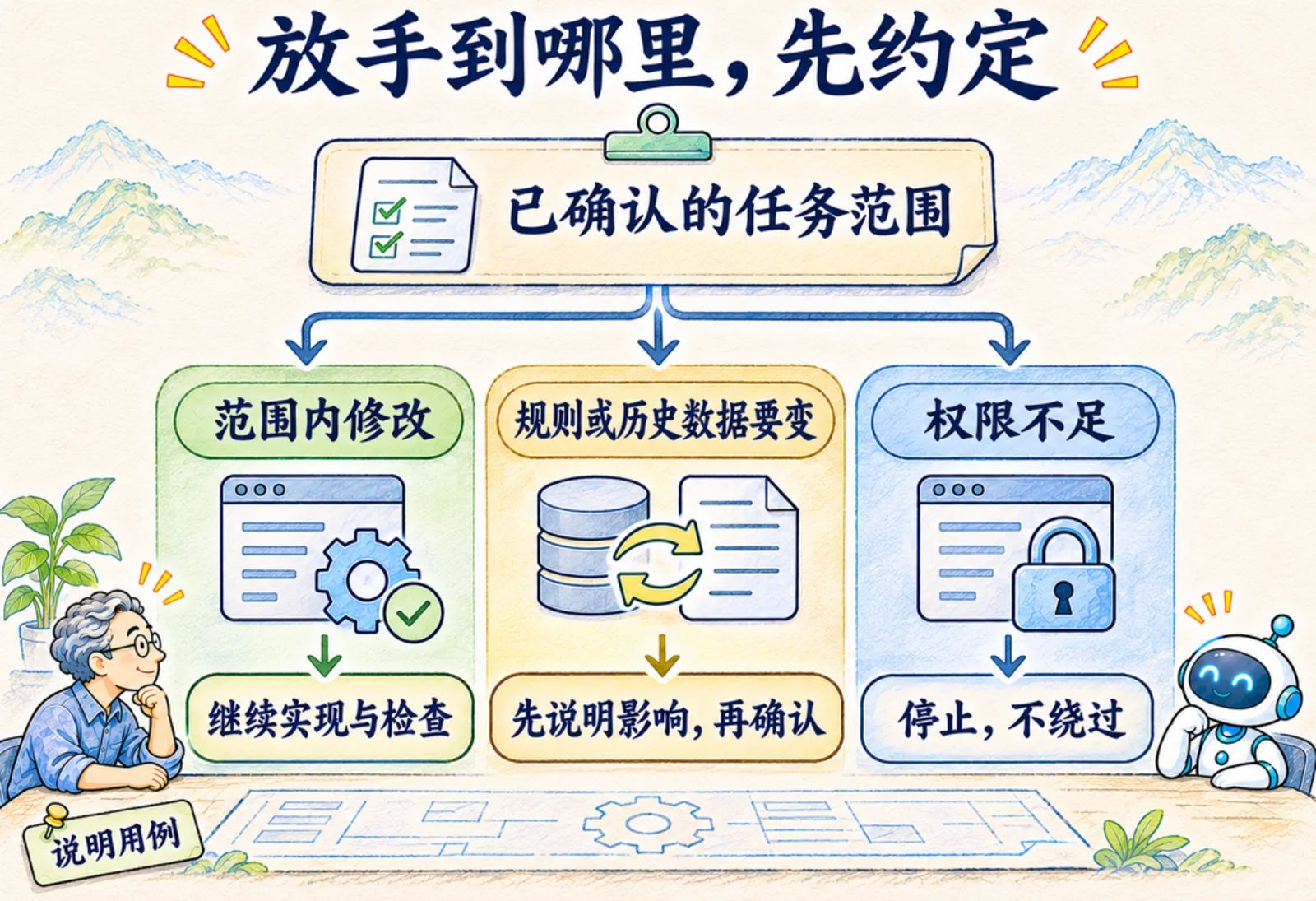
Operations involving money, permissions, data migration, or irreversible actions need earlier confirmation and restricted tool permissions.
Changing a prompt shouldn't require layers of approval; but changing write rules and letting it run unchecked is equally wrong. Intervention depth depends on impact and verifiability.
Ship a Version, Then Iterate with Concrete Questions
I now often let the agent produce a first version — maybe 0.1 or 0.5 of the target — then test and iterate to an accepted 1.0. The numbers are illustrative; 1.0 means it meets current usage requirements; production readiness is a separate check.
Each round should have a clear question. Get the happy path working, then check error rows and retries, then check processing interruption, permissions, and data scope. Otherwise "polish it a bit" easily yields more code without knowing what actually improved.
Anthropic's long-task agent engineering article records similar problems: doing too much at once breaks session continuity, declaring done without sufficient testing. They use feature checklists, incremental changes, progress logs, and end-to-end tests to improve. Those are specific experimental practices; real effectiveness must be validated in your own projects.
Each feedback loop must revisit the original agreements. If retry was not supposed to duplicate writes but wrote twice, and the original discussion didn't cover corrected-file retries, the fix differs.
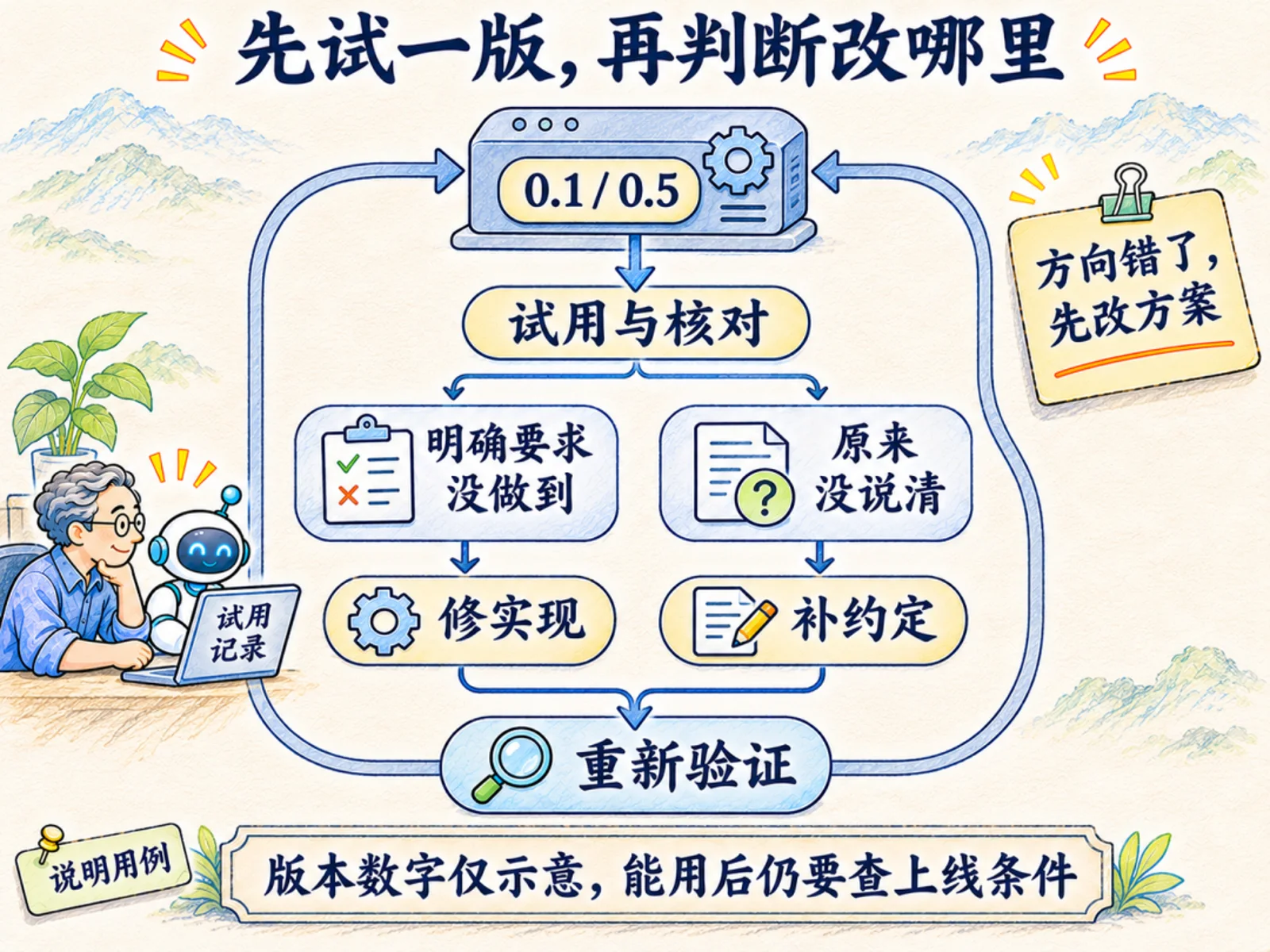
Deeply hidden failures may only surface during trial use. Distinguish code fixes, design additions, and operational adjustments — don't blame the model for everything. If business boundaries were reversed or a key dependency is unusable, adjust the plan first.
Tests Pass — What Else Do I Check?
My bigger worry: the agent misunderstands, and tests are written to match that misunderstanding. For instance, business allows partial success, but the agent treats a single error as whole-batch failure; code and tests may align perfectly.
So I fix a small set of samples and expected outcomes based on business agreements, then compare actual results against them.
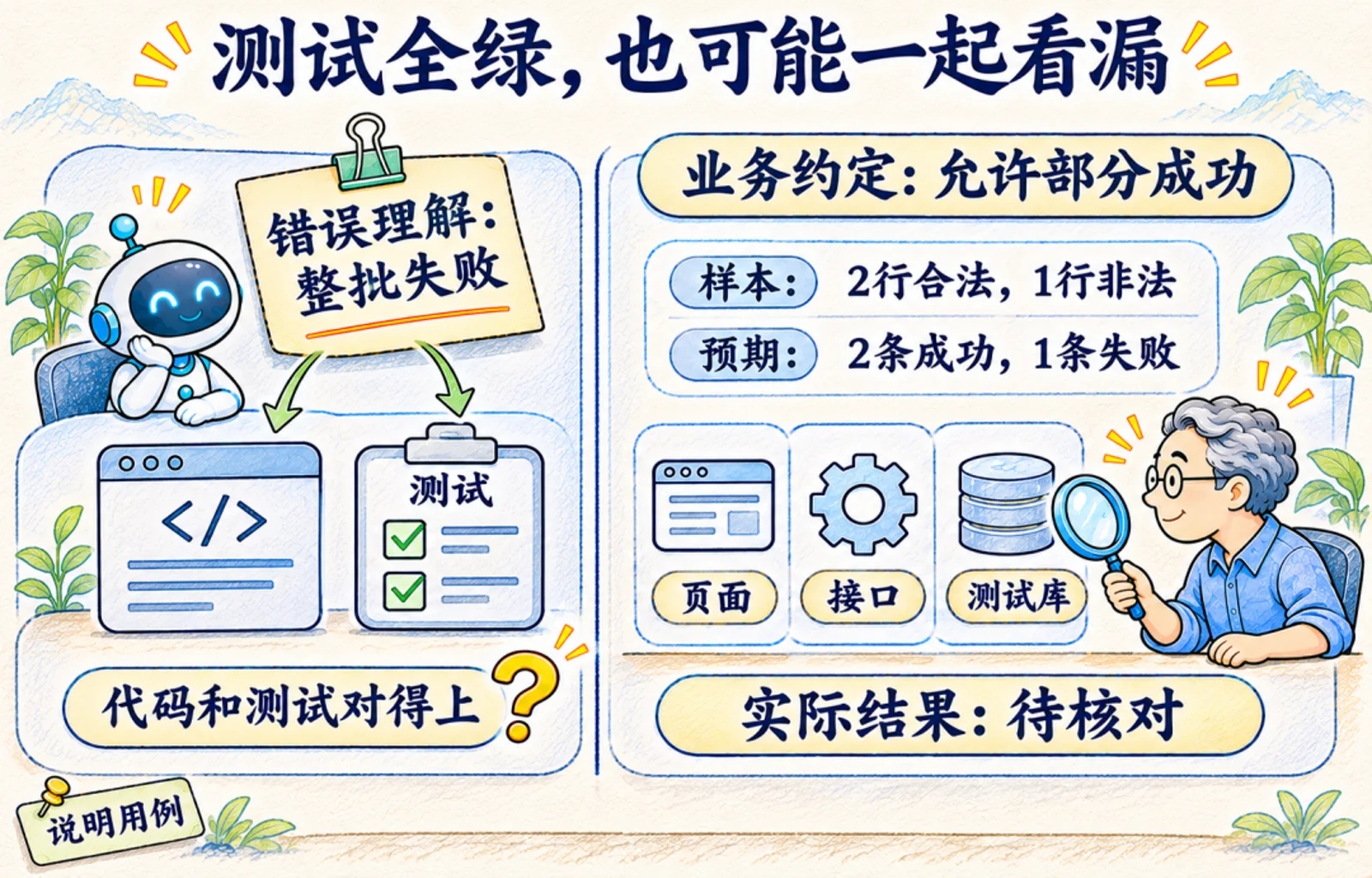
Expectations must not be changed just to make tests pass. If the agent thinks the original expectation is wrong, it should explain why, then get confirmation from the right person. The diagram only shows normal and error rows; original request retry, processing interruption, and recovery need separate checks — one sample cannot replace them.
An extra agent review helps, but they can miss things together. Verification needs business-confirmed expectations and actual execution results, not just mutual approval.
Prompt tweaks don't require re-running all fault experiments; but changing retry logic and transaction boundaries means you can't only test the UI. Parts without environment or execution get marked as pending verification — don't pass them with "should be fine."
When to Stop the Agent
Originally only fixing import dependencies, the agent starts splitting services and swapping frameworks — scope creep. Pause and compare against agreed scope. Extra suggestions are welcome, but they cannot silently merge into this change, nor lower acceptance criteria for implementation convenience.
When a new session starts guessing what was done before, leave the current version, confirmed rules, startup and test methods, and failure logs. Enough for the next run to continue; no need to regenerate similar docs each round; update stale records.
Same error repeatedly fixed, tokens burning, human constantly rescuing — pause and investigate. Agree upfront on time, cost, and consecutive-failure limits; when hit, stop blind retries.
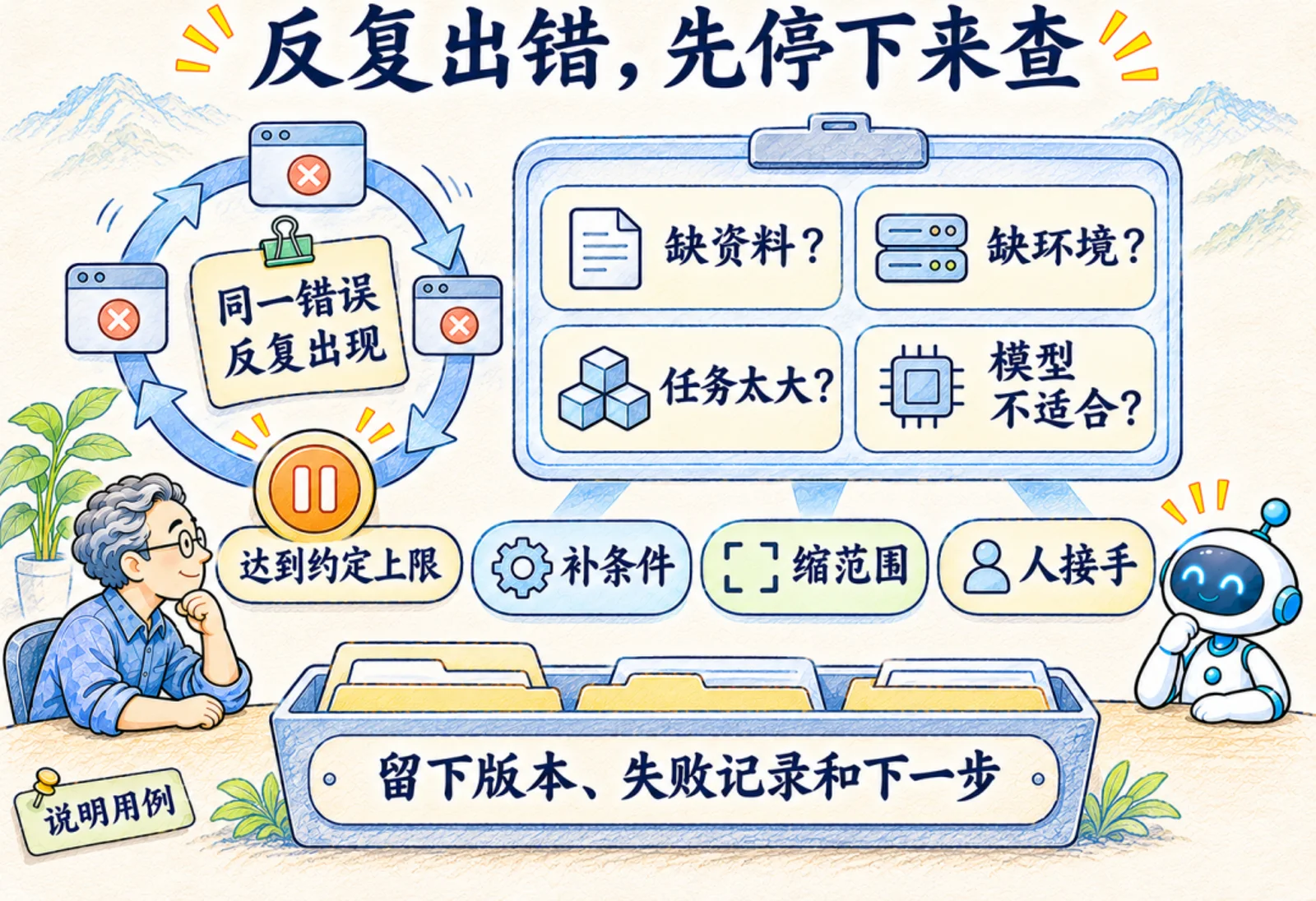
Another late-stage trap: feature done, but no one owns runtime. Who watches alerts post-launch? Who decides recovery on dependency failure? How is miswritten data handled? These need owners from design time, not patched at delivery. Capacity, security, recovery, and observability (logs, metrics, traces) must be designed in.
Platforms and automation can reduce repetitive work, but still need human maintenance. Don't concentrate all knowledge in one AI expert; others must find rules, run checks, and continue modifications.
Onboarding newcomers: don't just have them paste designs to the model and wait. Give a bounded complete change, allow full AI use, then have them explain the approach, investigate failures, interpret check results, reviewed by experienced members. At minimum they must articulate what they delivered.
After Handing Off Work, I Want Fewer Rescue Missions
I hope that as similar tasks repeat, the effort to correct already-clarified requirements, recover lost progress, and fix recurring errors decreases. Necessary business discussions and risk confirmations cannot be canceled to reduce "human intervention count."
Real improvement means counting communication, waiting, checking, and rework, then looking at post-launch quality. If the agent works for hours but the handoff requires a full cleanup, adjust the task, data, or verification — don't just count lines of code written.
I'm happy to delegate more, and accept that the agent outperforms me in places. But after each trial and fix, we must leave something reliable: confirmed rules, runnable tests, a version others can pick up. That's the basis for delegating further next time.
References
Anthropic, Justin Young: Effective harnesses for long-running agents , 2025-11-26. This article borrows its incremental execution, state handoff, and testing experience; human–agent division and import scenario are personal analysis and illustrative design. URL:
https://www.anthropic.com/engineering/effective-harnesses-for-long-running-agentsFor questions about attribution, corrections or content rights, please contactand we will review it promptly.