

Beyond Models: 7 Ontology Assets to Preserve When Migrating Platforms
When migrating ontology platforms, enterprises must preserve seven asset categories—definitions, ID mappings, rule implementations, authorization conventions, task traces, test records, and maintenance ownership—and verify both semantic meaning and executable behavior separately through fixed-task rehearsals that validate normal, error, and recovery cases while preventing duplicate execution during cutover.
Reading font
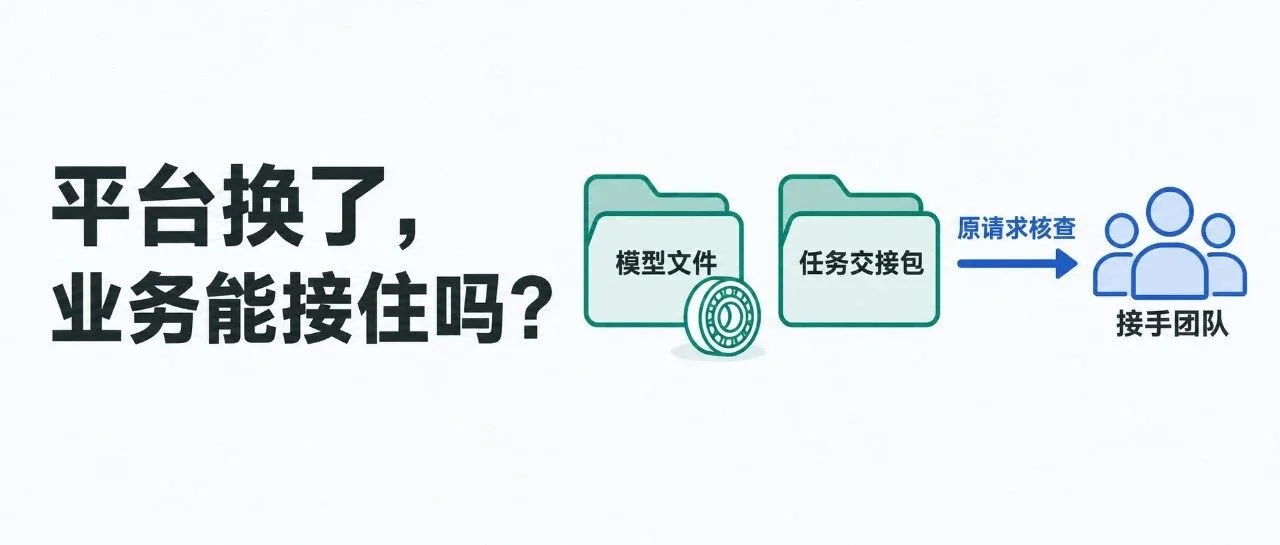
The article opens with a concrete scenario: a replenishment assistant project prepares to switch platforms. The model files open in the new environment and show entities such as products, warehouses, purchase orders, and approval records, but the receiving team cannot answer basic questions—why only 60 units were replenished, which parameter version was approved, or which request to query after a timeout. The delivery package contained diagrams but lacked mapping tables, interface conventions, and result-query entry points.
Seven Asset Categories That Must Be Handed Over
A table maps each required asset to the replenishment example and the capability the new team must gain:
Definitions and confirmation basis – Distinctions among inventory, unreceived purchase quantities, suggestions, approvals, and creations; the new team must explain meaning, scope, and trace to confirmation evidence.
ID mapping and provenance – Example SKU6204 in warehouse and purchasing systems, including conversion rules and data timestamps; the new team must locate the same product record and reconcile units and validity periods.
Rules and their implementations – Specified periods, valid documents, target quantities, packaging conditions, linked to programs or configurations; the new team must find where these checks execute and know what needs re-implementation after platform change.
Action and authorization conventions – Creation parameters, approval scope, permissions, side effects; the new team must enforce these checks in the new call path.
Results and unfinished tasks – Correspondence among tasks, approvals, requests, and documents; pending-check lists and handling entry points; the new team must determine how far a task progressed and continue processing the original request.
Test and release records – Sample cases: normal 60-unit, missing unit, unauthorized, lost receipt; the new team must re-run original samples and distinguish passed, failed, and untested items.
Experience and maintenance responsibility – Experience versions, sources, applicable warehouses, deprecation plans, and owners; the new team must select still-usable content and locate the person responsible for updates.
Each item must record storage location, version, owner, and whether the receiving party has access and continuing-use rights. Executable programs must be delivered with runtime dependencies, configuration notes, and tests; proprietary plugins or service-only dependencies must be explicitly noted. Original system records need not be moved, but authorized query entry points must be handed over. Interface credentials follow security processes; new accounts require fresh permission audits.
File Import Does Not Guarantee Semantic or Behavioral Fidelity
When using OWL (Web Ontology Language), first list the expressions actually used in the project, then verify both platforms support them. OWL 2 has different language profiles with non-identical expressivity; a platform claiming "OWL support" does not guarantee all project definitions transfer. Some constraints live only in annotations, executed by old-platform plugins. OWL annotations do not affect logical semantics; their use is application-defined. For example, the text "creation must verify approval" may import, but the new platform must be checked for where that check actually runs. The text remains; the program may not.
OPM (Object-Process Methodology) graphical models can still be used for business validation, but the programs that connect data, computation, and execution must be separately verified. Using the same modeling method does not mean any platform can directly continue running; migration does not require converting everything to OWL.
MCP tools likewise require actual call verification. A new client reading a "create purchase order" tool must test whether it passes correct parameters, acts within caller permissions, verifies approval, and handles duplicate requests without creating multiple orders. The tool name only confirms an entry point was found.
Migration Rehearsal with a Fixed Task
The incoming team runs a fixed rehearsal in an approved test environment using Warehouse #1 query and replenishment suggestion. Identical inputs, rules, and expectations are run on both old and new platforms. Any ad-hoc explanations or manual补齐 by the original team are recorded as delivery gaps—not as migration success.
Normal case : Target 300 units, available inventory 120 units, 12 boxes of valid unreceived purchases (10 units/box). Expected replenishment = 300 − 120 − 12×10 = 60 units. The check must trace back this rationale on both sides to prevent both platforms making the same error.
Error cases : Missing purchase data, unknown unit, no Warehouse #2 query permission. Observe what the tool actually retrieves, which conditions are blocked, and how the assistant explains them—not just whether the text reads smoothly.
Real-time query : Verify current record sources and timestamps; do not treat rehearsal-saved inventory as today's inventory.
Creation evaluation : Connect to a test purchasing system; validate approval-parameter correspondence, duplicate submission, parameter conflicts, and lost receipts. After the new platform saves a task record, reopening or restarting must still locate the same request and document—not only the current chat window.
Handover of In-Progress Tasks and Deduplication
After rehearsal, real-task handover is planned. For request REQ01 already sent with unknown result, designate which side continues querying, who handles late receipts, and how the new platform finds the original request. Do not treat it as a new task and re-submit.
The original request ID transfers, but the original deduplication guarantee may not. If the new platform uses a different service account or execution interface, verify whether the old system still recognizes it as the same request and whether the deduplication window remains valid. When unclear, retain the original query channel and assign authorized personnel—do not rely on re-submission to test outcomes.
The same demand must not be created in both environments simultaneously. Old-to-new comparison uses read-only or isolated test data; production cutover stops new submissions and automatic retries on the old side before taking over per agreement. Old-side result queries and late-receipt reception need explicit owners. Rolling back to the old platform follows the same rule: check already-sent requests first, do not re-process because of rollback.
Migration Phases and What Each Proves
A second table outlines four phases, the concrete results each must produce, and what remains unproven:
File import – Definitions, identifiers, references, and expression-support checks passed. Does not prove original query and processing programs have migrated.
Query and judgment – Fixed-input results, missing-data and permission samples. Does not prove current production facts are always correct.
Test-environment execution – Approval, creation, verification, and recovery results. Does not prove production authorization or unattended operation readiness.
Approved cutover and trial – Unfinished-task handover, original-request audit, exception and maintenance records. Does not prove all warehouses and business lines can directly reuse.
Each step documents passed, failed, and untested items, plus adaptation time. Gaps trigger supplementary delivery; unready capabilities retain explicit restrictions. There is no need to gloss over unverified tasks to declare "migration complete."
Retiring Old Capabilities with Evidence
When models become more powerful, the old work of field-by-field extraction and prompt iteration may shrink. Total investment—candidate organization, expert review, rework—must be measured against whether normal and anomaly samples still meet requirements; generation speed alone is insufficient.
An old tool serving only a decommissioned scenario can be considered for shutdown. First check for scheduled jobs, old sessions, or other applications still calling it; whether unfinished tasks have owners; whether historical evidence remains queryable. After confirming no new tasks need it, close the corresponding write paths; preserve needed queries and receipt reception separately; finally archive or delete per retention and authorization rules.
Existing query or rule services that are adequate allow removal of duplicate platform implementations. What stays are still-useful definitions, evidence, and executable checks—not every legacy component running forever.
Future Agent introductions follow the same method: small-scope task comparison—do different Agents organizing materials and cross-checking suggestions truly reduce manual rework, or just add waiting and handoff overhead?—before deciding on expansion.
Conclusion
After handover, the new team should pick up the task and retrieve the 60-unit calculation basis, the corresponding approval, the original request and purchase order. On timeout, they must continue querying along the record without recalling the original project group. This series used a single business case—Warehouse #1 "whether to replenish"—from start to finish. The ontology clarifies meaning and relationships among inventory, suggestion, approval, and purchase order; actual query, calculation, and order creation rely on corresponding programs. At delivery, both parts must be findable and verifiable.
Next platform evaluation: test this same business case first—what continues working, what must be rebuilt, what stays temporarily closed. What an enterprise should keep are the materials and capabilities that, after changing people and tools, still allow tracing evidence and operating per agreement.
References
W3C, OWL 2 Web Ontology Language Profiles , Section 1 and subset descriptions. Used to illustrate expressivity ranges of different language profiles; does not prove specific product support or migration compatibility. https://www.w3.org/TR/owl2-profiles/
W3C, OWL 2 Structural Specification and Functional-Style Syntax , Section 1 and annotation notes. Used to illustrate that annotations do not affect logical semantics; the article's asset checklist, rehearsal, and retirement steps are author recommendations. https://www.w3.org/TR/owl2-syntax/
For questions about attribution, corrections or content rights, please contactand we will review it promptly.