

uni-app Ends App Maintenance in 2027, Shifts to JS/TS Vapor Mode
uni-app will stop maintaining its App platform and VDOM mode in early 2027, directing developers to uni-app x's Vapor mode which compiles Vue templates to direct native operations for near-native performance using standard JavaScript and TypeScript, though migration requires a 14-step overhaul of layouts, Vue APIs, and native plugins.
Reading font

Maintenance Timeline and Scope
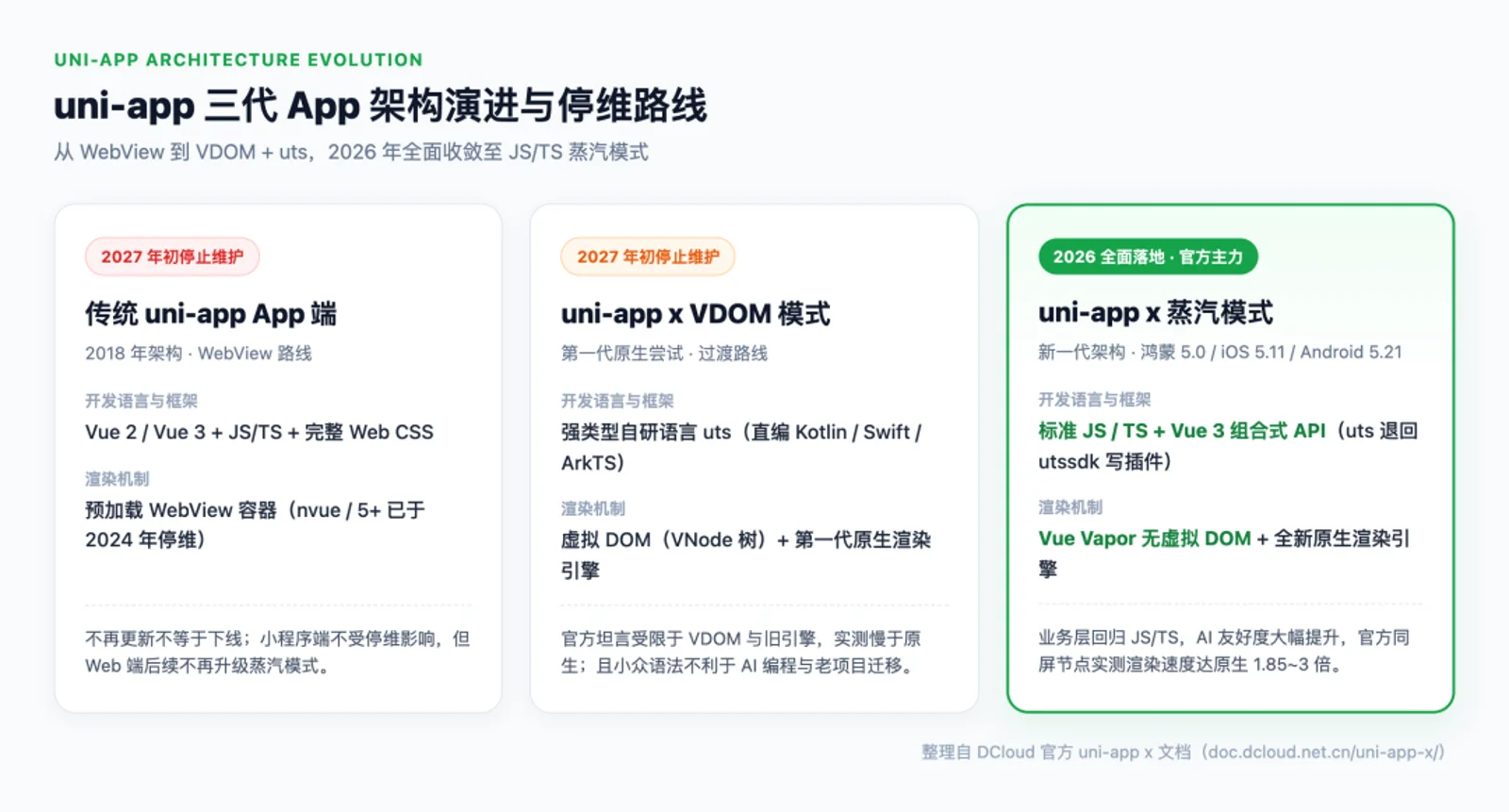
According to the official uni-app x documentation, DCloud stopped maintaining nvue and 5+ in 2024, and plans to halt regular updates for the legacy uni-app App platform and uni-app x's VDOM platform in early 2027. The announcement clarifies that "no longer maintained" does not mean immediate removal; existing apps will continue to run unless new device incompatibilities arise. Mini-program targets (WeChat, Alipay) are unaffected and can keep using legacy uni-app. Web projects, however, will not receive Vapor mode upgrades, and the official guidance recommends starting new web projects directly with uni-app x.
Why VDOM Was Dropped Alongside Legacy WebView
The first-generation uni-app (2018) used a WebView architecture, so its App deprecation is expected. The surprise is that uni-app x's VDOM mode — introduced only a few years ago — is also on the 2027 stop-maintenance list. The VDOM approach compiled the custom strong-typed language UTS to Kotlin (Android), Swift (iOS), and ArkTS (HarmonyOS). While cross-language calls were smoothed, the official docs admit that carrying VDOM and the old rendering engine still resulted in slower-than-native performance.
Another factor was AI-assisted coding: large models handle standard JavaScript and TypeScript fluently, but struggle with a proprietary language like UTS. Combined with high migration costs for existing projects, adoption stalled.
In 2026, DCloud replaced VDOM with "Vapor Mode" (inspired by Vue 3's Vapor Mode), rolled out across HBuilderX 5.0 (HarmonyOS), 5.11 (iOS), and 5.21 (Android). Vapor Mode eliminates the virtual DOM entirely: instead of building a virtual node tree at runtime, the compiler transforms Vue templates directly into code that manipulates real native nodes. This is paired with a brand-new native rendering engine. UTS is now confined to the utssdk directory for writing native plugins only.
Performance claims from DCloud's 4,050-node concurrent rendering test show HarmonyOS rendering time reduced to one-third of native, while Android and iOS approach twice the speed of native. Source code and comparison videos are publicly available.
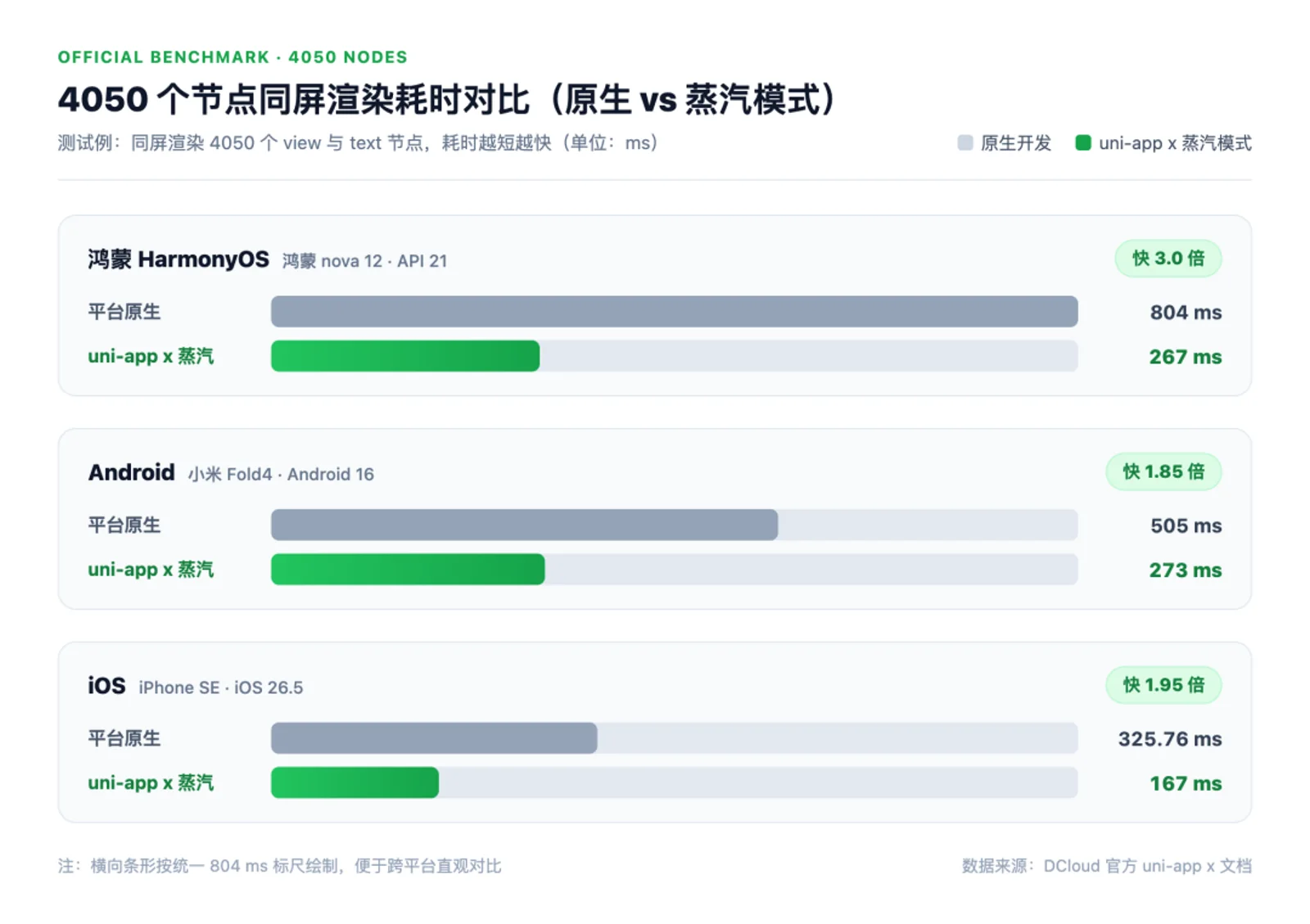
With standard JS/TS delivering this performance and AI tools able to generate it, maintaining the old WebView and VDOM stacks became unjustifiable.
Migration Guide: 14 Steps, Not Trivial
The official "uni-app to uni-app x" migration guide lists 14 steps and explicitly labels it a large-scale engineering effort, even recommending the use of DCloud's AI tool uni-agent for phased refactoring and acceptance.
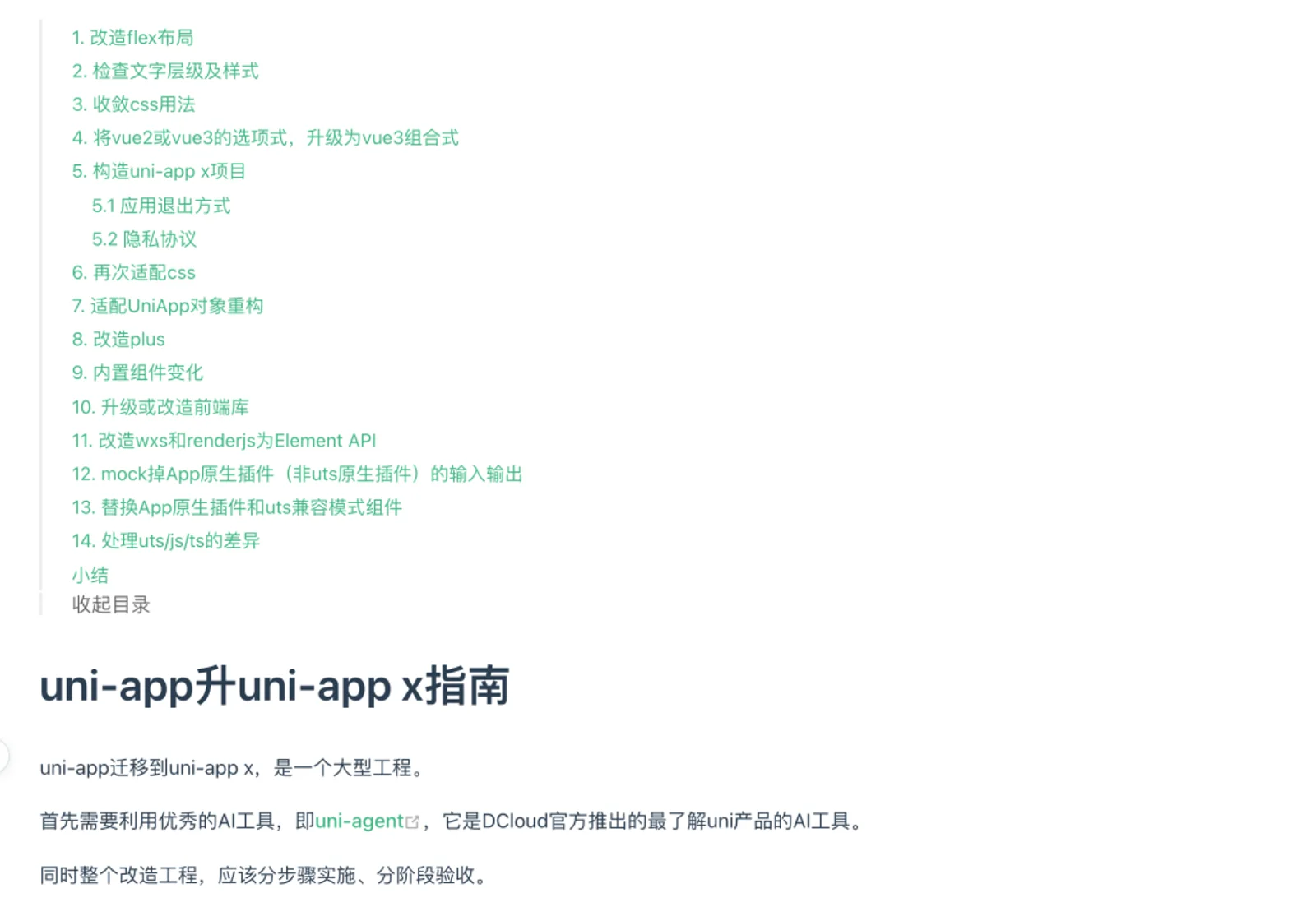
Key breaking changes include:
Layouts must switch entirely to Flexbox; block and grid are unsupported.
All text must be wrapped in <text> components; web-style inheritance, complex selectors, and pseudo-elements no longer work.
Vue 2 is unsupported; Vue 3 Options API and mixins are removed — code must migrate to Composition API.
Vuex must be replaced with Pinia.
Plugins pose the biggest friction: legacy native plugins in nativeplugins cannot be carried over. Native extension API plugins can be reused, but native component plugins are incompatible between legacy uni-app and Vapor Mode. If the plugin marketplace lacks a UTS replacement, teams must rewrite the wrapper themselves.
Practical Recommendations by Project Type
Mini-program-only teams: No action needed; legacy uni-app mini-program support continues.
Existing App projects: Assess cost carefully. Apps already in stable maintenance may not justify a 14-step rewrite before 2027, since they will keep running without regular updates.
New App projects: Start directly with Vapor Mode, especially when targeting Android, iOS, and HarmonyOS simultaneously, or when requiring 120 fps high-refresh, instant first-screen load, or smooth long-list scrolling.
References
[1] uni-app x official documentation: https://doc.dcloud.net.cn/uni-app-x/ [2] Vapor Mode documentation: https://doc.dcloud.net.cn/uni-app-x/app-vapor.html [3] uni-app to uni-app x migration guide:
https://doc.dcloud.net.cn/uni-app-x/uniapptox.htmlFor questions about attribution, corrections or content rights, please contactand we will review it promptly.