

uni-app Maintenance Clarified: App Platform Stops 2027, Mini-Programs Unaffected
DCloud announces uni-app App platform and VDOM rendering will stop maintenance in early 2027, but mini-program and web platforms continue; the article explains technical reasons, migration challenges to Vapor Mode, and community concerns.
Reading font

Introduction
Recently the front-end community has been buzzing with rumors that "uni-app is stopping maintenance." Screenshots and alarming headlines like "uni-app officially announces end of maintenance" and "App platform gone by 2027" have spread widely. Below is the official response from DCloud.
Don't panic. I spent an evening combing through the DCloud official documentation to clarify the situation from start to finish.
Conclusion: The rumors exaggerated the scope, but a specific group of developers does need to start planning migration.
1. What Did the Official Statement Actually Say?
Between rumor and truth lies the exact wording of the original text.
DCloud states in the uni-app x FAQ:
Official maintenance for nvue and 5+ stopped in 2024.
Maintenance for uni-app's App platform and uni-app x VDOM platform will stop in early 2027.
A critical clarification follows: "No longer maintained does not mean taken offline." This means that unless new phone compatibility issues arise, no further routine updates will be released.
Breaking it down into distinct items avoids confusion:
nvue, 5+ : Maintenance stopped in 2024 — should have been handled already.
uni-app App platform : Maintenance stops early 2027 — App developers must schedule migration .
uni-app x VDOM platform : Maintenance stops early 2027 — first-gen x projects must also move to Vapor Mode.
Legacy uni-app mini-program platform : Continues to be usable — official: if you only do mini-programs, both uni-app and uni-app x work.
Legacy uni-app Web platform : Will not upgrade to Vapor Mode — new Web projects should use uni-app x directly.
The core takeaway: the mini-program side is untouched; continuing with legacy uni-app for mini-programs is perfectly fine. The platforms being deprecated are the App platform and the first-generation VDOM rendering mode in uni-app x .
2. Decision Flowchart: Is Your Project Affected?
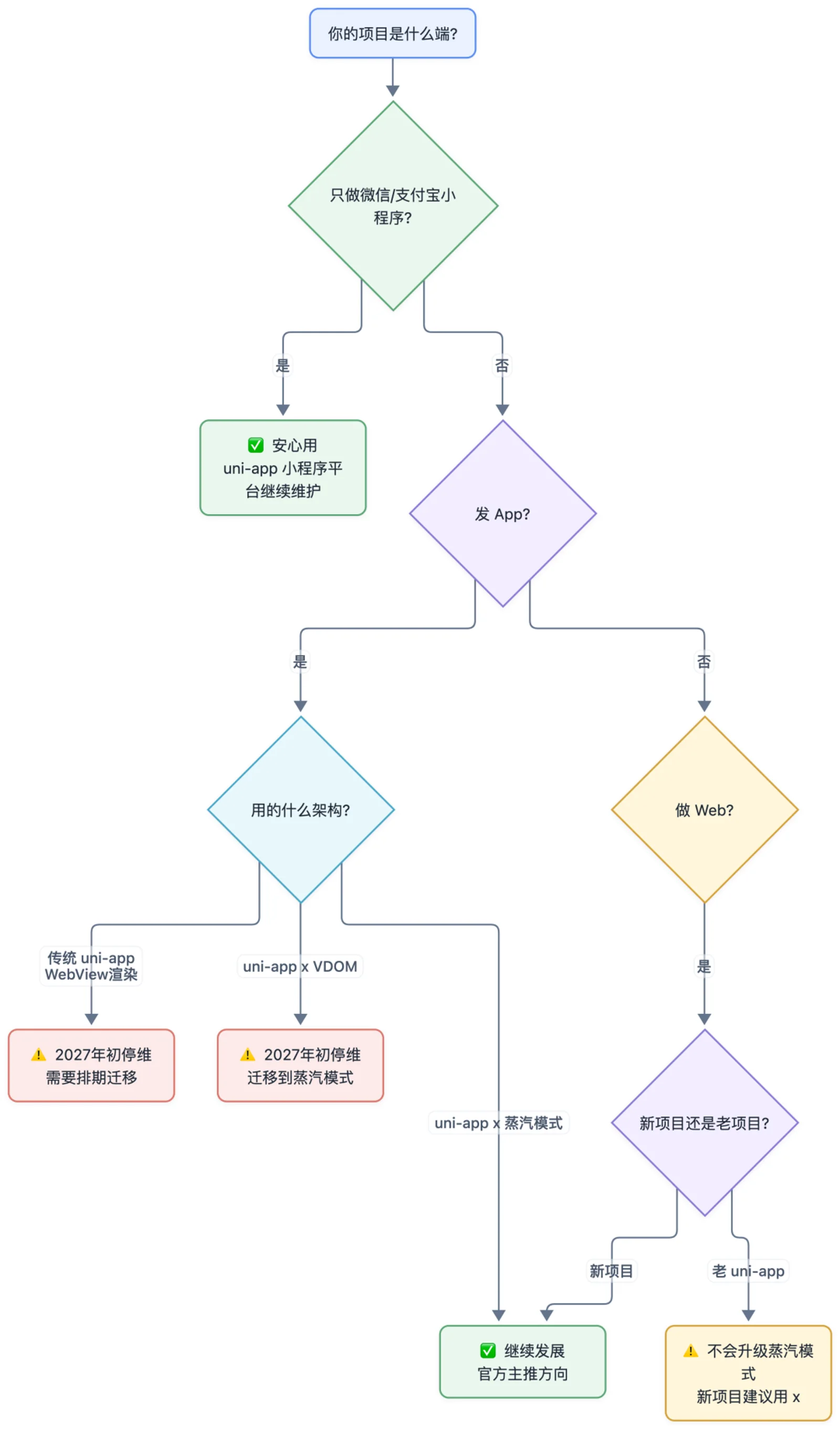
The decision tree is short: mini-program only — carry on; App — check which architecture you use; new Web projects — just use uni-app x.
3. Why Stop Maintenance?
Some may ask: "Legacy uni-app works fine, why stop now? Has DCloud lost its mind?"
Not at all. The technical debt became unsustainable.
3.1 Legacy uni-app App Platform Carried Two Heavy Burdens
Traditional uni-app on App used either WebView or nvue .
WebView essentially embeds a browser engine; its performance ceiling is fixed. A list scroll goes through JS engine, virtual DOM, native bridge — the longer the chain, the more jank.
nvue was DCloud's attempt to bypass WebView, but it stopped maintenance in 2024 . So the App platform now has one leg broken and the other barely holding.
3.2 Why Also Cut uni-app x's VDOM?
This surprised many. uni-app x launched in 2023 with VDOM mode and the custom uts language. Despite sounding hard-core, carrying virtual DOM and the old rendering engine still left performance behind native .
The killer issue was AI coding . LLMs write standard JS/TS fluently, but struggle with a proprietary strongly-typed language like uts. Migration cost for existing projects was high, so adoption stalled.
In 2026 DCloud flipped the table and introduced Vapor Mode .
Its core move: eliminate virtual DOM entirely. Official docs explain: previously rendering 1,000 elements required building a virtual node tree in memory at runtime, then creating real nodes. Vapor Mode compiles Vue templates directly into real-node manipulation code at compile time , skipping the intermediate layer.
According to the official 4,050-node concurrent rendering test, Vapor Mode reduced HarmonyOS rendering time to one-third of native, while Android and iOS approached twice the speed of native . Source code and comparison videos are published.
Performance improved, and the stack re-embraced JS/TS, making AI tooling viable again. Maintaining both legacy WebView and VDOM simultaneously no longer made sense.
4. If You Migrate, How Heavy Is the Lift?
Some might say: "Official says Vapor Mode is compatible with JS/TS and old projects can upgrade easily, so why not just upgrade?"
Open the official upgrade guide and you'll see how heavy "easy" really is.
The guide's first sentence states: "Migrating from uni-app to uni-app x is a large-scale engineering effort."
It lists a long series of transformation steps, even recommending the in-house AI tool uni-agent for phased refactoring and acceptance.
Concretely, every step is a hard bone:
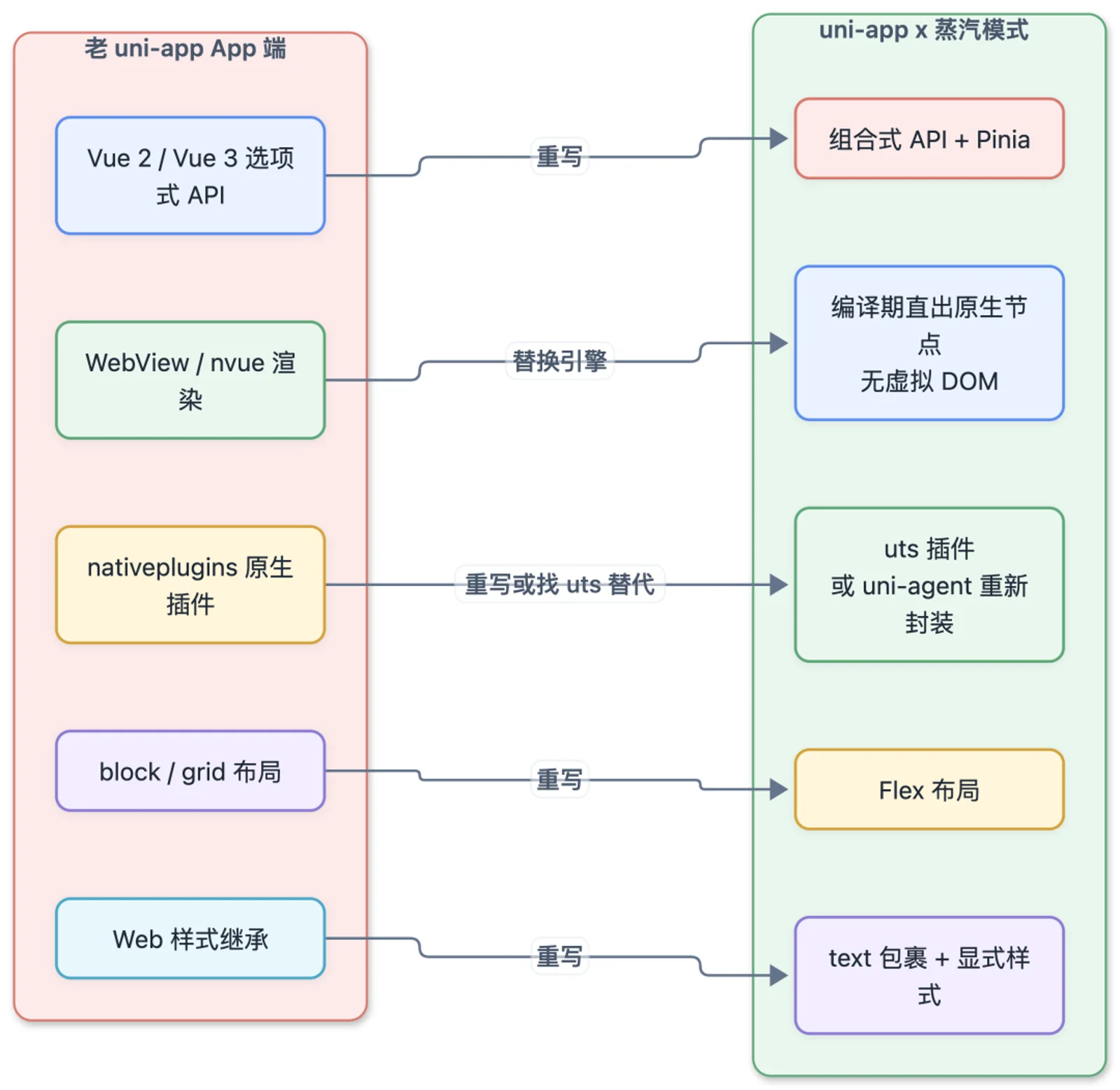
Layout: All pages must switch to Flex layout; block and grid are unsupported.
Text: Every text node must be wrapped in <text>; previous web-style inheritance fails, complex selectors and pseudo-elements must be rewritten.
Vue: Vapor Mode drops Vue 2 support, and even Vue 3 Options API and mixins are removed; code must move to Composition API, Vuex replaced by Pinia.
The most painful part is plugins. Old native plugins in nativeplugins cannot be carried over. The FAQ explicitly states: Native component plugins cannot be reused between legacy uni-app and uni-app x Vapor Mode , but uts-written API plugins can. If the plugin marketplace lacks a uts version, you must write it yourself or have uni-agent re-wrap it.
For mini-program-only developers, the official line is: uni-app or uni-app x both work.
But the same document adds: uni-app x has a slight edge.
uni-app x provides a cross-platform Element API to replace the awkward wxs/sjs, plus Style Isolation Strategy 2.0, reducing pitfalls for both component authors and consumers.
So legacy projects can stay on legacy uni-app, but new mini-program projects should consider uni-app x as the better choice .
5. Migration Flowchart: What Exactly Must Change?
6. Community Pushback Exists
One might ask: "You only cover the official view; what do developers think?"
Community opposition is real. A DCloud forum post titled "Strongly Oppose Stopping uni-app Maintenance" raises concrete points: Does every project need that level of performance? Are death-spiral lists really 0.1% of cases? Vapor Mode requires per-text styling — multi-theme projects risk bugs from a single missed style; swiper on iOS is still immature and visibly jankier than legacy uni-app; Vapor Mode crashes on accessing empty object properties where plain JS would not.
These voices may not be entirely correct, but they reflect a real problem: migration isn't free, and Vapor Mode's maturity needs time to prove itself.
The official docs themselves admit Vapor Mode's UI framework is new in 2026, theoretically less stable than React Native or Flutter, though showcased cases include apps with millions of downloads.
Final Thoughts
Back to the original question: Is uni-app really stopping maintenance?
Yes and no.
Yes , because the App platform will indeed stop maintenance in early 2027, and the first-gen VDOM architecture of uni-app x goes with it. This is not rumor; it's in black and white.
No , because the mini-program platform is not stopping .
If you only build WeChat/Alipay mini-programs, keep using legacy uni-app — no problem. Don't let clickbait scare you into a midnight rewrite.
Legacy projects keep running; new mini-program projects can evaluate uni-app x, which the official says has "slight advantages."
If you have a live App project on legacy uni-app, do one thing now: Open the project, check whether it uses WebView or nvue, and audit the nativeplugins directory for plugins that cannot be migrated.
Assess first, schedule second — don't wait until 2027 when new phones ship and your app crashes to start panicking.
Technology must move forward, but before stepping, see the ground clearly.
Migration is a "large-scale engineering effort," not a "syntax tweak."
The 2027 window gives you time to assess and plan, but not necessarily to procrastinate.
References
uni-app x Official FAQ (source of maintenance announcement): https://doc.dcloud.net.cn/uni-app-x/
uni-app to uni-app x Migration Guide: https://doc.dcloud.net.cn/uni-app-x/uniapptox.html
For questions about attribution, corrections or content rights, please contactand we will review it promptly.