

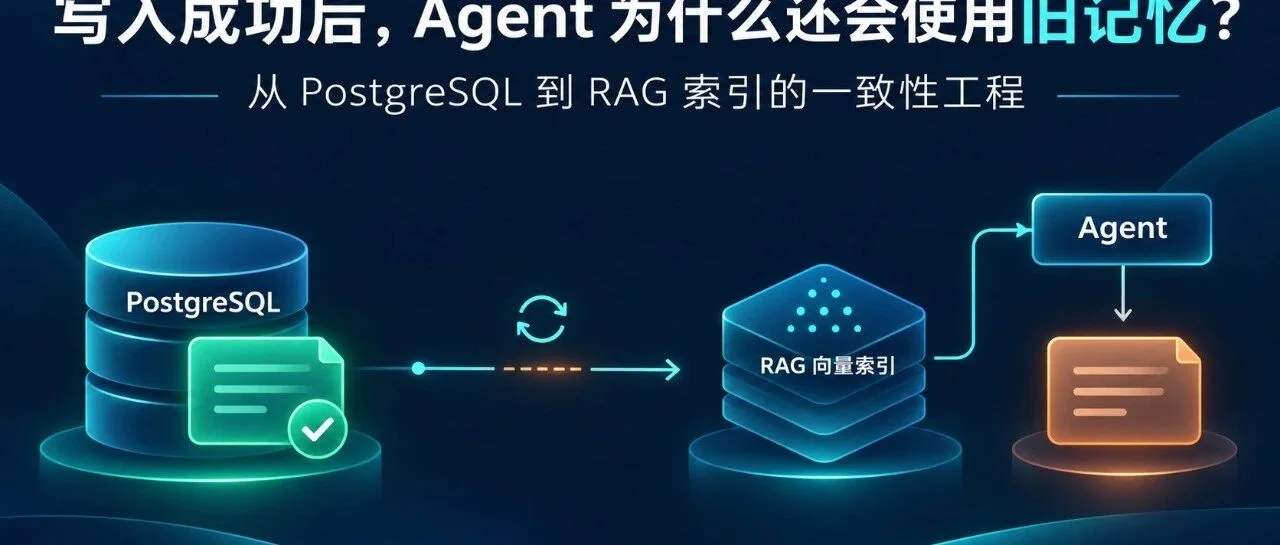
Why Agents Still Use Stale Memory After Successful Writes: PostgreSQL-to-RAG Consistency Engineering
The article explains why RAG systems serve stale data despite successful writes, presenting a consistency engineering framework using PostgreSQL as source of truth, Outbox for change propagation, Kafka for replayable logs, and Qdrant for candidate indexing, with protocols for write, projection, read, deletion, and rebuild.
Reading font
1. Define the Problem: Fact, Context, Execution Are Three Separate Paths
Using a refund agent as an example, after a user corrects an order number the system must simultaneously satisfy three distinct concerns:
Fact layer : Has B been committed? Is A invalidated? Responsible system: authoritative order/memory database. Common pitfall: treating vector payload as fact.
Context layer : Does this input contain stale, revoked, or unauthorized content? Responsible: retrieval service, ACL, back-source validation. Common pitfall: assuming index write success proves usability.
Execution layer : Are refund object, amount, permission, and idempotency key correct? Responsible: tool gateway, transaction service. Common pitfall: relying solely on RAG to decide tool parameters.
RAG consistency only guarantees the model does not receive stale evidence due to systematic data-path errors; it cannot eliminate model misunderstanding, prompt injection, or tool-call errors. High-risk tool calls must still re-verify identity, ownership, current state, amount, and business idempotency key against the business system.
Not every multi-store dual-write failure is a CAP issue. The real problem is that PostgreSQL, cache, and vector database lack a common atomic commit boundary: local transaction commits but network request may time out; remote succeeds but client never receives ack; retries may duplicate; old worker may finish after new worker. CAP is a trade-off framework under network partitions, not a substitute for modeling these concrete failure windows.
2. Write "Correctness" as Verifiable Contracts
Architecture should be verifiable by product, engineering, and QA together. Four contracts are adopted:
2.1 Commit Reliability
Before the API returns success, the current business state and at least one propagation intent must be committed in the same database transaction. Request retries must not produce duplicate logical changes. This does not mean the message has reached Kafka or that embedding is done; it guarantees that as long as the fact is committed, a pending propagation intent can always be found in the database.
2.2 Read-Your-Writes
A read carrying a version token must see an authoritative snapshot covering that token. If the index has not caught up, the system must either compensate, wait within a bounded deadline, or explicitly degrade; it must not silently return old content and treat it as success. This is not equivalent to "new text must enter semantic Top-K". Write visibility, relevance ranking, and context budget are independent goals. Critical fields like order numbers, confirmed preferences, and explicit constraints belong in a structured current-fact slot ; ordinary new documents should not be forced to the top just for read-your-writes.
2.3 Controlled Invalidation
Content that is already revoked, updated, or no longer authorized in the current authoritative verification snapshot must not enter the model context for this request. This constraint targets subsequent requests; if revocation occurs after content has been delivered to the model, the system cannot claw it back. Products must define the boundary of in-flight requests; extremely sensitive scenarios may add a second authorization check before model invocation.
2.4 Derivable Recoverability
After cache, consumer progress, or the entire vector collection fails, the system must be able to recover using the authoritative current state, retained events, and an explicit rebuild protocol. A derived index that cannot be recovered cannot be called an authoritative system.
3. Responsibility Layers: PostgreSQL Stores Facts, Vector Store Only Candidates
The pipeline: Write API → PostgreSQL (current state + events + Outbox) → Relay/Debezium → Kafka → Projector → Vector Candidate Index → Retrieval Service → Redis cache (optional) → Verified Model Context.
The most important design constraint: A vector hit is only a candidate, never proof that the content is still valid, still authorized, or still the latest version. For mutable, deletable, or ACL-protected content, the retrieval service must batch-query the authoritative current state. Redis may cache watermarks, hot content, or auth results, but cache failure can only affect latency, not result correctness; otherwise Redis becomes another critical store requiring atomic dual-write with the database.
3.1 Do Not Mix Three Kinds of Sequence Numbers
memory_version— scope: single logical memory; meaning: optimistic concurrency version of one object; must not express session-global order. session_seq — scope: single session within a tenant; meaning: continuous logical prefix of committed events; must not express cross-session order.
Kafka partition/offset — scope: single partition log; meaning: consumption, retention, and rebuild boundary; must not express business object version. session_seq is a scalar logical clock for a single session, not a Version Vector. Version vectors are only needed when multiple non-serialized write sources require concurrent causality expression. A knowledge base should not use a single global counter per tenant: hot tenants would cause lock contention. Documents use their own versions; cross-partition progress is recorded as offset sets or shard watermarks.
4. Data Model: Current State, Change Log, Idempotency, Projection Progress
The model deliberately separates "current facts" from "change records for propagation/audit". This is not automatic Event Sourcing: without event schema evolution, full retention, and replay rules, one should not claim Event Sourcing is implemented.
CREATE TABLE agent_sessions (
  tenant_id UUID NOT NULL,
  session_id UUID NOT NULL,
  committed_seq BIGINT NOT NULL DEFAULT 0 CHECK (committed_seq >= 0),
  PRIMARY KEY (tenant_id, session_id)
);

CREATE TABLE memory_current (
  tenant_id UUID NOT NULL,
  session_id UUID NOT NULL,
  memory_id UUID NOT NULL,
  memory_version BIGINT NOT NULL CHECK (memory_version > 0),
  session_seq BIGINT NOT NULL CHECK (session_seq > 0),
  status TEXT NOT NULL CHECK (status IN ('ACTIVE','REVOKED')),
  content TEXT,
  metadata JSONB NOT NULL DEFAULT '{}',
  updated_at TIMESTAMPTZ NOT NULL DEFAULT statement_timestamp(),
  PRIMARY KEY (tenant_id, session_id, memory_id),
  FOREIGN KEY (tenant_id, session_id) REFERENCES agent_sessions (tenant_id, session_id),
  CHECK (status <> 'ACTIVE' OR content IS NOT NULL)
);
CREATE INDEX memory_current_delta_idx ON memory_current (tenant_id, session_id, session_seq);

CREATE TABLE memory_events (
  event_id UUID PRIMARY KEY,
  tenant_id UUID NOT NULL,
  session_id UUID NOT NULL,
  memory_id UUID NOT NULL,
  memory_version BIGINT NOT NULL,
  session_seq BIGINT NOT NULL,
  op TEXT NOT NULL CHECK (op IN ('UPSERT','REVOKE')),
  payload JSONB NOT NULL,
  recorded_at TIMESTAMPTZ NOT NULL DEFAULT statement_timestamp(),
  UNIQUE (tenant_id, session_id, session_seq),
  UNIQUE (tenant_id, session_id, memory_id, memory_version)
);

CREATE TABLE idempotency_requests (
  tenant_id UUID NOT NULL,
  session_id UUID NOT NULL,
  request_id UUID NOT NULL,
  request_hash BYTEA NOT NULL,
  response JSONB NOT NULL,
  created_at TIMESTAMPTZ NOT NULL DEFAULT statement_timestamp(),
  PRIMARY KEY (tenant_id, session_id, request_id)
);

CREATE TABLE outbox_messages (
  id UUID PRIMARY KEY,
  aggregatetype TEXT NOT NULL,
  aggregateid TEXT NOT NULL,
  type TEXT NOT NULL,
  payload JSONB NOT NULL,
  created_at TIMESTAMPTZ NOT NULL DEFAULT statement_timestamp()
);idempotency_requestscannot store only the request ID. Same ID with different body must return conflict; same ID with same body returns the first successful response and token. Concurrent retries are arbitrated by primary key unique constraint, not by a racy "SELECT then INSERT".
Event payloads are also sensitive data. If events need replay, their retention policy must be designed together with current-state content deletion; do not just delete from the current table and forget Outbox, Kafka, logs, object storage, and backups.
5. Write Protocol: Generate Fact and Propagation Intent in One Transaction
A single write follows these steps, all inside the same database transaction:
Attempt to write idempotency record with (tenant_id, session_id, request_id); on conflict compare request_hash.
Lock the session row, allocate this event's session_seq.
Execute CAS update on current state with expected memory_version; on conflict roll back entire transaction.
Write to memory_events and outbox_messages.
Write version token into idempotency response, commit, return.
Sequence is generated via the session row:
UPDATE agent_sessions
SET committed_seq = committed_seq + 1
WHERE tenant_id = $1 AND session_id = $2
RETURNING committed_seq;
The update holds the row lock until transaction end, so writes to the same session serialize at this point. If one transaction modifies multiple memories, allocate consecutive sequence numbers and return the last one. Do not use BIGSERIAL: PostgreSQL sequence values do not roll back on transaction abort, and the order of sequence allocation does not equal commit order.
Inside the lock only database work is allowed. Embedding, remote HTTP, object storage, and long-running business computation must happen outside the transaction. Cross-session transactions must define a consistent lock order and handle deadlock retries.
The write API's version token can be represented as:
{
  "tenant_id": "...",
  "session_id": "...",
  "required_seq": 42
}
The token may use server-side session state or signed encapsulation, but must validate principal, tenant, session, numeric upper bound, and expiry. It expresses a read dependency, never an authorization credential; token leakage must not grant session escalation.
6. Outbox and CDC: Reliable Propagation, Not Distributed Transaction Magic
Outbox value: puts "business fact" and "need to propagate that fact" into the same commit boundary. It does not promise external systems are already updated; therefore consumers must design for at-least-once delivery, possible duplicates, and possible delays.
Polling Relay — suits early systems, few dependencies, controllable traffic; cost: task claiming, retry, send acknowledgment, cleanup, scan index.
Debezium CDC — suits existing Kafka Connect/CDC platform, multiple projections; cost: replication slots, permissions, offsets, snapshots, connector ops.
Kafka same-partition ordering has preconditions: same session uses same key into same ordered topic; upstream send order controllable; downstream won't parallelize causing out-of-order external writes. Do not split UPSERT and REVOKE into different topics and still assume cross-topic ordering. Partition scaling may change key-to-partition mapping; a migration protocol is required.
Debezium Outbox Router commonly uses id/aggregatetype/aggregateid/type/payload. aggregateid should use an unambiguous tenant+session combination; payload must carry at least event ID, schema version, operation, memory version, session sequence, and necessary content. Before go-live, verify topic, predicate, heartbeat, publication, message key, and decoding result with the real connector.
Heartbeats help low-traffic databases advance offsets, but cannot eliminate WAL buildup caused by connector stop, Kafka blockage, or permission errors. At minimum observe:
SELECT slot_name, active, restart_lsn, confirmed_flush_lsn,
       pg_wal_lsn_diff(pg_current_wal_lsn(), restart_lsn) AS retained_bytes
FROM pg_replication_slots;
Cleaning the Outbox table does not release WAL retained by the replication slot. When setting a WAL ceiling to protect the primary, accept that the replication slot may become invalid, CDC may need re-establishment, and projections may need rebuild. If the primary uses async replication for failover, transactions already acknowledged to the user may not have reached the new primary; application-layer Outbox cannot recover a commit that was never durably replicated — that belongs to RPO, synchronous replication, and backup/restore boundaries.
7. Projection Protocol: Handle Duplicates, Also Handle Late Writes
The most dangerous failure is not duplication but a late old write overwriting a newer one. Typical window: Worker A reads version 10, starts computing embedding for version 11; Worker B completes version 12 and writes to vector store; A finishes last, stable point ID gets overwritten by old vector. Even if Redis holds version 12, vector content has regressed.
Redis Lua can only atomically protect Redis, not atomically wrap Qdrant requests. Consumer rebalance, client timeout while server continues, old pod losing lease but continuing work — all can create late writes. Kafka transactions do not automatically compose PostgreSQL, embedding service, and Qdrant into an exactly-once transaction.
7.1 Versioned Immutable Points
Generate deterministic point ID for each logical version and projection generation:
from uuid import UUID, uuid5

POINT_NAMESPACE = UUID("6d823729-4dc6-4aad-a91b-13a708241724")

def point_id(tenant_id, session_id, memory_id, version, projection_id):
    key = f"{tenant_id}/{session_id}/{memory_id}/{version}/{projection_id}"
    return str(uuid5(POINT_NAMESPACE, key))
Same version retry writes same point; new version writes new point. Point payload must carry tenant, session, memory ID, memory_version, session_seq, and projection_id. Old worker cannot overwrite new version; old points even if lingering will be excluded by retrieval-time current-state validation.
Cost: old versions occupy candidate pool, so must over-recall, deduplicate by logical memory, continuously GC, and monitor "valid candidate ratio". If using stable point IDs, must prove target has business version comparison or fencing; consumer lease alone cannot constrain late requests.
7.2 Continuous Watermark and Post-Hole Completion Set
Watermark W strictly means: for a given projection generation, tenant, and session, all events with session_seq <= W have completed per projection rules. If 41 fails and 42 succeeds, watermark stays at 40. Using MAX(completed_seq) instead of continuous watermark would let readers incorrectly think 41 is projected, skipping necessary compensation.
Therefore store both continuous prefix and "completed after hole" events:
CREATE TABLE projection_progress (
  projection_id TEXT NOT NULL,
  tenant_id UUID NOT NULL,
  session_id UUID NOT NULL,
  contiguous_seq BIGINT NOT NULL DEFAULT 0,
  updated_at TIMESTAMPTZ NOT NULL DEFAULT statement_timestamp(),
  PRIMARY KEY (projection_id, tenant_id, session_id)
);

CREATE TABLE projection_completed_gaps (
  projection_id TEXT NOT NULL,
  tenant_id UUID NOT NULL,
  session_id UUID NOT NULL,
  session_seq BIGINT NOT NULL,
  event_id UUID NOT NULL,
  completed_at TIMESTAMPTZ NOT NULL DEFAULT statement_timestamp(),
  PRIMARY KEY (projection_id, tenant_id, session_id, session_seq),
  UNIQUE (projection_id, event_id)
);
Processing order:
Decode and validate schema, tenant, sequence, operation, and event idempotency.
UPSERT versioned point or execute revocation cleanup, wait for target acknowledgment.
In PG transaction, register this event completion; lock projection_progress, absorb projection_completed_gaps continuously from contiguous_seq + 1 until a gap is hit.
Finally commit Kafka offset; never advance partition record before reliable processing.
External write succeeds but progress commit crashes → replay; deterministic point IDs tolerate this. Progress commits first, external write later → permanent skip. Poison messages can go to DLQ to restore throughput, but that session's watermark cannot cross the gap; must enter controlled back-source, repair, or manual remediation.
Qdrant's wait, write ordering, replica consistency are separate control planes. Even with strong ordering, they cannot compare business version freshness, nor eliminate ANN search misses. On collection rollback, read strategy change, or rebuild, invalidate or switch the corresponding projection generation's watermark.
8. Read Protocol: Candidate Validation, Incremental Compensation, and Budget Must All Hold
Querying PostgreSQL only when indexed_seq < required_seq is insufficient. Even if watermark caught up, old points may arrive late; objects may be revoked; permissions may have changed. Sensitive paths must validate candidate current state within the same authoritative snapshot.
Suggested read time sequence:
Validate tenant, session, identity, token; read trusted projection watermark W.
In PostgreSQL primary, open short REPEATABLE READ READ ONLY transaction, read session head H.
Check H >= required_seq; read candidate current state and current-state delta for W < session_seq <= H.
In same snapshot, verify version, status, ACL; construct valid semantic evidence and current facts.
End transaction, then hand slotted context to model; do not wait for model or network calls while holding DB snapshot.
async def retrieve(ctx, query, token, k=5):
    required = validate_token(ctx, token)
    W = await trusted_progress(ctx.projection_id, ctx.tenant, ctx.session)
    hits = await vector_search_or_empty(ctx, query, limit=4 * k)

    async with ctx.pg.acquire() as conn:
        async with conn.transaction(isolation="repeatable_read", readonly=True):
            H = await load_session_head(conn, ctx)
            if H < required:
                raise ReadDependencyNotSatisfied()
            if W > H:  # generation mismatch, rollback, or recovery state untrustworthy
                W = 0

            delta = await load_delta_current(conn, ctx, W, H,
                                             limit=ctx.delta_limit + 1)
            if len(delta) > ctx.delta_limit:
                raise ProjectionLagTooLarge()

            semantic = await validate_in_batches(conn, ctx, hits, k)
            recent = await authorized_active_rows(conn, ctx, delta)

    return compose_context(
        semantic=semantic,
        recent=select_recent_facts(recent, token_budget=ctx.recent_budget),
        snapshot_seq=H,
        indexed_seq=W,
)validate_in_batchesshould batch-read authoritative current state by memory_id, require exact memory_version match, exclude REVOKED and unauthorized rows, and use authoritative content to construct evidence. Index payload may be used for coarse filtering and location, but not as final content or permission basis.
8.1 Candidate Starvation: Fixed k * 4 Is Not a Guarantee
Immutable points avoid old-write overwrites but let old versions participate in ANN Top-K. If first-round 4k candidates are mostly expired, the real valid new version may rank much later. Simply "fetch more" has no engineering guarantee.
More reliable: budgeted progressive expansion. Start with 4k, if valid count < k then fetch 8k, 16k; each round deduplicate, record elimination reasons, and respect max candidates, max DB time, total deadline. Stop when valid k reached, candidate cap hit, or deadline expires. If still insufficient, return evidence_incomplete or follow product-defined degradation path; never pad with unvalidated old content.
8.2 Two Slots, Not a Mixed Pile of Scores
Vector similarity, BM25, and "just written" priority have no natural common scale. Setting all deltas to 1.0 neither guarantees priority nor avoids crowding out truly relevant evidence.
Current-fact slot : order numbers, confirmed preferences, explicit constraints — structured state resolved by business override rules.
Semantic-evidence slot : knowledge chunks validated for version, status, ACL — ranked by reranker or well-defined fusion strategy.
Both slots need count, byte, and token caps. Incremental compensation must have row-count, byte, DB time, and token budgets; on budget exceed, critical fields can read current structured values and pause auto-execution dependent on stale knowledge; ordinary Q&A can degrade to bounded full-text search with degradation flag; if permissions cannot be verified, content must not be sent.
9. Deletion and Revocation: Immediate Masking and Physical Erasure Verified Separately
Revocation completes in the same PostgreSQL transaction: current state becomes REVOKED, version and session sequence increment, event and Outbox written. API success only means revocation fact is committed.
Redis tombstones help early filtering but cannot be sole basis: process may crash after PG commit but before Redis write; TTL may be shorter than failure window; cache recovery may lose data. Bloom filters are only acceleration structures; false positives reduce recall. Therefore current state and current ACL are the basis for model-context masking.
Physical erasure is a separate workflow covering vector points, document chunks, cache, object storage, event payloads, model input logs, exported copies, and backups. Recommend maintaining PENDING / RUNNING / CONFIRMED / RETRY state per target, recording retry count, last error, deadline, with reconciliation jobs continuously checking "authoritative revoked but target still residual" objects.
Distinguish three data categories:
Minimal audit metadata (event ID, version, cleanup status) — may retain, no content.
Recoverable content (event payload, object storage) — explicit retention period, access control, replay boundary.
Content bound by deletion request (user memory, sensitive docs) — online cleanup, backup expiry; envelope encryption with key destruction if needed.
Business revocation event, Kafka compacted topic null-value tombstone, and PostgreSQL physical delete belong to different layers. Externally must separately state "masked from subsequent retrieval context" and "physically erased within committed scope"; cannot conflate with a single fixed TTL.
10. Blue-Green Rebuild: No Gaps Between Snapshot and Incremental
When changing embedding model, chunking strategy, or index structure, do not overwrite production collection in place. Qdrant alias atomic update only switches collection mapping; it does not simultaneously switch query embedding, chunk rules, filter schema, and cache namespace. These parameters should form a projection generation, and a single request must be pinned to one generation.
A reasoned rebuild protocol:
Create new collection and new projection generation; fix embedding model, dimensions, normalization, chunking, schema version.
Before opening PG consistent snapshot, persist starting offset set O0 for each relevant Kafka partition; confirm Kafka retention covers estimated rebuild duration.
Scan current valid data from an explicit consistent snapshot. Parallel scans must share the exported snapshot; cannot take new snapshot per page and still claim full consistency.
Backfill by replaying increments from O0. Changes already in snapshot arriving again are acceptable duplicates; versioned points and idempotent progress absorb them.
Record ending offset set O1, continue real-time consumption after catch-up, verify integrity, ACL, deletion results, retrieval quality.
Switch collection, query model, chunk version, cache namespace via single generation routing.
Old generation continues updating during observation window for rollback; clean up per retention policy after acceptance.
Why replay from O0 before snapshot? Because duplicates are handleable, but changes missed during snapshot are often irrecoverable. Prerequisite: all changes go through Outbox, Kafka log has no gaps, retention sufficient; otherwise adopt a CDC snapshot protocol that can prove completeness.
Acceptance cannot just compare vector counts. Must also check logical document/chunk coverage, version distribution, deletion residue, cross-tenant retrieval, fixed eval set Recall@K, citation correctness, P50/P95/P99, cache hit rate, degradation ratio. Same vector dimension does not mean compatible vector space; query embedding must match target collection.
11. RAG Watermark Cannot Replace Task Execution Protocol
Pod disappearance, task still RUNNING, and RAG projection lag may co-occur, but cannot be solved by a single watermark. Long tasks need at least task state version, lease expiry, execution epoch or fencing token, result commit transaction, external side-effect idempotency key, and UNKNOWN state.
When old worker submits result, DB must verify it still holds current epoch; worker that lost lease cannot advance final state. Refund request timeout must query payment channel fact, not re-refund just because local success record missing. Task result, associated memory, and Outbox can commit in same PG transaction, but "model saw a memory" never equals "task completed".
12. Prove Contracts with Fault Injection, Detect Degradation with Metrics
Each test record should include tenant, session, memory ID, request ID, write token, authoritative version, retrieval snapshot, candidate version, final context source, filter reason, latency. Assertions target authoritative state, not whether a particular ANN happened to hit.
Fault windows and required verified behaviors:
PG commit before response crash → same request retry returns same logical result and token.
Outbox send success but ack lost → duplicate events do not duplicate logical state changes.
Vector write success, progress commit crash → replay acceptable, no projection loss.
41 fails, 42 succeeds → watermark stops at 40; after fixing 41, continuous advance.
Rebalance then old worker late write → old version does not enter valid context.
Delete committed, Redis unavailable → authoritative validation still masks content.
Qdrant timeout or prolonged backlog → compensation budgeted, degradation per contract.
Old points crowd candidate pool → progressive expansion or explicit insufficient valid evidence.
Snapshot period has delete/auth change → new generation after catch-up has no invalid content leakage.
PostgreSQL failover → commit promises, CDC recovery, read dependencies meet RPO/RTO.
Suggested metrics: projection_apply_latency_seconds — distribution from explainable event start to target acknowledgment. projection_seq_gap / projection_gap_count — session head vs continuous watermark difference, post-hole backlog. retriever_fallback_total{reason} — distinguish watermark lag, vector timeout, auth unverifiable. retriever_candidate_rejected_total{reason} — observe old version, revoked, ACL filter ratios. retriever_candidate_expand_rounds — detect old versions crowding candidate pool. retriever_delta_rows / retriever_delta_bytes — evaluate back-source compensation cost. deletion_pending_age_seconds — track physical cleanup overdue.
WAL retained bytes, Kafka lag, connection pool wait — identify propagation and compensation bottlenecks.
Do not call created_at exact commit time; it may be generated before commit. Vector visibility must be measured separately for by-ID read and real ANN search; report P50/P95/P99 with data scale, load structure, embedding cache hit rate, hardware, clock error, and failed request counting methodology. N samples with no observed error only means this sample found no error, not an absolute guarantee.
13. Phased Rollout: Upgrade by Evidence, Not Fixed QPS
Start : PG current state, CAS, durable idempotency; evaluate pgvector if needed. Next when query or async compute starts impacting transaction SLO.
Separate Retrieval : PG + Outbox Relay + independent vector store; batch current-state validation. Next when Relay latency or maintenance cost becomes measured bottleneck.
Streaming Projection : Debezium + Kafka; durable watermark, gaps, replay, bounded compensation. Next when multi-generation projections, complex recovery, or multi-consumer governance become requirements.
Continuous Evolution : Blue-green rebuild, quality eval, deletion reconciliation, capacity and recovery drills. Adjust by SLO, cost, real failure patterns.
Even with PostgreSQL and pgvector co-located, as long as content commits first and embedding is generated asynchronously afterwards, projection latency still exists. Co-location reduces cross-system coordination but does not automatically turn async computation into the same transaction.
Conclusion
The hard part of RAG systems is not "how to write vectors faster", but acknowledging that the vector index is a derived candidate system and designing clear truth sources, propagation protocols, read-time validation, deletion boundaries, and recovery methods.
A mature system must answer: What is the authoritative version of this content? How far has the index caught up? If not caught up, what can the current request safely provide? If candidates are expired, permissions unclear, or budget exhausted, how does the system degrade? If collection is deleted, replication slot invalid, or old replica flows back, how to recover?
The highest priority is not stacking all components, but four things: Authoritative facts decidable, propagation intent never leaves transaction, model context validated for version and permission, failure paths bounded and recoverable.
References and Verification Entry Points
PostgreSQL 17 — Transaction Isolation
PostgreSQL 17 — Logical Decoding Concepts
PostgreSQL 17 — Replication Configuration
Debezium — Outbox Event Router
Debezium — PostgreSQL Connector
Qdrant — Consistency Guarantees
Qdrant — Collections
For questions about attribution, corrections or content rights, please contactand we will review it promptly.