This article details common causes of native memory leaks in HarmonyOS apps and provides a step-by-step workflow using DevEco Profiler's Allocation template to reproduce, identify, analyze, and fix leaks via Native Heap and call stack analysis, illustrated with a real-world case study.
This article demystifies Kotlin's Flow, StateFlow, SharedFlow, and Channel by explaining their emission, storage, and loss mechanisms, illustrating common pitfalls with concrete code examples, and providing practical guidelines for choosing the right asynchronous data container in Android apps.
This guide explains how HarmonyOS enhanced freeze logs use multi-sampling stack collection and CPU load analysis to precisely diagnose app freeze root causes, covering a four-step analysis workflow with concrete log examples.
This guide demonstrates the complete six-step workflow for developing and publishing HarmonyOS third-party libraries to the OpenHarmony central repository using DevEcoCli and DevEcoCode, covering account setup, RSA key configuration, HAR module creation, oh-package.json5 requirements, release-mode building, and ohpm publishing with troubleshooting tips.
Huawei releases DevEco Code 0.1.3 and DevEco CLI 1.2.0 with enhanced ArkTS code generation, new static analysis tools, Goal mode improvements, and comprehensive CLI commands for HarmonyOS app development including build, run, emulator management, and MCP services.
This article analyzes nine lock-free data structures in Android 17, including MPSC/SPSC queues, triple buffers, ring buffers, and a lock-free MessageQueue, detailing their mechanisms, memory layouts, and use cases in audio, graphics, Binder IPC, and Perfetto tracing.
This guide walks through the complete workflow of using the open‑source TestHub platform to automate a mobile app—splitting a business process, connecting a device, creating a project and elements, arranging test cases, executing them, viewing reports, and troubleshooting common issues.
The article analyzes how Android evolves in 2026 from a simple app platform into a full‑blown intelligence system, covering on‑device AI via AICore and Gemini Nano, hybrid inference, intent‑based computing, the new AppFunctions framework, AI‑enhanced Chrome, and a transformed developer workflow.
This article presents a systematic methodology for analyzing HarmonyOS native crashes using CppCrash skills, demonstrated through a real-world SIGSEGV case study that reveals a use-after-free bug in ECSConnection reference counting across threads.
This tutorial demonstrates a full video transcoding workflow on HarmonyOS using the AVTranscoder API, covering instance creation, progress tracking, pause/resume/cancel controls, and playback of the transcoded output, with complete ArkTS code examples.
This article details how the usb-driver-dev Skill for OpenCode reduces HarmonyOS USB-HID peripheral driver adaptation from 2-3 weeks to 1-2 days by combining knowledge injection, template reuse, and automated compile-fix loops, demonstrated through a 10-step workflow for a drawing tablet.
This guide covers HarmonyOS wearable app development from fundamentals to distribution, including cross-device continuation, rotating crown and gesture interactions, ArkTS/ArkUI frameworks, JS-like paradigm for lightweight wearables, design guidelines, best practices for architecture and security, debugging, performance tuning, and AppGallery Connect publishing.
This article details integrating local LLMs into HarmonyOS apps, covering use cases like narrative generation and offline privacy, real-world benchmarks on Mate 60 Pro with Qwen2.5-0.5B, architecture using ArkTS and llama.cpp, performance optimizations via O3/LTO/KleidiAI, and key pitfalls like token limits and UI threading.
The article explains how Android’s historic lack of per‑app memory caps let rogue background apps exhaust device RAM, causing lag and crashes, and how Android 17’s new hardware‑enforced memory limits, precise leak detection, and industry‑wide fair‑memory standards aim to eliminate this long‑standing slowdown issue.
This article details a systematic 7-step workflow for diagnosing HarmonyOS app freezes, moving from experience-driven manual log analysis to automated AI reasoning that correlates stack traces, EventHandler queues, sampling stacks, and Binder/IPC data to pinpoint root causes in minutes.
This guide explains how to combine spatialization and multi-device adaptation in HarmonyOS 7, recommending that ordinary apps first refine five core page types — home/workbench, list/detail, edit/form, empty states, and settings — by restructuring information hierarchy, master-detail layouts, confirmation boundaries, and responsive width thresholds before adding visual effects.
Kuaishou contributes to the KMP&CMP community, expanding cross-language syntax support to 78% coverage with complex generics, function expressions, abstract classes, and typealias, while introducing KSP-powered compile-time type solidification to solve runtime generic erasure in ArkTS-Kotlin interop.
This guide introduces DevEcoCli, a unified command-line tool that wraps DevEco Studio's toolchain (ohpm, hvigor, hdc, emulator, hilog) for HarmonyOS app development, covering installation, core commands (create, build, run, emulator, docs, skills), and integration with AI coding agents like Claude Code and Cursor for natural-language-driven workflows.
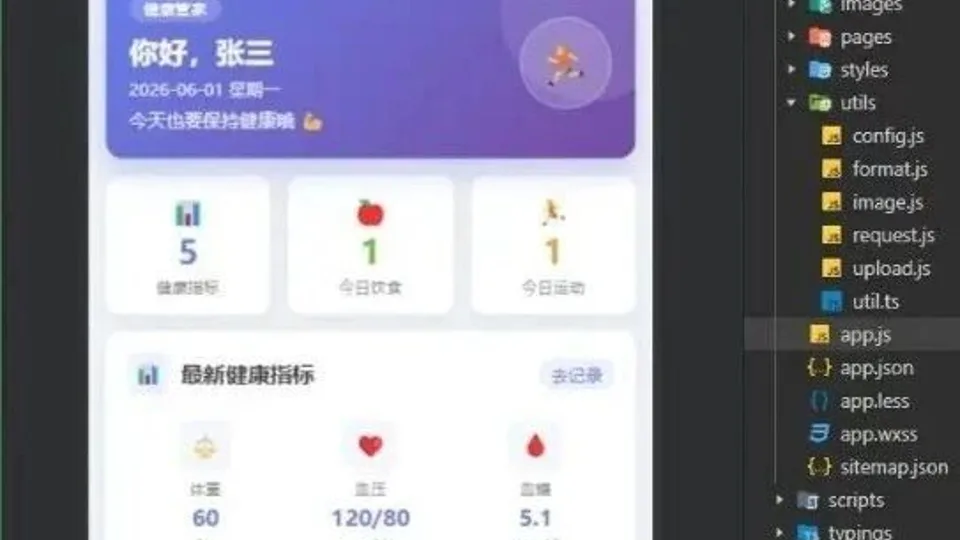
In just 20 minutes, the author uses Cursor AI to generate a full‑stack WeChat mini‑program for personal health management, featuring an AI‑driven health consultant, a Spring Boot 4 backend with JWT security, MySQL storage, and a Vue 3 admin console, and explains the architecture, routing, and deployment details.