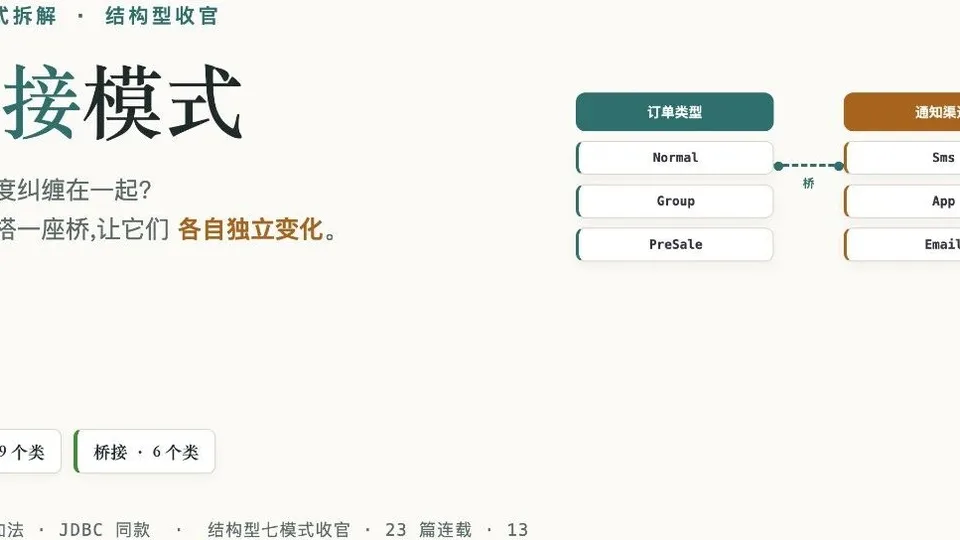
The article explains how the Bridge design pattern separates two orthogonal dimensions—such as order type and notification channel—into independent hierarchies, replacing inheritance‑driven class explosion with compositional bridges, and demonstrates its rationale, code, real‑world examples, and differences from similar patterns.
This article introduces the Bridge design pattern, explains its purpose of separating two independent dimensions to reduce class explosion, provides practical real‑world examples, and walks through a complete Java implementation with interface, abstract bridge, concrete classes, and a test driver.
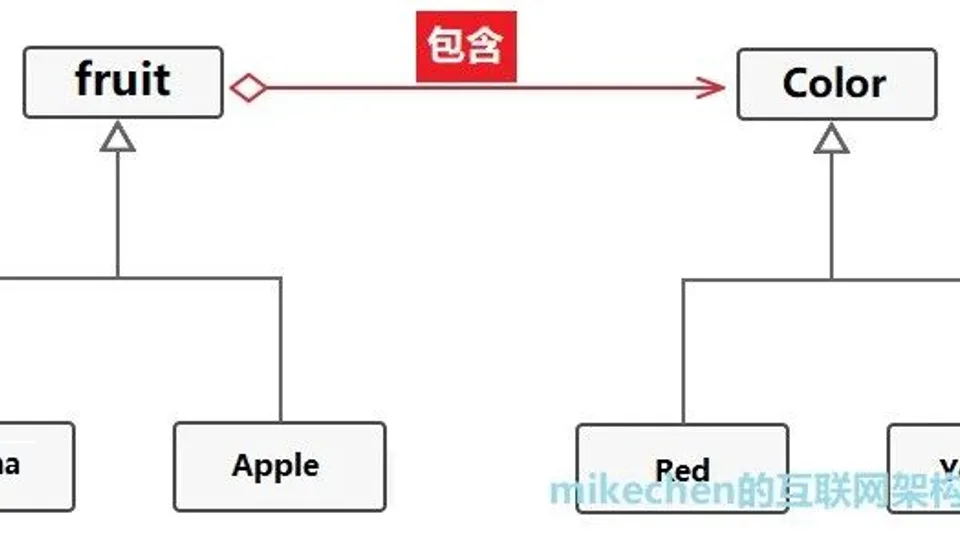
This article explains the Bridge design pattern, a structural pattern that separates abstraction from implementation to avoid class explosion, provides detailed Java code examples, UML diagrams, advantages, disadvantages, and typical scenarios for applying the pattern in software development.
This article explains the Bridge design pattern in Go by defining its purpose, illustrating how Shape and Pen interfaces can be combined through a Bridge struct, and providing a complete Go code example that demonstrates interchangeable colors and shapes.