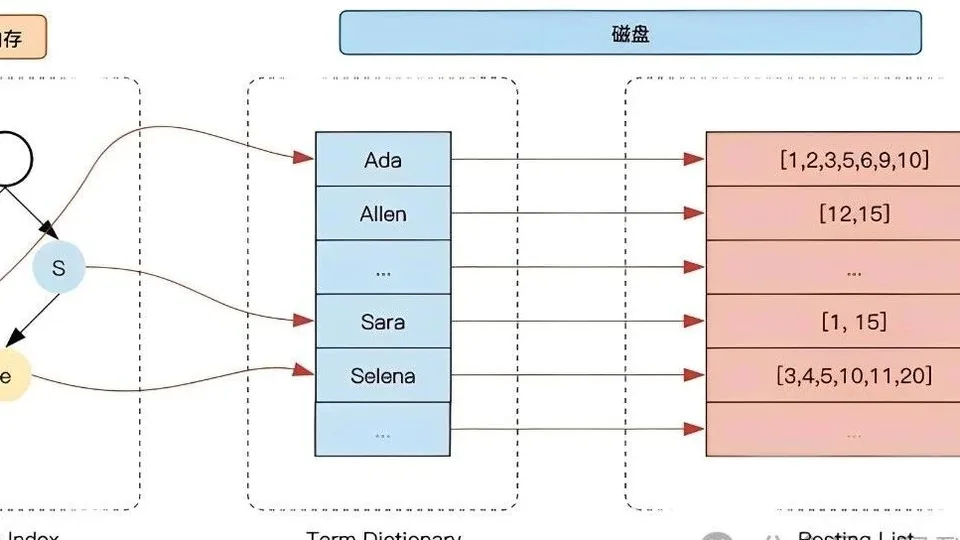
The article explains how Elasticsearch implements efficient search using an inverted index, detailing its components—posting list, term dictionary, and term index—illustrating the query flow with concrete examples, compression techniques, and the role of Lucene.
This article explains how Elasticsearch transforms simple keyword matching into a high‑performance, scalable search engine by using inverted indexes, term dictionaries, posting lists, term indexes, stored fields, doc values, segments, and distributed node architectures to achieve fast, reliable full‑text search on massive data sets.
This article explains how Elasticsearch leverages Lucene's inverted index, term dictionaries, and posting list compression methods such as FST and Frame‑of‑Reference to achieve fast, accurate, and tolerant search performance, while also discussing practical implementation details and examples.
This article explains how Elasticsearch achieves fast search by using inverted indexes, detailing the structure of posting lists, term dictionaries, term indexes, and compression methods such as Frame of Reference and Roaring Bitmaps, as well as techniques for efficient union and intersection queries.
This article explains the concept of inverted indexes, their role in full‑text search, and provides a detailed overview of how Apache Lucene implements inverted indexing, including term dictionaries, posting lists, query processing, and numeric handling with BKDTree.