

11 Must-Have Codex Skills for AI-Powered Development
This article details 11 essential Codex Skills that enhance AI coding agents with progressive loading, test-driven development, CI debugging, frontend design, web testing, MCP server building, code auditing, PR review, persistent memory, document parsing, and context engineering, including installation methods and pros/cons.
Reading font
Introduction
AI coding agents often produce code that "looks fine but fails in production" — missing edge cases, exception handling, or security checks. Codex Skills address this by encapsulating expert workflows into reusable, progressively loaded instruction packs that save 80-95% of token consumption.
What Are Codex Skills?
Codex Skills are instruction packs centered on a SKILL.md file. At startup Codex reads only skill names and descriptions (~2% context budget); full instructions load on demand when a task matches. If no match, zero context is used. The same SKILL.md works across Codex CLI, Claude Code, Gemini CLI, Cursor, and GitHub Copilot.
Skills have three scopes (user, project, enterprise) and two trigger modes: explicit ( $skill-name) and implicit (auto-match on task description).
How to Install Skills
Method 1: Manual Clone
# Create Codex skills directory
mkdir -p ~/.agents/skills

# Clone skill (example: superpowers)
git clone https://github.com/obra/superpowers.git ~/.agents/skills/superpowers

# For Codex App, also sync to .codex/skills
mkdir -p ~/.codex/skills
cp -r ~/.agents/skills/superpowers ~/.codex/skills/
Method 2: Official skill-installer
# Install official skill
$skill-installer <skill-name>

# Install experimental skill
$skill-installer install https://github.com/openai/skills/tree/main/skills/.experimental/<skill-name>
Method 3: Community Automation Tools
@supercorks/skills-installer — npx @supercorks/skills-installer install; interactive, supports Git sparse checkout and Codex Agent conversion.
@sstar/skill-install — skill-install install [URL or local file] --tool codex; supports public URLs, wikis, local files, auto-extract and validate.
@goodpostidea-tech/skills — npx @goodpostidea-tech/skills add [repo-url] --skill [name]; install from any GitHub repo, interactive tool selection.
@bbhxwl/skills — npx @bbhxwl/skills install [name] --target codex; install from registry, supports update and uninstall.
Example interactive flow with @supercorks/skills-installer:
# Run installer
npx @supercorks/skills-installer install

# Interactive steps:
# 1. Choose install type (skills / subagents / both)
# 2. Choose path (global or local)
# 3. Check skills to install (navigate with ↑/↓, SPACE to toggle, → to expand description, A to select all, ENTER to confirm)
After installation run codex restart to reload skill metadata (clears session cache and reloads trigger keywords and preconditions).
💡 Tip : Share a single skill directory across all AI tools via symlink: ln -s ~/.claude/skills ~/.agents/skills
Where to Find More Skills
TokRepo — 500+ skills, Chinese support, community voting, one-click install. URL: https://tokrepo.com
Anthropic Official Skills — SKILL.md reference implementations. URL: https://github.com/anthropics/skills
VoltAgent/awesome-agent-skills — Community awesome list with official skills. URL: https://github.com/VoltAgent/awesome-agent-skills
OpenAI Codex Skills Catalog — Official Codex skill directory. URL: https://github.com/openai/skills
ComposioHQ/awesome-codex-skills — Curated Codex skills. URL: https://github.com/ComposioHQ/awesome-codex-skills
SkillsMP — 700k+ skills, smart filtering. URL: https://skillsmp.com
Batch install: npx antigravity-awesome-skills --codex (requires antigravity-awesome-skills package).
11 Essential Skills
Skill 1: create-plan
Open source: https://github.com/openai/skills/tree/main/skills/.experimental/create-plan
Install: $skill-installer install create-plan or via LobeHub.
One-liner: Forces Codex to output a reviewable execution plan before writing any code.
Problem: Complex tasks cause Codex to start coding immediately, leading to wrong direction, repeated prompt tweaks, and massive token waste. create-plan requires a structured plan ( <NAME>_PLAN.md) that you approve before implementation — mirroring an architect's workflow. Since January 2025, it's partially built into Codex CLI (Shift+Tab toggles Plan/Code modes).
Pros: Drastically reduces rework; ensures high-level correctness; works for all complex tasks.
Cons: Extra confirmation step; slightly tedious for frequent simple tasks.
Best for: Multi-file, multi-module medium/large tasks; projects requiring collaborative plan review.
Skill 2: Superpowers
Open source: https://github.com/obra/superpowers (90k+ stars)
Install: Clone directly, use npx @supercorks/skills-installer install and select superpowers, or
skill-install -t codex install https://github.com/obra/superpowers/archive/main.zip. Must restart Codex because Superpowers relies on session-start hooks.
Core philosophy: Enforce TDD + automated code review. Contains 14 skills + 1 agent covering the full dev lifecycle: brainstorming → writing-plans → test-driven-development → subagent-driven-development → requesting-code-review → verification-before-completion → finishing-a-development-branch.
Pros: Significantly higher code quality; proactively catches edge cases and missing exception handling; reduces later debugging cost.
Cons: TDD flow increases token usage; not ideal for rapid prototyping.
Best for: Production-grade business code; projects requiring test coverage; core feature development.
Skill 3: gh-fix-ci
Open source: Official: https://github.com/openai/skills/tree/main/skills/gh-fix-ci; Community: https://github.com/davila7/claude-code-templates
Install: $skill-installer install gh-fix-ci; or via LobeHub; or npx @bbhxwl/skills install gh-fix-ci --target codex.
Problem solved: GitHub Actions failure triage consumes hours weekly. gh-fix-ci automates the chain: read failed run logs → understand failure → analyze related code → locate root cause → propose fix. Executes an 8-step structured process: verify gh CLI auth → identify failed PR checks → extract logs → distinguish Actions-internal vs external failures → summarize failures → request user approval → implement fix → push and verify.
Pros: Compresses 20-minute CI debugging to seconds; auto-identifies multiple error types; structured output.
Cons: Requires GitHub Actions and gh CLI installed locally.
Best for: Backend/full-stack/DevOps engineers using GitHub Actions heavily; multi-person projects; pre-release quality gates.
Skill 4: frontend-skill (frontend-design)
Open source: https://github.com/anthropics/skills/tree/main/skills/frontend-design
Install: Clone Anthropic skills repo or npx tokrepo install frontend-design.
Default Codex front-end output is functional but visually "retro". This skill encodes design principles (spacing, color, typography, radius, shadows) and modern component patterns, steering AI toward bold, deliberate aesthetic directions (minimalist, retro, futuristic, brutalist, etc.) with attention to layout, color, motion, and spatial details.
Pros: Significant visual uplift; composable with other design skills.
Cons: Complex custom designs still need manual tweaking.
Best for: Frontend/independent developers building admin panels, marketing pages; teams without dedicated designers.
Skill 5: webapp-testing
Open source: https://github.com/openai/skills/tree/main/skills/webapp-testing
Install: $skill-installer install webapp-testing.
Built on Playwright, it simulates user interactions (clicks, form fills, login/logout flows, console error capture). Core advantage: describe test scenarios in natural language; system generates and runs scripts, returns results with screenshots. Auto-detects project test framework (Jest, Mocha, Playwright, Cypress) and matches existing naming/style conventions by scanning package.json and existing test files.
Pros: Maintains project test style consistency; works with any web stack.
Cons: Requires pre-configured test framework; complex integration tests still need manual addition.
Best for: QA engineers and full-stack developers; CI pipelines with coverage requirements.
Skill 6: mcp-builder
Open source: https://github.com/openai/skills/tree/main/skills/mcp-builder
Install: $skill-installer install mcp-builder.
MCP (Model Context Protocol) standardizes model-to-external-system communication (JSON-RPC 2.0, client-server). mcp-builder guides building high-quality MCP servers via a four-phase workflow:
Plan: Understand data source/API; decide which Tools, Resources, Templates to expose.
Implement: Build server with MCP SDK (Python/FastMCP or Node/TypeScript).
Evaluate: Test tool behavior, response formats.
Optimize: Iterate on performance and logic.
Quality metric: how well the server helps LLMs accomplish real-world tasks.
Pros: Standardized process prevents omissions; ensures code quality and maintainability.
Cons: Four phases may feel heavy for trivial servers.
Best for: Developers building AI agent integrations with external APIs; projects needing standardized toolsets.
Skill 7: brooks-lint
Open source: https://github.com/hyhmrright/brooks-lint
Install: Clone directly or npx @bbhxwl/skills install brooks-lint --target codex.
Unlike generic linters, brooks-lint extracts six decay-risk dimensions from six classic software engineering books:
The Mythical Man-Month (Brooks) → Conceptual integrity, communication overhead
Code Complete (McConnell) → Readability, construction practices
Refactoring (Fowler) → Code smells, design decay
Clean Architecture (Martin) → Architectural boundaries, dependency rules
The Pragmatic Programmer (Hunt & Thomas) → Pragmatic coding, separation of concerns
Domain-Driven Design (Evans) → Domain model integrity
Integrates multi-language linting, scans PR diffs against project rules, reports exact violation locations and fix guidance. Triggers via GitHub Actions CI job or local Git pre-commit hook.
Pros: Efficient automated code-standard enforcement; embeddable in CI/Hook; authoritative book-driven deep diagnosis.
Cons: Requires correct project rule-set configuration for best results.
Best for: Teams needing unified code style; standard code-review pipeline step.
Skill 8: pr-review
Open source: https://github.com/openai/skills (official catalog)
Install: $skill-installer install pr-review.
On PR submit, Codex auto-scans changed files and emits a structured issue report. Multi-dimensional analysis: functional correctness, architectural soundness, security vulnerabilities. Can combine multiple AIs (Claude, Codex, Gemini) for comprehensive review. Triggered via GitHub Actions ( on: pull_request: types: [opened, synchronize, reopened]), reads diffs, checks null pointers, resource leaks, API compatibility, security flaws, outputs structured report as PR comment.
Pros: Massive reduction in manual code-review effort; 24/7 availability.
Cons: Requires proper automation trigger setup; complex business logic may need human intervention.
Best for: Daily PR workflow in collaborative projects; team code-review efficiency optimization.
Skill 9: Planning-with-Files
Open source: https://github.com/OthmanAdi/planning-with-files
Install: Via plugin marketplace ( /plugin marketplace add OthmanAdi/planning-with-files then /plugin install planning-with-files@planning-with-files) or manual download/unzip to ~/.agents/skills/planning-with-files.
Leverages progressive loading: main context uses 2% for skill summaries; domain knowledge loads on demand. Planning-with-Files uses Markdown files as persistent external memory. AI writes intermediate results, decisions, TODOs to files and reads them later. Critical for tasks exceeding single-session token limits — after /clear context wipe, Codex fully restores state from these files.
Creates and maintains three files: task_plan.md — task breakdown, overall plan, phase progress, decisions findings.md — investigation findings, intermediate conclusions, session operations and errors progress.md — current progress, completed steps
Pros: Breaks single-session context ceiling; dramatically improves long-running task execution.
Cons: File I/O adds minor overhead.
Best for: Large refactoring/development tasks spanning multiple sessions; scenarios requiring auditable AI execution history.
Skill 10: DocumentSkills
Open source: https://github.com/anthropics/skills (Anthropic official)
Install: Clone repo (
git clone https://github.com/anthropics/skills.git ~/.agents/skills/anthropic-skills) or via plugin marketplace ( /plugin marketplace add anthropics/skills/plugin then /plugin install document-skills@anthropic-agent-skills).
Enables opening PDF, Word, Excel, PPT in Codex sidebar with preview. Uses LLM-based document parsing to convert unstructured docs into structured data AI can reason over. Lets Codex "read" product requirement docs, API specs, or design docs and generate code from them.
Pros: Expands AI knowledge beyond codebase; enables document-driven development workflows.
Cons: Parsing accuracy varies with document complexity.
Best for: Auto-generating code from requirement docs; onboarding legacy project documentation.
Skill 11: Context-Engineering
Open source: https://github.com/openai/skills (experimental)
Install: $skill-installer install context-engineering.
AI is normally unaware of its own token consumption and context state. This skill adds monitoring, compression, and priority management: continuously tracks token usage; when nearing limit, proactively compresses or summarizes non-critical context; ensures high-priority context stays in window for critical tasks. The Antigravity-awesome-skills Context Engineering Suite includes 7 complete context-management tools.
Pros: Reduces "amnesia" in long conversations; auto-optimizes token spend.
Cons: Compression may lose some information.
Best for: Long-running AI tasks; cost-sensitive AI usage requiring fine-grained control.
Underlying Principles
The efficiency gains stem from the Skill system design:
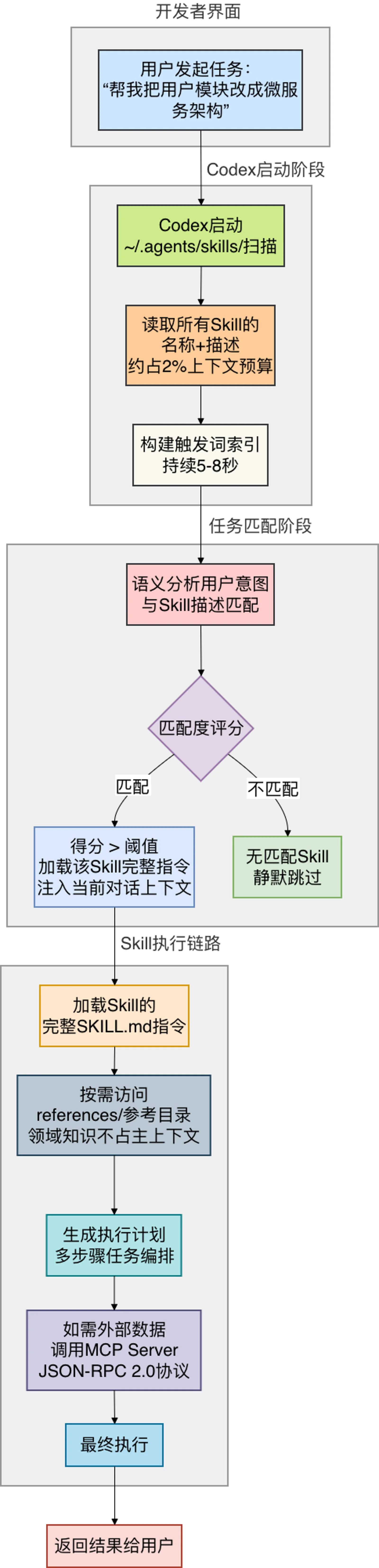
Progressive loading (2% preview + on-demand load) delivers expertise while slashing token use. Real-world comparison for 100k customer-service queries: traditional prompt ~15M tokens; MCP ~12M (including ~1.5M protocol overhead); Skills ~2-3M via knowledge compression — an 80-90% reduction.
MCP protocol defines standardized model-external interaction (JSON-RPC 2.0, client-server). When a skill needs external data, MCP translates DB queries or API responses into model-friendly JSON, drastically simplifying AI service calls.
Skill discovery uses BFS directory traversal (max 6 levels up, max 2000 directories) to locate SKILL.md files, balancing discoverability with scan overhead.
Pros and Cons of the Skill System
Pros:
Token efficiency — core knowledge progressive loading saves 80-95% vs traditional prompts.
Knowledge persistence — skills are "executable domain knowledge"; reusable, version-controllable.
Composability — arbitrarily combine multiple skills for complex tasks.
Output consistency — knowledge solidification boosts consistency by ~300%.
Cross-platform — same SKILL.md works on Codex, Claude Code, Cursor, etc.
Cons:
Learning and setup investment — initial time to learn configs and recommended lists.
Quality variance — start with high-popularity/official skills; avoid "skill stuffing".
Less flexible than raw prompting for highly bespoke tasks — may add steps.
Recommended Scenarios
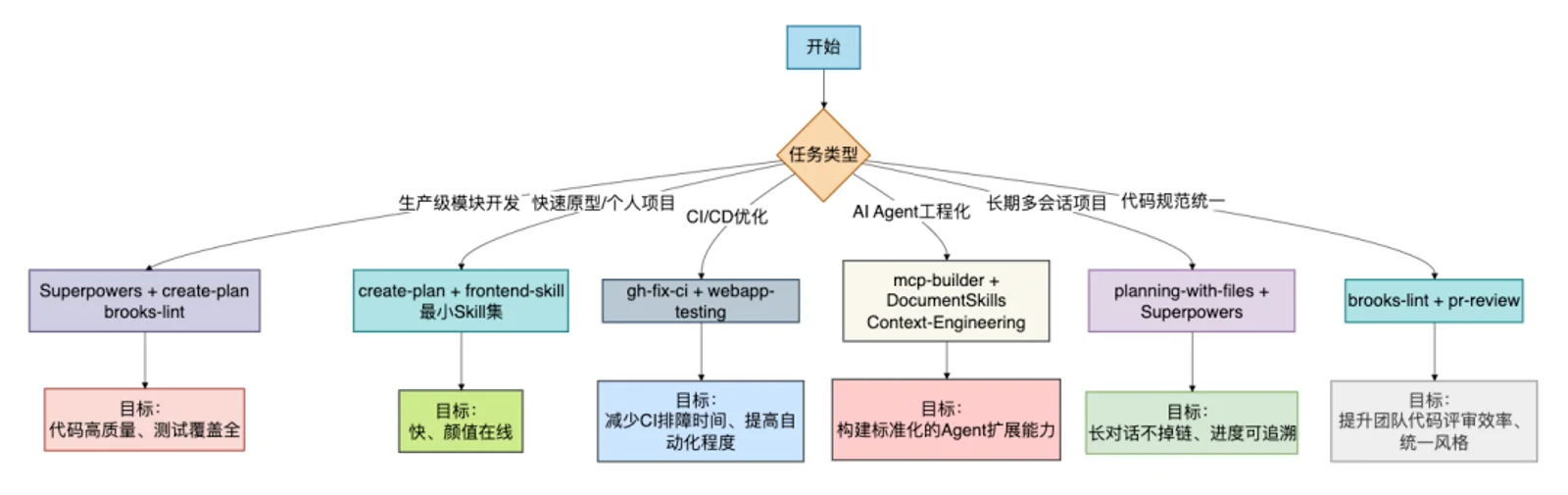
Two key principles:
Not more skills, but the right skills.
Skills amplify your thinking, not replace it.
Summary
If 2024 was MCP's "protocol year", 2026 is Skills' "application explosion year". The Skill system's "expert knowledge encapsulation + progressive loading" design gives AI agents a powerful extension mechanism. From custom skills to a community ecosystem indexing thousands via awesome-agent-skills.
The 11 skills above are battle-tested over six months. Suggested install path: start with create-plan to experience task decomposition, add Superpowers to make TDD and code review habitual, then layer gh-fix-ci, frontend-skill as needed. Pair planning-with-files and Context-Engineering — the "two buddies" — so even multi-day large refactors run efficiently without context loss.
Final thought: Master skills, and AI graduates from a "know-it-all intern" to a "seasoned architect who actually delivers".
For questions about attribution, corrections or content rights, please contactand we will review it promptly.