

AI Agent, Skills & MCP: Core Concepts and Layered Architecture Explained
This article explains the core concepts of AI Agents, Skills, MCP, Harness, OpenClaw, and Agent Platforms, detailing their relationships through a six-layer architecture model that spans from LLMs to executable agents, with a concrete skill example and interaction flow.
Reading font
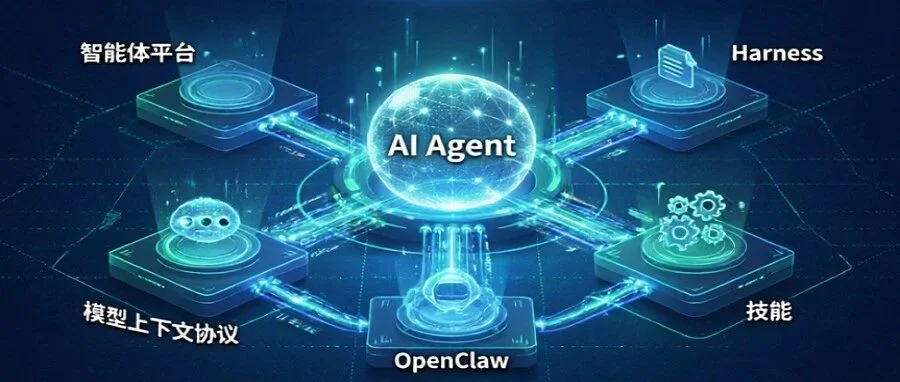
1. Core Concepts
1.1 AI Agent
An AI Agent is a software entity that perceives its environment, makes autonomous decisions, and executes actions to achieve goals. It integrates a large language model (LLM), memory, planning, and tool‑calling capabilities. Key characteristics include autonomy, reactivity, proactivity, and social ability.
Perception : Receives information via sensors or APIs (user input, system logs, database state, web content).
Planning : The “thinking” process; the agent formulates one or more action plans based on world knowledge and available tools, ranging from linear steps to dynamic task trees with conditional branches.
Action : Executes concrete operations by invoking internal Skills or external tools via MCP (e.g., running code, calling APIs, querying databases).
Memory : Short‑term (conversation context) and long‑term (user preferences, interaction history) memory enable context‑aware, personalized decisions.
Autonomy : Advanced agents dynamically adjust plans and actions without human intervention to ensure goal completion.
In the overall system, the AI Agent acts as the “commander” or “brain,” bridging user intent and concrete execution.
1.2 Skills
Skills are atomic, reusable capability modules that an Agent can invoke. Each Skill implements a specific operation such as querying a database, sending an email, or calling an API. They serve as the standardized interface between the Agent and the external world, encapsulating deterministic logic, workflows, and parameter specifications.
A Skill typically consists of:
Name and description – for the Agent to understand its purpose.
Input parameters – required information for execution.
Execution logic – usually a code snippet (e.g., a Python function) defining the operational steps, including tool calls and data processing.
Output result – the data format returned after execution.
Example: a database-performance-query Skill.
# Skill name: database-performance-query
## Applicable scenarios
When the user asks for any database performance data, monitoring metrics, or running status, activate this skill.

## Workflow
1. <strong>Intent parsing</strong>: Extract target <code>db_type</code>, <code>instance_name</code>, <code>metric_names</code>, and <code>time_range</code> from user input.
   - If no specific metric is given, default to all key metrics (QPS, active connections, slow queries, replication lag, etc.).
   - If the user only asks “is load high?”, translate to querying connections, QPS, CPU‑related metrics.
2. <strong>Get capability list</strong>: Call MCP tool <code>list_available_metrics(db_type)</code> to confirm queryable metrics.
3. <strong>Execute query</strong>: Call <code>query_metrics</code> tool to fetch actual data.
4. <strong>Interpret and output</strong>:
   - Present data in a table.
   - Provide brief diagnosis for abnormal metrics (e.g., alert when connections exceed 80% threshold).
   - If multiple metrics are queried, optionally attach a simple radar or line chart description (handed to platform for rendering).
Skills form the “business logic layer,” turning the Agent’s high‑level plans into precise, reliable execution steps.
1.3 MCP (Model Context Protocol)
Introduced by Anthropic, MCP is an open protocol that defines a standardized interface between AI models and external tools or data sources . It uses a client‑server architecture:
MCP Server : Exposes concrete tools, resources, and prompts.
MCP Client : Runs on the Agent or platform side, discovers and invokes server capabilities.
Without MCP, each new tool requires custom integration, leading to N×M complexity. MCP provides a universal interface so that all tools connect in a standardized way and the Agent only needs to communicate with MCP.
Key benefits:
Standardization : Unified API specs, communication protocols (HTTP, gRPC), and data formats simplify tool onboarding and invocation.
Security : Centralized authentication, authorization, auditing, and data masking prevent tool misuse and data leaks.
Discoverability : Tool registration and discovery let Agents dynamically learn available tools and their functions.
Reliability : Handles network communication, retries, and circuit breaking for stable interactions.
MCP constitutes the “integration layer” or “infrastructure,” enabling unlimited extension of external capabilities for Skills and Agents.
1.4 Agent Platform
An Agent Platform integrates the core components and services needed to build, run, and manage one or more AI Agents, including development tools, runtime environments, communication mechanisms, management UIs, and integration support for Skills and MCP. Examples include Dify, Coze, LangGraph, CrewAI, and AutoGen. The platform organizes scattered components into a standardized, engineering‑grade, extensible environment, allowing developers to focus on business logic rather than reinventing infrastructure, thereby enabling scalable Agent production.
1.5 Harness
In the AI Agent context, Harness is not a specific product but a key architectural concept or design paradigm . It is the execution layer that sits outside the core intelligence (LLM) and handles task execution, process control, environment interaction, and system governance. Harness provides reliability, safety, and engineering constraints such as multi‑model fallback, safety guardrails, long‑running task management, and token‑usage control.
Core responsibilities:
Task orchestration and state management : For multi‑step tasks, Harness orchestrates, tracks execution state, manages intermediate results, and ensures recoverability after interruption.
Tool integration and execution environment : Provides a controlled execution environment (e.g., sandbox) for tool calls, manages authentication and permissions, and captures output and errors.
Feedback loops and reflection : Captures environmental feedback (success, failure, errors) and feeds it back to the Agent’s core intelligence for reflection, plan adjustment, and next actions.
Process governance and risk control : Enforces preset rules, policies, and permissions; restricts high‑risk operations; performs cost control; isolates faults and limits damage.
Observability : Supplies detailed logs, tracing, and metrics so developers and operators can audit, debug, and optimize every Agent decision and action.
The LLM handles thinking and planning; Harness translates intent into precise, coordinated, controlled actions and deals with unexpected situations.
1.6 OpenClaw
OpenClaw positions itself as a “local‑first” AI agent framework, aiming to be an “AI operating system kernel” or “personal AI assistant gateway” that connects users, multi‑channel communication, large models, and various tools. It emphasizes running on the user’s local device or private cloud, giving full control over data, models, and Agent behavior, addressing privacy and security concerns of cloud‑based AI services. Unlike Harness (a methodology), OpenClaw is a concrete, downloadable, runnable software implementation with complete code, enabling developers and enthusiasts to quickly experience and build their own AI Agents.
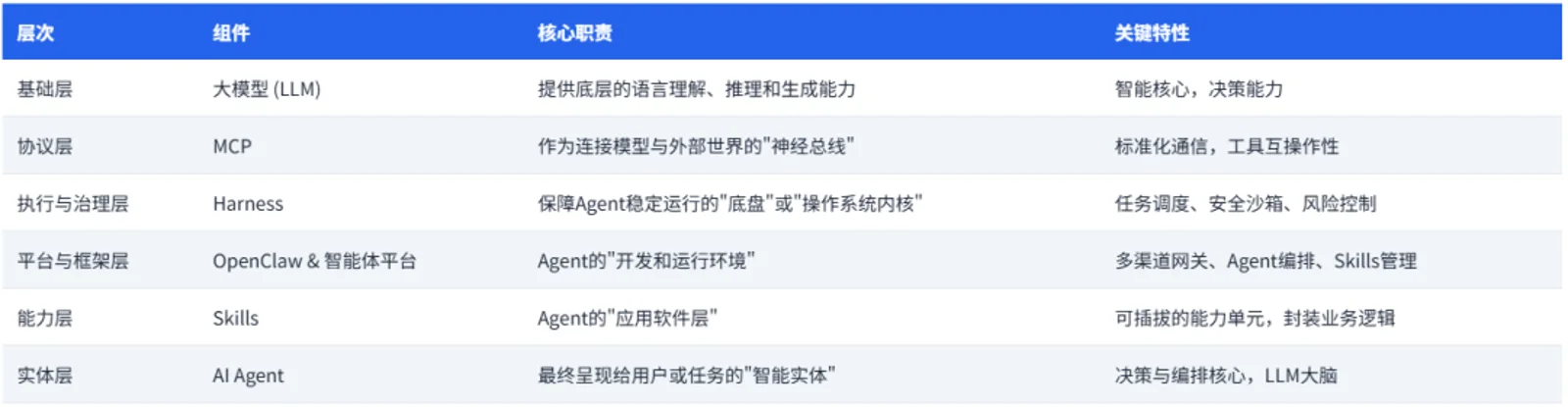
2. AI Agent Layered Model
Placing all concepts in a unified framework yields a clear layered model (bottom‑up, decreasing abstraction, increasingly explicit roles):
Foundation Layer – LLM : Provides base language understanding, reasoning, and generation.
Protocol Layer – MCP : Connects the model to the external world, defining a standard communication language for unified, secure tool and data‑source access.
Execution & Governance Layer – Harness : The kernel that ensures stable Agent operation; wraps MCP and tool calls, handles task scheduling, state management, security sandboxing, risk control, and audit logging.
Platform & Framework Layer – OpenClaw & Agent Platform : The development and runtime environment. OpenClaw embodies Harness principles (providing an execution environment) and adds multi‑channel gateway, Agent orchestration, and Skills management. “Agent Platform” broadly refers to any commercial or open‑source system offering such capabilities.
Capability Layer – Skills : The “application software layer.” Skills are pluggable capability units that run on the platform/framework, encapsulating concrete business logic and workflows, and invoking underlying Harness and MCP capabilities.
Entity Layer – AI Agent : The final intelligent entity presented to the user or task. An Agent instance is created on the platform, configured with a set of Skills for its unique abilities, and driven by its internal LLM brain.
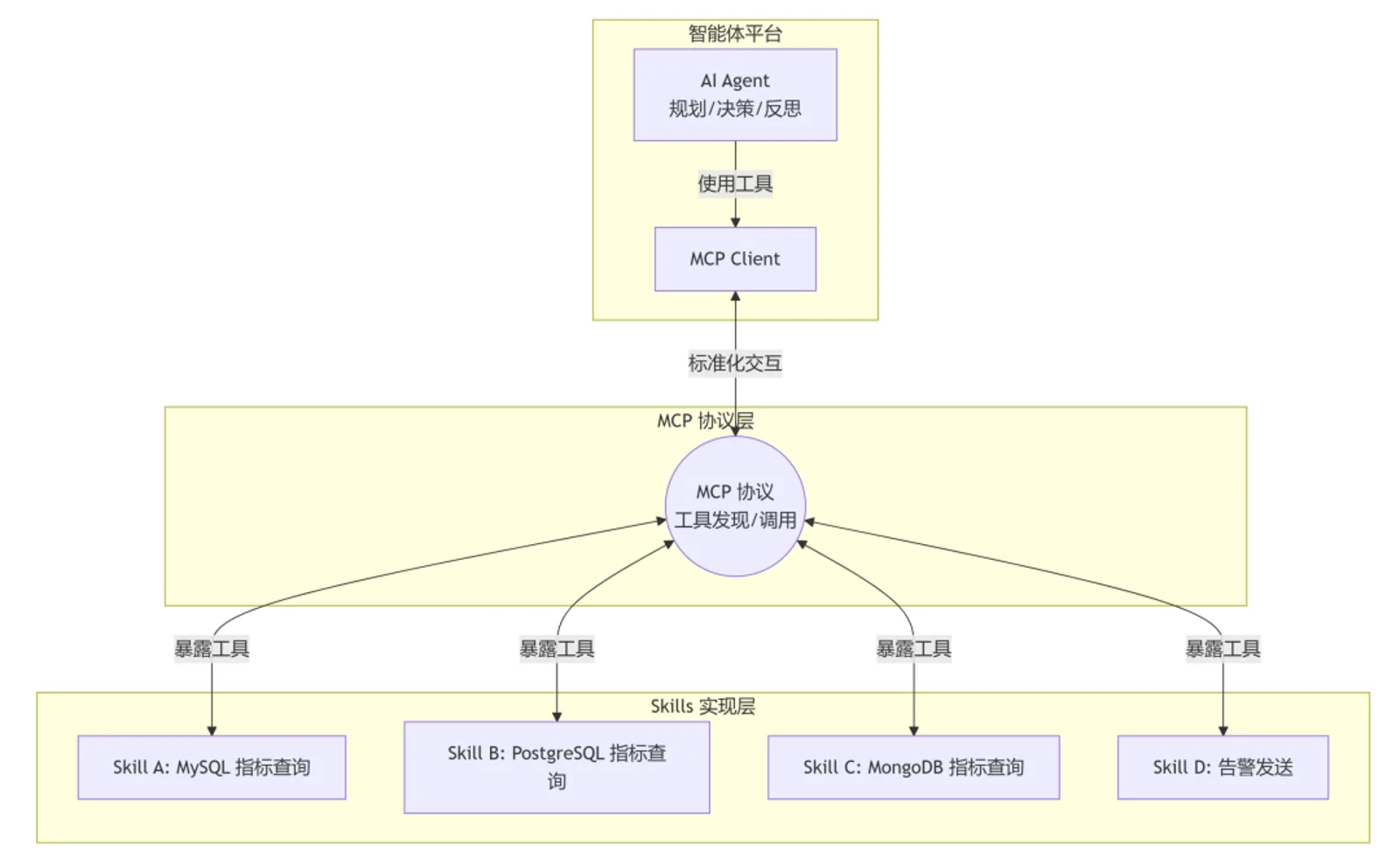
2.1 MCP and Skills Relationship
Within the Agent Platform, the AI Agent uses a built‑in MCP Client to communicate with the protocol layer. The MCP layer discovers and invokes MCP Servers. Skills are implemented as MCP Servers that expose standardized tools. The Agent sees only a unified tool interface, unaware of Skill implementation details.
Workflow:
Build/obtain Skill: Developers encapsulate database performance query functions into independent MCP Servers (each Server implements one or more tools).
Platform onboarding: The Agent Platform connects via MCP Client, automatically discovering available tools.
Define Agent: Create an Agent on the platform, grant it tool‑calling permissions, and write system prompts describing when to use which tools.
User interaction: User asks in natural language → Agent LLM plans → decides which tools to call → MCP Client invokes the corresponding MCP Server → receives structured results → Agent synthesizes a reply.
Extensibility: Adding a new database type only requires a new MCP Server; the platform and Agent remain unchanged.
2.2 Layered Architecture Model
The following diagram illustrates the relationships among AI Agent, Agent Platform, MCP, Skills, OpenClaw, and Harness.
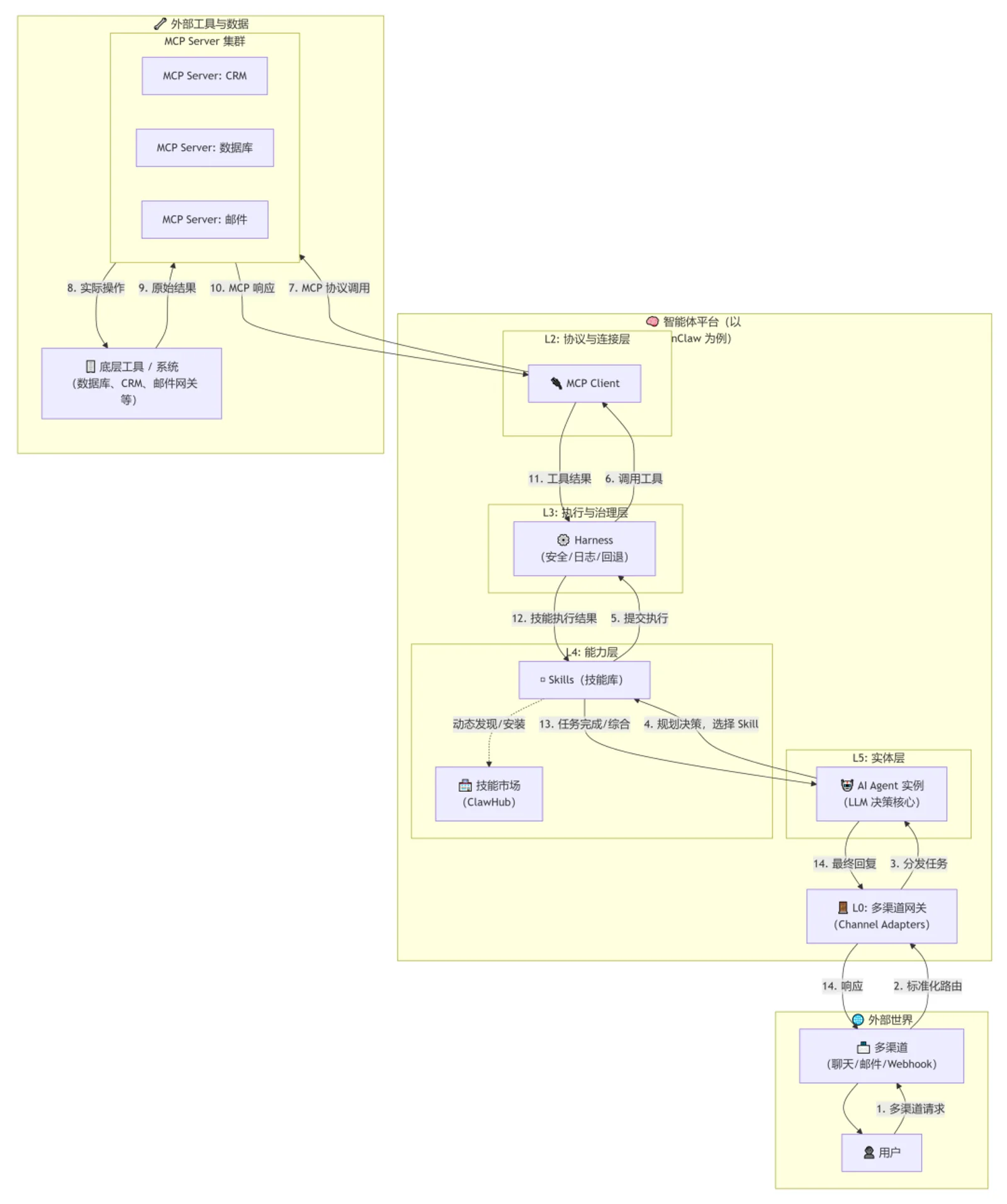
The layers from top to bottom, left to right correspond to:
L0 Gateway : OpenClaw’s channel adapters unify diverse user entry points into standard requests.
L5 Entity Layer : AI Agent as the brain, handling intent understanding, planning, and Skill selection/orchestration.
L4 Capability Layer : Skills as atomic executable capabilities, dynamically discovered and installed via a skill marketplace (ClawHub).
L3 Governance Layer : All Skill execution passes through Harness, which provides secure containers, error handling, logging, and policy enforcement.
L2 Protocol Layer : Harness embeds or calls an MCP Client to communicate with external MCP Server clusters via standard protocol, completely shielding underlying tool implementations (CRM, databases, email).
The closed‑loop interaction (steps 1–14):
User sends request from multiple channels.
Gateway standardizes and routes.
Task passed to Agent instance.
Agent decides and selects Skills from the library.
Skill submitted to Harness for safe execution.
Harness invokes via MCP Client.
MCP Client locates the target MCP Server per protocol.
Server operates the actual underlying tool.
Results return through the MCP layer (steps 9–10).
Harness validates and returns results to the Skill (steps 11–12).
Agent aggregates all Skill results, forms final reply, and sends back via gateway (steps 13–14).
In summary, the user request enters through the gateway, the Agent makes decisions, selects Skills, Skills execute under Harness governance, Harness calls external MCP Servers via MCP Client, results propagate back layer by layer, and the Agent synthesizes a final response delivered to the user.
Conclusion
This article introduced six fundamental concepts—AI Agent, Agent Platform, MCP, Skills, OpenClaw, and Harness. These concepts are not isolated; together they form a complete, clearly layered intelligent agent technology stack comprising the LLM foundation, MCP protocol layer, Harness execution & governance layer, OpenClaw & Agent Platform framework layer, Skills capability layer, and AI Agent entity layer.
Reference:
OpenClaw Architecture Analysis (https://mp.weixin.qq.com/s?__biz=MzI3MzUzMjIxNA==&mid=2247486459&idx=1&sn=be11dc530008197afd9fd46438294366&scene=21#wechat_redirect)
For questions about attribution, corrections or content rights, please contactand we will review it promptly.