

GraphRAG: Knowledge Graphs Enable Multi-Hop Reasoning & Global Insights Beyond RAG
This article analyzes the limitations of traditional RAG — fragmented semantic chunks and flattened vector representations — and explains how GraphRAG integrates knowledge graphs to enable multi-hop reasoning, query-focused summarization via hierarchical community summaries, and explainable traceability, while discussing engineering challenges like indexing cost, graph quality maintenance, and hybrid retrieval routing.
Reading font
RAG's Promise and Hidden Limitations
Traditional RAG (Retrieval-Augmented Generation) has become the standard architecture for enterprise AI deployment. By chunking private documents, embedding them into vectors, and storing them in a vector database, RAG gives LLMs an "external brain" that mitigates outdated training data and hallucinations for fact retrieval tasks.
However, as Rewire's From Data to Insights implies, data is not merely discrete fragments; implicit logical relationships exist between data points. When users ask complex questions like "What are the major technical trends across millions of documents?" or "How did Event A indirectly cause Outcome B?", vector-similarity-based RAG fails. This marks the "ceiling of vector retrieval."
Technical Bottlenecks of Traditional RAG
2.1 Fragmentation from Semantic Chunking
The core RAG pipeline — Chunking, Embedding, Vector Search — assumes answers can be located directly in specific text chunks via semantic similarity. This works for fact retrieval (e.g., "What is the company's leave policy?") but breaks down in two scenarios:
Multi-hop Reasoning Across Documents: If Document A states "Product X uses Component Y" and Document B states "Component Y's supplier Z went bankrupt," a query about risks to Product X requires connecting physically separated, semantically unrelated chunks — something naive RAG cannot do.
Global Summarization (Query-Focused Summarization): Vector search returns Top-K most similar chunks, which only represent local perspectives. They cannot assemble a holistic view of an entire dataset.
2.2 The "Flattening" Curse of Vectors
Vector databases compress text into high-dimensional points, capturing semantics but discarding structure . Explicit relationships such as "belongs to," "causes," or "located in" become mere distances. This flattening leaves the LLM seeing only a set of points, not the network connecting them.
GraphRAG: Deep Fusion of Graphs and Vectors
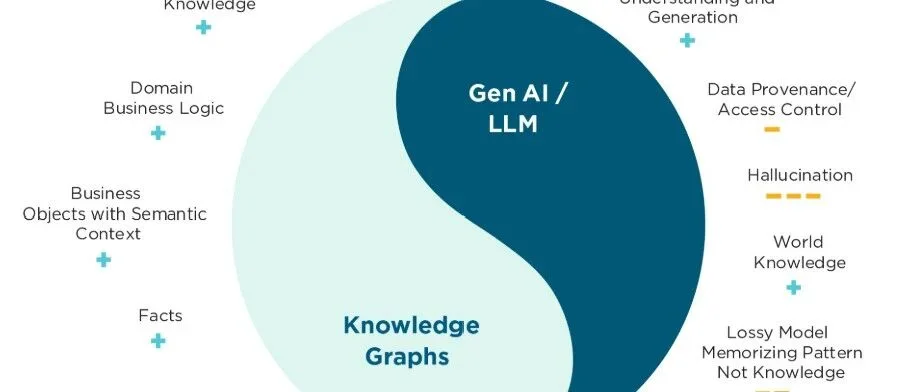
GraphRAG does not replace RAG but upgrades its retrieval module by introducing a Knowledge Graph (KG) , transforming unstructured text into structured nodes (entities) and edges (relationships). Modern KGs can incorporate LLM-processed unstructured data, enabling reliable retrieval of originally unstructured information.
For example, an LLM reads text chunks and extracts entities and relations: from "Apple released Vision Pro" it extracts (Apple) --[released]--> (Vision Pro).
This synergy creates a complementary system managing multiple information types, crucial for enterprise knowledge management.
3.1 How the Combination Works: Construction Flow
Build Knowledge Graph with RAG: First, establish a KG based on inherent data associations, using RAG from the start. All internal documents undergo Chunking and Embedding. Similarity search on these vectors reveals hidden connections that help shape the KG structure.
Link Documents to the Graph: After KG construction, connect chunked document vectors to corresponding terminal nodes. For instance, all vectors about "Project A" link to the "Project A" node, creating a rich graph where nodes directly reference source document vectors.
3.2 Handling Complex Queries with Hybrid Retrieval
For queries answerable from KG structure alone, answers are returned quickly. For queries needing detailed document evidence, a RAG process is triggered:
Locate the relevant KG node (e.g., "Project A").
Retrieve all vectors connected to that node (e.g., all document chunks linked to "Project A").
Perform similarity search between those vectors and the user's question.
Augment the original prompt with the most relevant chunks (using database keys to fetch the actual text).
Pass the augmented prompt to the LLM for a comprehensive answer.
Three Technical Leaps of GraphRAG
Connecting Silos: Multi-hop Reasoning. Explicit edges enable reasoning along relationship paths:
Entity_A --{relates to}--> Entity_B --{relates to}--> Entity_C. Traditional RAG might retrieve A and C but cannot establish the causal chain; GraphRAG feeds the logical chain directly to the LLM, producing genuine "insights."
Global View: Query-Focused Summarization (QFS). For massive datasets (legal cases, medical records, financial reports), GraphRAG uses hierarchical community summarization to overcome context-window limits. Instead of stuffing all documents into the context, it retrieves high-level community summaries to quickly build a global perspective.
Explainability and Traceability. Vector search is a black box; it's hard to explain why two vectors are similar. A knowledge graph is a white box. GraphRAG can explicitly show:
"I concluded this because Document A mentions Entity X, and Document B defines Entity X as a subset of Entity Y."
This explainability is critical for high-stakes domains like finance, healthcare, and law.
Engineering Challenges and Practical Considerations
Indexing Cost and Latency: Unlike fast vector embedding, KG construction requires massive LLM calls for entity extraction, causing token consumption spikes and longer write latency — unfriendly for high-real-time data streams.
Graph Quality Maintenance: LLMs make mistakes, extracting wrong entities or relations. Graph cleaning and Entity Resolution (e.g., recognizing "Steve Jobs" and "Jobs" as the same person) are major engineering hurdles.
Hybrid Retrieval Strategy Tuning: Not every query needs GraphRAG. The future best practice is a Vector + Graph hybrid mode: simple fact queries use the vector path; complex reasoning uses the graph path. Designing the Router mechanism is key to system optimization.
For questions about attribution, corrections or content rights, please contactand we will review it promptly.