

Traditional RAG vs Agentic RAG: How Autonomous Agents Transform Retrieval-Augmented Generation
This article compares traditional linear RAG with Agentic RAG, detailing their workflows, strengths, and limitations. It explains how Agentic RAG introduces iterative reasoning, tool selection, self-evaluation, and feedback loops to handle complex multi-hop queries more accurately, while noting increased complexity and latency.
Reading font
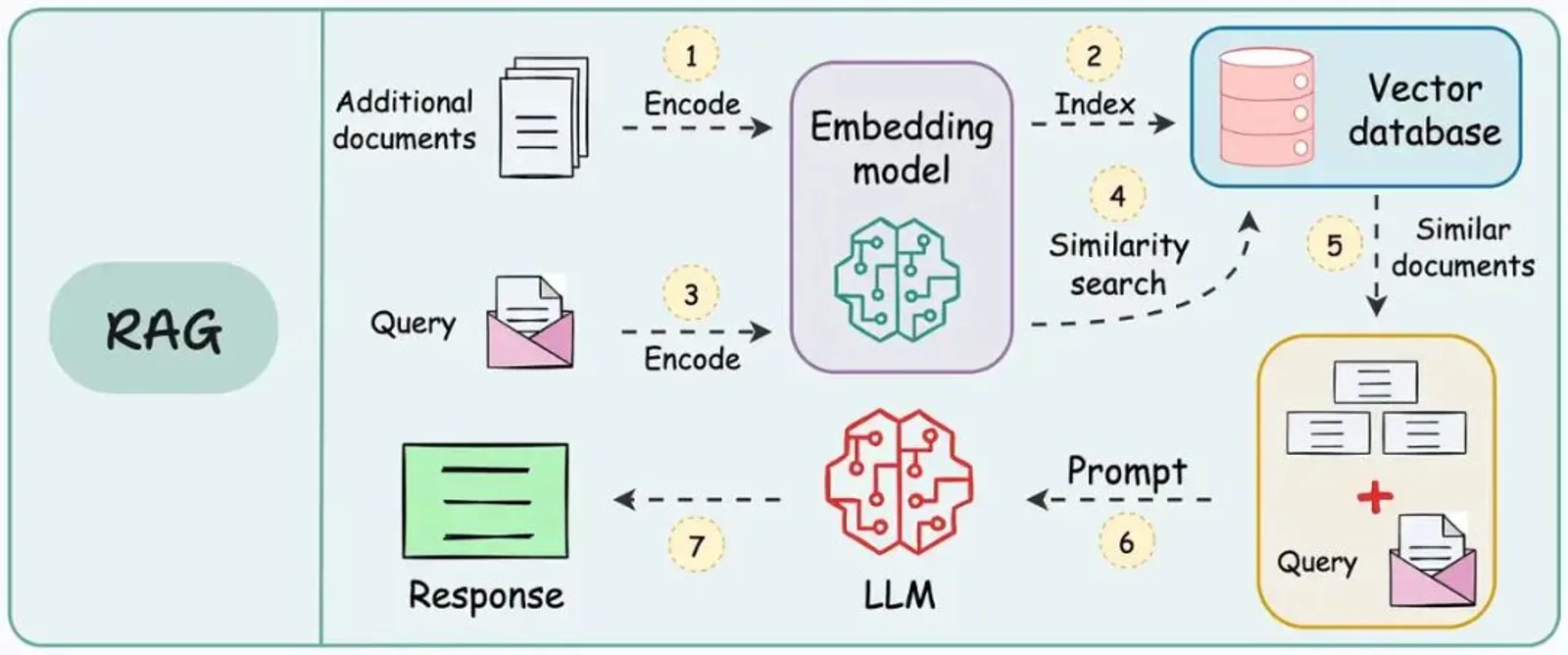
Traditional RAG: Linear Retrieval-Generation Pipeline
Traditional RAG follows a straightforward, linear process:
Knowledge encoding and indexing (offline, steps 1–2): Additional documents are passed through an embedding model to produce high-dimensional vectors, which are indexed and stored in a vector database.
Query encoding (step 3): The user's query is encoded using the same embedding model to generate a query vector.
Similarity search (steps 4–5): The query vector is used to perform a similarity search in the vector database, retrieving the most semantically similar documents.
Prompt construction and generation (steps 6–7): Retrieved similar documents are combined with the original query as context, formatted into a prompt, and sent to an LLM, which generates the final response.
Characteristics: Simple structure, clear flow, easy to implement, efficient for direct single-hop QA. However, the linear flow lacks self-evaluation and planning, making it struggle with complex, ambiguous, or multi-step reasoning queries. Errors in retrieval propagate directly to generation, increasing hallucination risk.
Agentic RAG: Agent-Driven Iterative Loop
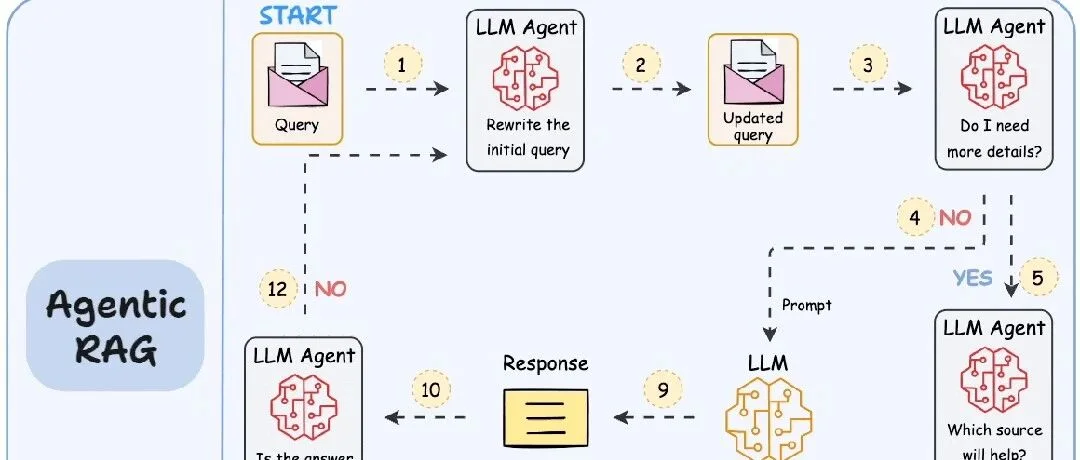
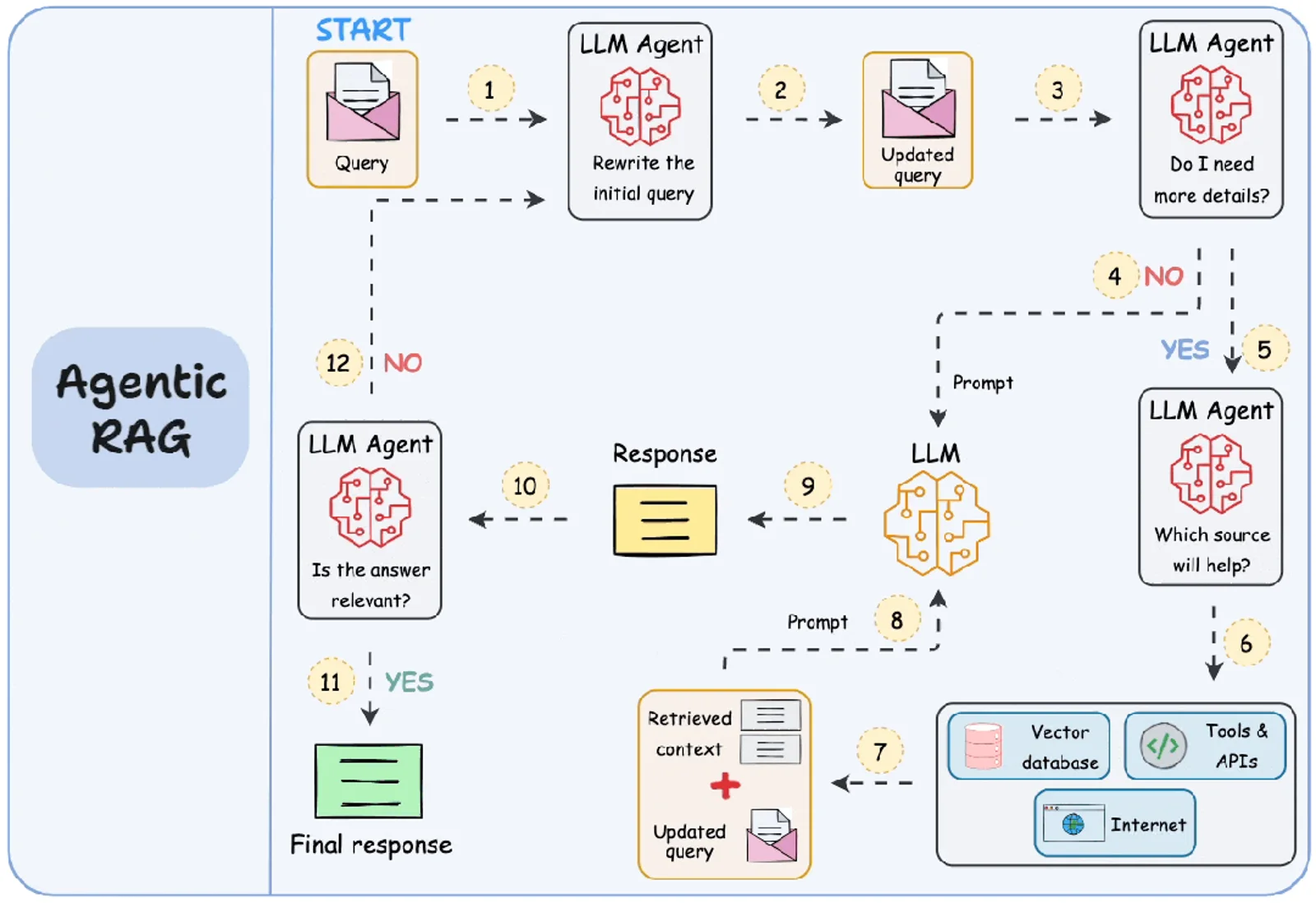
Agentic RAG introduces an LLM agent that actively thinks, plans, selects tools, and iterates:
Agent-led query processing (steps 1–3): The initial query is first rewritten by the LLM agent for precision. The agent then self-evaluates whether more information is needed.
Active planning and tool selection (steps 4–6): If more information is required, the agent decides which source can help and actively chooses and invokes different tools (vector database, internet search, structured databases, custom APIs). Tool use is a key feature.
Retrieval and generation (steps 7–9):
Retrieval and context construction (step 7): The system retrieves context using the selected tools, obtaining 检索到的上下文 (retrieved context). This context is prepared with the updated query for generation.
Preliminary response generation (steps 8–9): The system packages 检索到的上下文 and 更新后的查询 (updated query) into a prompt, sends it to an LLM, which generates a preliminary response.
Iterative loop and self-evaluation (steps 10–12): The agent evaluates the preliminary response for relevance. If unsatisfactory, it loops back to earlier steps — re-planning, re-retrieving — until a satisfactory answer is produced. This feedback loop and self-correction capability is central to solving complex problems.
Advantages: Stronger reasoning for multi-hop queries; higher accuracy via self-evaluation and iteration; greater adaptability through flexible tool selection; better explainability as the agent's thought process (query rewriting, tool choices) can be logged and traced.
Limitations: Higher system complexity increases design and debugging difficulty; multiple iterations and tool calls can introduce higher response latency.
Comparative Summary
LLM Role
Traditional RAG: Passive content consumer, executes retrieval and generation
Agentic RAG: Active agent that thinks, plans, decides, and executes
Process
Traditional RAG: Linear, one-way
Agentic RAG: Cyclic, iterative, with decision points
Tool Use
Traditional RAG: Primarily vector database
Agentic RAG: Flexible use of multiple external tools (vector DB, web search, APIs, etc.)
Complex Queries
Traditional RAG: Struggles with multi-hop, ambiguous, or reasoning-heavy queries
Agentic RAG: Excels at complex, multi-hop, multi-step reasoning
Self-Evaluation
Traditional RAG: None
Agentic RAG: Present (judges need for more details, answer relevance)
Error Handling
Traditional RAG: Retrieval errors propagate to generation
Agentic RAG: Can self-correct via feedback loops
Implementation Difficulty
Traditional RAG: Relatively simple
Agentic RAG: Relatively complex
Conclusion
Traditional RAG opened the door to combining LLMs with external knowledge and remains efficient for many scenarios. However, as AI applications grow more complex, Agentic RAG represents the inevitable evolution: it elevates the LLM from a mere generator to an autonomous agent capable of independent thought, planning, and execution, enabling more powerful, reliable, and human-like knowledge-intensive AI systems. Mastering Agentic RAG's core concepts is key to building next-generation AI applications.
For questions about attribution, corrections or content rights, please contactand we will review it promptly.