

Hybrid Alibaba Cloud + IDC AIOps: Unified Monitoring & Cross-Domain RCA
This article details a practical AIOps implementation for hybrid Alibaba Cloud and self-built IDC environments, covering architecture integration, real-world cross-domain root cause analysis cases (AC failure, UPS degradation, line cutover), integration patterns for cloud monitoring and data center environmental systems, and a phased rollout roadmap to unify alerting, asset topology, and incident management across domains.
Reading font

Pain Points of Hybrid Alibaba Cloud + IDC Operations
Many medium-to-large enterprises run a hybrid architecture: core workloads on Alibaba Cloud (ECS, ACK, RDS) while database backup, storage, disaster recovery, physical gateways, power and cooling reside in self-built IDC data centers. The existing monitoring landscape is split:
Alibaba Cloud side: CloudMonitor alerts, ARMS traces, SLS logs, ACK container metrics — all pushed to one on-call group.
IDC side: Environmental monitoring (voltage, temperature/humidity, water leakage, UPS status) via a separate system, alerts sent to another group.
Operators must watch two platforms, two alert streams, two asset registries. The article identifies five concrete pain points:
Broken fault causality: An IDC air-conditioner failure → rising cabinet temperature → physical gateway overheating → packet loss on the leased line → cloud service timeouts. Cloud monitoring (ARMS, RDS latency) shows symptoms but cannot see the IDC temperature/AC status; the environmental system only reports the AC alarm without knowing which cloud services are impacted.
No unified asset mapping: Cloud assets (ECS, ACK pods, RDS) and physical assets (cabinets, switches, UPS, leased-line equipment) have no binding relationship. Tracing a cloud service to its physical leased line and cabinet requires manual Excel lookups.
Alert storms obscure root cause: A single power fault triggers environmental alarms + leased-line alarms + ECS network alarms + application alarms — dozens of alerts scattered across two channels.
Change management disconnect: IDC cutovers, leased-line expansions, UPS maintenance are recorded only in the local ticketing system; Alibaba Cloud releases and autoscaling events stay in the cloud console. AIOps cannot automatically correlate a cloud anomaly to an IDC change.
Dual operational processes: Separate ticketing, SLA tracking, on-call rotations, and MTTR statistics for cloud and IDC.
The author argues that native cloud monitoring (CloudMonitor, Enterprise Monitor) and vendor environmental platforms each understand only their own domain; they cannot perform cross-domain correlation and root-cause reasoning. AIOps acts as the unified fusion layer, event convergence layer, and cross-domain causal analysis layer .
Overall Integration Architecture: AIOps as the Central Fusion Hub
Core principle: do not replace existing Alibaba Cloud observability tools or the environmental monitoring system; integrate via data ingestion, not reconstruction. Data flows one-way into AIOps; AIOps does not modify the underlying cloud or environmental systems.
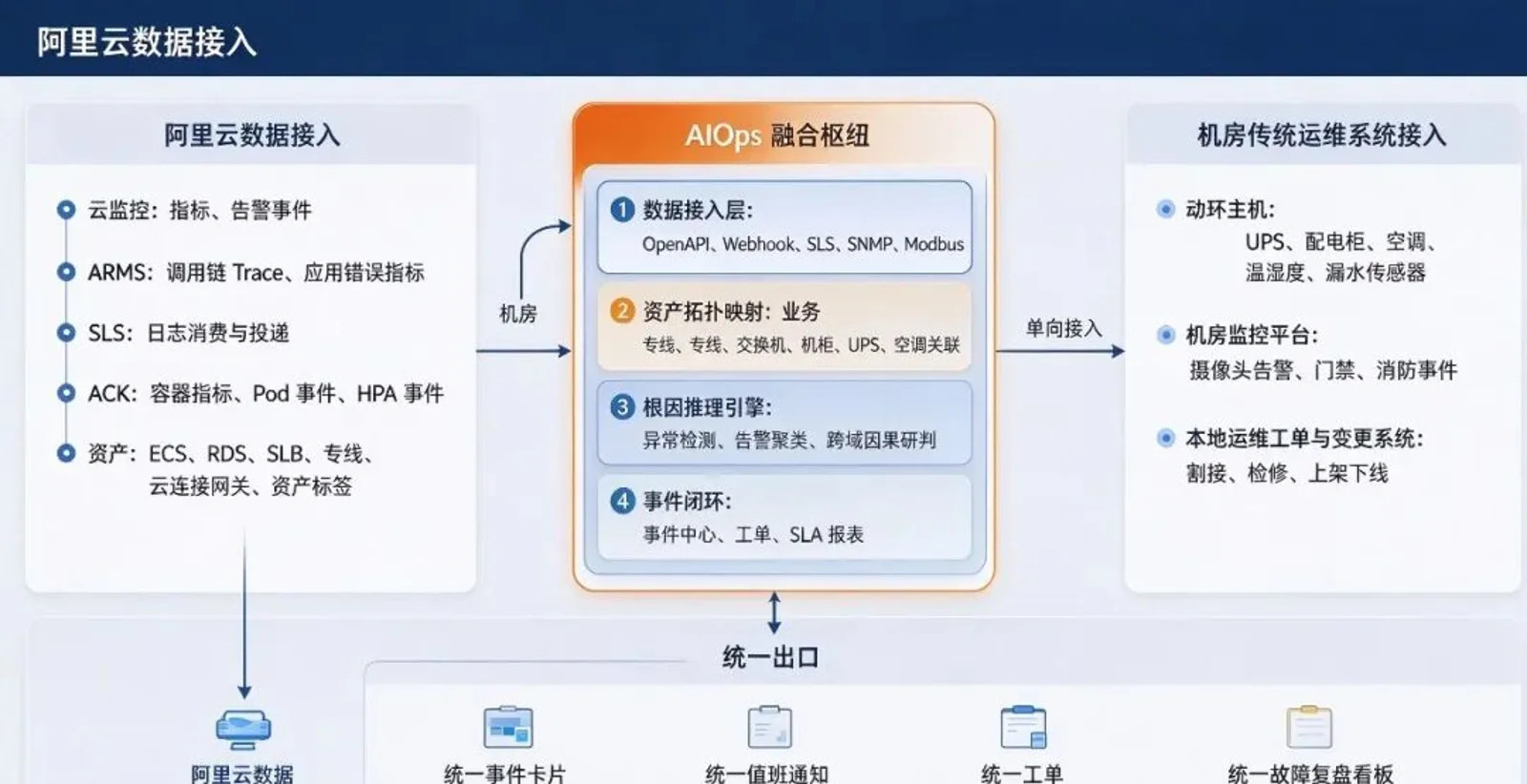
1. Alibaba Cloud Data Ingestion Layer
CloudMonitor: Metrics and alert events via OpenAPI + alert webhook push.
ARMS: Distributed traces and application error metrics.
SLS: Logs delivered via SLS consumption/delivery to AIOps (Kafka recommended to avoid API rate limits).
ACK: Container metrics, pod events, HPA events.
Assets: ECS, RDS, SLB, leased lines, Cloud Connect Network gateways — synchronized periodically with tags via Asset Center OpenAPI.
2. IDC Traditional Operations Ingestion Layer
Environmental hosts: Pull UPS, power distribution, precision AC, temperature/humidity, water-leakage sensors via Modbus/SNMP for metrics and alerts.
IDC monitoring platform: Camera alerts, access control, fire events.
Local ticketing & change management: Cutover, maintenance, rack up/down events.
3. AIOps Core Engine
Asset Topology Mapping: Builds the dependency graph "cloud service → cloud leased line → IDC physical switch → cabinet → UPS/AC".
Anomaly Detection Engine: Time-series baseline detection + cross-domain alert clustering.
Root Cause Reasoning Engine: Performs cross-domain causal inference on the topology (key: distinguish cloud-native faults from IDC-infrastructure-induced cloud faults).
Event Center, Ticket Closure, SLA Reporting: Unified incident cards, on-call notifications, tickets, and postmortem dashboards.
4. Unified Output
Single incident card, single on-call notification, single ticket, single postmortem dashboard.
Three Real-World Cross-Domain AIOps Cases
Case 1: IDC Air-Conditioner Failure → Cross-Cloud Root Cause Auto-Diagnosis (Classic Scenario)
Background
Alibaba Cloud leased-line access equipment sits in an IDC cabinet cooled by a precision air-conditioner. One day the AC fails, cabinet temperature rises slowly, the physical gateway chip overheats, the leased line drops packets, and cloud order service & RDS cross-database access suffer massive timeouts.
Traditional Process (70 minutes)
On-call receives ARMS business timeout alerts → checks SLS logs, finds cross-leased-line packet loss → manually checks the leased-line device's IDC cabinet → opens environmental platform, discovers AC already down.
AIOps-Enabled Process (12 minutes MTTR)
Environmental system pushes AC shutdown alarm via SNMP to AIOps event center.
AIOps topology engine automatically retrieves which cabinets this AC serves, which leased-line devices sit in those cabinets, and which Alibaba Cloud services map to those leased lines.
Within a short time window, Alibaba Cloud webhooks push a batch of alerts: leased-line packet loss, application P99 latency spike, RDS access timeout.
AIOps performs causal reasoning on the topology.
Root cause candidate: IDC precision air-conditioner shutdown (confidence 94%) Derived impact: Cabinet temperature rise → leased-line gateway packet loss → Alibaba Cloud order/inventory service cross-leased-line call timeouts Affected scope: Alibaba Cloud ACK cluster order application, cross-IDC RDS read requests Recommendation: Restore AC on-site; cloud side can temporarily fail over to backup leased line
Only one aggregated incident card is pushed, attached with: environmental AC metric curves, cabinet temperature curves, Alibaba Cloud leased-line metrics, list of affected cloud services.
Pitfall & Fix
Pitfall: Initially only alert aggregation without asset topology binding — AIOps merely merged messages, unable to distinguish causality.
Fix: Pre-build the dependency relationships among leased lines, physical devices, and cloud services; maintain the topology. Topology is the foundation of cross-domain RCA.
Case 2: UPS Battery Degradation Early Warning → Linked Cloud Business Risk Assessment
Background
IDC UPS powers leased lines and core switches — the backup power for Alibaba Cloud leased lines. Environmental monitoring only sees voltage; individual battery cell degradation is hard to detect. If mains power fails, UPS cannot hold, and cloud services lose connectivity instantly.
AIOps Implementation
AIOps continuously pulls per-cell internal resistance, voltage, temperature time-series from environmental system.
Time-series anomaly algorithm learns baseline, detects continuous internal-resistance drift, outputs battery State-of-Health (SOH).
Upon detecting degradation risk, AIOps queries topology: which leased lines does this UPS back, and which Alibaba Cloud core businesses map to them.
Generates a graded warning ticket annotated with: risk location + associated cloud business priority (core trading / internal admin), pushed to both operations and business owners.
Difference from pure environmental alerts: environmental system only says "battery has a problem"; AIOps tells you "if this battery fails, these specific Alibaba Cloud services will be impacted, with this business priority", guiding prioritized repair of high-risk assets.
Benefit: Hidden power-supply risks identified early, achieving prediction from infrastructure hidden danger to cloud business impact .
Case 3: IDC Leased-Line Cutover Change → AIOps Auto-Verifies Alibaba Cloud Side Anomalies
Background
IDC frequently performs leased-line expansions, switch cutovers, maintenance. Change records exist only in the IDC ticketing system; Alibaba Cloud side has no record. Post-cutover cloud jitter often discovered long after.
AIOps Implementation
IDC change ticket pushed to AIOps with change time window, involved leased lines/cabinets.
At change start, AIOps auto-subscribes to Alibaba Cloud metrics for those leased lines: bandwidth, packet loss, application error rates.
During the change window, if Alibaba Cloud metrics show anomalies, AIOps tags them change-associated anomaly and prioritizes notification to the change owner.
At change end, auto-generates a change verification report. Stability of cloud business metrics during the window becomes the success criterion.
This capability solves cross-domain change verification, distinguishing "spontaneous business faults" from "IDC-change-induced cloud faults".
Alibaba Cloud Integration Practical Details
Alert ingestion: CloudMonitor and ARMS support webhooks; configure callback URL to AIOps event receiver.
Metrics & asset sync: Call Alibaba Cloud OpenAPI (CloudMonitor OpenAPI, Asset Center OpenAPI) on a schedule to pull ECS, RDS, SLB, Cloud Connect, leased-line assets and metrics; use a RAM sub-account with least privilege.
Log ingestion: Configure SLS delivery to Kafka; AIOps consumes Kafka log stream to avoid high-frequency SLS API pulls and rate limits.
Permission norms: RAM sub-account granted read-only observability permissions; AIOps does not receive cloud resource operation permissions by default . Root-cause conclusions are advisory only, no automatic cloud self-healing execution, ensuring safety.
IDC side integration: Environmental devices prefer SNMP; newer platforms support HTTP WebService; legacy Modbus-only devices use an edge gateway for protocol conversion before feeding standardized metrics to AIOps. Key point: Many older IDC environmental systems lack open APIs — this is the biggest integration bottleneck. Prioritize edge-gateway protocol standardization; avoid hacking the environmental host directly.
Phased Rollout Roadmap (Iterative, Avoid Project Stalls)
Phase 1 (0–1.5 months): Connectivity + Asset Mapping — Ingest Alibaba Cloud alert webhooks and IDC environmental alarms; map leased-line, physical-device, cloud-service dependency topology; enrich tags. Goal: unified alert aggregation, queryable asset relationships.
Phase 2 (1.5–3 months): Alert Noise Reduction + Cross-Domain Clustering — Implement alert similarity clustering and suppression; differentiate root alerts from derived alerts within the same fault window. Solve alert fatigue first; team gets quick tangible benefit.
Phase 3 (3–6 months): Cross-Domain Root Cause Reasoning + Change Correlation Verification — With stable topology, enable cross-domain RCA; prioritize high-frequency scenarios like IDC infrastructure → cloud network.
Phase 4 (Long-term): Joint Capacity Prediction + Unified SLA Statistics — e.g., IDC bandwidth/leased-line capacity forecasting linked to Alibaba Cloud business traffic trends for unified capacity planning.
Summary
Two extreme views of AIOps exist: either it's only cloud microservice trace RCA with large models, or it's just IDC camera CV patrols. In the hybrid architectures common across government, enterprise, manufacturing, and mid-sized internet companies, AIOps' pragmatic role is a cross-domain observability fusion platform :
Does not replace Alibaba Cloud native monitoring, does not retire years-running IDC environmental systems.
Bridges the two operational languages, predicting infrastructure fault impact on business.
During incidents, helps ops decide: is it an Alibaba Cloud business issue, or a chain failure from IDC power, cooling, or leased lines?
Unifies events, tickets, and postmortems, solving the "each manages a segment" pain of dual operational systems.
Hybrid cloud / cloud + self-built IDC architectures remain widespread; this cross-domain AIOps often delivers differentiated value that pure-cloud RCA cannot.
For questions about attribution, corrections or content rights, please contactand we will review it promptly.