

Multi-Agent Collaboration: Comparing Codex, Claude, Antigravity & Token Bank
The article analyzes four multi-agent collaboration frameworks—Codex Subagents, Claude Code Agent Teams, Antigravity Swarm, and Token Bank—comparing their task delegation, communication, verification, and workspace strategies, and highlights challenges in cross-device, cross-agent coordination for reliable software delivery.
Reading font
The next inevitable step for Agent development is management and coordination, and the concept of Agent Swarm is heating up. Looking at humans, only management science and economics seem to transcend cycles; we must jump out of specific capability completion and micro‑operations and focus on how to build and manage.
Running ten Agents simultaneously is not hard; the author previously demonstrated Kimicode's Swarm capability. But making them form a team that can actually deliver is far from simple. A previous video argued that human organizations need upgrading for AI efficiency, and Agents similarly need group operations, division of labor, and collaboration—their organizational upgrade is equally important.
Google Antigravity's built-in /swarm command popularized this direction. Analyses comparing Codex Subagents, Claude Code Agent Teams, and Antigravity Swarm show all three address multi‑Agent collaboration but differ in task scheduling, communication mechanisms, and lifecycle management. A common premise of these three is that team members reside in the same tool on the same machine. Reality is more fragmented: Claude Code, Codex, Cursor each installed separately, code on a laptop, test environment on a home mini PC, specialized tasks delegated to someone else's tuned Agent. Token Bank takes a fourth route, positioning itself as infrastructure for intelligent software services: not teaming inside a single tool, but connecting Agents scattered across applications, devices, and people into a dispatchable network.
Context: Coding Agents and Collaboration Primitives
A Coding Agent can read code, edit files, and run commands. A Subagent is typically spawned by a main Agent, carries an independent context, and returns results to the main thread. Agent Teams and Swarm further organize multiple independent sessions into a team.
Codex Subagents: Hierarchical Task Delegation
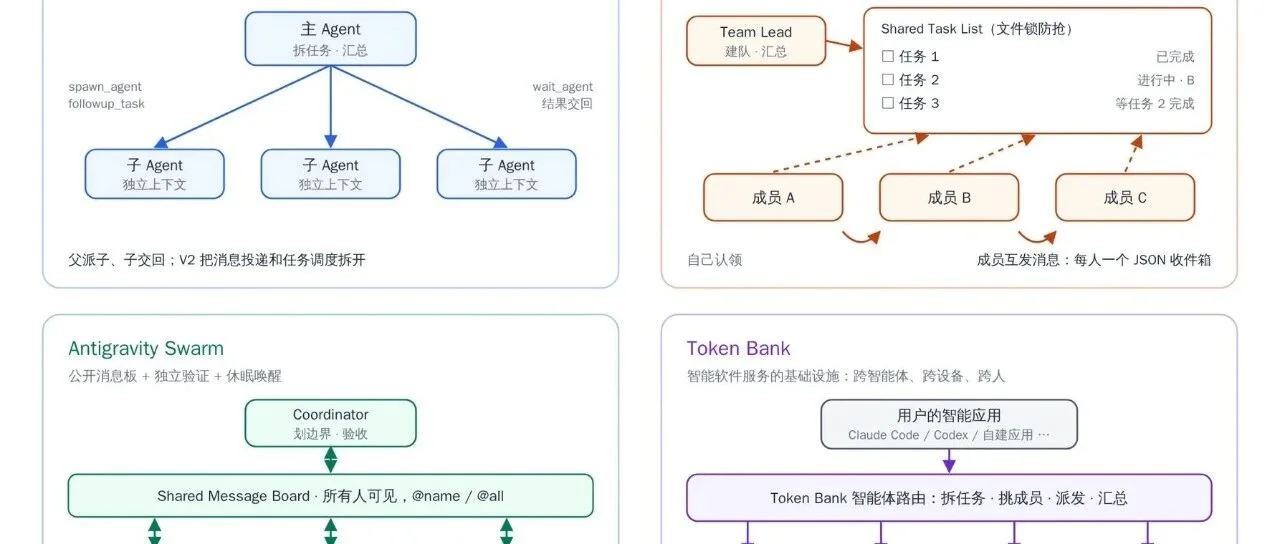
Codex's multi‑Agent collaboration is based on hierarchical delegation. The main Agent understands requirements, decomposes tasks, creates child Agents with independent contexts, dispatches tasks, appends instructions, waits for results, and aggregates delivery.
Multi‑Agent V1 relies on core tools: spawn_agent creates a child Agent, send_input sends instructions to an existing Agent, wait_agent waits for execution results, resume_agent and close_agent resume or close an Agent.
The latest public source code for Multi‑Agent V2 decouples message passing from task scheduling and introduces hierarchical Task Paths to identify Agents. send_message only delivers messages without starting a new execution round; followup_task assigns follow‑up tasks to an existing Agent and restarts execution if needed. V2 also adds Mailbox message waiting, Agent list querying, and execution interruption. Tool availability depends on model and runtime configuration.
Codex allows configuring different models, reasoning intensity, and sandbox policies per role. Lower‑cost models handle code search; stronger models handle complex logic and code review. Overall, it extends from parent‑child delegation to more flexible communication and lifecycle management, suitable for codebase exploration, parallel review, and relatively independent subtasks.
Claude Code Agent Teams: Shared Task List and Member Mailboxes
Claude Code's Agent Teams introduce two key components atop independent sessions: a Shared Task List and Mailboxes.
The team consists of four parts: Team Lead (forms team, decomposes tasks, aggregates results), Teammates (independent sessions and contexts), Task List (maintains shared task status, ownership, dependencies), and Mailbox (handles inter‑member messaging).
With Task‑series tools enabled, members completing a task can proactively claim unassigned, dependency‑free tasks from the shared list. File locking handles concurrent claim races. When a predecessor finishes, downstream dependencies are automatically unblocked.
Communication uses a per‑member JSON inbox at ~/.claude/teams/{team-name}/inboxes/{agent-name}.json. Members send direct messages via SendMessage without routing through the Team Lead. A frontend Agent discovering a missing backend field can directly negotiate with the backend Agent. Hooks like TeammateIdle, TaskCreated, TaskCompleted let developers integrate tests and static checks into the task lifecycle, blocking completion on failure.
Newer Claude Code versions allow ordinary named Subagents to communicate directly. Some newer models default without Task‑series tools, so members coordinate purely via messages. Agent Teams integrates independent sessions, member management, task state, and quality control into a collaboration mechanism. It remains Experimental.
Antigravity Swarm: Public Message Board, Independent Verification, Sleep/Wake
Antigravity's /swarm adopts a different approach. Launching a Swarm turns the current session into a Coordinator, which defines task boundaries, creates Workers, assigns responsibilities, and verifies results; Workers perform the technical work.
Each Worker has an independent session and context. Unlike Claude Code's private Mailboxes, Swarm uses a public Shared Message Board. Task scope, forbidden modifications, completion criteria, questions, code change summaries, and test results are posted sequentially on the same board. Members communicate openly via @name, @group, @all —no private messages; the entire collaboration is visible to the team and user.
Three designs stand out:
Sleep & Wake – event‑driven. Workers with no tasks or awaiting replies can sleep, consuming no model tokens. An @ mention automatically wakes them, avoiding idle polling.
Verifier – independent verification. Coordinator typically assigns one Verifier per two to four Workers to check code changes, run tests, and feed issues back to the responsible Worker. Workers and Verifiers can use different models, enabling cross‑model code review.
Monitor – stall detection. When the whole team is waiting but tasks remain incomplete, Monitor proactively messages relevant members to push progress.
Workspace defaults to shared, but multiple Workers can receive independent repository copies to reduce parallel edit conflicts. A Graph view visualizes inter‑Agent communication and replays the entire message interaction history. Previously only final deliverables were observable; now discussion, negotiation, verification, and repair become observable. Antigravity Swarm is in Preview.
Token Bank: Infrastructure for Intelligent Software Services
The first three approaches are internal capabilities of specific coding tools; team members are sessions derived from the same tool. Token Bank differs: it is not a model‑switching tool for Agents but infrastructure for intelligent software services. Models, Agents, skills, prompts, MCP assets, user devices, community hiring/renting, and an intelligent butler for sustained availability are unified at this layer. Any application connecting to it gains these capabilities. Multi‑Agent collaboration is one usage built on this infrastructure: a unified Agent interface lets any application session dispatch work to other applications, devices, or hired Agents.
The user's intelligent application need not decompose tasks itself. It can be a session in Claude Code, Codex, Cursor, or a custom app; it routes work to a Token Bank Agent router like selecting a model route. An Agent router defines who dispatches (Claude Code, Codex in orchestration mode), by what rules, to whom, and fallback when no suitable member exists. Decomposition, member selection, dispatch, and aggregation are handled by the router using tb_list_agents to see who can work, tb_dispatch_agent to assign, tb_task_status to collect results. Independent subtasks are dispatched in parallel; first‑come‑first‑served collection mirrors Codex's hierarchical delegation. The difference: workers can span Agents, devices, people—local Agents, a home mini's Codex ( mine:codex@mini), or community‑hired Agents running on their devices. The user's app integrates them via Token Bank; when the assignee is known, the router can be bypassed for direct assignment. Each subtask records its dispatcher, forming an auditable task tree.
Once members scatter across machines, the challenge shifts from "how to divide work" to "what happens after dispatch":
Before starting, the remote side verifies application and workspace readiness.
During execution, step increments sync back.
On completion, output files are pulled back per manifest and verified.
Long disconnects mark tasks as lost contact, so the dispatcher need not wait indefinitely; when the remote reconnects, real results fill in.
Hired Agents undergo security review on the lessor's side; each hirer gets an isolated directory; only progress summaries and final artifacts return.
Underpinning all this is the intelligent butler. It is more than Swarm's stall Monitor; it is the kernel that keeps Token Bank smart, stable, and self‑improving—an AI operations brain. It swaps faulty model sources, repairs broken integration configs, diagnoses dispatch failures, and pre‑screens hired tasks for security. It rules first, then falls back to model judgment; user corrections are remembered and applied to the router. Every automated action is logged and reversible. As multi‑Agent collaboration grows complex, this non‑working role that ensures system availability becomes essential.
Token Bank has clear boundaries: no shared task list, no public message board, no dedicated Verifier. Orchestration is done by the Agent router; verification happens at router aggregation or by dispatching a review Agent. In multi‑Agent collaboration, this infrastructure layer handles: where members come from, how work is delivered, how results are retrieved, and how faults are contained.
Comparison of the Four Approaches
The design focus of each is distinct:
Codex Subagents – hierarchical task delegation, child Agent lifecycle management, message passing.
Claude Code Agent Teams – shared task state, autonomous task claiming, team member communication.
Antigravity Swarm – shared message board, event‑driven scheduling, independent verification, stall monitoring.
Token Bank – cross‑Agent, cross‑device, cross‑person task dispatch, plus post‑dispatch state sync and fault tolerance.
Comparison Table:

                        Codex Subagents      Claude Code Agent Teams      Antigravity Swarm      Token Bank
Who decomposes tasks    Main Agent           Team Lead                    Coordinator            Agent Router
Member origin           Same tool derived    Same tool derived            Same tool derived      Local apps, other devices, hired Agents, external Agents
Message flow            Parent‑child         Shared Task List + Mailboxes Public Message Board   Task interface: dispatch, query progress, collect results
Completion judgment     Main Agent aggregates Hooks gate completion        Verifier + Coordinator Agent Router aggregates; Smart Butler fallback
Workspace               Configurable sandbox Independent sessions, shared repo Default shared, optional independent copies Per‑device workspaces; hired Agents isolated per person
No strict iterative replacement exists among them; they can be combined. A Claude Code Team Lead can dispatch a subtask via Token Bank to a Codex instance on another machine. Swarm is not fully decentralized—it still needs a Coordinator. The key is how they organize tasks, pass information, and judge team completion.
Antigravity itself retains Subagents, Swarm, Boost, and Teamwork modes for independent subtasks, parallel development, repeated verification of complex problems, and long‑cycle projects. Different tasks need different Agent organization; not everything warrants a swarm.
A community member shared a practical boundary for Antigravity's /run-workflow: use /run-workflow when the execution path is fixed, batch distribution by file list is needed, and strict structural validation of aggregated results is required; use /swarm when task boundaries are undefined, multiple roles must co‑design interfaces iteratively, and repeated rework/acceptance is expected. Adding to that: when the work requires other tools, other machines, or other people's expertise, the problem shifts from "how to form a team" to "how to send the work there and get results back safely"—exactly what Token Bank's infrastructure solves.
With members distributed across machines and people, new challenges emerge: remote state sync, fault detection and recovery, data integrity, and trust boundaries.
As Agent count grows, classic issues appear: communication overhead, resource contention, state consistency, task dependencies, failure recovery. Task claiming uses locks, but code edits lack mutual exclusion; independent context windows don't guarantee independent filesystems; multiple Workers reporting completion doesn't mean integrated code passes tests. If dependencies aren't correctly resolved or all Agents wait on each other, the team can stall. Cross‑device adds: "done" doesn't mean files are fully back; silence doesn't mean failure.
Task completion and team delivery are different. Who runs integrated tests after merge? Who diagnoses whether a failure stems from interface contracts or a Worker's change? Without clarity, even perfect division of labor stalls.
These problems remain unsolved. More Agents are not always better; for highly coupled tasks, blindly adding Agents increases communication overhead, duplicate reasoning, and token consumption.
An increasingly clear verdict: beyond model capability and Agent Harness polish, organizing multiple Agents with independent contexts, tools, and reasoning to achieve reliable collaboration at controlled cost will become a critical competitive direction for Coding Agents. When Agents are distributed across applications, devices, and people, "dispatching work, retrieving results, and containing errors" is half the collaboration.
Agent quantity determines parallelism; organization determines whether complex work becomes a deliverable.
References
Codex Subagents (https://developers.openai.com/codex/subagents)
Claude Code Agent Teams (https://code.claude.com/docs/en/agent-teams)
Google Antigravity Swarm (https://antigravity.google/docs/swarm/)
meow on Swarm (https://x.com/meow2149/status/2125846119620227335)
JL on /run-workflow (https://x.com/LJL06019/status/2125847355027320886)
Token Bank (https://tokenbank.wink.run)
For questions about attribution, corrections or content rights, please contactand we will review it promptly.