

Nitori Breach Exposes 37.6M Records: Attack Analysis & Modern Defense Lessons
Analysis of Nitori's 37.6M record data breach reveals likely credential theft via infostealers and weak VPN authentication, examines the high-value 'four-piece' data combo enabling precision phishing, compares with simultaneous Iris Ohyama attack, and outlines four pillars for modern defense: phishing-resistant FIDO2 authentication, identity-based microsegmentation, application-layer encryption with independent KMS, and AI-driven UEBA detection to catch mass exfiltration early.
Reading font
Introduction
On November 9, 2026, Japanese home furnishing giant Nitori disclosed a severe data breach affecting 37.62 million records. The same week, manufacturer Iris Ohyama confirmed a cyberattack. These back-to-back incidents have put the information security posture of Japan's retail and manufacturing sectors under scrutiny. This article provides a technical walkthrough covering the incident timeline, attack path speculation, impact analysis of the leaked data, the parallel Iris Ohyama case, and a blueprint for building a modernized defense system.
1. Incident Recap: What Happened
Nitori operates over 900 stores globally, with its "Nitori Net" online mall holding tens of millions of user registrations, shipping addresses, and order histories. According to the November 9 announcement, the breach traces back to late October 2026. Security teams detected abnormal database access patterns — bulk query spikes during off-hours from a handful of overseas proxy IPs. Forensic investigation with a third-party firm confirmed attackers had obtained read access to the core customer database, totaling approximately 37.62 million records.
Leaked fields likely include user names, emails, phone numbers, shipping addresses, and encrypted password hashes. Nitori stated payment card data is hosted by a third-party payment gateway and was not in scope, though this has not been independently audited.
2. Attack Path Speculation & Technical Analysis
Nitori has not released full attack chain details. Combining public information, JPCERT/CC advisories, and community discussion, a plausible attack path emerges.
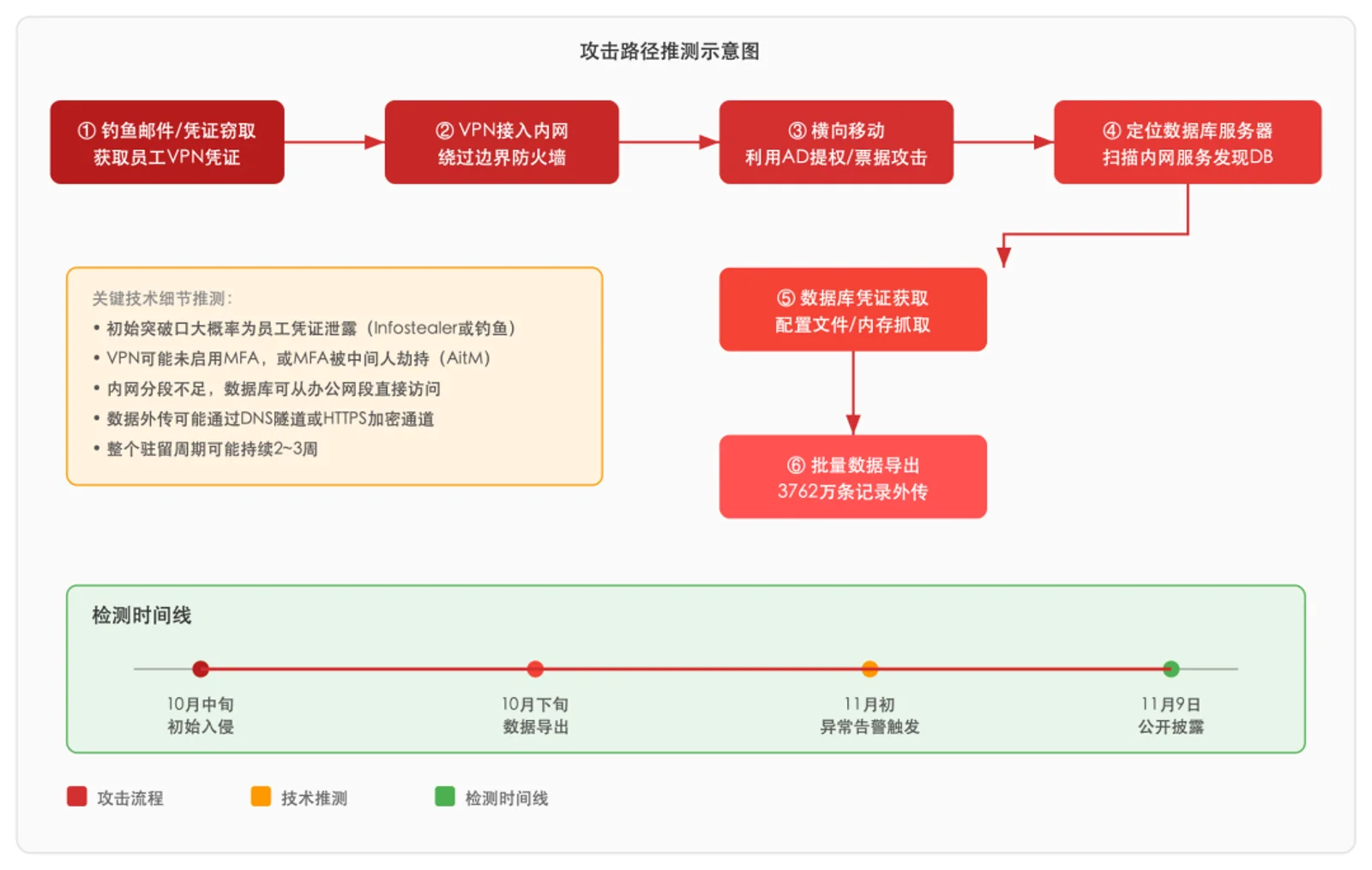
Industry patterns and recent Japanese intrusions point to credential theft as the initial vector. Since 2025, infostealer malware targeting Japanese employees has surged, delivered via phishing emails or trojanized software installers. These steal browser-saved VPN credentials, granting attackers legitimate-looking internal network access.
A critical question is whether the VPN gateway enforced multi-factor authentication (MFA). Analysis by Japanese security outlet piyolog indicates Nitori's internal systems still relied on traditional LDAP+password authentication, without widespread FIDO2 phishing-resistant methods. If the VPN lacked effective MFA, a single compromised credential equals a network entry pass.
Post-exploitation lateral movement details remain unconfirmed. However, retail enterprises often suffer from incomplete segmentation between office and business networks, lowering the barrier to reach database segments. Attackers ultimately obtained database connection credentials — possibly from application server config files or via memory scraping tools on running application processes.
3. What 37.62 Million Records Means
Nitori's domestic registered members number roughly 40-45 million (including inactive accounts), meaning this breach covers nearly the entire user base.
From a monetization perspective, the combination of name, phone, email, and address — a "four-piece" set — commands high value on darknet markets, typically $0.5-$2 per record. The full dataset could fetch tens of millions of dollars if sold in bulk.
The more immediate threat is secondary attacks . With accurate names and addresses, attackers can impersonate Nitori support via SMS or phone — "Your order to [exact address] has a delivery issue, click to confirm." The precision dramatically raises victim click-through rates.
Regarding password hashes: if Nitori used modern algorithms like bcrypt or Argon2id, bulk cracking risk is low short-term. But if legacy salted MD5 or SHA-1 were used, GPU-equipped attackers could crack large volumes given time.
4. Parallel Incident: Iris Ohyama Compromised
During the same week, Sendai-based appliance and daily goods maker Iris Ohyama acknowledged a cyberattack. Their conservative wording — "unauthorized access detected on some servers" — contrasts with observed service outages and partial e-commerce downtime, suggesting actual impact may exceed the announcement.
The near-simultaneous timing raises speculation of a connection: a single threat group targeting Japanese retail/manufacturing in a concentrated campaign, or a shared supply-chain component (common SaaS vendor, same IT outsourcer) enabling a "one-pot" compromise. This remains conjecture pending detailed investigations.
5. Building a Modernized Security Defense System
The exposed gaps are common across Japanese and broader Asian enterprises. Based on 2026 technical practices, four key directions are critical.
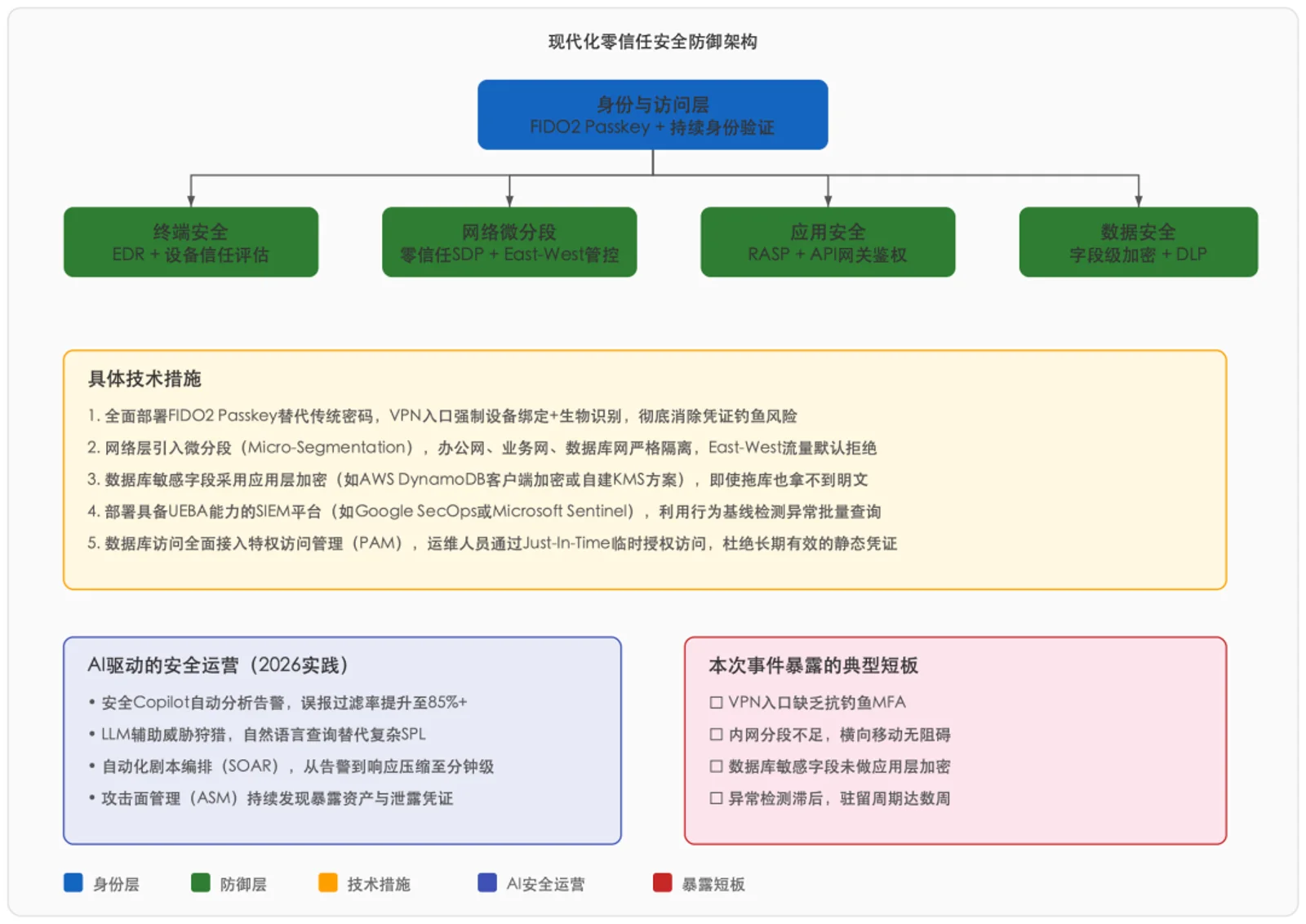
First, identity authentication must upgrade to phishing-resistant level. In 2026, relying on "username+password+SMS OTP" for VPN leaves a backdoor. FIDO2 Passkeys are now universally supported across OSes and browsers; deployment cost is no longer an excuse. Combined with Device Trust — only MDM-managed, compliant endpoints may access the internal network — this establishes a proper admission baseline.
Second, network segmentation cannot stop at VLANs. Traditional VLANs are virtually useless against lateral movement. Modern approaches adopt Software-Defined Perimeter (SDP) or identity-based microsegmentation, forcing every cross-segment access through real-time policy engine evaluation. Database segments should be whitelist-only: only specific application server IPs, over specific ports, using authenticated service accounts may connect.
Third, sensitive data must be encrypted at the application layer. The classic "TDE (Transparent Data Encryption) + transport TLS" model offers almost no protection when the entire database is exfiltrated, because TDE keys typically reside with the database instance. Effective practice encrypts sensitive fields — phone numbers, ID numbers, addresses — at the application layer before writing to the database, with keys managed by an independent KMS (Key Management Service). Even with a full database copy, attackers see only uninterpretable ciphertext.
Fourth, detection capabilities must match attack tempo. In this incident, the dwell time from intrusion to detection was likely 2-3 weeks — unacceptably long by 2026 security operations standards. A modern SIEM with UEBA (User and Entity Behavior Analytics), augmented by AI-driven alert triage and threat hunting, can spot anomalous patterns before mass exfiltration — e.g., a service account suddenly executing million-row SELECT queries at 3 AM. Such signals must not be missed.
6. Closing Thoughts
Nitori's breach sounds a loud alarm for the retail sector. 37.62 million records are not an abstract number; behind each are real people whose names, phones, and home addresses may now be priced on darknet forums.
Security is not a "good enough" domain. Skipping MFA on VPN, neglecting internal segmentation, leaving sensitive data unencrypted — these might have been tolerated as "technical debt" a decade ago. In 2026, with attacker toolchains fully weaponized, every deferred security upgrade is a ticking time bomb.
For affected users: if you are a Nitori member, change your password immediately, especially where reused on other platforms. Stay vigilant against any SMS, email, or call claiming to be from Nitori — the peak of precision phishing campaigns begins in the months following a breach.
This analysis is based on public information; some technical details are reasoned speculation. Final conclusions await official announcements from Nitori and Japanese regulators.
For questions about attribution, corrections or content rights, please contactand we will review it promptly.