

NTU's ACAP: Async Multi-Agent Robot Control Cuts Task Time 28% via Reasoning-Execution Overlap
NTU S-Lab's ACAP framework splits a robot into persistent coding agents per control group, coordinated by a hyper-agent that reclaims direct control for coupled actions, achieving 28.2% faster task completion over single-agent baselines by overlapping reasoning with execution rather than adding concurrent motion.
Reading font
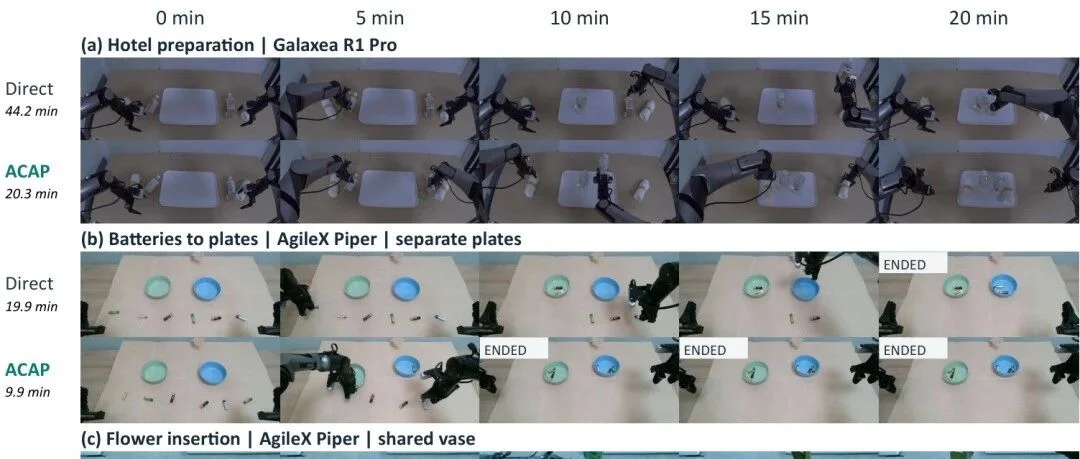
Researchers from NTU S-Lab, Oxford, and ACE Robotics propose ACAP (Asynchronous Coding Agents as Policy), a framework that decomposes a single robot into multiple persistent coding agents, each responsible for a distinct control group (e.g., arm+gripper, torso+base). A hyper-agent allocates tasks, coordinates dependencies, and can reclaim direct control over multiple groups when actions are physically coupled. In 72 real-robot rollouts on Galaxea R1 Pro 2025 and AgileX PiPER platforms, ACAP reduced task-balanced completion time by 28.2% compared to a single-agent baseline (Direct).
Why a Single Agent Is Slow
When one agent controls the entire robot, every component's decision passes through the same inference loop. A grasp-failure diagnosis on one arm blocks the other arm's independent motion. ACAP lets members run asynchronously: while one member diagnoses a grasp, another can simultaneously plan a placement, and the low-level controller tracks issued actions so that reasoning and physical execution overlap .
ACAP Architecture
Persistent members: Each member observes, reasons, writes code, and executes at its own pace, retaining context across tasks and control switches.
Hyper-agent: Allocates tasks, monitors progress and execution feedback, and decides when to seize direct control (lead) for tightly coupled actions (e.g., towel folding, bottle opening). This decision is dynamic, not based on a fixed task graph.
Control groups: The robot is split by physical subsystems — one arm with gripper, another arm with gripper, torso with mobile base — each assigned to a member.
Four Scaffolding Mechanisms
Persistent context: Observations, dialogue, and generated programs persist across tasks and control transfers.
Message buffering: Commands and reports are stored until acknowledged, allowing agents with different speeds to synchronize.
Event-based waiting: Only the specific action that requires a shared resource waits (e.g., inserting a flower into a vase waits for access permission), while other work (arranging flowers) continues.
Exclusive control authority: Each control group obeys only its current owner; authority cannot switch mid-controller-call, and controller targets are preserved during handover so the robot never goes limp.
Experimental Setup
Experiments used two robot platforms: Galaxea R1 Pro 2025 and AgileX PiPER series. The hyper-agent and lead (direct-control) policy ran on Astra xhigh; persistent members used the lighter Astra medium. Tasks were grouped into three categories:
Fully parallel: e.g., placing batteries into separate trays.
Parallel-sequential: e.g., preparing multiple flowers independently but inserting them one-by-one into a single vase.
Collaborative: e.g., folding a towel, opening a bottle cap — requiring tight bimanual coordination.
Results
Across 25 task/platform configurations, Direct averaged 19.04 minutes; ACAP averaged 13.67 minutes. Progress AUC rose from 62.3 to 72.9. In a 90-run repeat study (6 tasks), ACAP beat Direct on every task, with a task-balanced reduction of 29.4%. Category-level improvements:
Fully parallel: 20.49 min → 13.22 min
Parallel-sequential: 20.27 min → 13.86 min
Collaborative: 16.25 min → 13.75 min
Permanent Delegation Is Slower
A Fixed Delegation baseline (permanent assignment of groups to members, with inter-member communication for coupled actions) averaged 26.02 minutes on 8 collaborative settings — slower than Direct's 16.25 minutes. Completion rate: Fixed 3/10, Direct 8/10, ACAP 10/10. The paper attributes this to communication and synchronization overhead: a member may miss a shared-action start signal and must send a corrective command afterward. More concurrent inference does not guarantee shorter wall-clock time.
Key Insight: Overlap, Not Concurrency
Timing analysis shows the efficiency gain comes from overlapping reasoning with execution , not from more simultaneous robot motion. In fully parallel tasks, parallelism yields ~7 minutes savings. In coupled tasks, parallelism alone fails; direct control by the lead is faster. For towel folding, lead directly drives both arms for the joint fold. For bottle opening, ACAP assigns stabilizing and twisting to separate members but only ACAP succeeded; both baselines failed due to arm-crossing triggering hardware faults.
Stability Depends on Model Allocation
ACAP achieved 10/10 completion on collaborative tasks, but members used the lighter Astra medium while the lead used Astra xhigh. The hyper-agent dynamically decides which components need the heavier model; not every part should run the smallest model.
Paper: arXiv:2611.31205 ( https://arxiv.org/abs/2611.31205) | Hugging Face:
https://huggingface.co/papers/2611.31205For questions about attribution, corrections or content rights, please contactand we will review it promptly.