

OntoL: Breaking the Ontology High-Barrier Myth – Natural Language Query & Auto BI for Non-Experts
OntoL separates ontology complexity from user experience, enabling business users to query data via natural language and generate BI dashboards without ontology knowledge, using a semantic firewall to ensure consistent metrics and auditability while reducing modeling effort through AI-assisted schema scanning and visual configuration.
Reading font

OntoL challenges the perception that ontology-based products are inherently heavy, difficult, and have high adoption barriers. The article argues that this stereotype stems from conflating the expertise required for ontology modeling with the experience needed by end users.
OntoL's design enforces a clear separation: the ontology serves as a trusted foundational layer, not as an interface exposed to business users. For the majority of business analysts, production supervisors, supply chain specialists, finance, and operations staff, the two core capabilities — natural language conversational querying and automatic BI dashboard generation — require zero knowledge of ontology theory, axiomatic constraints, Allen temporal reasoning, DE-9IM topology, or the OntologyL_Cypher query language.
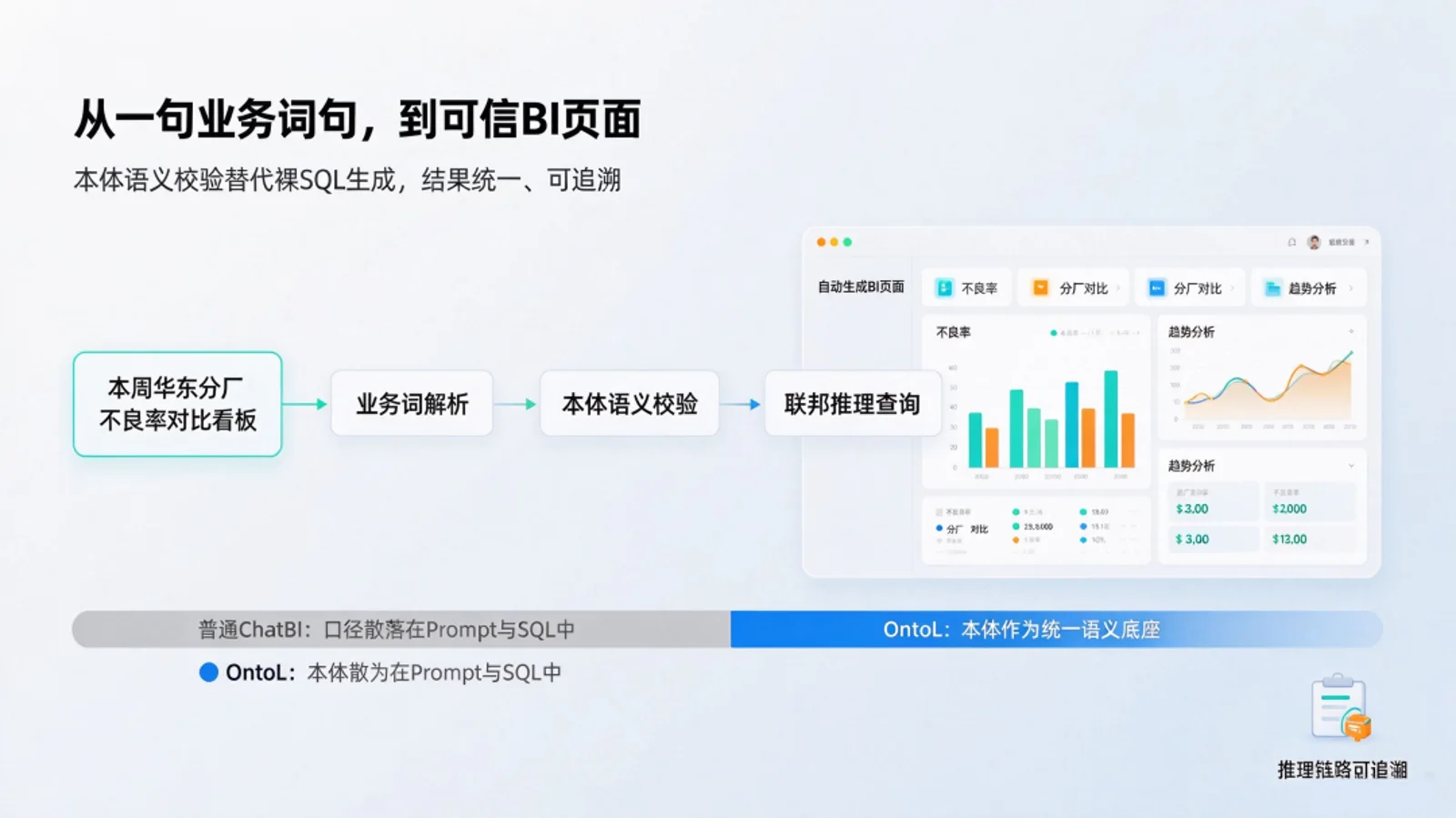
Business users simply ask questions in everyday business language, such as "Pull up a dashboard comparing defect rates across factories this week," "Check material kitting status for work-in-progress orders," or "Show procurement lead-time delay details for the last three months." The platform's built-in business glossary, predefined metrics, cross-system relationships, calculation rules, and data permissions are all encapsulated in the underlying ontology, remaining transparent to the user.
This approach differs fundamentally from typical Text-to-SQL ChatBI solutions. Ordinary ChatBI entrusts metric definitions and join logic to large-model prompts and scattered SQL, making them prone to metric drift, cross-system join errors, and unauditable results. OntoL's query pipeline follows a structured chain: natural language → business term parsing → ontology semantic validation → federated reasoning query → automatic BI chart rendering. The ontology acts as a semantic firewall, constraining model hallucinations, ensuring that the same metric yields identical definitions regardless of who asks or when, with automatic permission isolation and full traceability of the reasoning chain for every analytical result.
OntoL also continuously lowers the cost on the modeling side. It supports automatic schema scanning from MySQL, ERP, MES, and APIs, with AI assistance to generate initial ontology drafts. Modelers then only need to review and supplement business rules instead of writing ontologies from scratch. New metrics or adjusted business definitions can be maintained by business analysts through a drag-and-drop visual configuration interface for the business glossary, without touching the underlying ontology model.
In summary: the ontology is the platform's capability foundation, not the user's entry barrier. The professional complexity of ontology modeling is absorbed by implementation and modeling teams, while the business side receives a lightweight intelligent analysis experience — "speak naturally to query data, one click to generate BI pages." The rigor, reasonability, auditability, and cross-system semantic unity of the ontology are all encapsulated, silently supporting the upper-layer conversational and BI capabilities, allowing business users to focus solely on business analysis.
OntoL is reshaping the deployment paradigm for ontology platforms: hiding ontology complexity at the bottom layer and returning simple, trustworthy, and controllable intelligent analysis capabilities to the business. Ontology ceases to be a barrier to business digitalization and becomes an invisible "trusted data engine."

For questions about attribution, corrections or content rights, please contactand we will review it promptly.