

OntoL's Dual-Mode AI Routing: Default LLM Judgment with Optional Symbolic Guardrails
OntoL provides an ontology-native dual-mode decision routing framework for enterprise AI automation: default LLM-based flexible judgment selects from a pre-defined atomic action pool, while an optional symbolic reasoning layer can be added for deterministic pre-checks like compliance, throttling, and hard thresholds, enabling progressive risk control without sacrificing agility.
Reading font

Dual-Layer Pluggable Routing: Default AI Flexible Judgment, Rule Verification Added On-Demand
OntoL's decision routing mounts on ontology entity types and relationship types, unifying business semantics and decision definitions in the ontology TBox without an external scheduling system. Two runtime modes switch freely without intrusion:
Default Mode: LLM Autonomous Routing (Out-of-the-Box) After an event triggers (entity field change, ontology relationship generation, metric anomaly), the ontology context, entity attributes, link relationships, derived metrics, associated RAG documents, and MCP tool results are fed to the LLM. The LLM performs a single task: select a matching handling action from a pre-built, independently managed atomic Action pool, outputting the Action identifier, input parameters, and complete decision rationale.
All Actions are pre-encapsulated: create entity, modify field, add/delete Link relationships, external callbacks, message notifications, each with built-in transaction, permission, audit, and lineage. The LLM only selects actions, does not write underlying change logic; actions are uniformly governed, reducing risk.
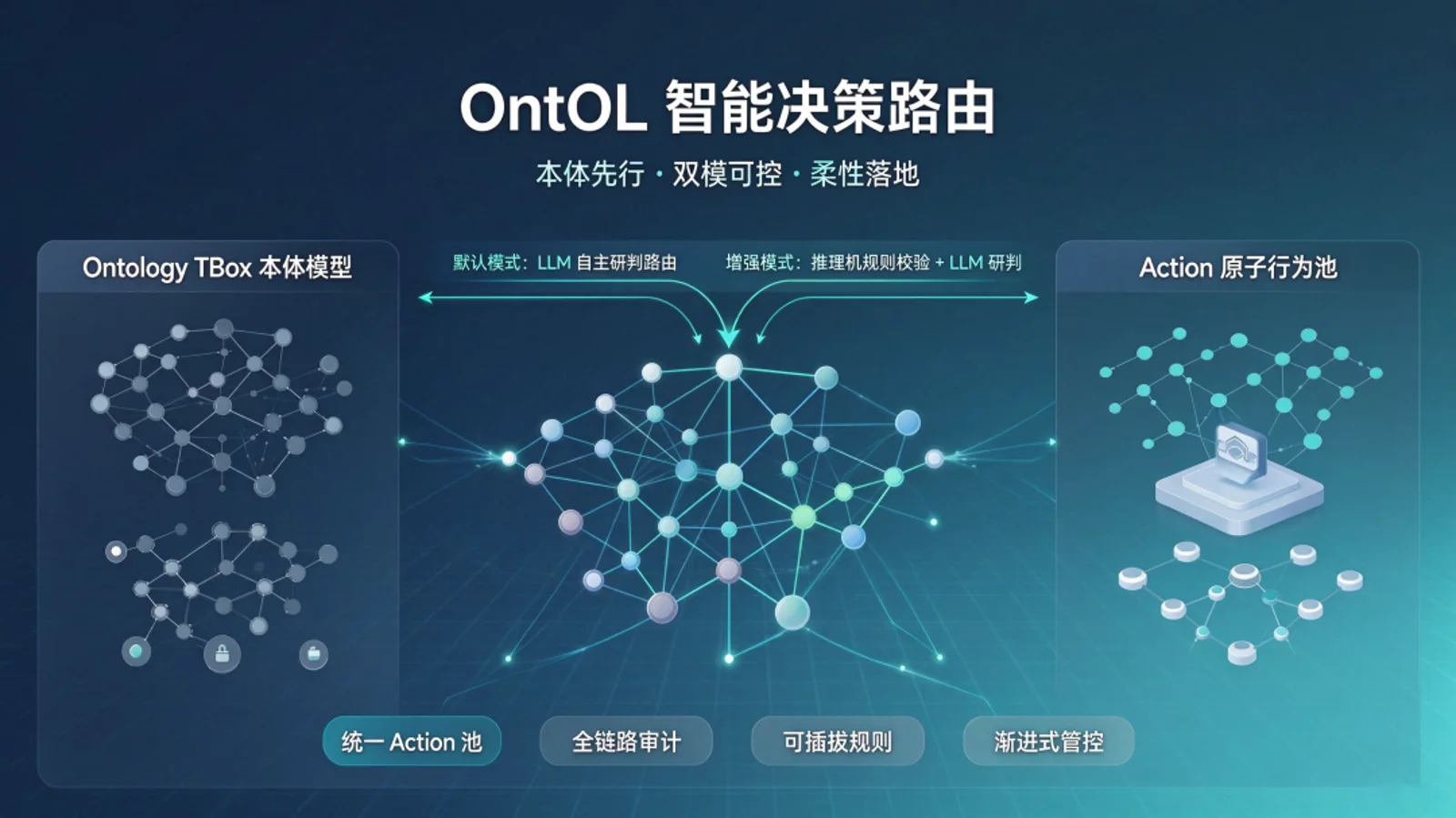
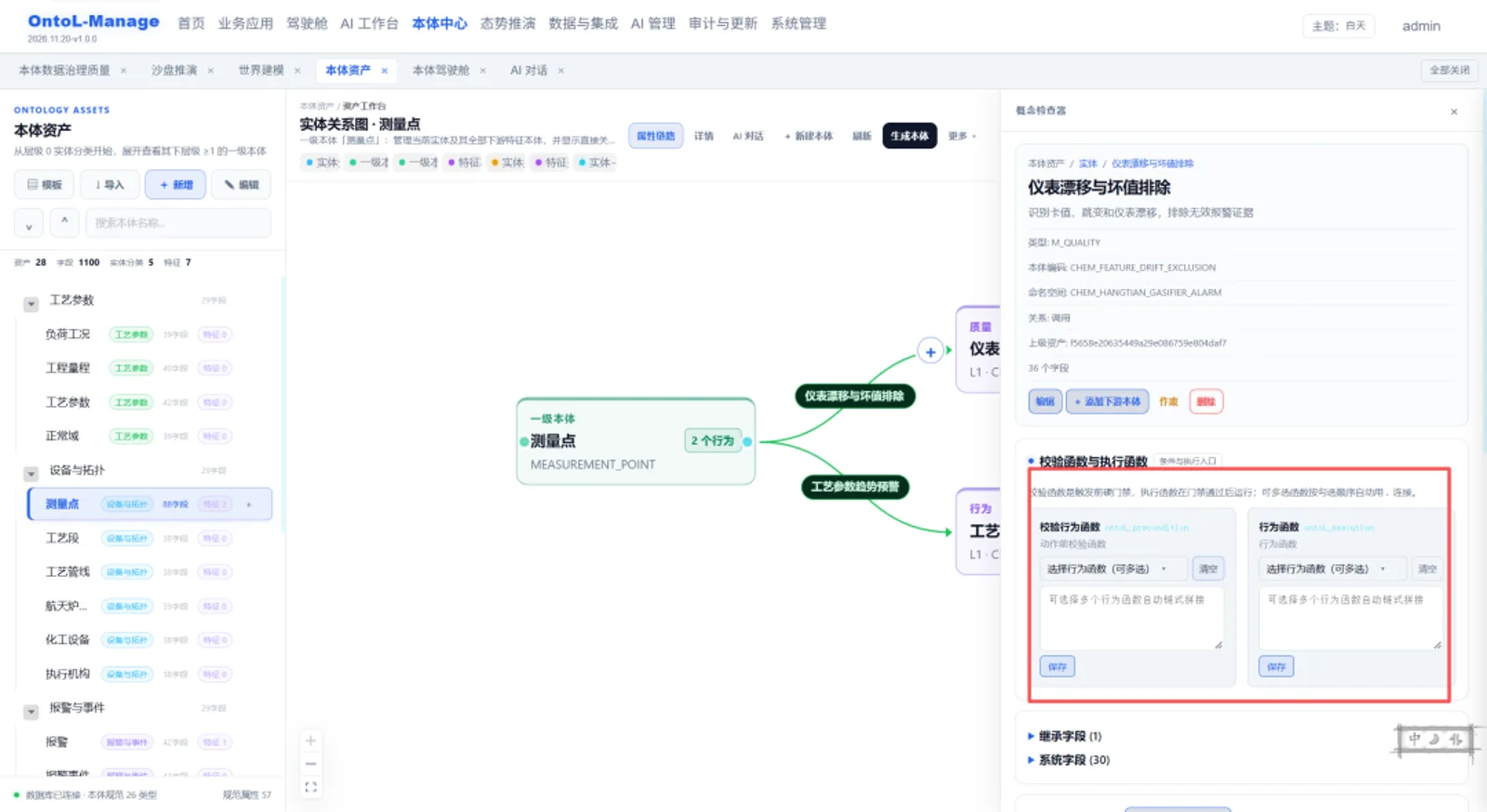
Enhanced Mode: Practitioners Optionally Add Symbolic Reasoning Pre-Check Rules (Not Governed by LLM, Optional) When business scenarios demand strong compliance, debouncing, rate limiting, or hard thresholds, implementation engineers can add a layer of ontology reasoning engine verification logic on the ontology relationship configuration. After event trigger, the symbolic reasoning engine performs deterministic checks first: cooling period, working hours, basic thresholds, duplicate trigger debouncing, permission constraints, compliance red lines. If verification fails, it intercepts directly without entering the LLM; if passed, it hands off to the LLM for complex trade-off judgment. This layer is not mandatory but a post-hoc optional capability: simple scenarios stay lightweight, high-risk scenarios get an "iron gate" protection on demand.
Core design philosophy: Default lightweight AI routing, rules as optional plugins rather than mandatory prerequisites. One ontology model adapts to different customers and business lines' control requirements.
Scenario Example 1: Industrial Equipment Anomaly Judgment
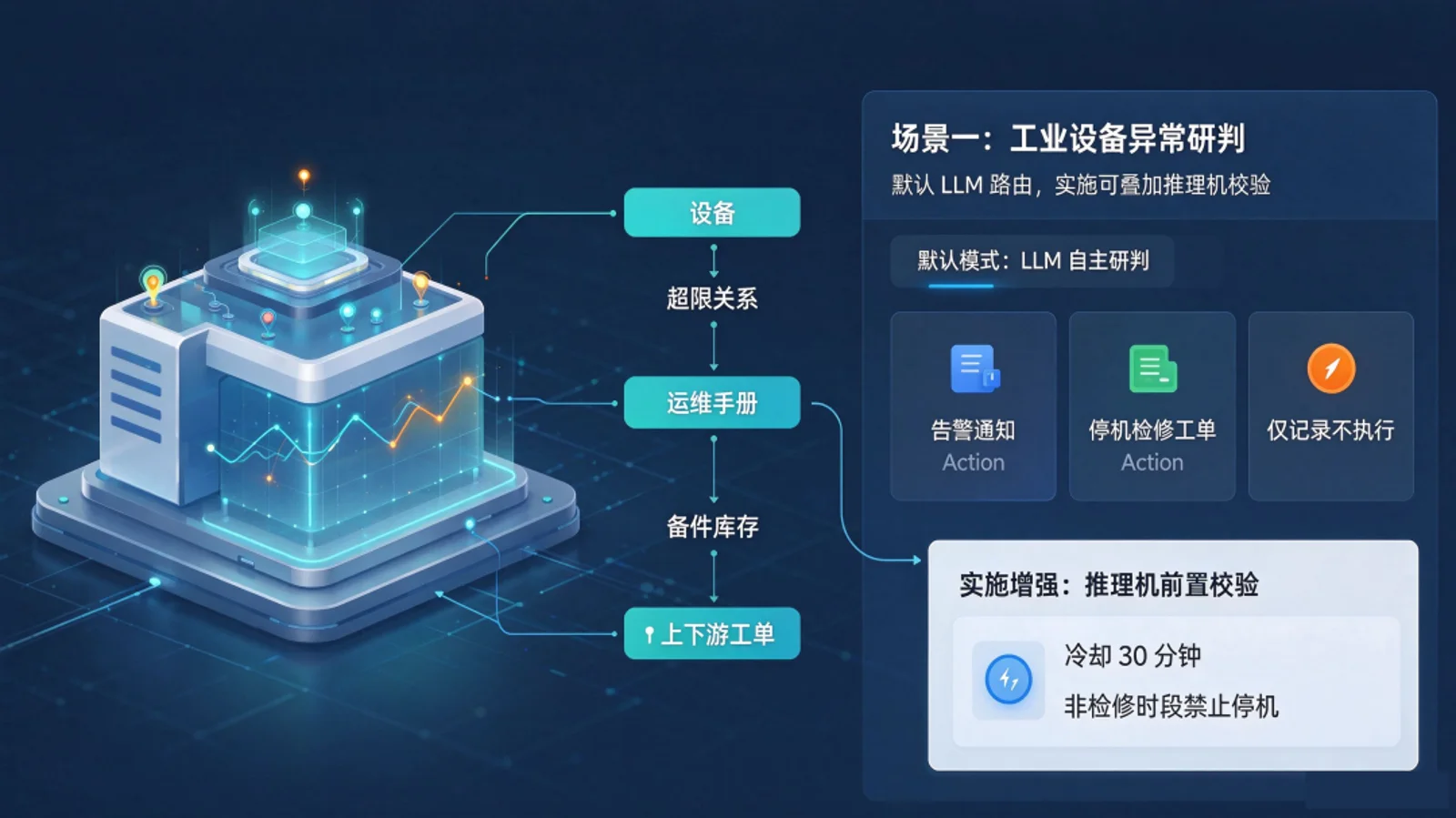
Configuration: Default LLM judgment, practitioners optionally add reasoning engine verification. Continuous equipment telemetry exceeding limits generates an [Equipment - Overlimit] ontology relationship, triggering decision routing:
Default Mode (No Reasoning Engine Verification): Directly sent to LLM. The LLM reads equipment ontology info, upstream/downstream work orders, RAG-loaded equipment maintenance manuals, MCP spare parts inventory query results, and comprehensively judges: short-term minor exceedance → alarm notification Action; accompanied by vibration anomaly and spare parts shortage → shutdown maintenance work order Action; judged as sensor noise interference → choose no action, only retain record.
Practitioner Enhancement (Add Reasoning Engine Verification): Practitioners add reasoning rules: trigger cooling 30 minutes, non-maintenance windows prohibit direct shutdown. The reasoning engine first filters out short-term jitter and triggers during nighttime non-allowed shutdown windows; after passing, the LLM combines manuals and inventory for fine-grained judgment.
Scenario Example 2: Master Data Change Conflict Handling
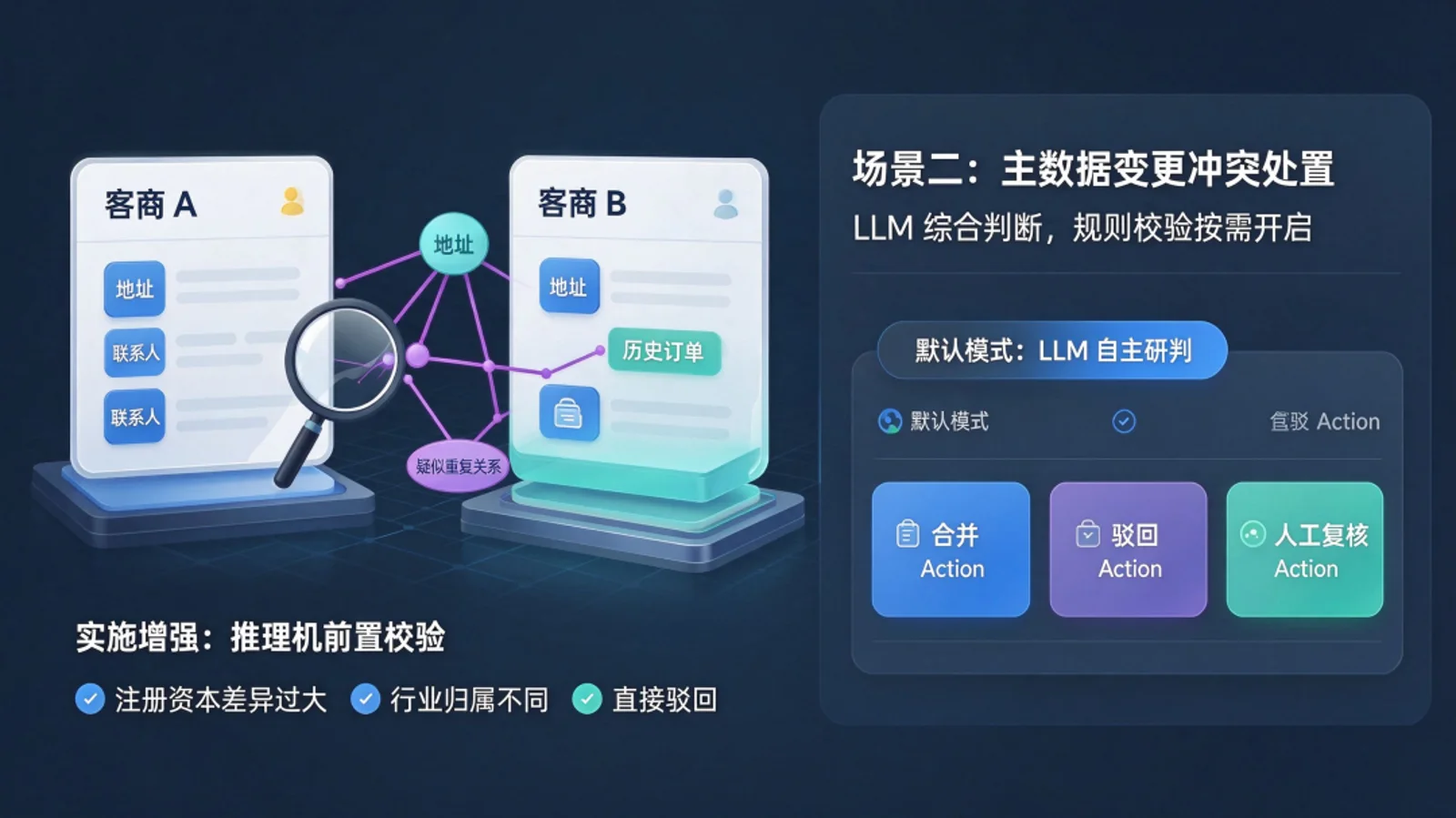
Configuration: Default LLM judgment, practitioners optionally add reasoning engine verification. Two merchant master data records match, generating a [Merchant - Suspected Duplicate] relationship, triggering routing:
Default Mode (No Reasoning Engine Verification): LLM reads both merchants' addresses, contacts, historical orders, RAG merchant archives, and autonomously chooses: highly consistent info → execute merge Action; large info differences → reject Action; doubtful info → submit manual review work order Action.
Practitioner Enhancement (Add Reasoning Engine Verification): Practitioners add hard reasoning rules: registered capital difference exceeds threshold, completely different industries → auto-reject without sending to LLM; only basic info similar conflicts pass to LLM for deep judgment.
Core Differences from Comparable Solutions
Benchmarking against Palantir Foundry: Ontology only carries entities and relationships; Automate monitoring, AIP Logic, and rules are mutually independent, routing logic scattered in external components, inherently fragmented. OntoL natively integrates decision routing into the ontology TBox:
✅ Default Lightweight: Out-of-the-box LLM judgment routing, rapid POC delivery and simple business scenarios, no need to maintain large rule sets upfront.
✅ Elastic Enhancement: Practitioners plug in reasoning engine verification layer on demand; same ontology model adds hard constraints for high-risk business, keeps low-risk business simple.
✅ Action Asset Reuse: All atomic behaviors uniformly precipitated; rule layer and AI layer share the same Action pool.
✅ Full-Chain Audit Lineage: Trigger source, reasoning verification records (if any), LLM context, selected Action, ontology change snapshots, fully auto-logged, traceable.
✅ Proposal Gate Support: High-risk Actions selected by AI can be configured to generate change proposals first, manual review before writing to ontology, fitting high-trust scenarios like chemical, energy, finance.
Applicable Industries
Industrial operations, equipment manufacturing, supply chain logistics, master data governance, enterprise risk control, energy scheduling, elderly care/park governance, etc. POC rapid validation phase uses default LLM routing; scaled production and strong compliance scenarios add reasoning engine rules progressively by practitioners.
Closing Thoughts
Enterprise AI adoption should not be a fixed shackle. OntoL's "pluggable pre-rule verification + LLM judgment routing" grounds on ontology as the truth base: default lets AI flexibly adapt to complex, changing business while retaining symbolic reasoning's deterministic capability, introduced by practitioners on demand and progressively reinforced. Ontology defines the business world, AI handles flexible trade-offs, rules act as optional safety gates, enabling intelligent automation to both land quickly and converge risks on demand.
For questions about attribution, corrections or content rights, please contactand we will review it promptly.