

Ontology SQL: Why MySQL 8 Materialization Beats Palantir's Translation Layer
This article compares Palantir's Ontology SQL, which relies on a translation layer over a custom JSON object store, with OntoL-Data's approach of materializing ontology objects directly into MySQL 8 tables, arguing that the latter's alignment with the relational paradigm and China's mature MySQL ecosystem eliminates heterogeneous overhead, reduces optimization burden, and simplifies scaling for domestic enterprise workloads.
Reading font
One of the core contradictions in landing ontology technology is the heterogeneous conflict between the ontology semantic model and the underlying storage engine . Ontologies are naturally object-oriented, relationship-oriented, and business-entity-centric abstractions, while different storage engines have completely different native capabilities, execution models, and ecosystem genes. When an ontology runs directly on a heterogeneous store, all SQL capabilities, permission translation, query pushdown, and result assembly must be handled in an intermediate adaptation layer — and that layer becomes the source of cost, constraints, and performance ceilings. Palantir's Ontology SQL is a typical product of this heterogeneous contradiction.
Palantir's Approach: SQL as a Translation Layer on a Custom Object Store
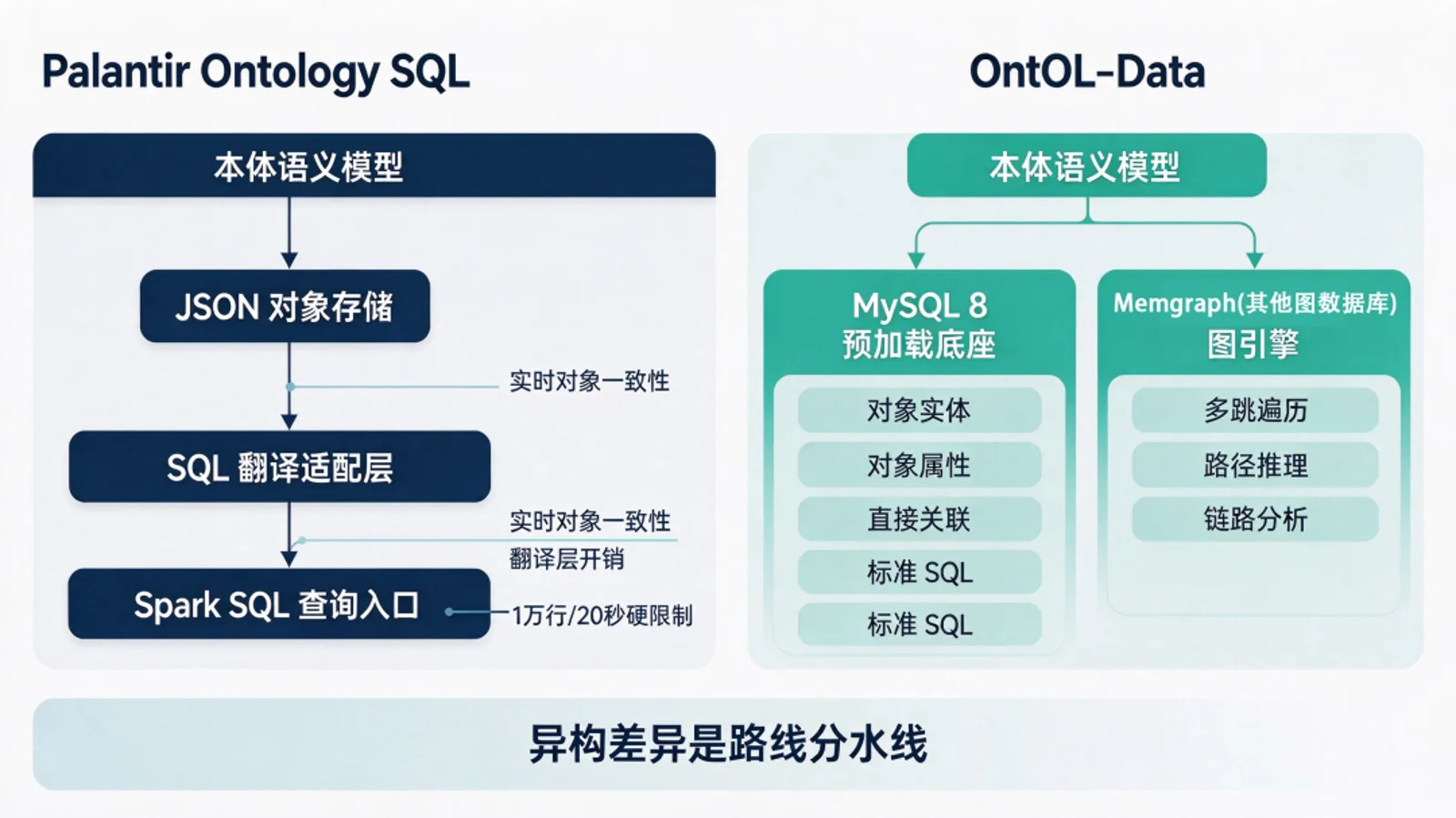
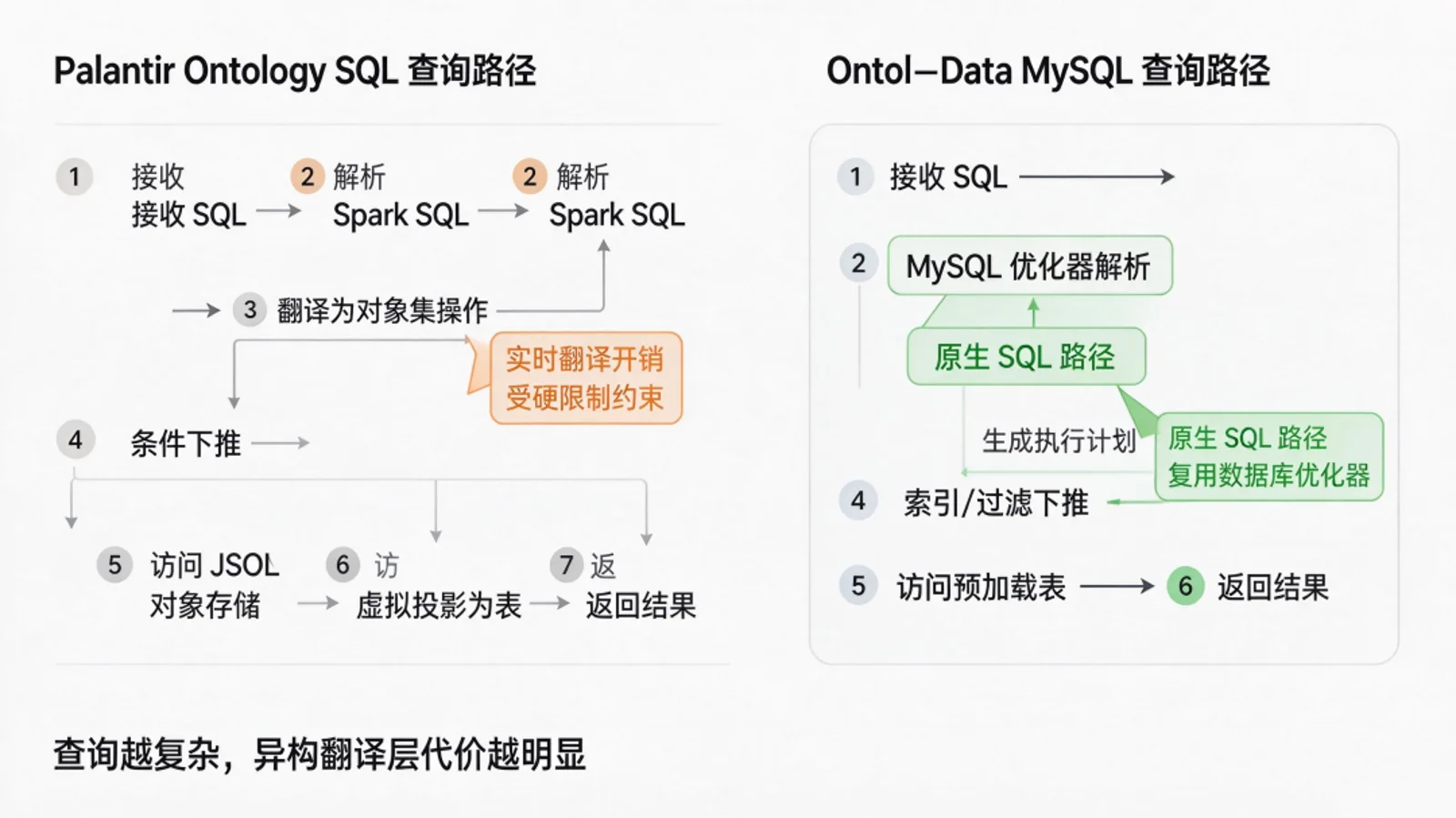
Palantir Foundry's native ontology carrier is its proprietary JSON Object Storage v2 . The object store's kernel is designed for object-set traversal, object-action orchestration, and real-time object-state snapshots — not for relational algebra, JOINs, index filtering, or bulk aggregation. The ontology model and the underlying storage belong to two different paradigms; heterogeneity is fundamental. Ontology SQL does not eliminate this heterogeneity. Instead, it builds a translation bridge: it receives Spark SQL, translates it into object-set operations, and then virtually projects the object structures into tables for return. This architecture determines that all its limits are inherent:
10,000-row truncation
20-second timeout
Complex queries automatically fall back to Spark
These are not product unwillingness but boundaries of the heterogeneous adaptation layer's carrying capacity. Every new query pattern requires additional translation logic, pushdown rules, and permission mapping logic, continuously accumulating heavy engineering debt. This architecture suits reconnaissance-style, interactive, strong-real-time-consistency scenarios but struggles to sink into China's massive, normalized business analysis, reporting, and self-service exploration scenarios.
OntoL-Data's Approach: Materializing Ontology into MySQL 8
In contrast, OntoL-Data chooses to materialize ontology semantics into MySQL 8 , compressing the heterogeneous gap at the source. MySQL 8 holds an irreplaceable natural position in China's internet industry:
Over a decade of large-scale business validation
Complete peripheral component ecosystem: CDC, sharding, middleware, monitoring, backup, high-availability solutions, and mature ops toolchains
Native flexible cluster expansion: master-slave, MGR, distributed middleware sharding — all with abundant first-line engineer experience and publicly available pitfall solutions
Ample talent supply
For an enterprise ontology platform, choosing MySQL 8 is not simply picking a database; it is directly accessing the most mature and reliable infrastructure foundation in China's internet ecosystem.
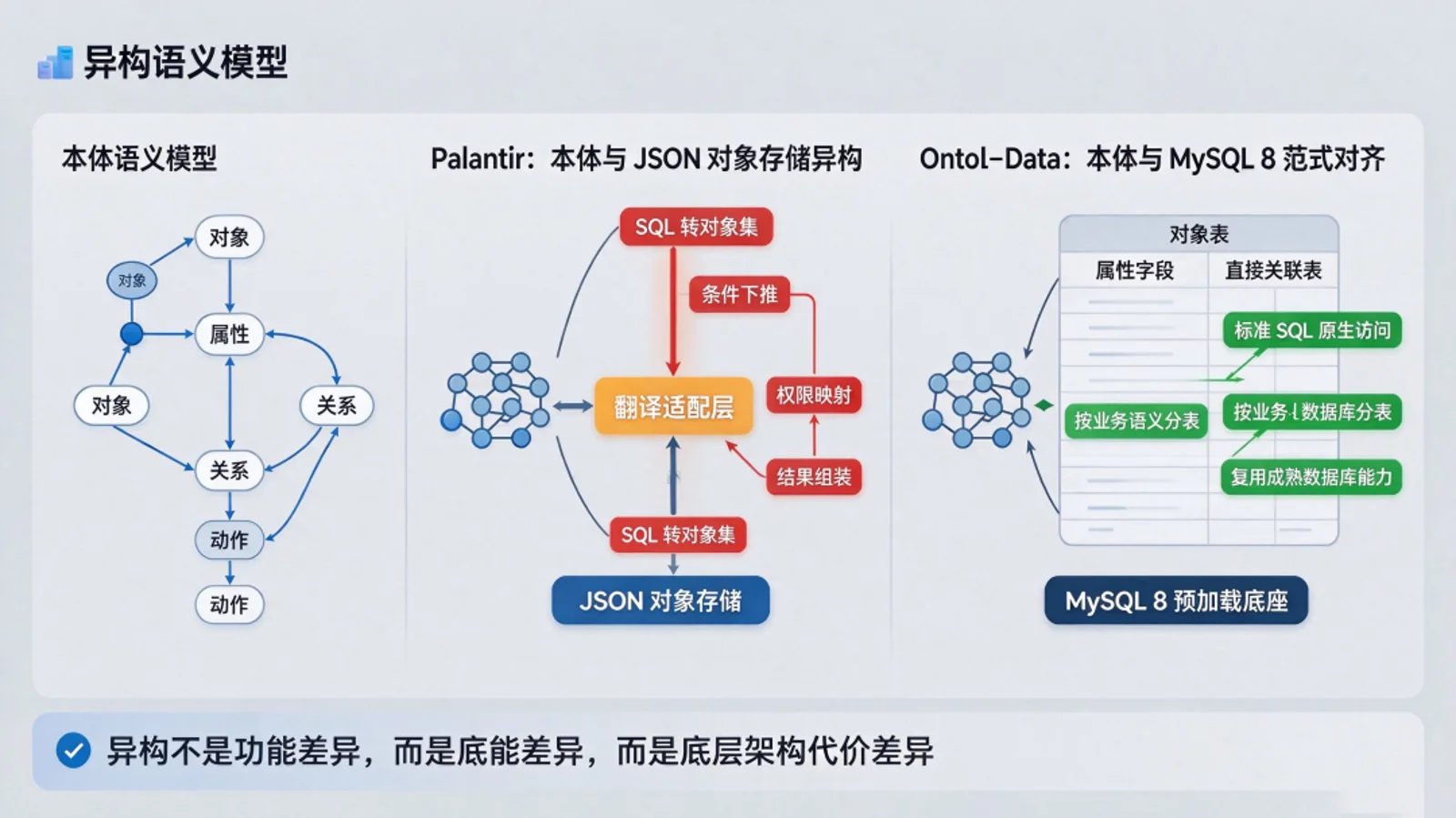
OntoL-Data's modeling logic aligns naturally with MySQL 8's relational paradigm: ontology objects are pre-loaded into MySQL tables, with tables created per business semantics to carry independent business meaning. Object types map to physical tables, attributes to columns, and many-to-many semantic relationships automatically generate intermediate association tables. Once the ontology semantic model lands, it is a standard relational structure; SQL is no longer an external translation layer but the database's native capability. This alignment yields concrete benefits:
Eliminate fundamental heterogeneous conversion overhead : No real-time SQL-to-object-set translation; queries are parsed natively by MySQL's optimizer, generating execution plans. Indexes, statistics, and filter pushdown are all native database capabilities — no need for the ontology team to build a custom query-semantic translation logic.
Sharding by business semantics naturally reduces big-data optimization pressure : Physical tables split by business objects naturally isolate scan ranges, avoiding scan bloat from ultra-wide tables. Leveraging MySQL's mature indexing system and partitioning capabilities, many big-data performance issues no longer require custom compute routing or in-memory fallback logic; they reuse decades of database optimization.
Expansion capabilities fit domestic enterprise ops habits : MySQL 8 cluster expansion paths are clear — hot-data partitioning, read-write separation, MGR high availability, sharding scale-out — all supported by mature components. As ontology object scale grows, capacity can be added smoothly along the database's own expansion lines; ops teams don't need to learn a brand-new proprietary object-store ops system.
Seamless ecosystem integration : BI, reporting platforms, ETL, data-quality tools, and data gateways all natively support MySQL — no custom adapters needed. Analysts, developers, and ops reuse existing skill stacks with near-zero learning cost.
Explicit Trade-offs
Choosing MySQL 8 materialization also entails clear trade-offs: data relies on pre-load synchronization, introducing controllable sync latency. Core business objects, queries, reports, and self-service analytics run on MySQL 8, handling high-frequency routine workloads. Meanwhile, the ontology model syncs to Memgraph/Neo4j (or other Cypher-supporting graph databases) to export graph structures, dedicated to multi-hop reasoning and complex path tracing — each engine doing its job without forcing a single engine to cover all ontology workloads.
By contrast, Palantir's route uses a single proprietary object store to carry the entire ontology; SQL is merely an attached capability. It solves the core demand of real-time object consistency but must continuously bear the complexity of heterogeneous adaptation. Its ecosystem, ops, and expansion systems are disconnected from China's mainstream tech stack, requiring teams to build and maintain an independent system for learning, ops, and scaling — with performance needing constant optimization.
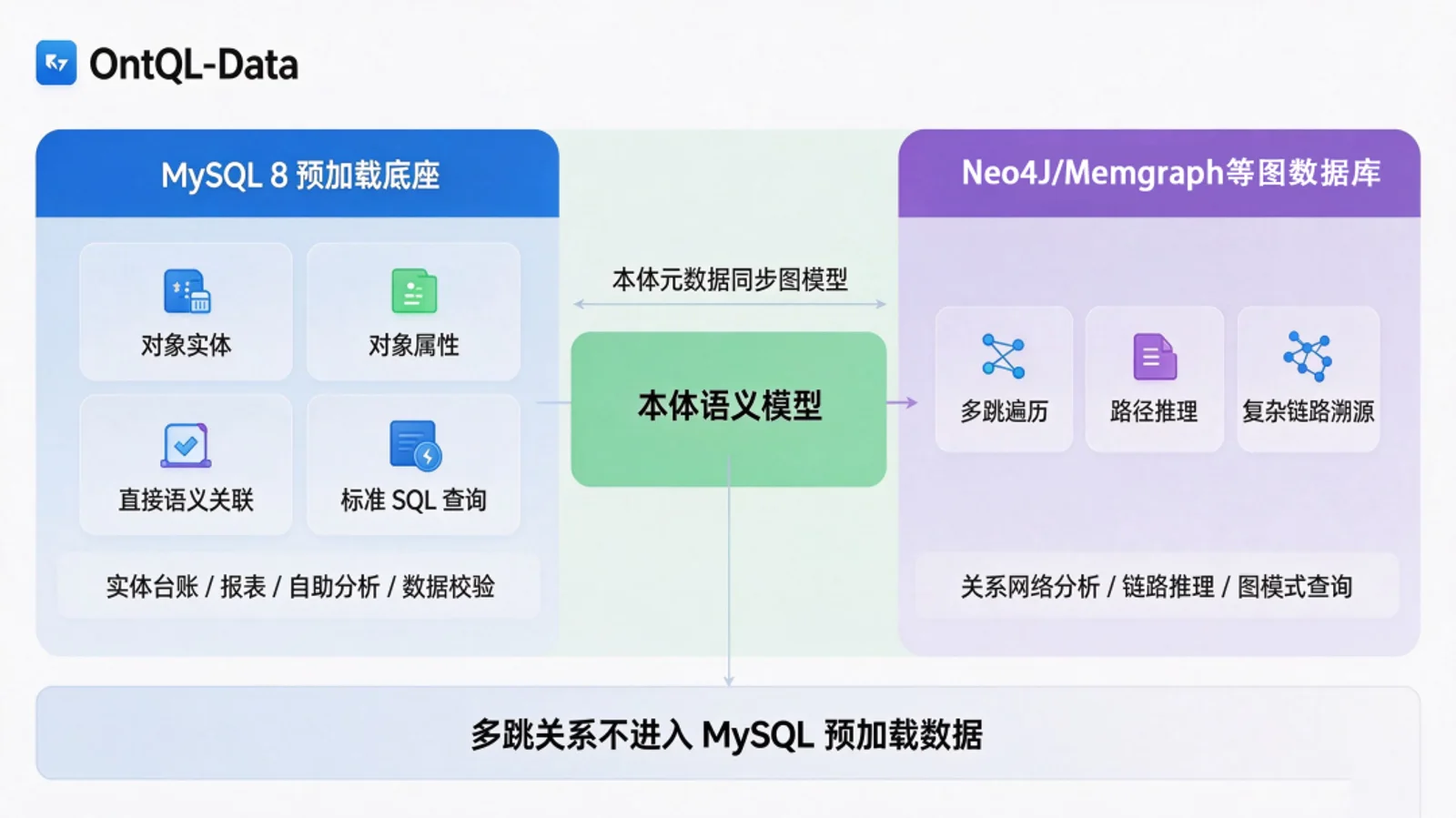
Core Comparison
Ontology-to-storage relationship : Palantir — fundamental heterogeneity (ontology model vs JSON object store) requiring a middle translation layer; OntoL-Data — paradigm alignment (ontology objects materialized into relational tables) eliminating real-time heterogeneous conversion.
Underlying foundation ecosystem : Palantir — proprietary object store, closed ecosystem, dedicated toolchain; OntoL-Data — MySQL 8, China's internet natural mainstream foundation, rich components, mature cluster expansion.
SQL capability source : Palantir — upper-layer translation adaptation, Spark SQL dialect, many hard limits; OntoL-Data — database native first-class citizen, standard ANSI SQL, capability boundaries determined by database resources.
Performance optimization burden : Palantir — requires continuous investment in custom query pushdown, multi-level compute routing, and other big-data specialized optimizations; OntoL-Data — business-semantic sharding isolates scans, reuses MySQL's mature optimization capabilities, drastically reducing specialized optimization investment.
Expansion path : Palantir — proprietary storage dedicated scale-out, independent ops system; OntoL-Data — master-slave, MGR, sharding mature routes, ample domestic ops talent reserve.
Shortcomings : Palantir — translation layer brings query ceilings and complex-query stability issues; OntoL-Data — pre-load sync latency exists, deep graph queries need external graph engine supplementation.
Landing Insights
The heterogeneous difference is the deepest watershed between the two routes — not SQL syntax or feature lists. If the business's first priority is millisecond-level object real-time consistency and reconnaissance-style object exploration, and the team can accept a closed ecosystem and independent ops costs, Palantir's object store + SQL (JSON-compatible) adaptation route is self-consistent. If facing normalized operational ontologies in China's manufacturing, supply chain, energy, eldercare, and other industries — needing to integrate with large numbers of existing BI, reporting, and business systems, with teams mainly composed of engineers familiar with the MySQL stack, expecting low-cost cluster expansion and reduced continuous big-data optimization investment — OntoL-Data's MySQL 8 based materialization route possesses structural advantages.
MySQL 8's status in China's internet is not a crush on technical parameters but a complete, massively validated, low-cost replicable ecosystem chassis. OntoL-Data leverages this chassis to simplify the landing of ontology semantics from "building a brand-new heterogeneous system" to "using the familiar relational database to carry semantic objects," reducing unnecessary complexity from the architectural bottom layer.
The ultimate goal of ontology is to make business semantics accessible, governable, and flowable; SQL is just the interaction entry point. The choice of storage foundation determines what kind of heterogeneous cost you have to bear.
For questions about attribution, corrections or content rights, please contactand we will review it promptly.