

OntoL: Lightweight Multi-Standard Ontology Base for Executable Industrial Knowledge Graphs
OntoL provides a lightweight, high-compatibility ontology platform that unifies RDFS, OWL2 DL, SWRL, SHACL, and Cypher standards, supports Memgraph and Neo4j, includes built-in temporal and spatial reasoning, and enables executable business actions across 44 industrial use cases from manufacturing to finance.
Reading font
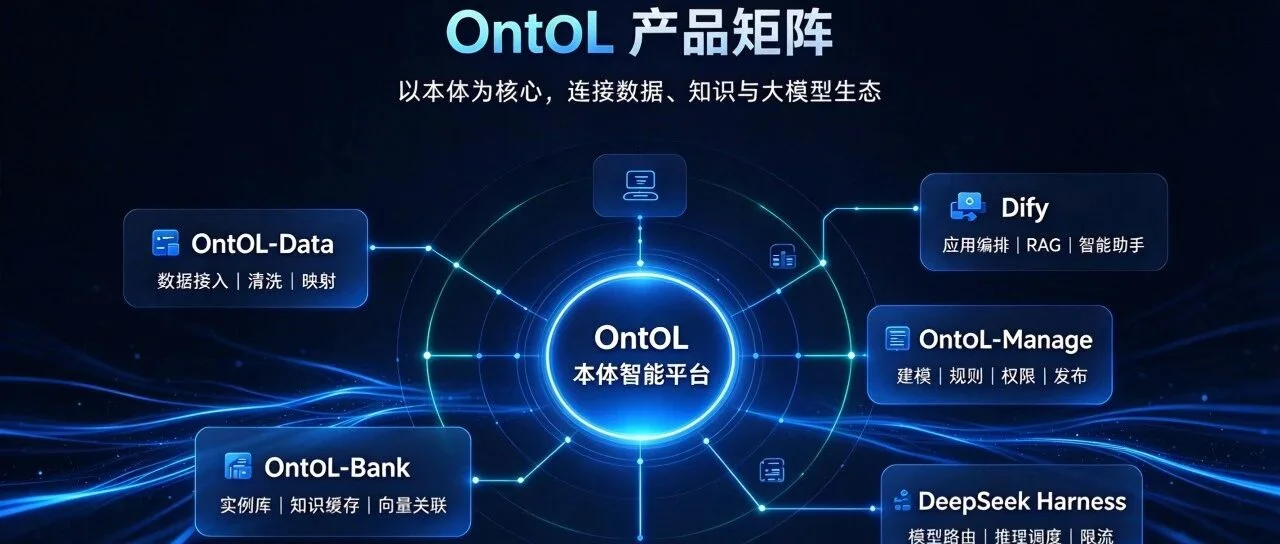
Layered Architecture with Dual Usage Modes
OntoL adopts a layered architecture supporting two modes: a lightweight out-of-the-box mode and an ontology-enhanced mode. The platform ships with six language entry points — five ontoL_* prefixed standard semantic entries ( ontoL_rdfs, ontoL_owl2, ontoL_swrl, ontoL_sh, ontoL_cypher) covering RDFS, OWL2 DL, SWRL rules, SHACL constraints, and native Cypher — alongside the default primary language OntologyL_Cypher 2.0 . The ontoL_* prefixes are used to import, compile, and debug standard semantic assets, while large-model-generated business behavior functions uniformly use the default OntologyL_Cypher. The underlying engine natively supports both Memgraph and Neo4j graph databases and includes built-in Allen temporal interval reasoning and DE-9IM spatial topology reasoning. Deployment is fully private and offline-capable, with 44 production cases spanning discrete manufacturing BOM/ECN, supply chain optimization, chemical safety control, equipment asset governance, financial master data compliance, footwear/apparel, elderly care, and drone operations.
Alignment with Mainstream Semantic Standards to Lower Learning Barriers
Unlike proprietary ontology engines that force users to learn a new closed syntax, OntoL natively integrates industry-recognized semantic specifications: RDFS, OWL2 DL, SWRL, SHACL, and Cypher. Engineers familiar with semantic web or graph databases can directly reuse existing knowledge, modeling, writing rules, and validating constraints in their preferred standard without learning a closed system from scratch. OntologyL_Cypher 2.0 serves as the main DSL, an enhanced dialect built on standard Cypher for business reasoning orchestration, balancing graph query expressiveness with ontology reasoning chain orchestration. Teams can choose per need: ontoL_owl2 for OWL habits, ontoL_sh for validation constraints, ontoL_cypher for graph queries. This multi-language entry design consolidates traditionally fragmented semantic stack capabilities into a single foundation, avoiding simultaneous maintenance of heterogeneous environments like Jena, Stardog, and graph databases, drastically reducing ontology engineering onboarding and operational costs. The platform avoids redundant capabilities, focusing R&D on core enterprise needs: heterogeneous system semantic unification, entity-rule binding, and business action orchestration. For business Agent scenarios, permissions, auditing, and process linkage are native, enabling entities to map directly to real business actions such as ECN changes, merchant control, and inventory scheduling — making the ontology truly executable.
Deep Industrial Scenario Immersion for Business-Critical Needs
OntoL has long specialized in industrial digitalization, refining its product around real pain points in manufacturing and government-enterprise sectors. It has accumulated extensive pre-built ontology models, industry rule templates, and mature implementation methodologies. The product was never positioned as a generalized graph tool for consumer content Q&A instead it targets industrial master data chaos, inconsistent BOM definitions, untraceable supply chain links, and difficult equipment fault root-cause analysis. This scenario focus yields stronger adaptability, faster delivery, and more mature, stable solutions for industrial customers. For buyers, the value boundary is clear, allowing rapid fit assessment during selection to avoid mismatches.
The reasoning layer follows the same practicality-first philosophy, balancing standard semantic capabilities with industrial deployability. It natively supports OWL2 DL, SWRL, and SHACL while prioritizing high-frequency industrial needs: temporal interval reasoning, spatial topology judgment, entity disambiguation matching, and custom business rule inference. Rule expressions mirror the business language of production lines, logistics, and asset control, offering strong readability, complete debugging traces, and clear audit trails, enabling business personnel to participate in rule configuration — achieving both semantic rigor and operational usability.
High Compatibility and Flexible Integration Protecting Existing Assets
High compatibility is a core OntoL advantage. The platform natively supports standard SQL and standard Cypher, adapts to both Memgraph and Neo4j graph engines, and connects to various relational databases and business APIs with built-in federated query capability. Developers can reuse existing SQL and Cypher skills; existing graph workloads and OWL/SHACL semantic assets import smoothly with minimal refactoring. Users choose their usage depth: lightweight direct graph querying, or layered ontology modeling and reasoning orchestration, seamlessly integrating with ERP, MES, WMS, and other existing systems. This compatibility lets enterprises build enterprise semantic networks incrementally on top of current IT assets, progressively achieving master data governance and intelligent Agent construction without ripping out existing digital foundations.
Conclusion
The value of an ontology ultimately lies not in theoretical logical completeness but in whether it enters the business and solves real problems. OntoL centers on "lightweight, high compatibility, multi-standard semantics, executability," unifying RDFS, OWL2 DL, SWRL, SHACL, and Cypher in a single platform. It balances semantic standards, engineering deployment cost, and compatibility with enterprise legacy systems, delivering a domestically controllable, moderately accessible ontology foundation for Chinese industrial customers. As enterprise Agents, master data governance, and supply chain intelligent optimization continue to land, this industry-oriented ontology approach offers a new reference direction for domestic semantic platform development.
For questions about attribution, corrections or content rights, please contactand we will review it promptly.