

OpenAI's Athena Targets Semantic Layer, Challenging Data Giants
OpenAI's Data Agent accuracy issues drive development of Athena, a semantic layer platform to manage business definitions, while Palantir, Databricks, and Snowflake advance their own ontology approaches, highlighting a growing battle over enterprise business knowledge management.
Reading font

OpenAI's Data Agent Accuracy Issues Spark Athena Development
OpenAI's enterprise Data Agent, launched in ChatGPT Work on September 10, 2026, integrates data querying, analysis, visualization, and follow-up work into natural language interactions. It connects to platforms like Snowflake, Databricks, ClickHouse, BigQuery, and Redshift, and can operate within Tableau, Power BI, and ThoughtSpot. However, within two months, customers questioned its analytical accuracy. The Information reported on November 24, 2026, that at least one client found accuracy insufficient for broad deployment. OpenAI is now developing a project codenamed Athena, a data management platform resembling a semantic layer that unifies business metric definitions such as revenue and customer calculations.
SQL Executes Correctly but Business Numbers Are Wrong
A manager asks: "What was last month's net revenue?" The agent finds order, payment, and refund tables, generates SQL, executes it, and returns a trend chart. The process runs without errors, yet the result may not match the business definition. Net revenue could mean order amount minus refunds, or further minus discounts and taxes. Time granularity may be calendar month vs. fiscal month. Cross-month refunds may be assigned to different periods. Different business lines may use different calculation rules.
These nuances are absent from database schemas. A field named revenue might represent contract value in sales, recognized revenue in finance, and a processed metric in operations. The data production process, calculation rules, and applicability are scattered across ETL code, metric platforms, BI reports, internal docs, and tribal knowledge. Even with correct table selection, wrong joins and filters cause silent errors. RAG expands knowledge retrieval but cannot resolve authority conflicts: the agent may retrieve finance's definition, sales' historical report, and an expired doc simultaneously. Retrieval relevance and business definition authority are distinct problems.
The semantic layer addresses this by mapping business terms, underlying data, calculation rules, and dimension relationships. Enterprises pre-define net revenue's calculation, data sources, and scope; the agent queries using governed definitions, reducing repeated inference. The critical error class is SQL executes successfully but returns numbers that violate business semantics — databases don't flag this, and users may take results into operating reviews. For decision-making agents, SQL generation success rate alone is inadequate.
OpenAI's Internal Six-Layer Context System for Data Understanding
OpenAI faced similar challenges internally. As of January 29, 2026, their data platform covered 600+ PB, 70,000 datasets, and 3,500+ internal users. Finding the right table was itself time-consuming. They built a six-layer context system:
Table Usage : Schema, lineage, and historical queries to understand structure and relationships.
Human Annotations : Domain experts add business meaning, applicability conditions, and special constraints.
Codex Enrichment : Analyzes data production and consumption code to extract semantics — filtering conditions, statistical granularity, coverage, update rules — that are invisible in the final table.
Institutional Knowledge : Pulls business terms, metric definitions, and org knowledge from Slack, Google Docs, Notion.
Memory : Stores user corrections and discovered special rules, with personal and global scopes.
Runtime Context : Real-time queries to the data warehouse and related systems to supplement or verify existing info.
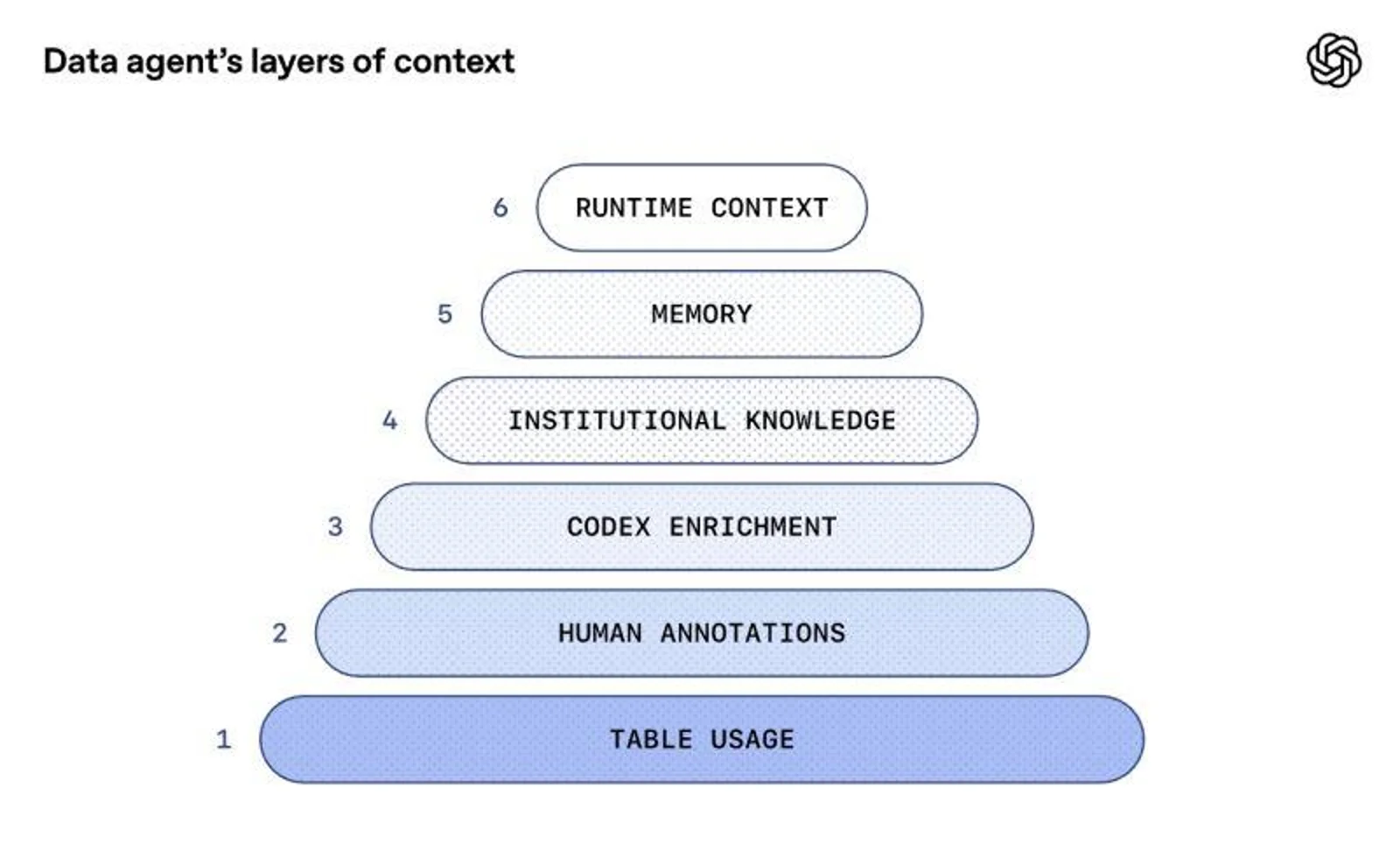
Codex Enrichment offers a novel approach: reconstruct business semantics from production code. Two tables with similar schemas may differ in filters, granularity, coverage, and update rules — differences only visible in code. OpenAI uses Codex to analyze code, letting the agent understand data genesis and auto-refresh context.
Not all six layers are fed to the model per query. A daily offline pipeline merges table usage, human annotations, and Codex-extracted knowledge into a unified representation, vectorized via Embeddings API. The agent uses RAG to retrieve relevant context; when knowledge is missing or stale, it queries the warehouse in real time. Offline knowledge processing and runtime exploration serve different roles, avoiding repeated scanning of raw metadata and logs.
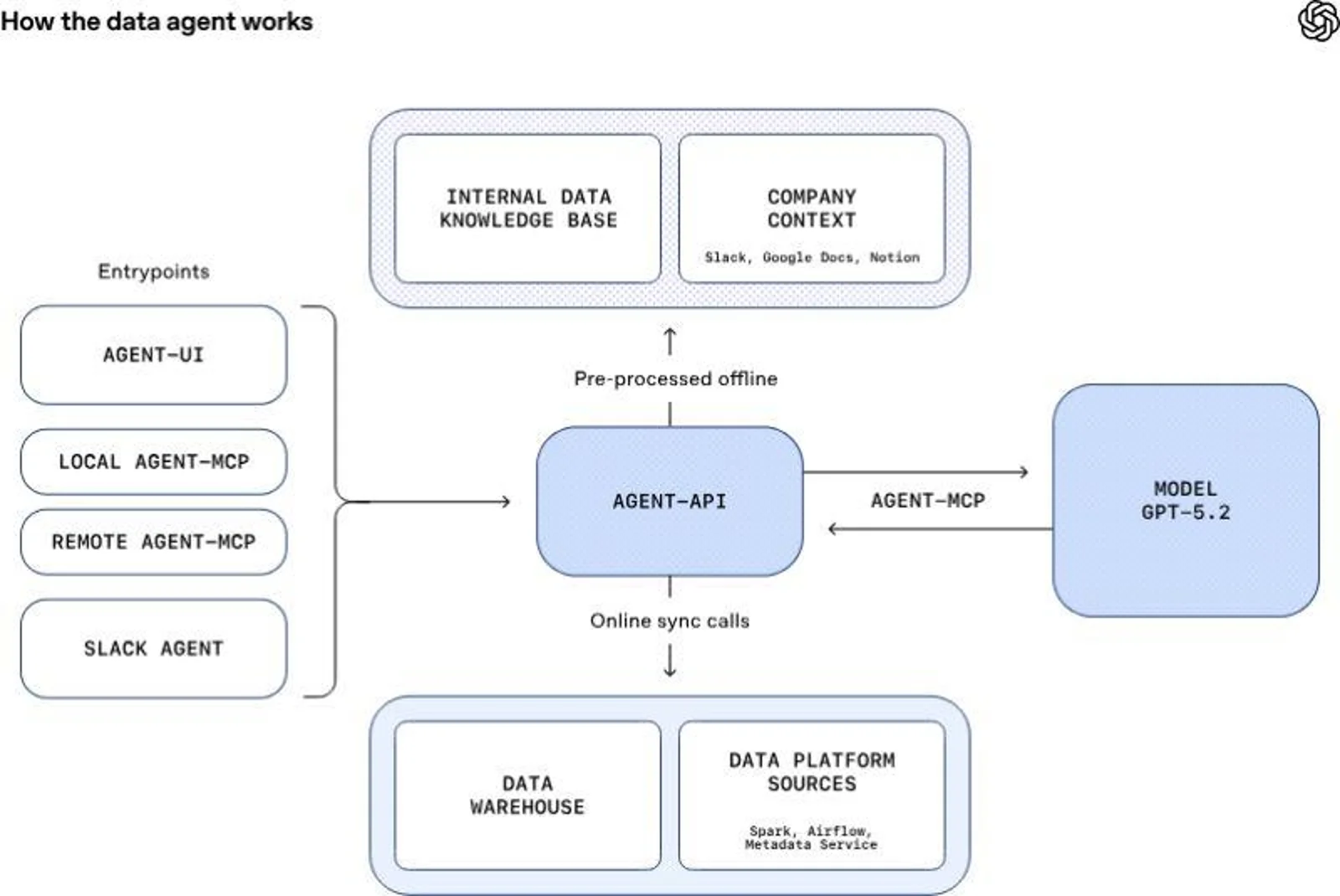
OpenAI also built a SQL evaluation mechanism using Evals API. For key metrics and tasks, humans write expected SQL; the agent's generated SQL is executed and compared on both query text and returned data. An evaluator scores and explains. Since different SQL can yield correct results, evaluation avoids simple string matching. This continuous eval detects accuracy regressions during agent iteration.
The six-layer design shows OpenAI places heavy engineering outside the model : code knowledge extraction, annotation maintenance, historical correction persistence, query result validation. This internal practice informs Athena's direction, though no public evidence confirms Athena will directly reuse this architecture.
Ontology Battle Reaches Model Layer: OpenAI vs. Data Giants
Before Athena surfaced, Palantir, Databricks, and Snowflake had already positioned around enterprise business semantics. All aim to let agents reuse accumulated business knowledge, but differ in knowledge organization, auto-discovery, metric governance, and business execution.
Palantir Ontology
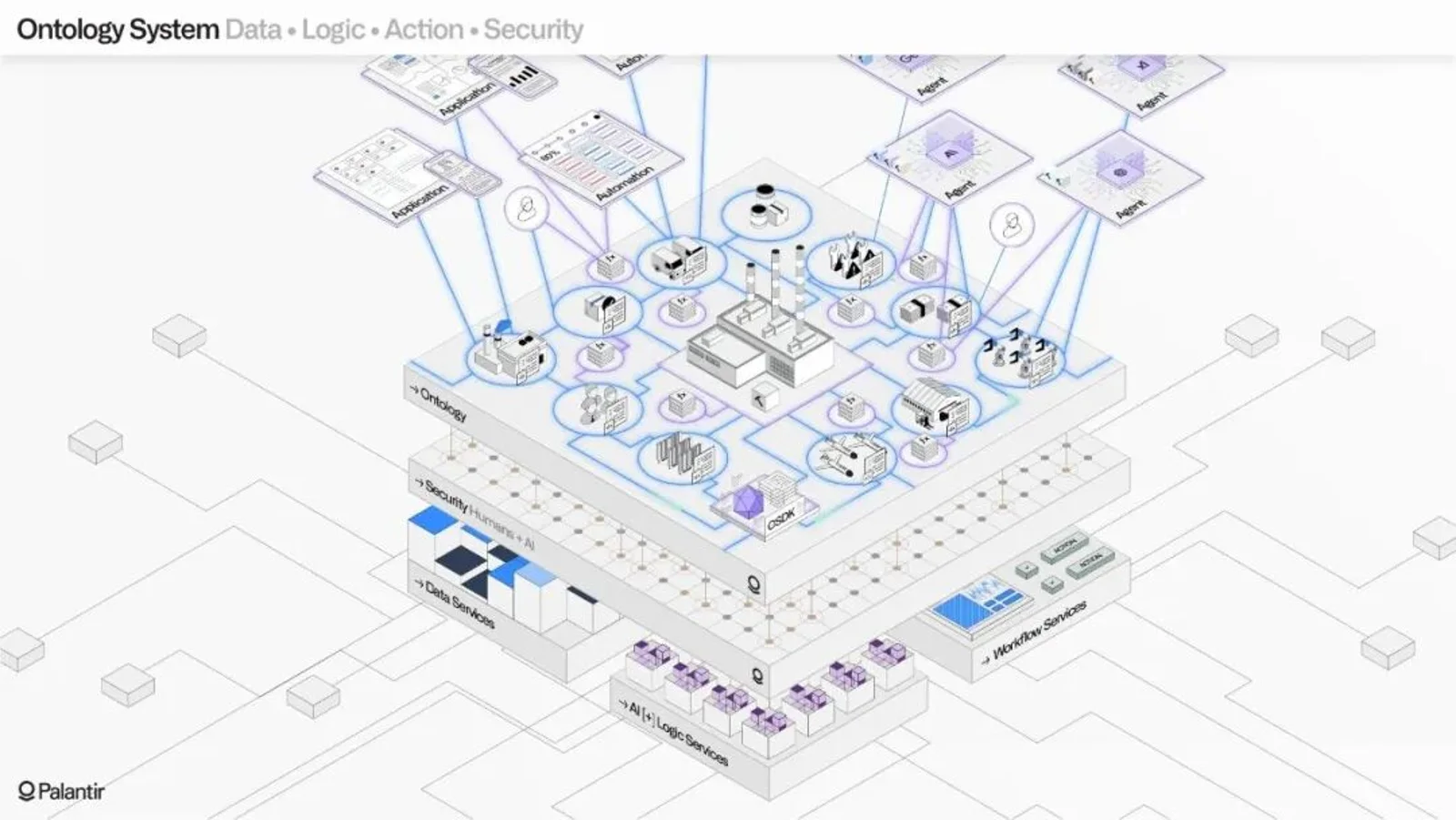
Palantir's Ontology unifies data, logic, actions, and security. Customers, orders, devices, inventory become business objects linked to computation rules, permissions, and actions. In inventory management, an agent can query factory stock and, under permission and rule constraints, participate in downstream workflows. This connects analysis to decision and execution, covering broader scenarios than traditional metric semantic layers.
Databricks Genie Ontology
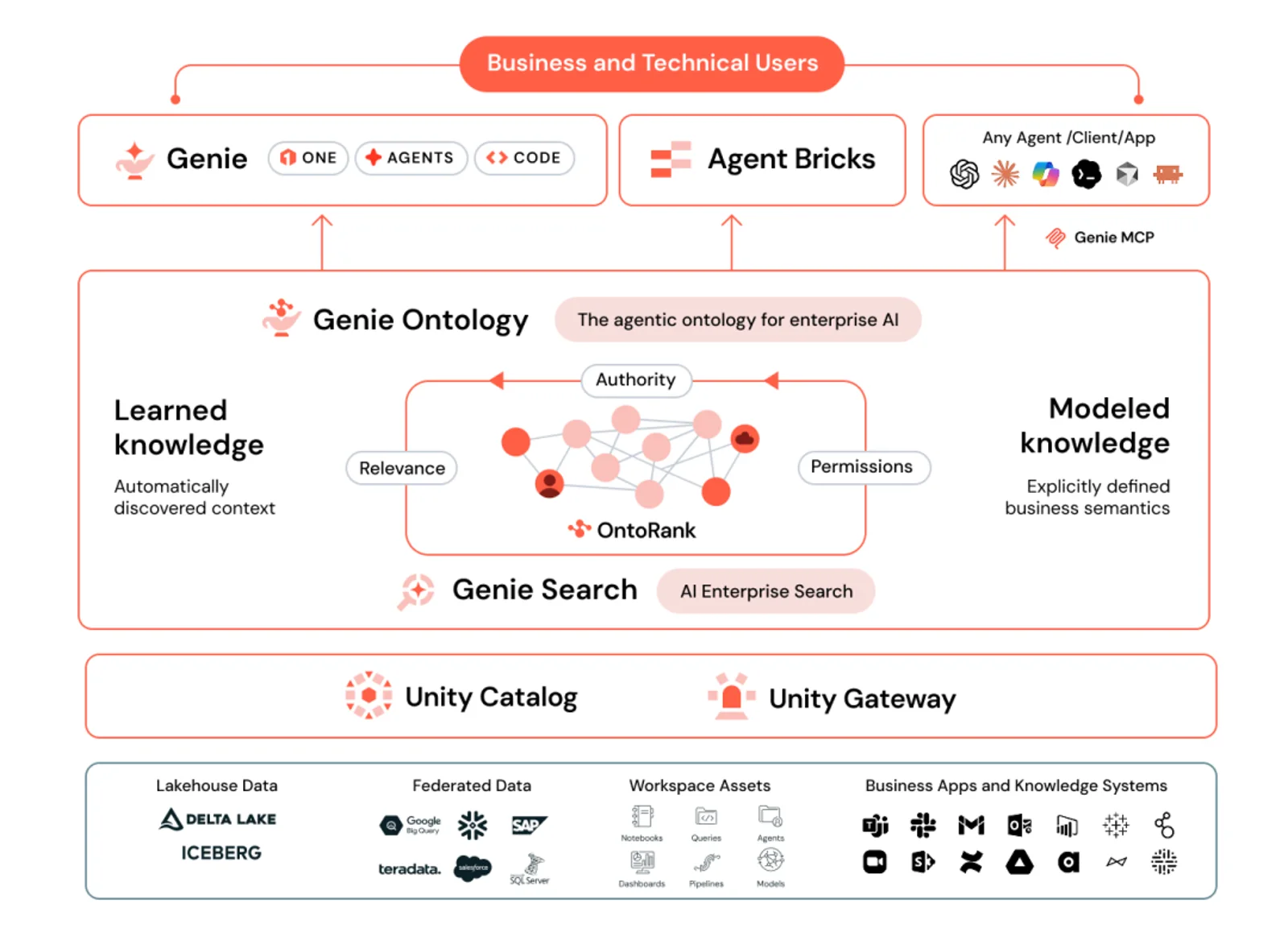
Databricks lets agents participate in knowledge production and maintenance. On November 11, 2026, Genie Ontology reached GA. Agents auto-extract business rules, calculation logic, and data relationships from historical SQL, dashboards, notebooks into reusable Ontology Snippets. These combine with Unity Catalog's human-governed authoritative definitions. The OntoRank algorithm weighs credibility of different knowledge sources. Via Genie MCP, these contexts are also exposed to external agents like ChatGPT and Claude.
Databricks and Turing built a simulated eval mimicking a UK energy supplier's real environment. Three agents ran each task five times against predefined criteria. Genie with Genie Ontology achieved 91% task pass rate ; two unnamed frontier agents scored 45% and 58%. Genie averaged 432K tokens per run, less than half the others. This vendor-designed eval with pre-accumulated context isn't a direct model capability comparison, but demonstrates the engineering value of pre-materialized business knowledge: agents avoid repeated rule discovery per task.
Snowflake Business Ontology
On November 3, 2026, Snowflake announced Business Ontology, entering public preview soon. Within Snowflake Horizon Context, Cortex Sense auto-discovers context, Business Ontology governs business meaning, and Semantic Views execute metric calculations. Three layers separate responsibilities. Domain experts confirm key definitions and applicability; different agents reuse the same calculation logic, reducing metric drift.
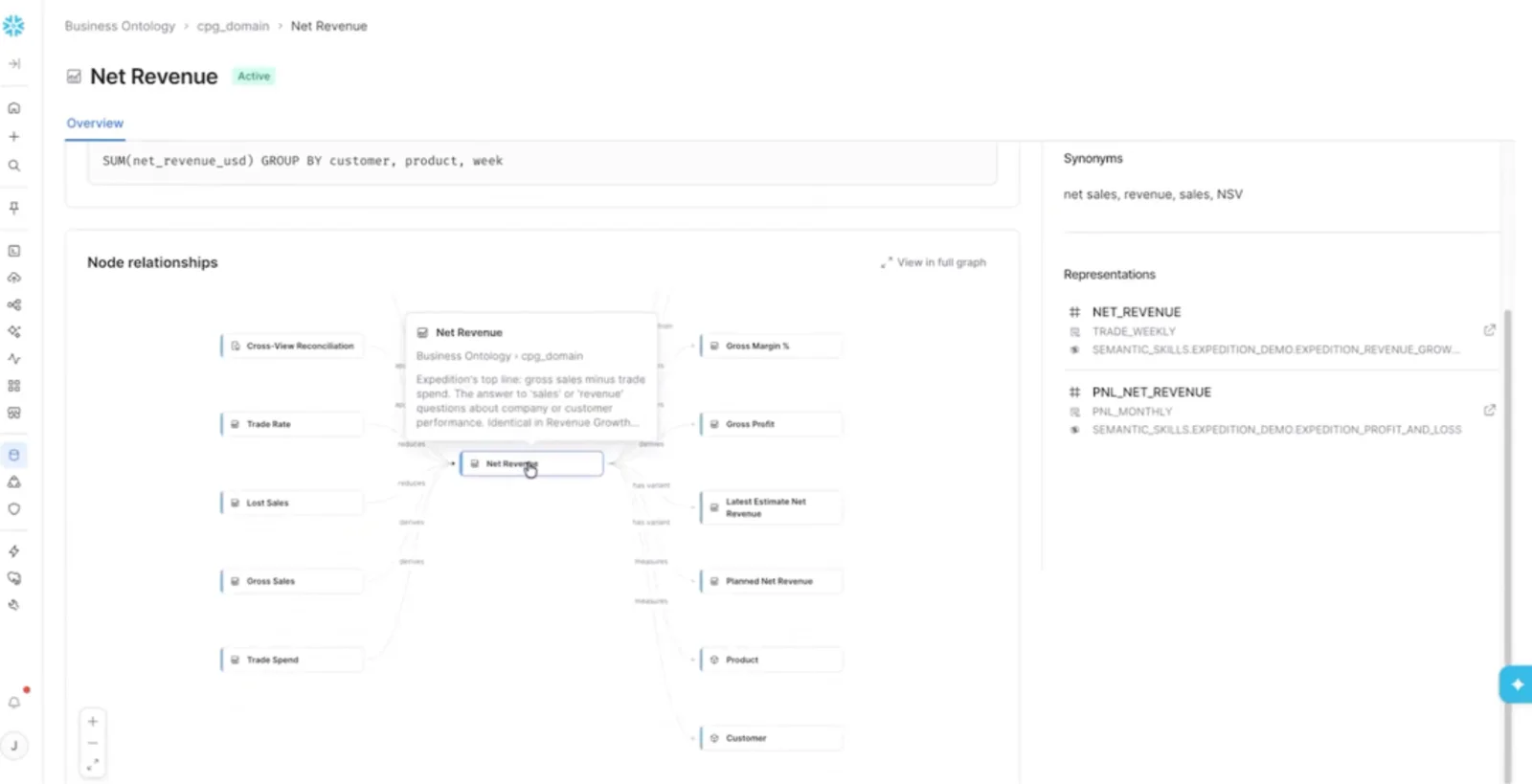
OpenAI's relationship with these vendors is shifting. Previously, Data Agent leveraged partners' business context; Athena signals OpenAI may build its own semantic management. Cooperation remains broad, but if model vendors master metric definition and context maintenance, data platforms' product boundaries face new competition.
Enterprises Must Not Let Business Knowledge Be Model-Bound
As internal agents proliferate, fragmented business semantics worsen. Sales agents define customers differently; finance agents maintain separate revenue rules; supply chain agents use another inventory definition. If each agent has independent prompts, knowledge bases, and metric definitions, the enterprise re-encounters metric inconsistency. Traditional data governance duplication extends into agent development and maintenance.
Enterprises should gradually extract relatively stable business knowledge from individual agents. Around core business objects and key operating metrics, curate confirmed definitions, data mappings, calculation rules, applicability scopes, and owners. Expose via standardized interfaces for multi-agent reuse. For genuine differences (e.g., finance vs. sales revenue definitions), govern separately and make applicability conditions explicit to agents.
This need not rely solely on manual modeling. Historical SQL, data lineage, ETL code, BI reports, and agent-generated correction logs are all knowledge sources. Auto-discovery expands coverage; domain experts review critical definitions; eval systems verify calculation results. When business rules change, corresponding context must update promptly.
As agents move into automated decisions, permission control, business constraints, approval workflows, and execution auditing must enter the architecture. The semantic layer organizes business meaning and calculation口径; Ontology further describes objects, relationships, and actions; Harness coordinates models, tools, and execution. Overlaps exist; enterprises should assign responsibilities by actual task to prevent knowledge scattering across non-reusable systems.
OpenAI built a context system spanning code, docs, memory, and live queries to make its agent understand 70,000 datasets. For teams advancing enterprise AI, the same scattered knowledge in business systems must be extracted, validated, and maintained.
Models can be swapped, agents can be rebuilt. But next time you swap the model, you shouldn't have to re-explain what an active customer is, or what net revenue means.
For questions about attribution, corrections or content rights, please contactand we will review it promptly.