

OpenClaw Architecture Deep Dive: Components, Workflow & Security Sandbox
This article explains OpenClaw's architecture as an open-source, self-hosted AI agent platform, detailing its six core components (gateway, agent runtime, nodes, skills, memory, channel adapters), execution workflow, security sandbox mechanisms (Docker, macOS Seatbelt, WASM), and how it differs from AutoGPT and LangChain by enabling local high-privilege task execution.
Reading font
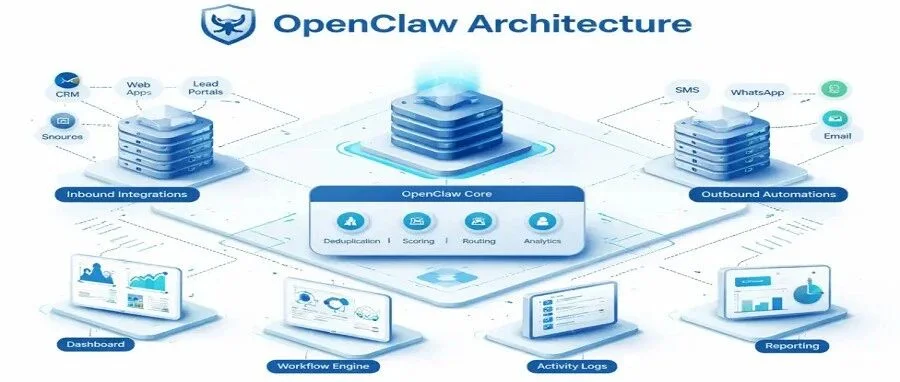
1. Core Components of OpenClaw
OpenClaw is a distributed system composed of multiple collaborating components that connect user devices, AI models, and communication platforms for intelligent automation.
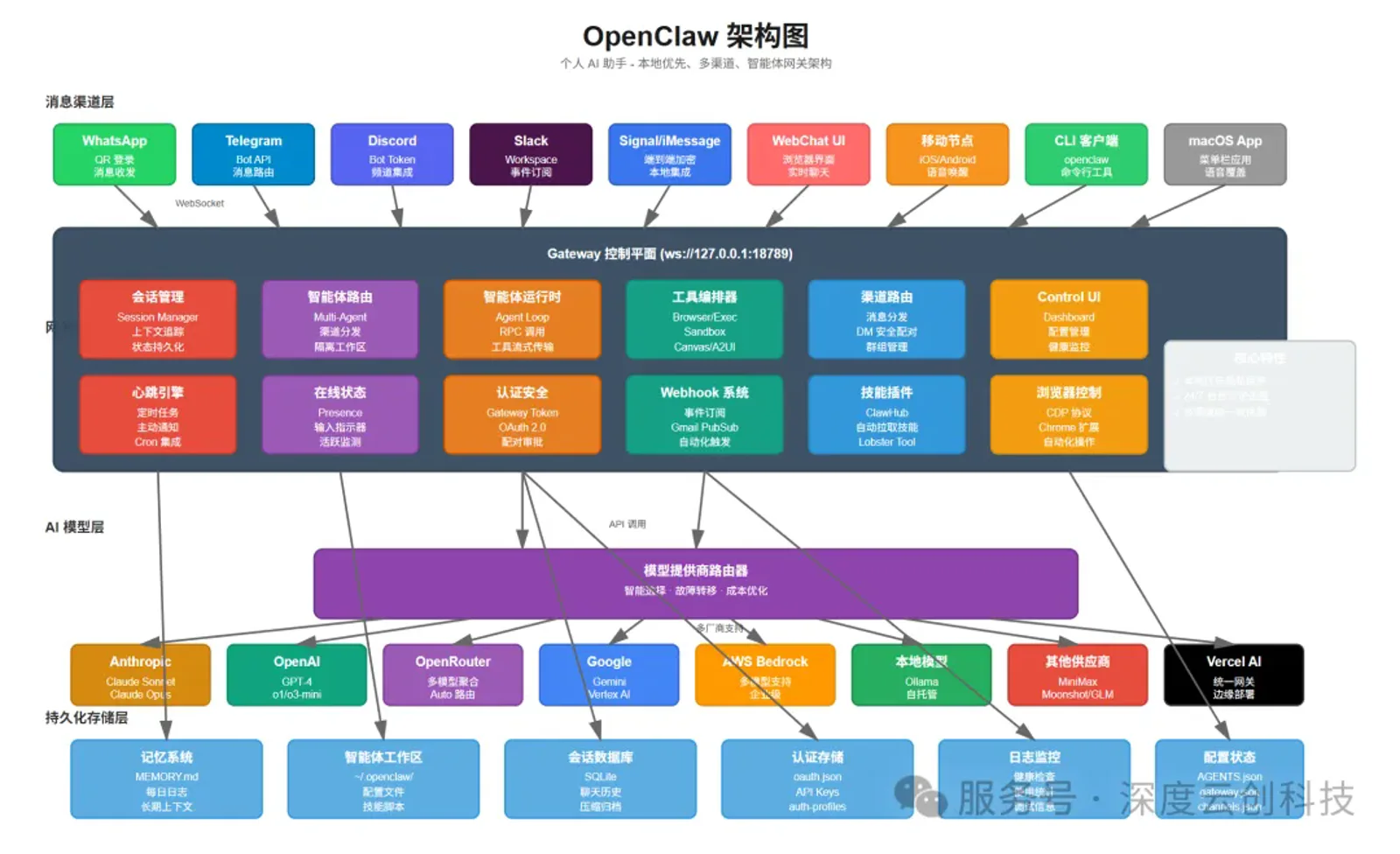
Gateway
The gateway serves as the command center and core component, typically deployed as a long-running process on a user-controlled server or PC. Its responsibilities include:
Connection and Routing: Acts as the entry point for all communication, connecting platforms like WhatsApp, Telegram, and Discord. An internal routing engine distributes messages to the appropriate agent based on preset rules.
Session Management: Maintains session state across users and platforms to ensure context continuity.
Instruction Dispatch and State Synchronization: Sends parsed instructions to the relevant agent or node for execution and synchronizes task status, returning results to the user.
Agent Runtime
The agent is the "brain" of OpenClaw, driving the reasoning process. Each agent is an independent logical unit with:
Logical Reasoning and Model Invocation: Integrates LLM APIs (e.g., GPT, Deepseek) for natural language understanding and task decomposition.
Contextual Memory: Interacts with the memory system to access historical conversations and long-term knowledge for context-aware decisions.
Task Execution Drive: Based on reasoning results, decides which skills or tools to invoke and generates execution commands.
Nodes / Device Capabilities
Nodes are agent programs distributed on terminal devices (PCs, phones) that provide hardware access and local execution environments, enabling OpenClaw to go beyond cloud APIs and interact with the physical and local digital world. Capabilities include:
Hardware Access: Camera, microphone, GPS, etc.
Local Execution: Running scripts, operating the file system, controlling desktop applications, and other high-privilege operations.
Skill System (Skills) / Tool System
Skills are modular plugins that encapsulate specific capabilities, acting as the agent's "toolbox." Key characteristics:
Modular and Reusable: Independently developed, installed, and updated; users can add new capabilities on demand.
High-Privilege Operations: Enable tasks like computer control, file I/O, web browsing, and email management.
Self-Evolution: Theoretically supports automatic generation and self-evolution, allowing agents to learn and create new skills per task needs.
Memory System
Provides stateful, continuous interaction by storing and retrieving information for agent decision-making.
Storage Mechanism: Uses simple file formats (JSONL, Markdown) for persisting conversation logs, user preferences, and long-term knowledge. This design is transparent, human-readable, editable, and version-control friendly.
Retrieval Methods: Supports vector search and keyword matching for fast, context-relevant recall.
Channel Adapters
Act as translators and authenticators for multiple communication platforms:
Message Normalization: Converts diverse platform-specific message formats into OpenClaw's internal standard format.
Authentication Management: Handles platform-specific auth logic for secure, legitimate communication.
Pairing Storage: Manages authorized user lists to prevent unauthorized access.
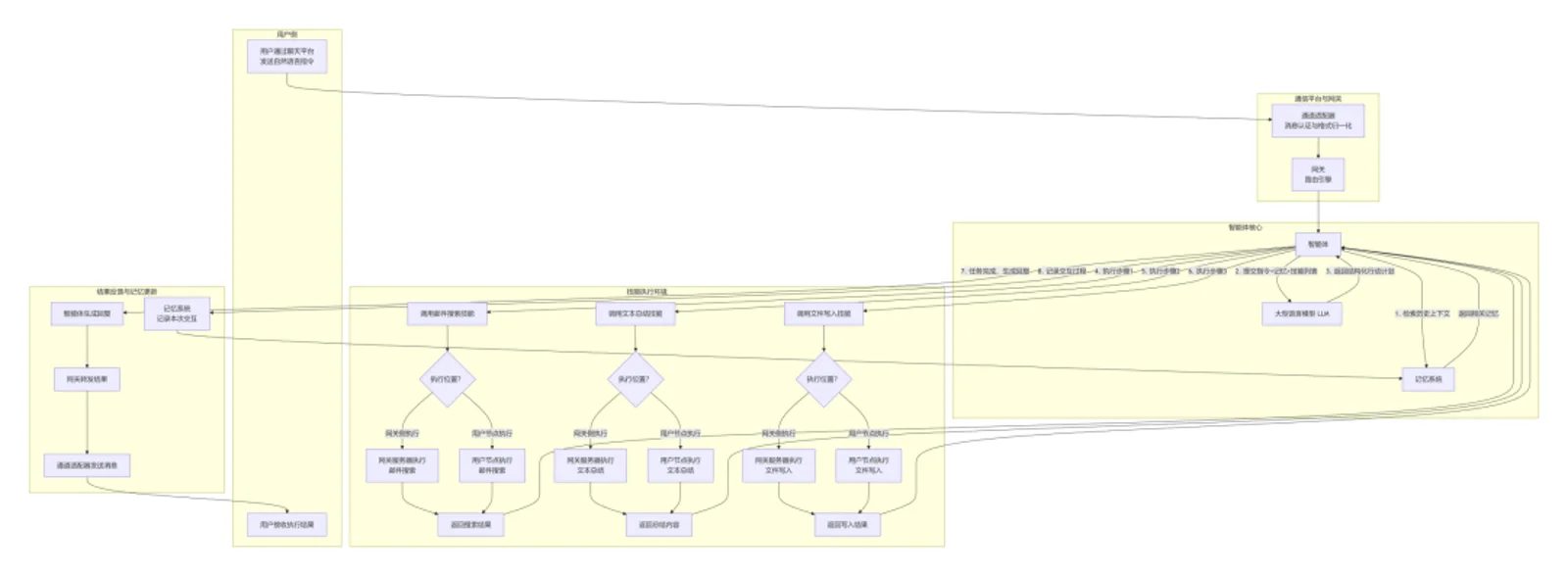
2. OpenClaw Workflow
A typical task execution follows these steps:
User Input: User sends a natural language command via a connected platform (e.g., WeChat): "Summarize yesterday's emails about 'Project A' and generate a draft report."
Message Reception and Normalization: The platform's channel adapter receives, authenticates, and normalizes the message, then forwards it to the gateway.
Routing and Dispatch: The gateway's routing engine determines the appropriate agent and dispatches the task.
Reasoning and Planning: The agent queries the memory system for context on "Project A," then sends the user instruction, relevant memories, and available skill list to the LLM. The LLM returns a structured action plan:
Skill Invocation and Execution: The agent executes skills sequentially. Some run on the gateway server (e.g., text summarization), others on the user's local node (e.g., email search, file write).
Result Feedback: Execution results return via node and gateway to the user, e.g., "Task completed, draft report saved to your desktop."
Memory Update: The entire interaction (user command, agent reasoning steps, final result) is recorded in the memory system for future reference.
3. OpenClaw and AI Agent Relationship
AI Agent is a broad concept with four capabilities: Perception (acquire info), Thinking (reasoning, planning, internal model), Action (tools, APIs, actuators). OpenClaw is a concrete implementation that fully realizes the Sense-Think-Act loop:
Perception: Via channel adapters receiving user commands.
Thinking: Via Agent Runtime and LLM reasoning/planning.
Action: Via Skills system and Nodes executing tasks.
Key differences from typical AI Agents:
Positioning: Many agents focus on conversation, reasoning, planning ("thinking"). OpenClaw's core value is granting agents high-privilege execution to directly operate local files, desktop apps, and hardware for tangible work.
Deployment: Most commercial AI products are cloud-first; OpenClaw is open-source and self-hosted, returning data ownership and compute control to users.
Capability: OpenClaw's Skills system offers high customizability and extensibility; users can leverage community skills or create private skills for specific workflows.
4. Role of Skills in the OpenClaw Ecosystem
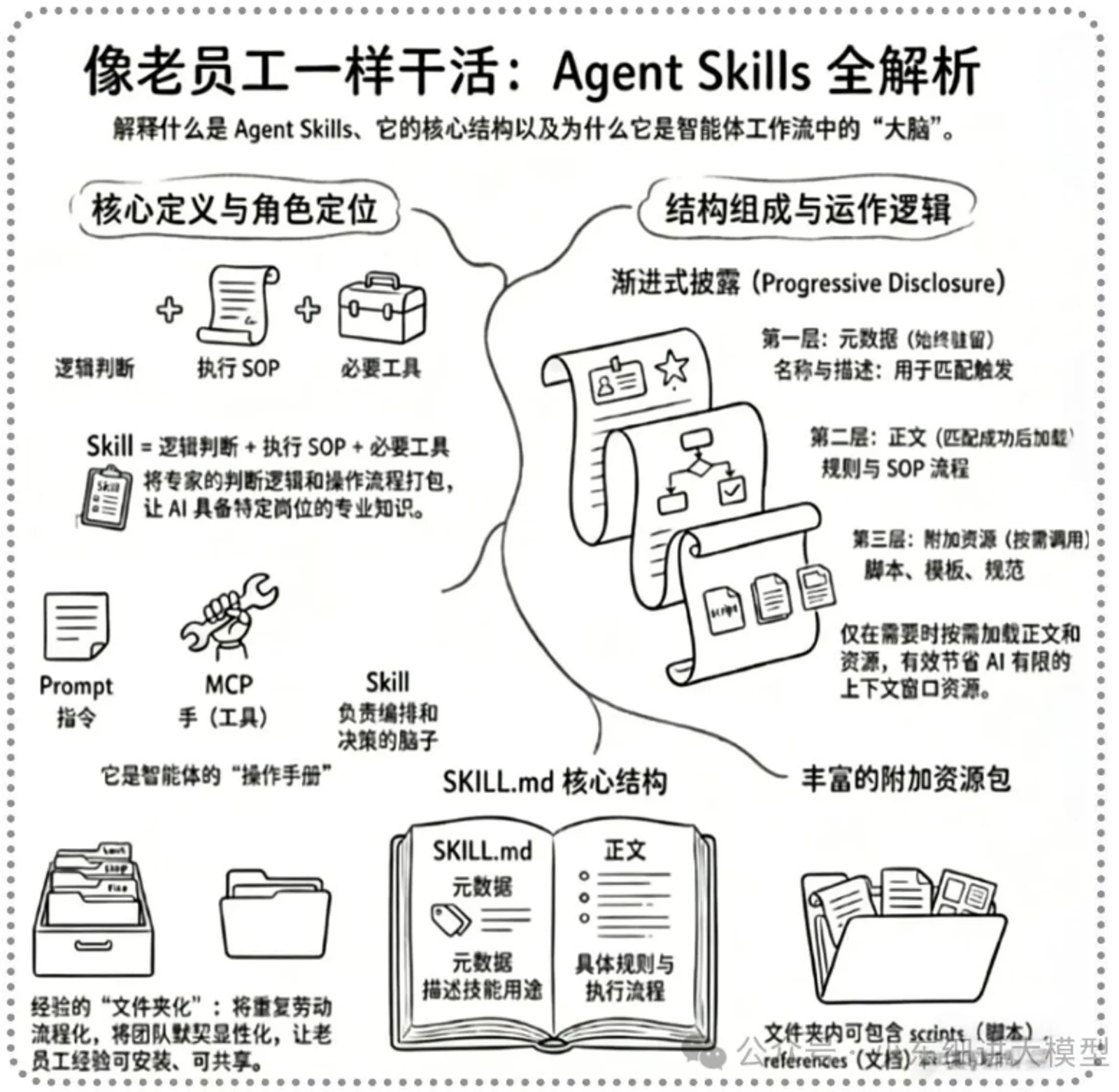
A Skill is a capability unit defining how an agent calls APIs, processes data, and interacts with external services or local systems. For example, a "Send Email" skill encapsulates SMTP details (address, auth, formatting) and exposes a simple LLM-callable interface.
Skills play multiple critical roles:
Functional Modules and Capability Plugins: Pluggable, independently enable/disable; users install skills like mobile apps to expand agent capabilities.
Define Agent Behavior and Capabilities: An agent's scope is largely defined by its loaded skills. An agent with "Web Browse," "Info Extraction," "File Write" becomes a research assistant; one with "Repo Clone," "Unit Test," "Release" becomes a developer aide. Skills serve as the agent's "instruction manual."
Enable Ecosystem Extensibility and Flexibility: Official and community skills grow continuously; users benefit from reusable skills and can contribute back, creating a virtuous cycle.
5. Skills Security Sandbox Mechanisms
Granting high-privilege skills (file read, system commands) makes security paramount. OpenClaw supports sandbox isolation: all skill execution is confined to a controlled, isolated environment preventing access to outside resources. Implemented via:
Docker Container Isolation: Skills run in Docker containers for strong filesystem and network isolation. Developers can fine-tune permissions, e.g., mount only specific working directories or allow specific network ports.
OS-Level Hard Isolation: On macOS, leverages Seatbelt sandbox mechanism for kernel-enforced isolation policies.
Experimental WASM/WASI Sandbox: WebAssembly provides language-agnostic, high-performance, secure-by-default runtime. WASI defines standard system interfaces. Compiling skills to WASM and running in WASI yields lighter, faster-starting sandboxes than Docker.
Additional measures: least privilege principle, access control with whitelists, audit logs, pairing authentication. Best practice: deploy in Docker or sandbox, install skills only from trusted sources, carefully review each skill's permission requests.
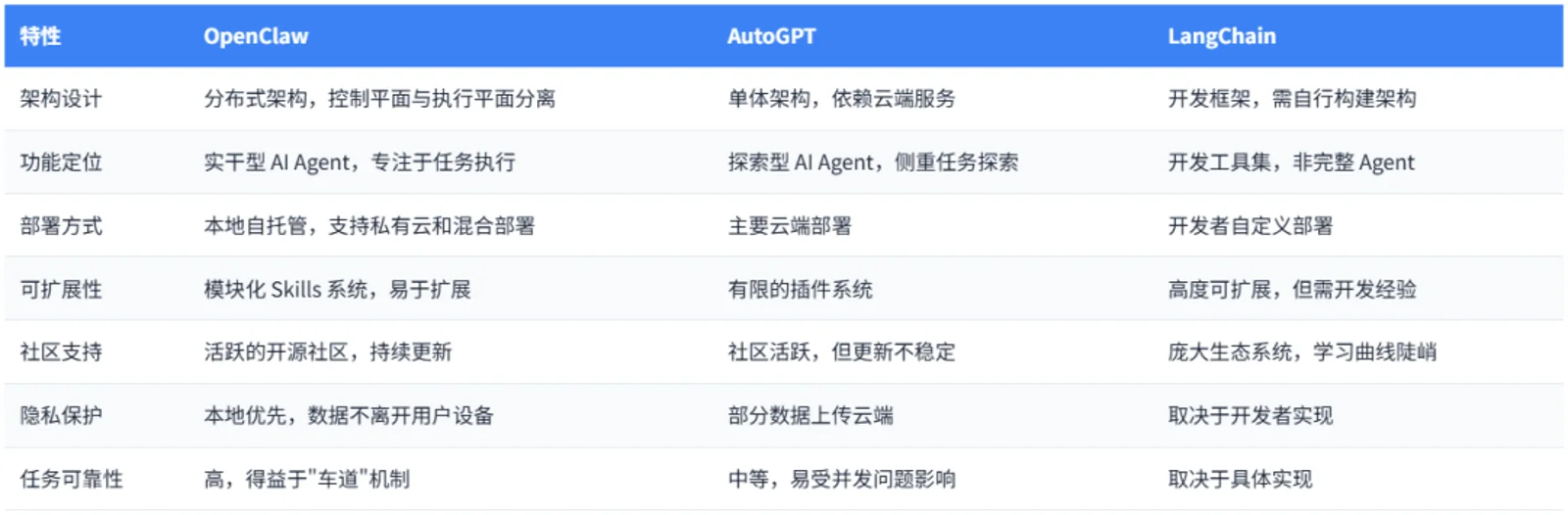
6. Multi-Dimensional Comparison with AutoGPT and LangChain
OpenClaw differs from mainstream AI agent frameworks in architecture, positioning, deployment, extensibility, and community support:
OpenClaw: Focuses on reliable local task execution, self-hosted, high-privilege operations, skill-based extensibility.
AutoGPT: Emphasizes autonomous exploration and discovery of new tasks.
LangChain: A development framework requiring developers to build complete agent systems themselves.
OpenClaw's core advantage is providing dependable localized execution capability, whereas AutoGPT leans toward task exploration and LangChain is a lower-level building kit.
7. Summary
Compared to traditional RPA (Robotic Process Automation), OpenClaw represents a new generation of "intelligent automation." RPA follows rigid scripts for highly repetitive, rule-based processes. OpenClaw acts like a cognitive "digital assistant" that understands ambiguous instructions, handles variable formats, and automates across broader scenarios, drastically lowering automation barriers and maintenance costs.
OpenClaw positions itself as a stable, reliable, secure, and easily extensible personal and team-level AI automation hub, pushing AI agent technology from theoretical discussion to daily productivity tool.
References: Toward Efficient Agents: A Survey of Memory, Tool learning, and Planning https://mp.weixin.qq.com/s/gAow65CBm6u4_fupaWB7EA https://mp.weixin.qq.com/s/M-xG0wrNQ9So6zKCde3o5A
For questions about attribution, corrections or content rights, please contactand we will review it promptly.