

Self-Harness: AI Agents That Self-Optimize Their Own Harnesses
The Self-Harness framework enables LLM agents to autonomously discover weaknesses in their operating harnesses, propose targeted modifications, and validate improvements through a three-stage iterative loop without human engineers or stronger external models, achieving up to 138% relative pass-rate gains on Terminal-Bench-2.0 across three model families.
Reading font
1. Why Self-Harness Is Needed
1.1 What Is a Harness?
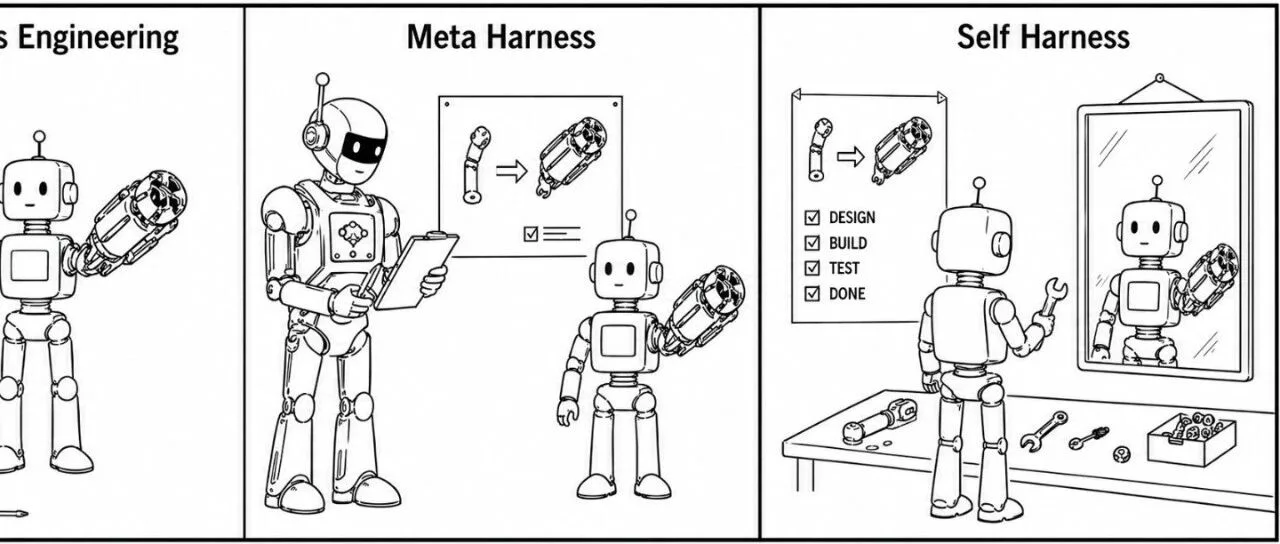
An LLM agent's performance is determined by two components: the Base Model (e.g., Claude, Qwen, GLM) and the Harness — the surrounding system that wraps the model, including system prompts, tool definitions, runtime mechanisms, verification rules, orchestration logic, and failure-recovery flows. The same model can behave dramatically differently under different harnesses.
1.2 Bottlenecks of Manual Harness Design
Current harnesses (ReAct, Claude Code, Codex, OpenHands) are almost entirely hand-crafted. This "manual tuning" faces three core problems:
Model specificity : Different models have vastly different behavioral habits (e.g., some loop on tool calls, some forget to generate output files, some give up on errors). A harness tuned for model A may backfire on model B.
Rapid model iteration : LLMs are replaced every few months; harness adaptation cannot keep pace.
Human bandwidth : Engineers cannot manually tune a dedicated harness for every model.
1.3 Shortcomings of Existing Approaches
Self-improvement methods (Reflexion, STOP) adjust memory, context, or response strategies — not the harness itself .
External optimization (Meta-Harness) uses a stronger model to optimize a weaker model's harness — but stronger models are costly, and for frontier models no stronger external model exists.
2. Self-Harness Core Idea: A Three-Stage Iterative Loop
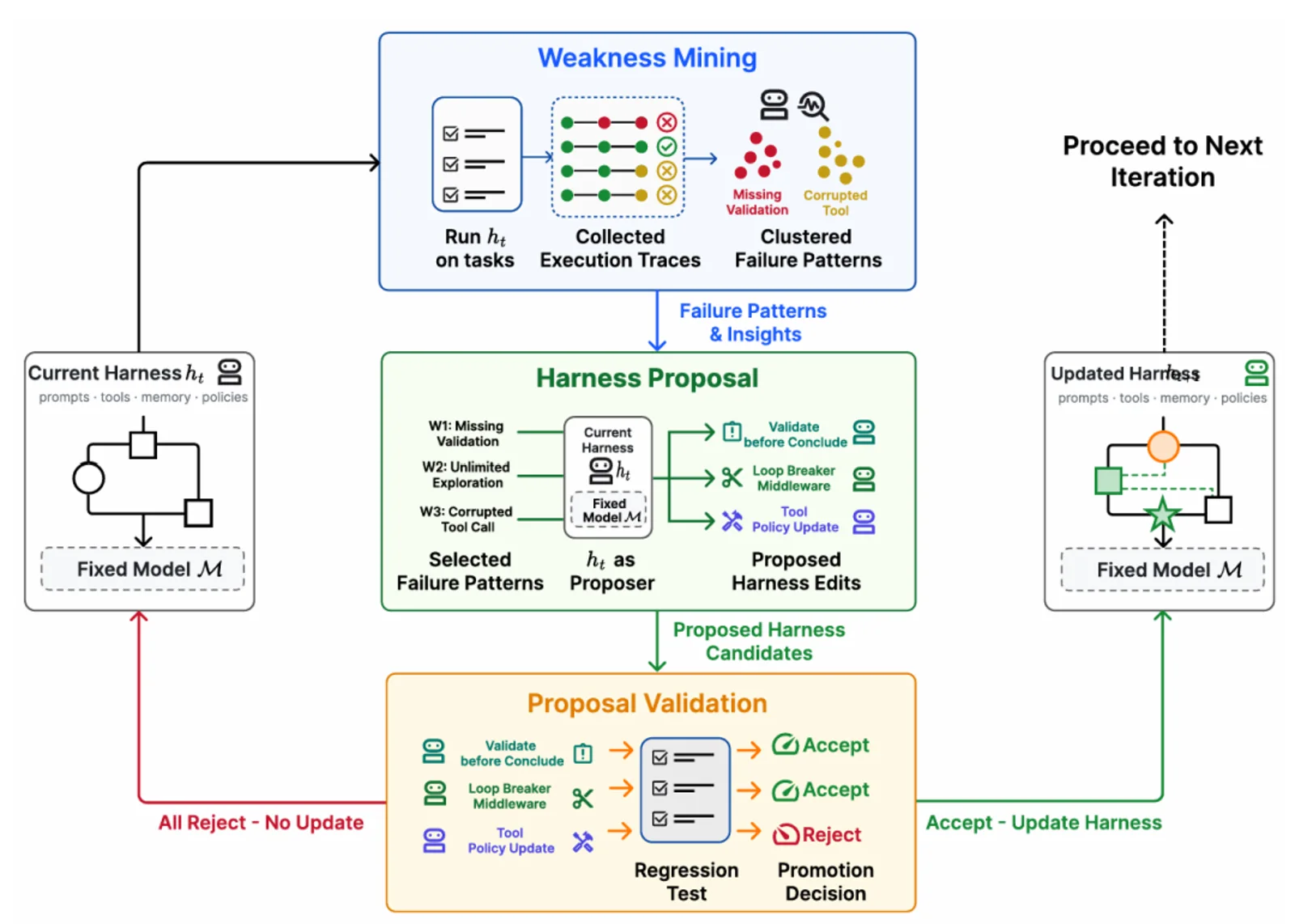
Core insight : Instead of relying on humans or stronger models, let the agent itself improve its harness — run under current harness → discover failure patterns → propose modifications → validate and adopt only those that pass.
2.1 Stage 1: Weakness Mining
Goal : Extract structured failure evidence from execution traces, not vague "something went wrong".
Process :
Run current harness on a held-in dataset.
Collect all failed execution traces.
Cluster failures by verifier-level failure signatures : c = terminal verifier reason (e.g., "missing required artifact") q = causal link between agent behavior and failure (e.g., "agent declared completion without creating file") m = abstract mechanism exposed by trace (e.g., "tool-use loop stuck")
Key design : Output is an Evidence Bundle describing what failed and why , without prescribing how to fix it . This separates diagnosis from prescription.
2.2 Stage 2: Harness Proposal
Goal : Generate diverse candidate modifications grounded in the failure evidence.
Design points :
Parallel generation of K proposals , each independently exploring a different modification direction.
Diversity across proposals : different failure mechanisms → different harness modification surfaces → different hypotheses.
Minimality within a proposal : change only what is necessary, leave unrelated parts untouched, avoid large-scale rewrites.
Each proposal outputs a bounded edit Δ plus an audit record a.
2.3 Stage 3: Proposal Validation
Goal : Adopt only modifications that genuinely improve generalization.
Validation uses a conservative promotion criterion — a candidate harness must not regress on either held-in or held-out splits , and must improve on at least one :
Δ_held-in ≥ 0 AND Δ_held-out ≥ 0 AND max(Δ_held-in, Δ_held-out) > 0This means:
Overfitting to held-in (training set) but failing held-out → rejected .
No change on held-in but improvement on held-out → accepted .
Improvement on both → accepted .
Multiple compatible candidate edits can be merged into the next harness version.
3. Experimental Results
3.1 Experimental Setup
Benchmark : Terminal-Bench-2.0: 89 containerized terminal tasks, fixed 64-case evaluation
Models : MiniMax M2.5, Qwen3.5-35B-A3B, GLM-5
Initial Harness : Minimal DeepAgent Harness (short system prompt + default file/shell tools)
Metric : Pass (%) — proportion of tasks passing the verifier
3.2 Main Results
Held-out results:
MiniMax M2.5 : Initial Pass 40.5% → Self-Harness Pass 61.9% (+21.4pp absolute, +53% relative)
Qwen3.5-35B-A3B : Initial Pass 23.8% → Self-Harness Pass 38.1% (+14.3pp absolute, +60% relative)
GLM-5 : Initial Pass 42.9% → Self-Harness Pass 57.1% (+14.2pp absolute, +33% relative)
Held-in results:
MiniMax M2.5 : Initial Pass 43.0% → Self-Harness Pass 50.0% (+7.0pp absolute, +16% relative)
Qwen3.5-35B-A3B : Initial Pass 15.1% → Self-Harness Pass 36.0% (+20.9pp absolute, +138% relative)
GLM-5 : Initial Pass 47.7% → Self-Harness Pass 57.0% (+9.3pp absolute, +20% relative)
Key findings :
All three models from different families achieved significant held-out gains .
Maximum absolute gain: 21.4pp; maximum relative gain: 138%.
No adopted harness caused regression on any split .
3.3 Different Models, Different "Prescriptions"
Self-Harness does not apply a universal prompt; it tailors fixes to each model's specific weaknesses:
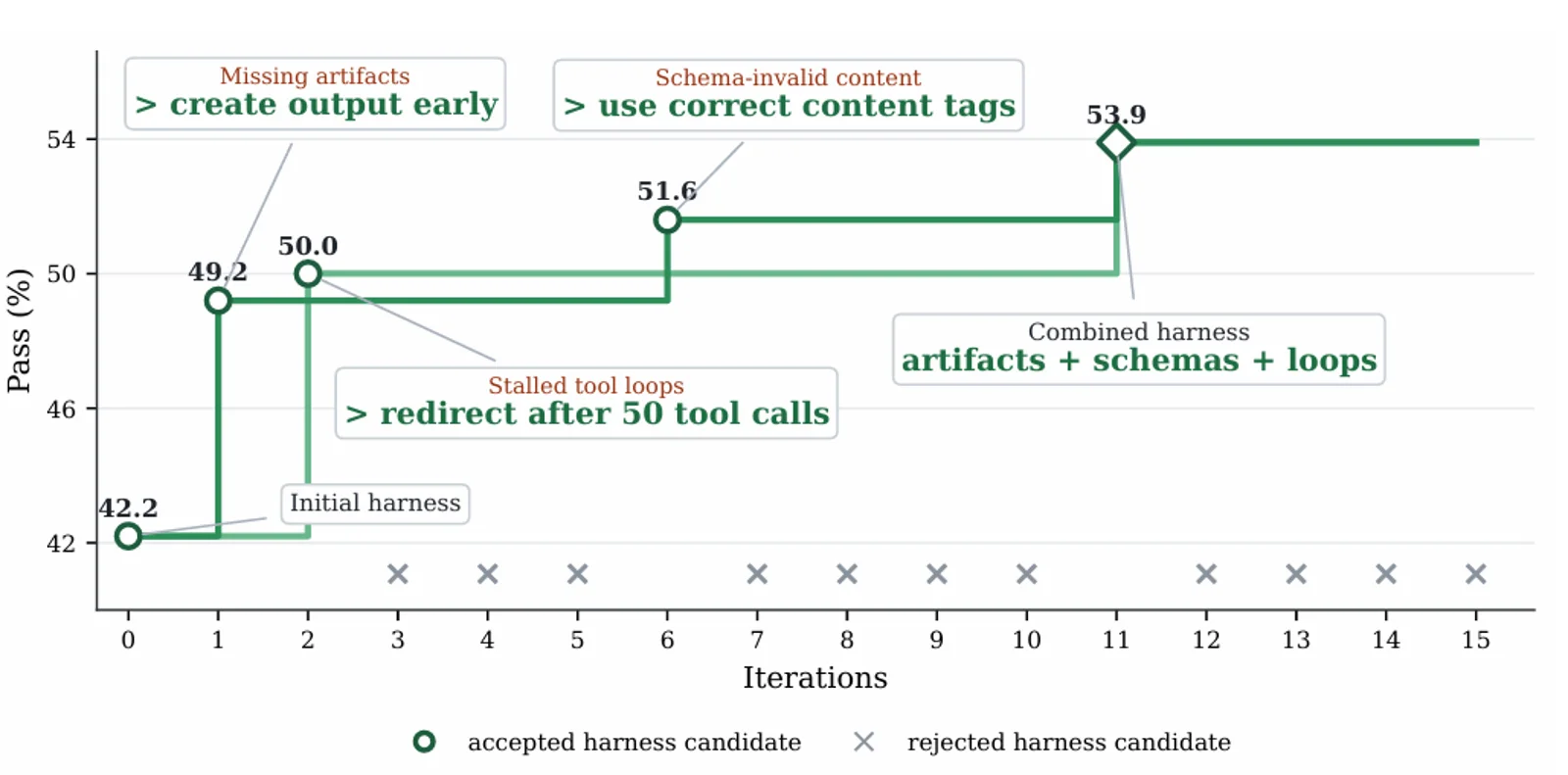
MiniMax M2.5 : Primary weaknesses — missing required artifacts, invalid schema in tool content, tool-use loops stuck. Self-Harness measures — create output artifacts early, handle structured tool content more cautiously, redirect execution after prolonged tool interactions.
Qwen3.5-35B-A3B : Primary weaknesses — missing artifact checks, unable to recover from errors, undisciplined retries. Self-Harness measures — add dependency pre-checks, loop interruption, tool-error-triggered recovery middleware.
GLM-5 : Primary weaknesses — environment changes not persistent, over-exploration without execution. Self-Harness measures — persist installed tools/paths across shell sessions, encourage shift from exploration to implementation and testing.
Common theme : All three models needed improved Artifact Reliability , but the root causes and fixes differed per model.
4. Case Studies: Concrete Harness Changes
Case 1: MiniMax M2.5 — From "Endless Exploration" to "Focused Execution"
Task : count-dataset-tokens (calculate dataset token count)
Initial Harness behavior : Repeatedly explored dataset metadata, exhausted tool-call budget, never generated answer file.
Optimized Harness behavior : Identify required output artifact → locate relevant metadata → compute result → write answer file → read back to verify.
Key changes : Bootstrap instruction changed to "identify required output artifact and create initial version early"; runtime strategy added tool-message total count limit.
Case 2: Qwen3.5 — From "Delete Files and Give Up" to "Error Recovery"
Task : extract-elf (extract ELF information)
Initial Harness behavior : After repeated parsing failures, deleted the required artifact file, ultimately failing verification.
Optimized Harness behavior : Tool error triggers system prompt → recreate extractor → fix parsing logic → retain required artifact file.
Key changes : Added tool-error-triggered recovery mechanism — on tool failure, automatically redirect to recovery flow instead of abandoning.
Case 3: GLM-5 — From "Install and Forget" to "Environment Persistence"
Task : build-pov-ray (build renderer)
Initial Harness behavior : Installed dependencies in one shell command, environment lost in next command; repeated downloads wasted budget; declared completion despite sanity-check failures.
Optimized Harness behavior : Phased bounded operations → verify external archive evidence before proceeding → fix sanity checks before completing.
Key changes : Harness instructions ensure environment changes persist across shell sessions, and encourage transition from exploration to implementation and testing.
5. Core Design Principles Extracted from the Paper
Principle 1: Harness Improvement = Empirical State Transition
A valid harness edit must explicitly declare:
Target behavior : what behavior it aims to change
Modification surface : which part of the harness it changes
Evidence : what failure evidence motivated the change
Evaluation result : what test results prove the change deserves adoption
Principle 2: Separate Diagnosis from Prescription
The weakness-mining stage outputs only "what failed", not "how to fix". This avoids premature convergence to local optima.
Principle 3: Parallel Multi-Proposal + Minimal Edits
Multiple proposals explore in parallel, avoiding "only one fix idea".
Each proposal stays minimal, avoiding "ripple effects".
Principle 4: Regression Testing + Dual-Split Guardrails
Any change must not regress on both training and validation splits.
Prevents "overfitting to the training set" style gaming.
Analogous to CI/CD pipelines in software engineering.
Principle 5: Harness ≠ Prompt Engineering
Harness is a broader concept than prompt — it includes tool definitions, runtime mechanisms, verification rules, orchestration logic, failure-recovery flows, etc. Many agent failures are harness problems, not model problems :
Report success without checking artifacts → missing verification mechanism
Repeatedly retry futile operations → missing loop-interruption mechanism
Environment changes lost → missing persistence mechanism
Give up on error → missing recovery flow
6. Limitations and Future Directions
Limited scope : Validated only in bounded harness-editing scenarios on a fixed benchmark, not open-ended self-improvement.
Benchmark specificity : Adopted edits may reflect benchmark-specific failure patterns; generalization needs further verification.
Verifier dependence : Protocol relies on verifier quality and trace recording quality.
Safety bar : High-stakes scenarios require stricter admission standards than "no pass-rate regression".
Future direction (from paper): Move toward a "recorded, testable, rollback-capable" harness engineering style — self-improvement should be grounded in behavioral evidence , not just proposer's arguments about "plausibility".
7. Takeaways for Agent Engineers
Self-Harness's core lesson: Harness improvement should be treated as an empirical state transition.
For practitioners building agents, this paper offers at least three actionable insights:
Don't stare only at the model — when an agent underperforms, first check whether the harness provides the right behavioral constraints and recovery mechanisms.
Let the data speak — use execution traces for evidence-driven harness iteration, not prompt tweaking by intuition.
Tests guard the baseline — every harness change must have regression-test protection to prevent "fix one bug, introduce three".
Based on the paper "Self-Harness: Harnesses That Improve Themselves" (https://arxiv.org/pdf/2606.09498), written from an engineer's perspective to distill core ideas and practical design principles. Corrections welcome!
For questions about attribution, corrections or content rights, please contactand we will review it promptly.