

PanDWM: Unified Panoramic 4D Driving World Model from Six Cameras
PanDWM stitches six camera views into a single panoramic strip, uses a 4-step causal diffusion transformer to generate future frames, then lifts them to a 4D Gaussian scene for novel-view rendering, achieving 1.96s/frame on an H100 and state-of-the-art FID/FVD on nuScenes.
Reading font
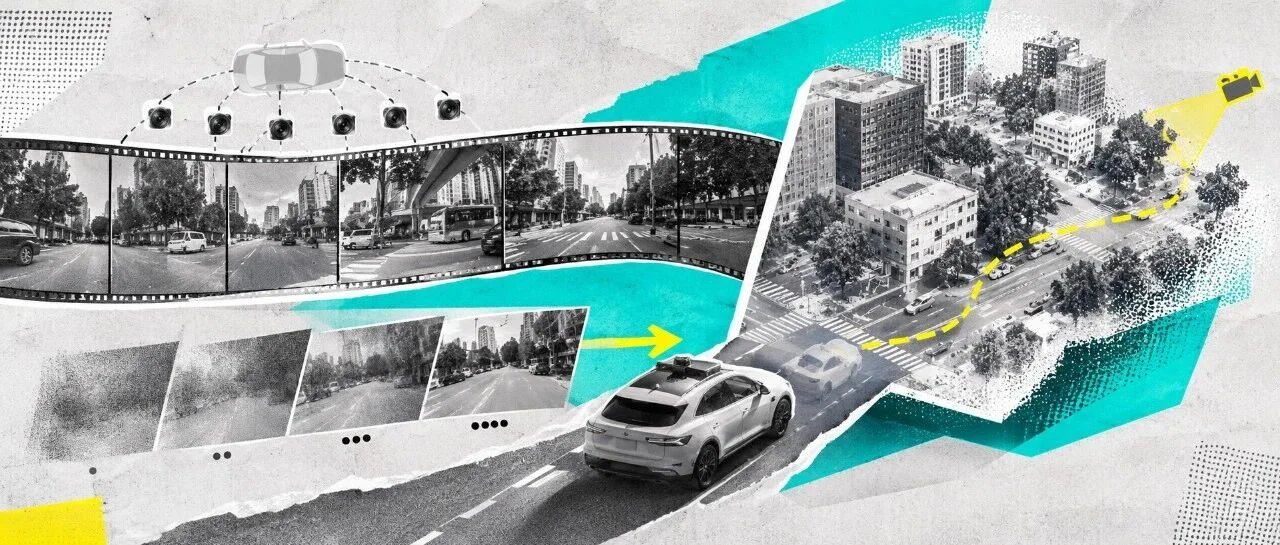
Problem: Seam Artifacts in Multi-Camera Driving World Models
Autonomous driving simulation requires a world model that can forecast future surround-view video given map, 3D boxes, and past frames. Most existing methods (e.g., UniMLVG, OpenDWM, DreamForge, DiST-4D, OmniNWM) generate video for each of the six cameras independently and rely on cross-view attention to align them. The nuScenes setup uses six cameras covering front, rear, and four diagonals. The core difficulty lies at camera boundaries: an object crossing the seam (e.g., a car half in front view, half in left-front view) must be generated consistently in two separate images. Overlap regions are narrow, providing limited signal for learning cross-view correspondence, leading to misaligned colors and contours at seams.
Panoramic Representation: One Continuous 360° Strip
PanDWM eliminates seams by mapping all six calibrated camera images onto a single 360° panoramic strip of resolution 4114 × 256. To fit pretrained models, the strip is split into two overlapping halves (2304 × 256 each), with split positions chosen so that every original camera boundary falls inside a half, not at the edge. This converts cross-camera consistency into intra-image spatial continuity: objects spanning camera boundaries are generated in one coherent image. Each pixel retains its source camera ray, preserving accurate geometry for later 3D lifting. 3D boxes and HD map conditions are stitched into the strip using the same projection.
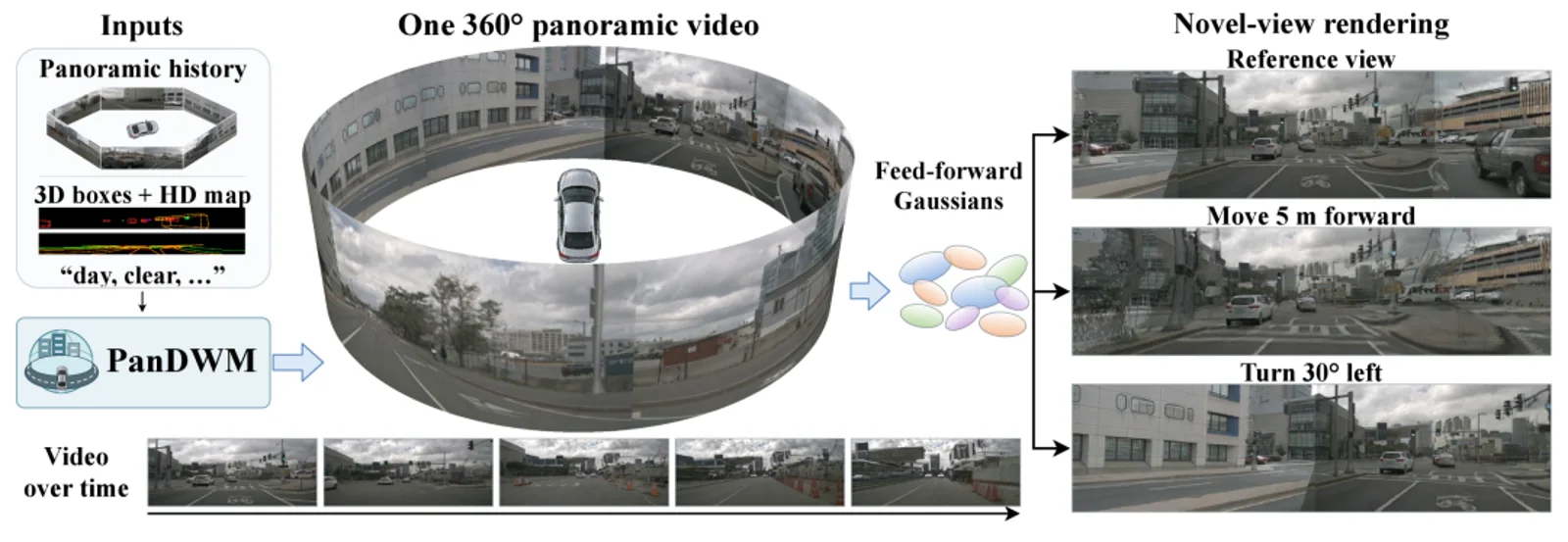
Figure 2: PanDWM overall framework, including causal panoramic video generation and feedforward Gaussian lifting.
Causal Video Generation: Chunked Diffusion with 4-Step Distillation
The generation backbone is a chunked causal diffusion Transformer. Each window conditions on 3 history frames and generates 16 future frames; windows roll forward sequentially. Training uses a two-stage distillation pipeline:
Teacher: A 50-step causal diffusion model trained on ground-truth panoramic sequences.
Consistency distillation compresses the teacher into a 4-step student.
Distribution Matching Distillation (DMD) with an adversarial discriminator head further pulls student outputs toward real data distribution.
Motion and sharpness constraints prevent blur and stiff motion.
Crucially, during student training the history frames are the student's own previous predictions, not ground truth. This exposes the model to its own errors early, mitigating error accumulation during long-horizon rollout.
Feedforward 4D Gaussian Decoder: From Video to Novel-View Renderable Scene
The panoramic video alone can only be viewed from the original camera poses. To enable free-viewpoint rendering, PanDWM employs a feedforward Gaussian decoder:
For each pixel, a 3D Gaussian is placed along its source camera ray (pixel-aligned), producing a single-frame 3D scene in one forward pass—no per-scene optimization.
Static Gaussians from adjacent frames are fused to fill occlusion holes, forming a 4D (space-time) Gaussian scene.
For viewpoints far from the original trajectory, a refinement pass cleans up rendering artifacts.
The output is a 4D scene that can be re-rendered from laterally translated poses (e.g., 0, 1, 2, 4 meters offset).
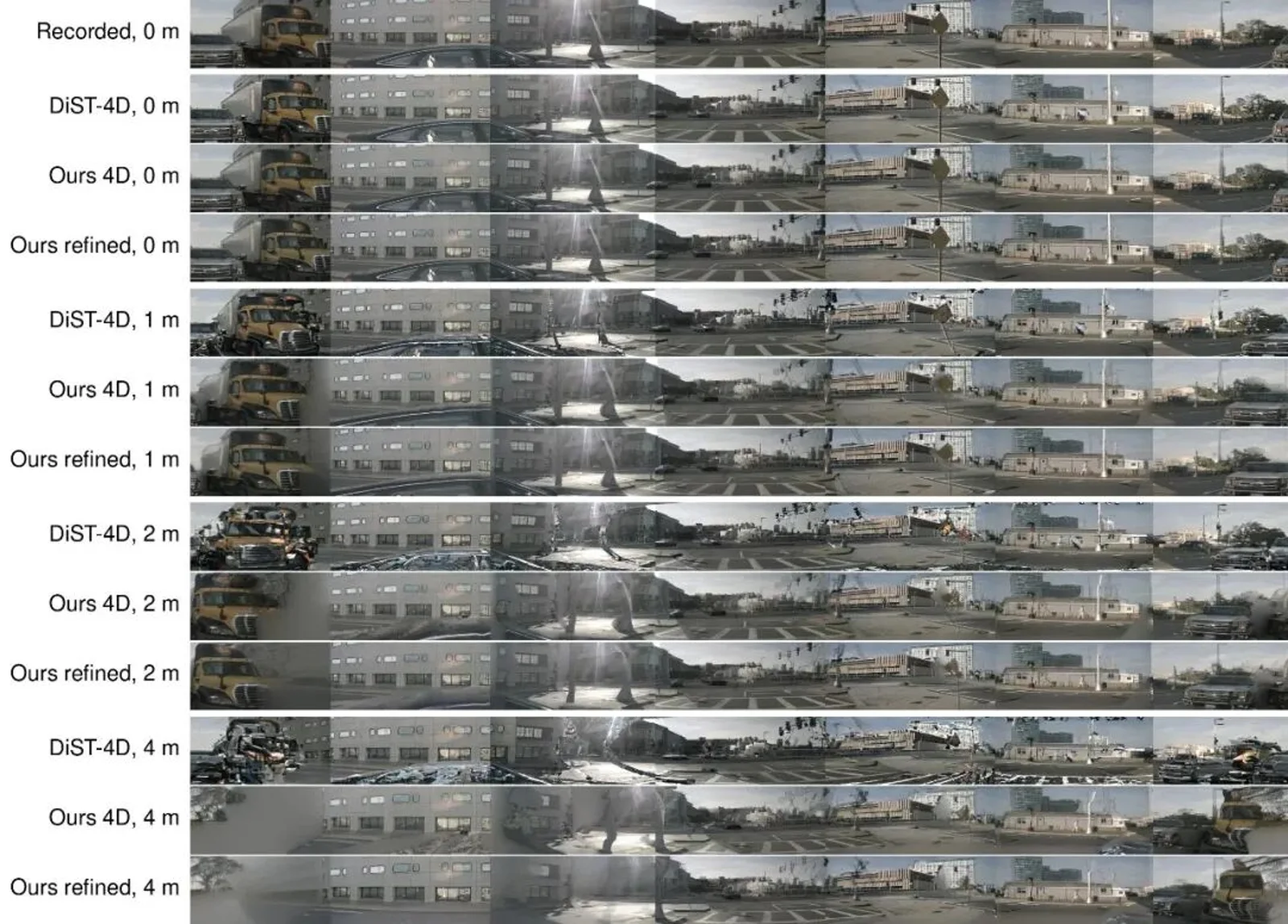
Figure 3: Rendered results after lateral shifts of 0, 1, 2, 4 meters. First row: real footage; other rows: DiST-4D and PanDWM 4D scenes.
Experiments on nuScenes
PanDWM is evaluated against UniMLVG, OpenDWM, DreamForge, DiST-4D, and OmniNWM on the nuScenes dataset.
Speed
PanDWM: 1.96 seconds per frame (including VAE decode) on a single H100.
50-step teacher: 33.7 seconds/frame (~17× slower).
All baselines: 8× to 46× slower than PanDWM.
Panoramic Video Quality (360° strip evaluation)
FID: PanDWM 10.1 (lowest among all methods).
FVD-1: PanDWM 37.4 (lowest).
4-step student vs. 50-step teacher: FID nearly matched (10.1 vs. 9.93); FVD reduced by 22–25%.
Ablation: Panoramic vs. Six-Camera Representation
Under identical initialization and training settings, a panoramic model and a six-camera model were trained. The panoramic version achieved lower FID both when evaluated in panoramic space and when projected back to six-camera space, confirming the benefit of the unified representation.
Long-Horizon Rollout (19.5 seconds, 12 windows)
The 4-step student's FVD remained lower than the 50-step teacher's at every time segment, validating that training on self-generated history curbs error accumulation.
4D Scene Quality
PanDWM achieves the lowest depth error among feedforward methods that use only camera inputs (no LiDAR).
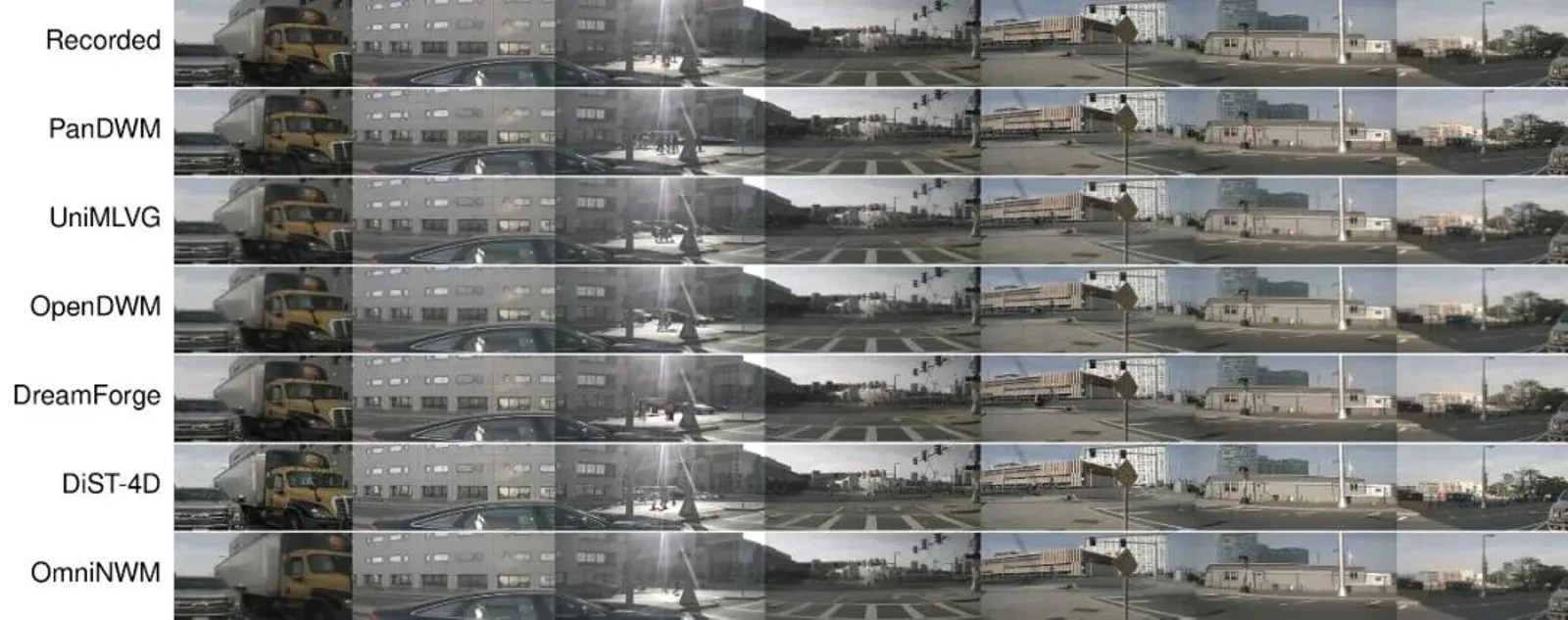
Figure 4: Same-timestamp 360° panoramic comparison across methods. First row: real footage.
Conclusion
PanDWM demonstrates that a unified panoramic representation simplifies cross-camera consistency, enabling fast causal video generation and feedforward 4D Gaussian lifting. The 4-step distilled student matches the 50-step teacher in quality while being ~17× faster, and self-history training stabilizes long-horizon rollout. The resulting 4D scenes support novel-view rendering meters away from the original trajectory. Paper, code, and model weights are publicly available:
Paper: https://arxiv.org/abs/2611.19857
Project page: https://aigeeksgroup.github.io/PanDWM/
Code: https://github.com/AIGeeksGroup/PanDWM
Model: https://huggingface.co/AIGeeksGroup/PanDWM
For questions about attribution, corrections or content rights, please contactand we will review it promptly.