

SteerSound: Post-Training Method Cuts Audio Editing Errors by 70% Across Six Tasks
Researchers from Renmin University, Tencent, HKU, and CUHK introduce STEER, a post-training method that focuses on early denoising steps and adds recovery training to fix selective audio editing errors. Applied to a new 1.35B parameter dual-branch diffusion transformer, SteerSound supports six editing types and reduces wrong-source edits by over 70%, outperforming UNISON, Audio-Omni, ZETA, and MMEdit on five tasks.
Reading font

Selective Audio Editing Challenge
Audio editing modifies an existing recording via a text instruction — adding rain, replacing piano with violin, removing background music, or shifting pitch. Many operations target only one sound source while preserving the rest, a setting called selective editing . The model must first identify which source the instruction refers to.
Existing Models Are Unreliable
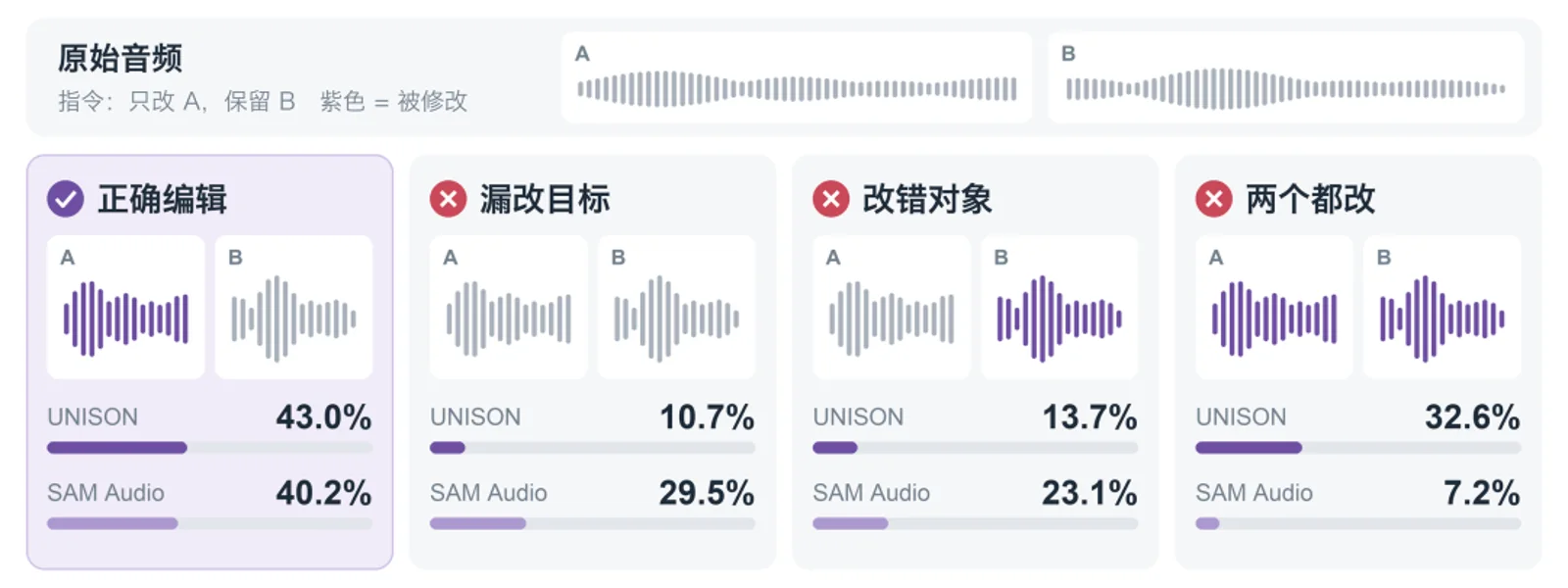
Tests on two state-of-the-art models — unified editor UNISON and source-separation specialist SAM Audio — show that when a recording contains two sounds and the instruction targets only one, both models succeed completely in only about 40% of cases. The remaining edits either miss the target, modify the wrong source, or alter both (Figure 1).
Errors Are Decided in the First Few Denoising Steps
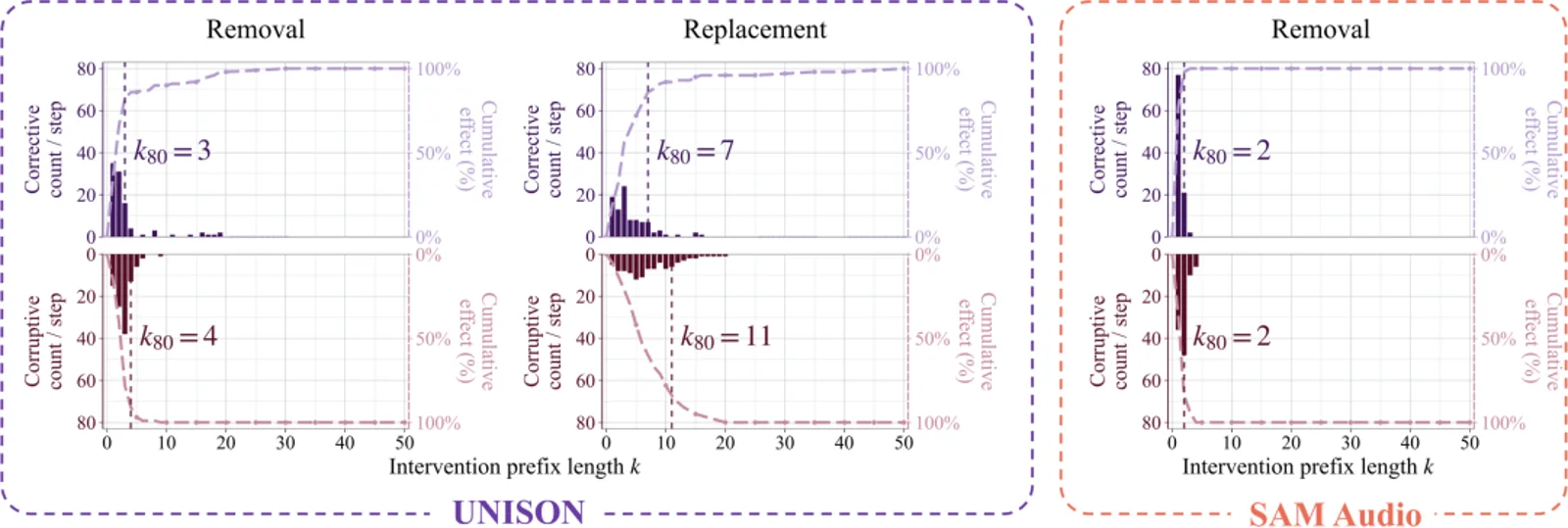
These diffusion models start from noise and run 50 denoising steps. By extrapolating the intermediate state at each step to the final audio, researchers found that failed edits already reveal the wrong source selection within the first 5 steps , even though the audio is still blurry. The early trajectory matches the final error.
Two controlled experiments confirm this: (1) replacing the first few steps of a failed edit with steps toward the correct target rescues most failures; (2) replacing the first few steps of a successful edit with steps toward the wrong target causes the edit to fail. Swapping more steps later adds almost no further change — the later denoising simply continues the early direction without self-correction (Figure 2).
Root Cause: Training Bias and No Exposure to Own Errors
Easy to choose wrong: Training noise-level sampling favors middle steps, so the critical early steps are under-trained.
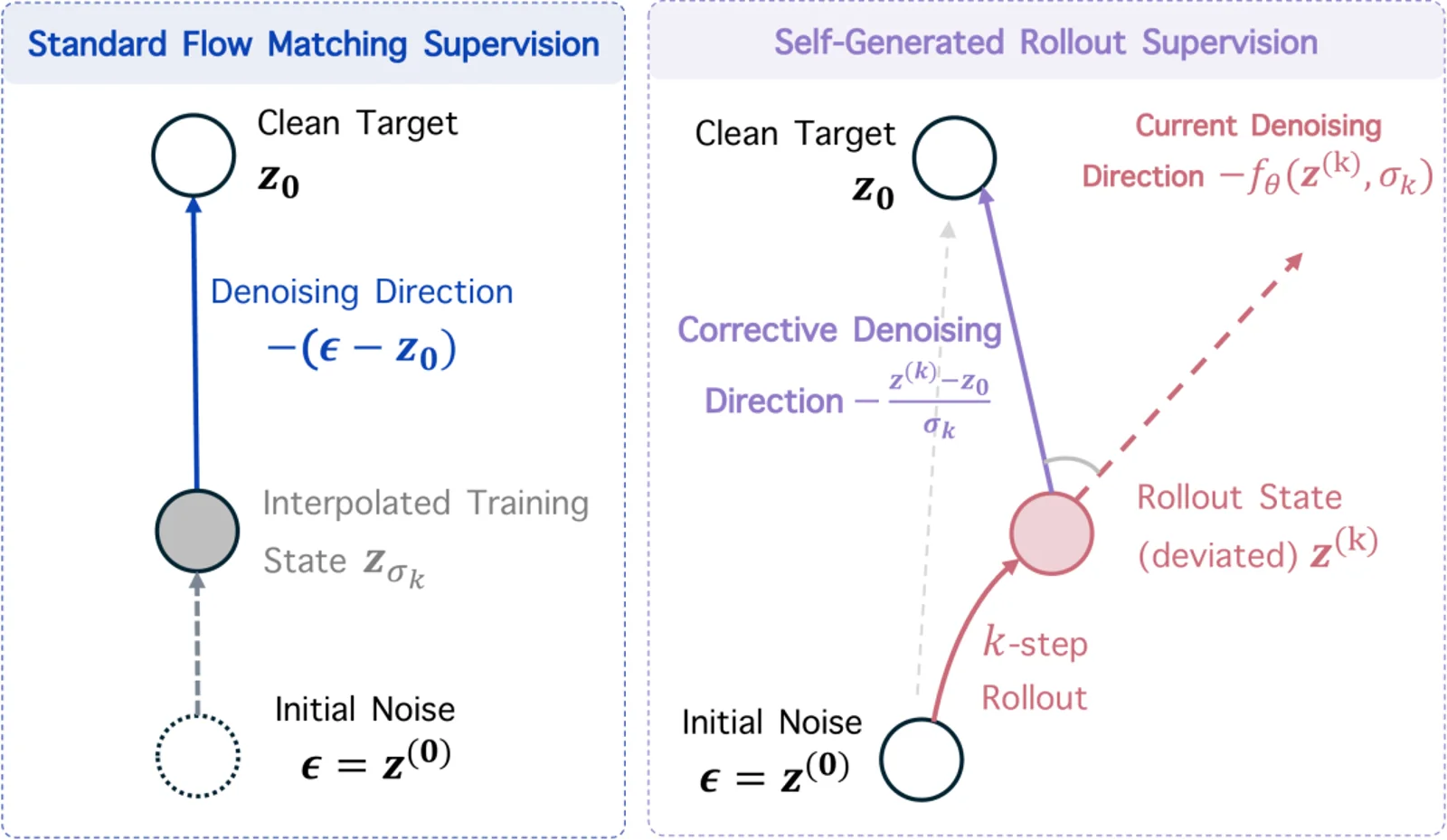
Hard to recover: Training intermediates are generated by adding noise to the ground truth; the model never sees its own erroneous trajectories. At inference, once the early steps go wrong, the model just refines the mistake.
STEER: Two-Phase Post-Training
STEER is a post-training method applied to a pre-trained editor, addressing both issues without changing the architecture.
Phase 1: Emphasis — Focus on Early Steps
Different tasks require different numbers of decisive steps: removal needs only the first 2 steps; replacement, pitch, and volume need the first 15. Emphasis restricts training sampling to those critical early steps for each task.
Phase 2: Recovery — Learn to Correct from Self-Generated Errors
The model is allowed to denoise a few steps on its own, producing a potentially biased intermediate state. It is then trained to recover from that state to the correct target (Figure 3).
SteerSound: Unified Editor for Six Tasks
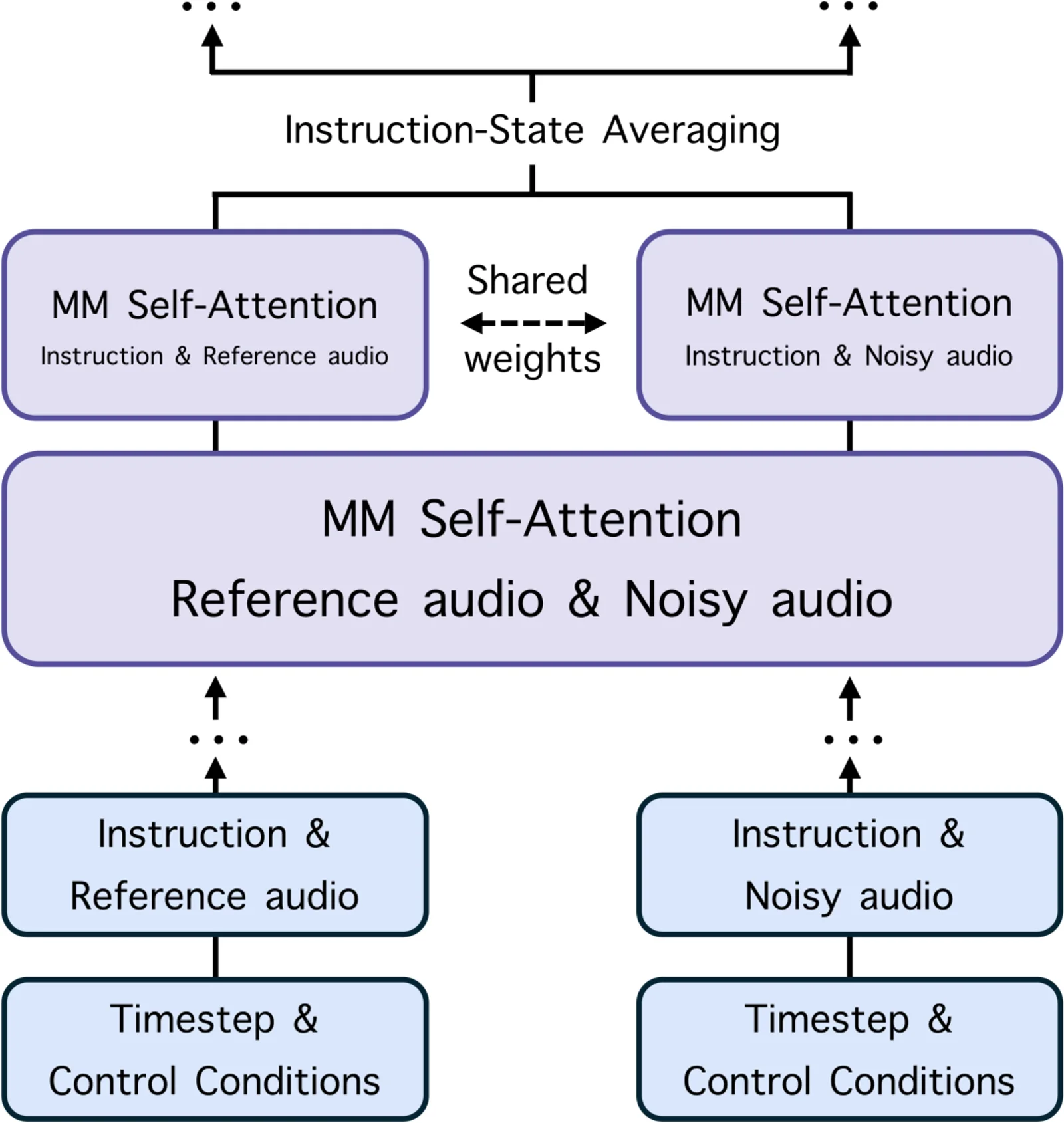
To support all six editing types — generation, addition, replacement, removal, pitch modification, volume modification — researchers trained a dual-branch diffusion Transformer (~1.35B parameters) from scratch as the base editor (Figure 4), then applied STEER post-training to obtain SteerSound .
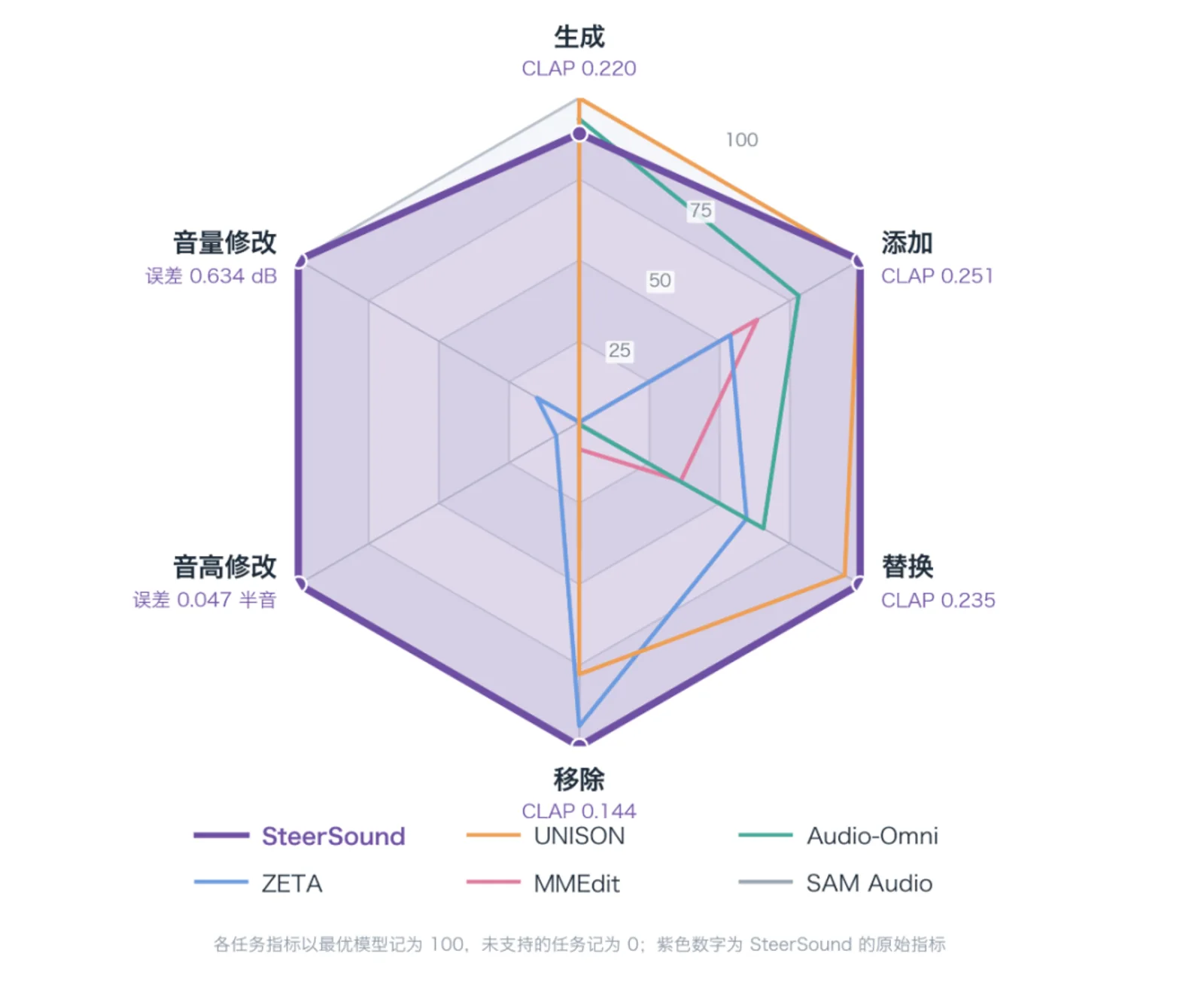
SteerSound is the only model covering all six tasks and achieves the best results on five of them, surpassing UNISON, Audio-Omni, ZETA, and MMEdit.
STEER Generalizes to Existing Models
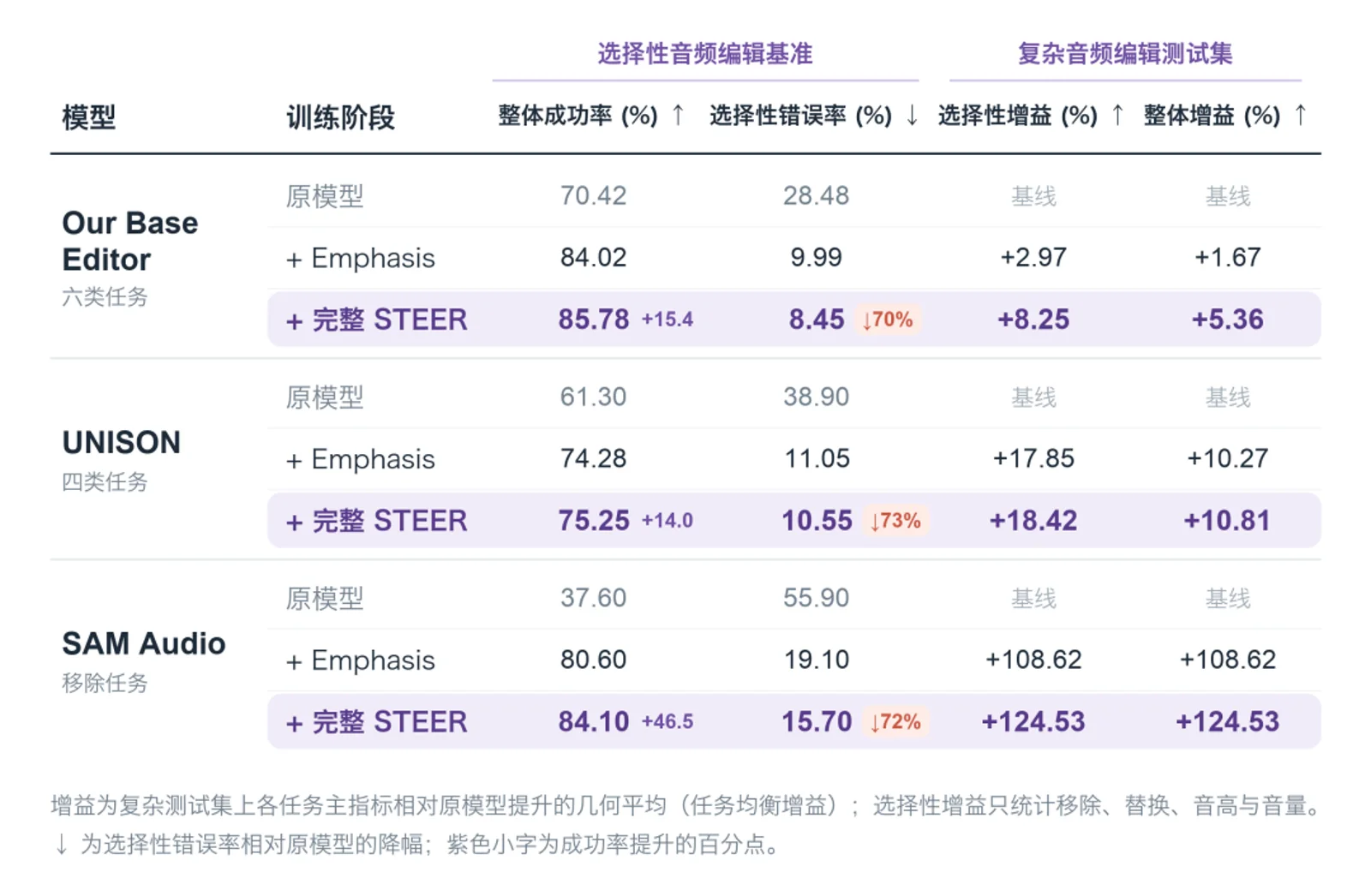
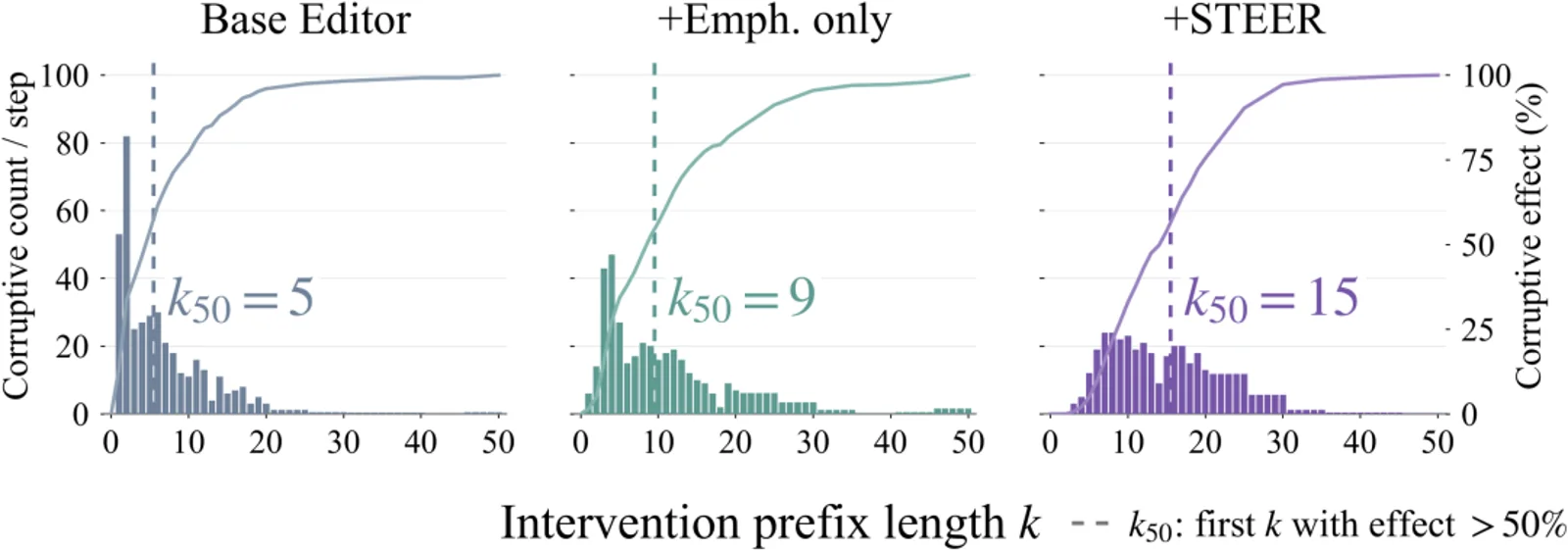
Applying STEER to UNISON and SAM Audio reduces wrong-source edit rates by over 70% (Figure 5). Recovery capability also improves markedly: when the first few steps are deliberately steered toward the wrong source, the original model fails half the edits within 5 steps, while the STEER-enhanced model withstands 15 steps before breaking down (Figure 6).
Additional Evidence in the Paper
Per-task quantitative comparison across all six editing types.
Human listening evaluations.
Ablation study separating the contributions of Emphasis and Recovery.
Extension experiment: locating a speaker by spoken content.
Conclusion and Broader Implications
The work started from a simple observation: which sound gets edited is fixed in the first few denoising steps . STEER modifies only the training procedure, not the model architecture. Since image and video editing models also denoise from noise step by step, the same principle — early steps decide object selection — likely holds there, suggesting STEER's approach could transfer to those domains.
Open Resources
Paper: https://arxiv.org/abs/2611.10630 Project page: https://gewu-lab.github.io/SteerSound/ Code: https://github.com/GeWu-Lab/SteerSound Model: https://huggingface.co/GeWu-Lab/SteerSound Dataset:
https://huggingface.co/datasets/GeWu-Lab/SteerSoundFor questions about attribution, corrections or content rights, please contactand we will review it promptly.