

What Should AI Agents Learn from a Master Technician's 'I Know by Sound'?
The article explains how to capture expert technicians' diagnostic reasoning by reconstructing specific judgment moments, separating observations from hypotheses, recording applicability conditions and counterexamples, validating with held-out cases, and structuring knowledge for reliable AI agent retrieval without conflating intuition with confirmed faults.
Reading font

Introduction: The Problem with "I Know by Sound"
An experienced equipment master might say a machine sounds abnormal, but if knowledge capture stops at "abnormal sound may indicate fault", it fails to guide the next judgment: what sound, under what load, on which product, with what background noise? The previous article "MES and ERP Are Connected, Why Can't the Agent Get Things Done?" organized recorded correspondences, yet the conditions the master uses during judgment may not be written down.
This article continues with a hypothetical machining line dimensional deviation case. The master mentions a sound change — a clue worth pursuing, but its link to deviation must be verified. "Learning" here means enabling the Agent to find and correctly use such experience, not necessarily training a model immediately. Organized cases, applicability conditions, and check steps can be invoked on demand during tasks.
Don't Ask "What's Your Experience" — Reconstruct One Judgment
"Tell me your experience" is too broad. Skilled people omit conditions they consider obvious and jump to conclusions. Instead, ask them to recount a specific event, tracing back from the moment their judgment changed.
What were they machining, at which step? How did speed, load differ from normal?
Was the sound sudden or gradual? Besides sound, did they check dimensional trends, vibration, surface condition?
What did they check first? Why not another component? What result would make them abandon the initial judgment?
Explaining "why they took one extra check" is easier than summarizing a repair tutorial and yields content easier to verify. However, hindsight bias distorts recall: after fault confirmation, people think they knew the cause all along. Cross-check with contemporaneous records and timestamps: what was known at that moment, what was learned only after checks.
This approach draws on Applied Cognitive Task Analysis (ACTA). Militello & Hutton (1998) describe identifying cognitive skills needed for tasks via interviews [1]. The experience cards below borrow this idea but are not a full ACTA method.
Separate Four Records So Experience Can Be Verified
If the oral account is "sound is off, definitely bearing failure", don't store the whole sentence as diagnostic knowledge. First verify records, split confirmed content from pending judgments:
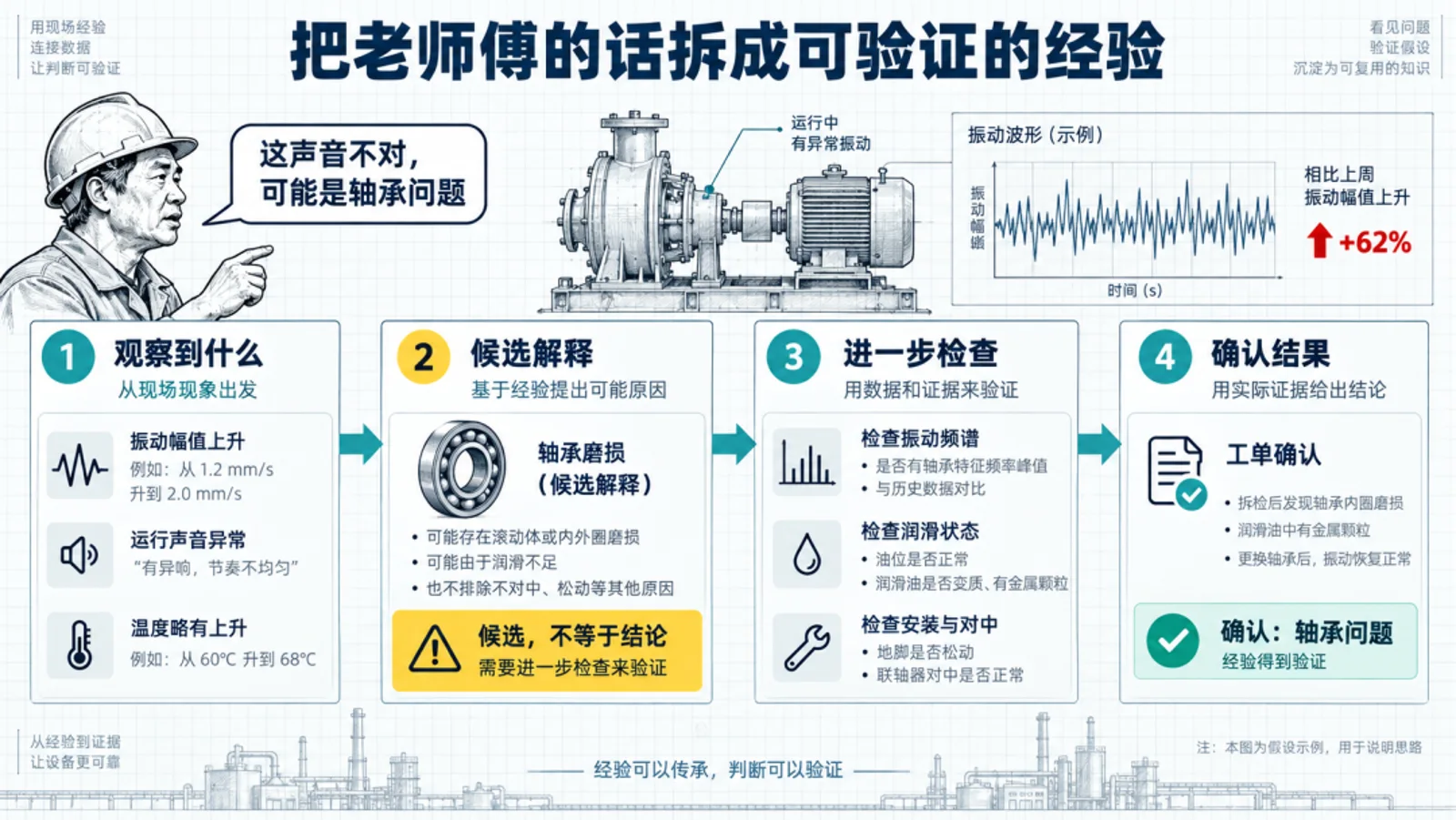
The image illustrates four record types, not an automatic pipeline from utterance to fixed conclusion.
Observation: During a machining segment, sound differed from familiar normal state; dimensional deviation recorded same period. Save observer, period, operating conditions, raw materials. Do not turn "feels abnormal" into quantified fact.
Candidate Explanations: Expert suspects certain component or condition change, lists alternative explanations. This is judgment, not confirmed cause.
Further Checks: Follow approved on-site procedures to supplement equipment, process, inspection info to support or rule out candidates. Required checks decided by responsible personnel.
Confirmed Results: What was actually found, whether it explains the deviation, which relationships remain unconfirmed. Unresolved cases can be kept without forcing a root cause.
After separation, the Agent can say: "Current clues resemble this case, but the operating conditions and check results from that time are missing." If all four layers are mashed into "hearing this sound means that fault", reuse speed increases misuse scope.
These records can serve as case material for ReAct-style alternating reasoning and action methods, helping the Agent adjust candidate judgments based on tool-retrieved new information [2]. Experience cards record verifiable judgments and actions, not model-internal thoughts; even when inserted into prompts, effects must be validated.
When hearing "this often happened before", ask: "Which records? Any cases with similar sound that checked out fine?" Co-occurrence and post-check confirmation are different things.
Record When Experience Does Not Apply
The card below can be attached to a de-identified case without requiring the expert to write a long report. Collection staff organize, expert confirms, validation staff add test records.
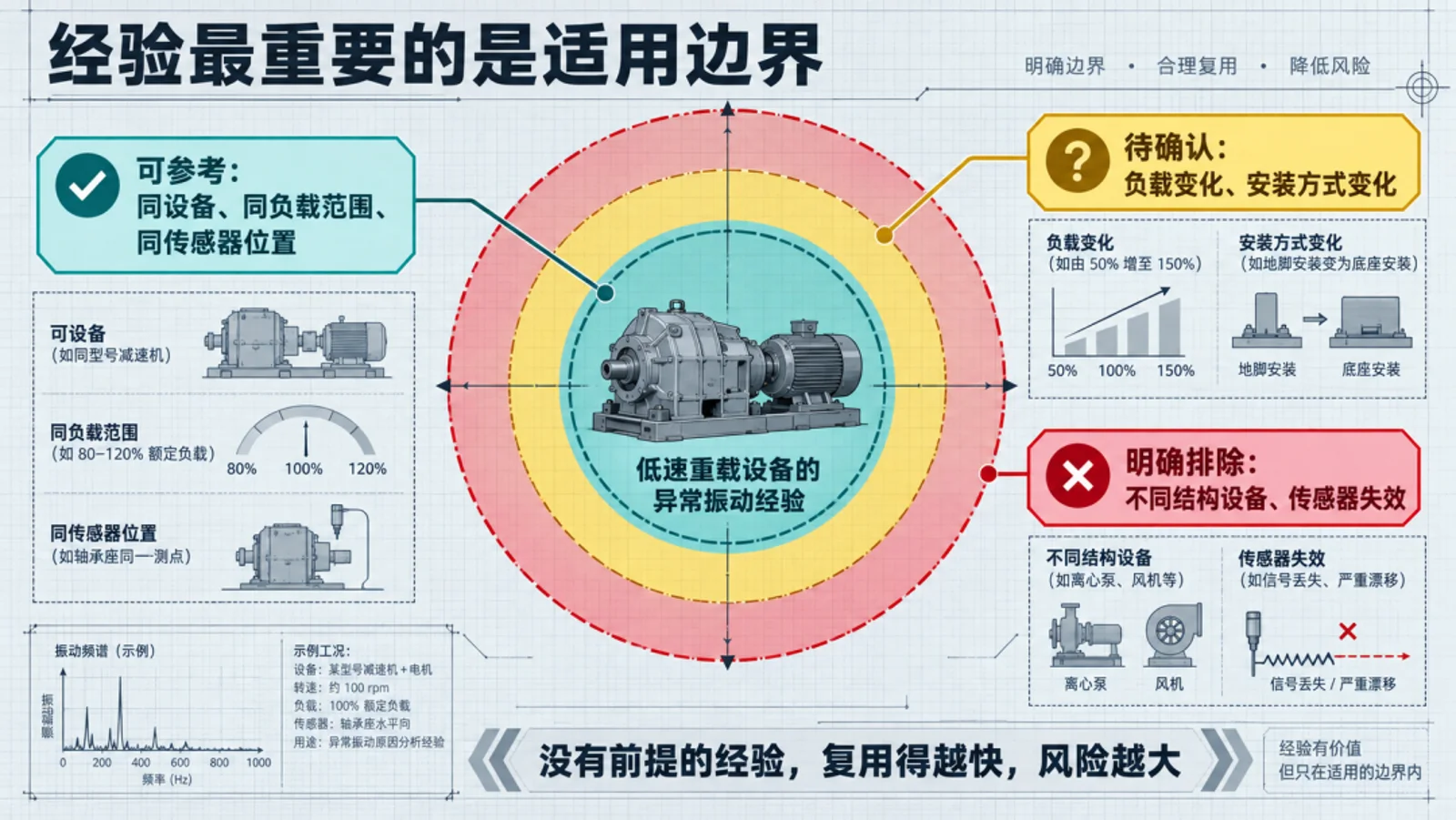
Before using a card, determine which situation the current task falls into. "Exclusion" here means excluding the experience's applicability, not excluding equipment fault. Changed load but not yet verified = pending confirmation. Only for explicit detection tasks, cases verified to meet normal criteria can be labeled as normal negative samples. Cannot label "this experience unusable" as "equipment has no problem".
Operating conditions are not decorative background. DCASE 2021 acoustic anomaly detection task discussed domain shift: speed, load, or environmental noise changes may alter normal sound distribution, causing false alarms [3]. This shows sound judgment must consider condition changes; it does not mean large models have mastered maintenance experience.
At integration, distinguish: oral account is human observation, audio analysis is another capability needing separate validation of acoustic models or tools on-site. Agent can query cases and cross-check conditions based on detection results, but anomaly scores alone cannot determine fault cause.
If the site only has an unreconstructable intuition without verifiable material, keep it as an investigation lead. It still has value but should stay at "alert human attention", not enter automatic diagnosis or action rules.
Expert Disagreements Can't Be Resolved by Who Sounds More Convincing
One expert thinks sound change warrants stopping for check; another says it's common after product change. Even if a model compiles a compromise, the disagreement remains unresolved.
First compare conditions: same equipment, same period? Does one know tooling was just changed? Do they define "abnormal" differently — unfamiliar sound vs. already affecting machining quality?
If different conditions, both experiences may hold; write separate applicability ranges.
If same conditions but opposite explanations, keep both judgments, list missing checks. Process, equipment, quality conclusions each go to respective roles; cross-discipline disputes resolved via existing responsibilities — no need to force the model to synthesize a single answer.
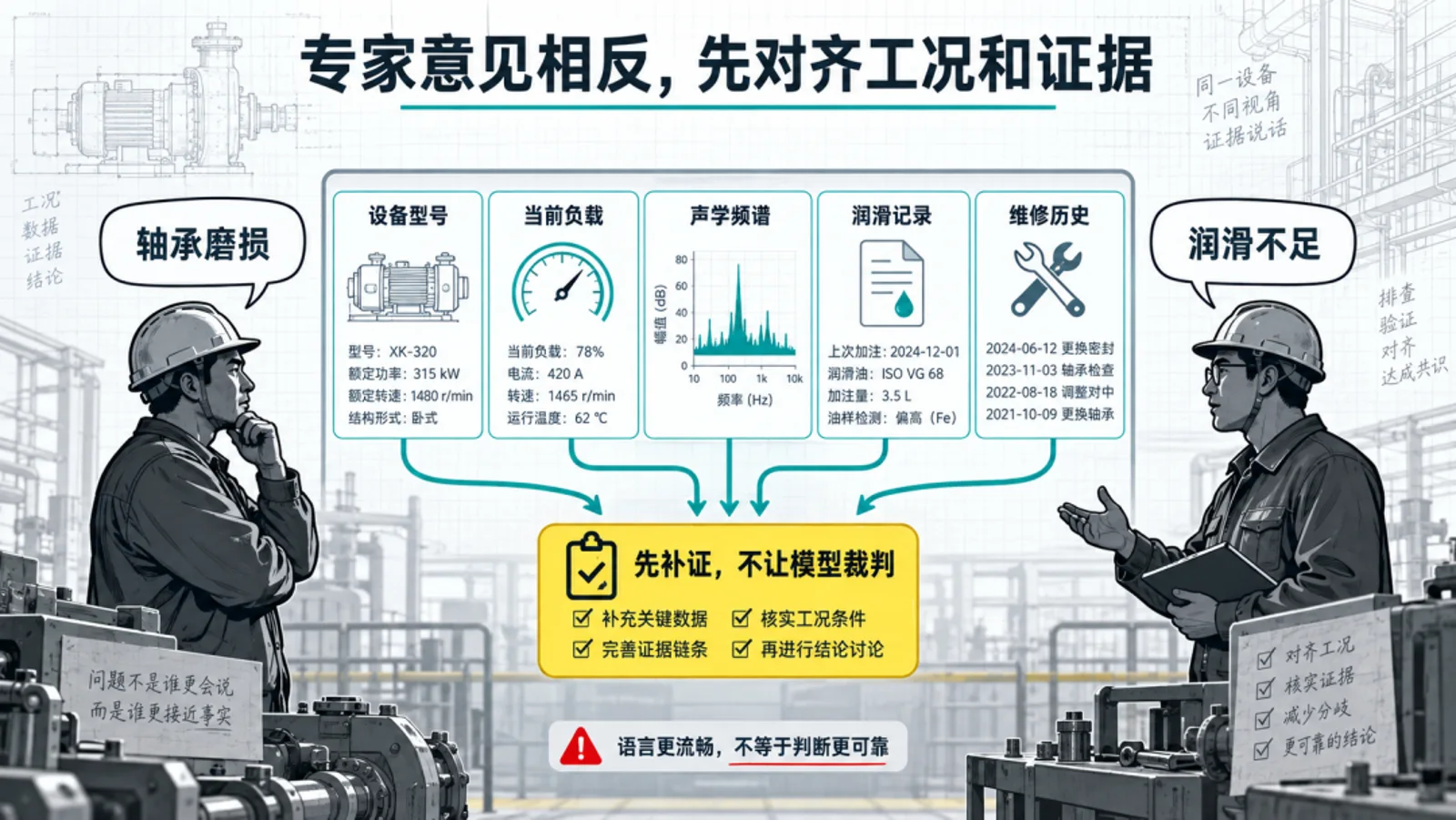
Validation plans must target the disagreement itself. If dispute is whether load change explains sound, collecting more recordings at same load may not help. Professional personnel should determine needed controls and checks; not create dangerous faults for training samples.
Cases Used for Induction Cannot Also Serve as Acceptance Tests
If ten events are used to summarize experience, then those same ten events test the Agent, good results are unsurprising — it may just memorize phrasing or even read the repair conclusion.
During organization, data/algorithm staff must hold out a batch of cases, not used for induction or prompt tuning, reserved for acceptance. Judgment criteria set by process and equipment experts, results reviewed by quality or designated validators. For historical replay, withhold repair conclusions; give Agent only information visible at the time, compare at the end.
Before acceptance, agree on which step the Agent should assist: find similar cases, prompt missing checks, or identify anomalies. Finding the right case ≠ correct diagnosis. Cases with unconfirmed actual cause cannot compute root-cause accuracy. Agent "cannot judge" responses must be recorded separately, not just count willing answers. With insufficient samples, acknowledge limited evidence, use for assisted verification first.
Acceptance must check not only how many it got right, but whether it can detect insufficient conditions and state what further checks are needed.
At minimum cover these scenarios:
Independent anomaly cases under similar conditions: Can it identify relevant clues, not recite old cases? If fails, revise applicability conditions or add evidence.
Similar sounds verified as normal conditions: Does it label familiar signals as faults? If so, add exclusion conditions, limit conclusion strength.
Cases with different products, loads, or noise: Does it detect exceeding experience range? If so, switch to supplementary checks or human judgment.
Cases with missing clues or conflicting sources: Does it explicitly say "don't know" rather than fabricate cause? If not, restrict use, fix input and expression.
Confirmed anomalies without that sound: Does it rule out problems due to missing familiar signal? If so, add other investigation paths, prohibit reverse inference.
"This check found no problem" does not necessarily serve as a normal counterexample; must examine check scope, means, and follow-up records. Insufficient evidence cases remain pending confirmation.
After replay, conduct on-site assisted trial within approved scope, recording false-alarm inspection burden, misses, and human overrides. Experience cards also need re-review: equipment modifications, process changes, or recurring counterexamples may invalidate old cards.
Not All Experience Belongs in the Ontology
After organizing experience, don't stuff everything into the ontology. Equipment and condition definitions, confirmed constraints — these suit ontology or business semantic models. Why a judgment changed, along with conditions and evidence at that time, better stored as diagnostic cases.
Stable, approved check steps can enter Standard Operating Procedures (SOP) or be encapsulated as controlled process skills callable by the Agent. Unverified guesses stay in candidate area; drawing them as graph relations won't make them formal rules.
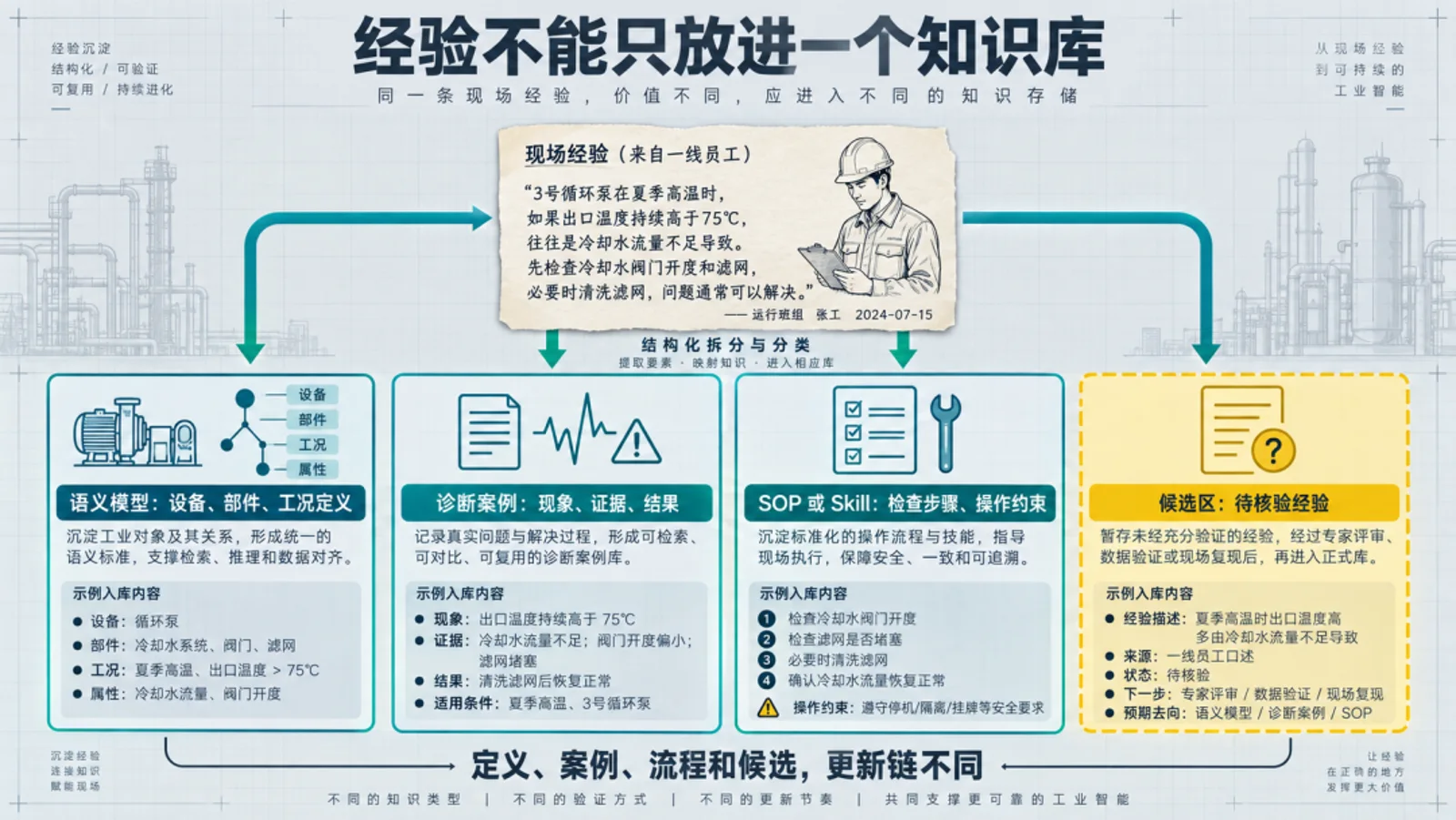
Diagnostic cases can be served to the Agent via RAG (Retrieval-Augmented Generation): retrieve materials first, then organize answers [4]. During retrieval, verify equipment, conditions, card version, and availability status; pass applicability scope, missing conditions, and evidence to the model. Finding only "sound anomaly — bearing fault" without premises, no matter how high the match score, cannot support a conclusion.
When ontology or knowledge graph exists, use confirmed equipment, component, process, and condition relationships to narrow candidate cases first, then compare phenomena and check records. Relations help narrow scope; original records provide judgment basis. For simple objects, structured field filtering suffices, no extra graph needed.
Previous article "The Hardest Part of Enterprise AI Isn't Building Ontology: Why Frontline Experience Never Gets Adopted" discussed contribution and collaboration conditions. This article adds content quality: willingness to speak is just the start; still need people to organize, verify, and maintain. Mature handbooks already specify content clearly — reference and maintain directly, no need to re-interview to "invent" the same knowledge.
Summary
Next time you hear "I know by sound", don't rush to write a rule. Ask instead: "Which time did you hear a similar sound but later changed your judgment?" That may yield more than another hour of generic experience sharing.
Next article "Agent Recommends Shutdown — Who Presses the Confirm Button?" will discuss boundaries after judgment: even with evidence, the recommendation hasn't earned execution authority.
References
[1] Militello, L. G. & Hutton, R. J. B.: Applied cognitive task analysis (ACTA): a practitioner's toolkit for understanding cognitive task demands, 1998. This article reads and cites the PubMed abstract for method positioning, does not reproduce full interview procedure. https://pubmed.ncbi.nlm.nih.gov/9819578/
[2] Yao et al.: ReAct: Synergizing Reasoning and Acting in Language Models, 2022 preprint, ICLR 2023. Cites its alternating reasoning and action, adjusting judgments via external information; the four-category experience records here are not the paper's fixed template, nor imply on-site execution is authorized. https://arxiv.org/abs/2210.03629
[3] DCASE 2021 Task 2: Unsupervised Detection of Anomalous Sounds for Machine Condition Monitoring under Domain Shifted Conditions. Used only to illustrate operating condition impact on acoustic anomaly judgment, not as evidence of manufacturing Agent deployment effectiveness. https://dcase.community/challenge2021/task-unsupervised-detection-of-anomalous-sounds
[4] Lewis et al.: Retrieval-Augmented Generation for Knowledge-Intensive NLP Tasks, NeurIPS 2020. Cites basic idea of retrieval-assisted generation; this article's condition, version, and applicability checks belong to scenario engineering design, not industrial mechanisms validated by the paper. https://arxiv.org/abs/2005.11401
Code example
[1] Militello, L. G. & Hutton, R. J. B.:Applied cognitive task analysis (ACTA): a practitioner's toolkit for understanding cognitive task demands,1998。本文读取并引用PubMed摘要中的方法定位,未复述完整访谈程序。https://pubmed.ncbi.nlm.nih.gov/9819578/
[2] Yao 等:ReAct: Synergizing Reasoning and Acting in Language Models,2022年预印本,ICLR 2023。引用其交替推理与行动、通过外部信息调整判断的方法思路;本文四类经验记录不是论文提出的固定模板,也不代表现场执行已获授权。https://arxiv.org/abs/2210.03629
[3] DCASE 2021 Task 2:Unsupervised Detection of Anomalous Sounds for Machine Condition Monitoring under Domain Shifted Conditions。仅用于说明工况变化对声学异常判断的影响,不作为制造业Agent落地效果证据。https://dcase.community/challenge2021/task-unsupervised-detection-of-anomalous-sounds
[4] Lewis 等:Retrieval-Augmented Generation for Knowledge-Intensive NLP Tasks,NeurIPS 2020。引用检索资料辅助生成的基本思路;本文工况、版本和适用条件检查属于场景工程设计,并非论文已验证的工业机制。https://arxiv.org/abs/2005.11401For questions about attribution, corrections or content rights, please contactand we will review it promptly.