This tutorial walks individual developers through the entire process of applying for and integrating WeChat Virtual Payment into a mini-program, covering eligibility checks, application steps, key configuration parameters, product creation, frontend and backend integration flows, iOS IAP considerations, a pre-deployment checklist, and two common pitfalls to avoid.
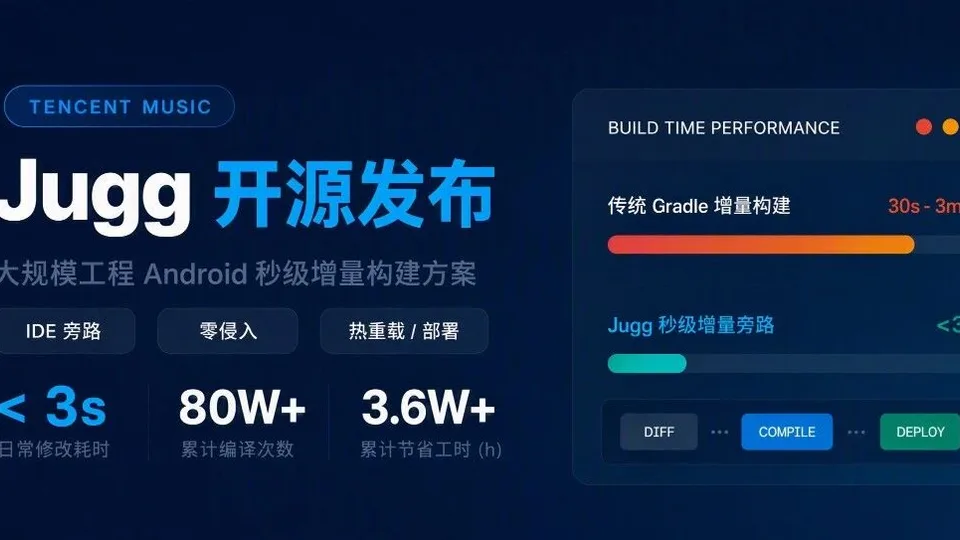
Tencent Music open-sources Jugg, an Android incremental build tool that achieves sub-3-second iteration by bypassing Gradle's fixed overhead via a sidecar compilation pipeline, using custom AAPT2 incremental linking, bytecode-level impact propagation, and JVMTI-based hot reload with hot-fix fallback, validated across 800k production builds.
This guide explains why video recordings that upload correctly on a real device can fail after TestFlight or cloud packaging, detailing the mismatched file‑system paths between plus.io, iOS Documents/Library, and Android Movies directories, and provides step‑by‑step fixes to ensure reliable uploads to Alibaba Cloud VOD.
This article details two approaches to implement edge bounce effects in HarmonyOS 7.x Lists: using the built-in edgeEffect.Spring API for quick integration, and a custom physics-based animation with damping formula and spring curve tuning for deep customization, including parameter recommendations, bottom bounce implementation, performance comparison, and five common pitfalls with solutions.
HarmonyOS SDK introduces requestPermissionOnSetting() API to display a half-modal permission settings dialog directly in-app after user denial, replacing 5–7 step system settings navigation with a one-tap flow that takes ~8 lines of code and boosts authorization conversion and retention.
A randomized trial showed that a step‑tracking app lowered office workers' psychological distress, and the article breaks down the system architecture, data collection, just‑in‑time adaptive interventions, statistical evaluation, 2026 AI advances, and practical engineering advice for building such health‑focused mobile solutions.
Facing rising hardware costs and tighter device memory, Google announced that from early 2027 Android apps distributed via Play must meet new memory usage and code‑optimization standards, with phased limits on foreground/background RAM, bitmap usage, DEX size, and mandatory Restore Credentials API integration.
This article details a four-step HarmonyOS cold start optimization methodology: baseline measurement, deferred non-critical parsing, taskpool concurrency for heavy parsing, and skeleton screens with in-process caching to decouple first-frame and interactive metrics, validated via dual-track measurement on a sample 'Morning Brief' page.
Huajiao Live and Meishe Technology have jointly integrated their live‑push SDK and AI beauty SDK on HarmonyOS, creating a single streaming pipeline that combines stable push, professional real‑time beauty, low‑latency encoding and adaptive network handling, while simplifying developer integration and reducing maintenance overhead.
A recent randomized trial shows that a smartphone‑based step‑tracking and nudging app can lower office workers' psychological distress, and the article breaks down the system’s sensor pipeline, adaptive intervention engine, statistical evaluation, and 2026 tech upgrades like on‑device models and federated learning.
Zhihu's ZSpec workflow enables one developer to manage iOS, Android, and Harmony development by unifying requirements in a Group while isolating platform-specific facts in Units, using AI Agents with scoped skills for code investigation, implementation, and automated on-device verification, reducing redundant context switching and rework.
This tutorial walks through building a full-featured HarmonyOS news module with category tabs, list rendering, custom pull-to-refresh and load-more logic using touch events and offset animations, network request encapsulation with Promise-based error handling, and a layered architecture separating view, viewmodel, and common utilities.
Dactyl, the new AI‑driven vibe‑coding platform created by Node.js creator Ryan Dahl, lets you describe a mobile app in natural language within a browser and instantly generates native SwiftUI code that runs on iOS, iPadOS and Android, while offering real‑time previews, ChatGPT integration, and a pricing model that shifts most of the traditional mobile‑dev workflow into a single conversational flow.
This article solves a HarmonyOS 7 issue where getAddressesFromLocation returns an empty array without errors, revealing the root cause is a coordinate system mismatch: Map Kit provides GCJ02 coordinates while the geocoding API requires WGS84, and provides a conversion algorithm and complete implementation.
This article details six HarmonyOS diagnostic tools—GWPAsan for buffer overflows, AppFreeze enhanced logs for main-thread stalls, JSLeakWatcher for ArkTS memory leaks, AppFreeze-Analysis for AI-driven freeze diagnosis, APMS for proactive alerting, and DevEco Profiler for native memory leaks—explaining each tool's mechanism, core value, and target scenarios to help developers quickly resolve stability issues.
This guide explains how to enable ArkTS's built-in ArkGuard obfuscation with just two configuration files and a release build, detailing its bytecode-level operation, automatic semantic-aware rules for ArkUI and system APIs, multi-module rule management, mapping files for debugging, and step-by-step rollout with practical demos for property, filename, and dynamic access keep rules.
This guide details HarmonyOS 7's Core Vision Kit ImageSR API for on-device 4x AI super-resolution, covering API usage, ArkTS demo code, permissions, constraints (2048x2048 input, RGBA_8888 format), common pitfalls (emulator unsupported, model download, resource leaks), and suitable use cases like e-commerce and social images where perceptual quality matters more than pixel-perfect accuracy.
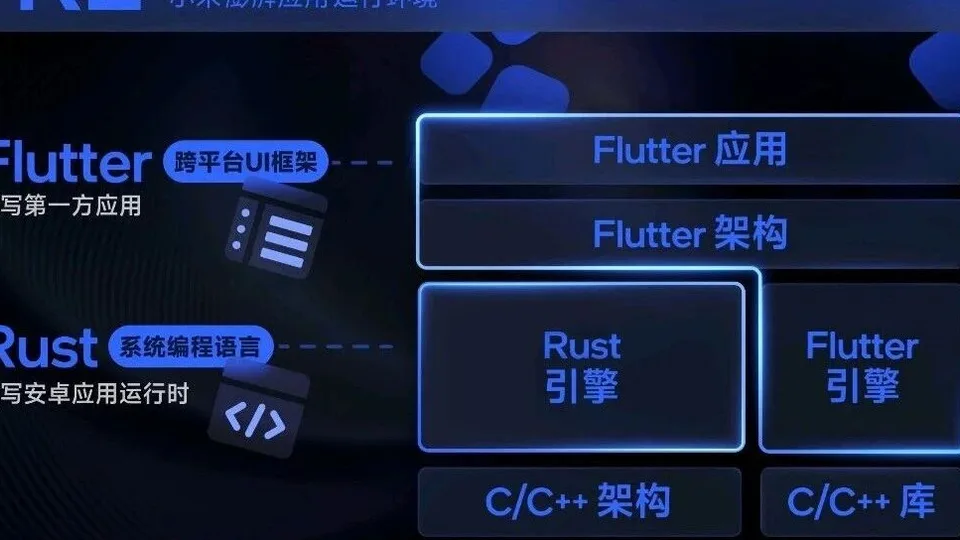
An analysis of Xiaomi's HyperOS 4 adopting Flutter for UI and Rust for system services, weighing performance benefits against Dart VM maintenance burdens and divergence from Android's mainline optimization.