Amap's search, recommendation, and advertising team shares engineering practices using AI agents for cross-repo development, code refactoring, and real-device verification, structuring delivery into four stages—intent specification, context provisioning, traceable review, and continuous evaluation—to convert individual AI coding gains into sustainable team delivery capabilities, with concrete metrics and case studies.
This article explains how managers can avoid taking over subordinates' tasks by aligning expectations before work begins and checking progress at key milestones during execution, while guiding rather than replacing, allowing controlled mistakes, and shifting from individual output to team capability building.
New managers should first align with leadership on key priorities, then categorize team members into core backbone, high-potential, and execution-focused roles, assigning critical tasks to the first two groups while breaking down simpler work for executors, using priorities to reject distractions and maintain team rhythm.
The MLNLP community's Paper-Presentation-Tips project now includes an AI-powered skill that helps researchers structure presentation narratives, highlight methods and experiments, and generate editable PPTX files from paper materials, complementing 11 practical slide-design tips with before-and-after examples.
This guide explains how to create effective business architecture diagrams by focusing on roles, business domains, and end-to-end chains, using a four-layer structure to visualize capability boundaries and business flow rather than just listing functions.
The author built a free WeChat mini-program for vocabulary learning using WorkBuddy in two hours, implementing spaced repetition and four question types, and discovered that unambiguous product rule specification is more challenging and crucial than coding itself.
Forrester's 2026 survey reveals 53% of employees check six-plus channels for a single critical notice; this article dissects the technical root causes — siloed architectures, disjointed push mechanisms, and missing unified identity — quantifies productivity losses from context switching and duplicate work, and evaluates three mature 2026 solution architectures: a unified notification hub, AI-driven aggregation assistants, and protocol-level standardization via Matrix, illustrated by a real-world case cutting daily search time from 62 to 11 minutes.
This article explores how developers can maintain critical judgment when AI agents generate code that passes tests but embeds implicit design choices, using a transaction-order example to illustrate predict-then-verify review, requirement-driven testing, junior skill development, and documenting trade-offs for future maintenance.
The article argues that cross-department collaboration fails when teams skip alignment meetings and consensus-building; it illustrates with an IT-HR conflict over a scheduling system and prescribes two fixes: escalate to leadership for top-down alignment, and create a dedicated project group for real-time progress, risk, and plan visibility.
Spawn, a 10-person multiplayer game platform company, uses a fleet of persistent AI agents to handle development tasks from bug reports to deployment, achieving 77,000 changes in 30 days with hourly releases, automated testing every 15 minutes, and AI-assisted decision-making, while humans focus on product experimentation and high-level trade-offs.
An IT manager shares a real case of recommending a salary increase for a mid-level developer who exceeded role expectations by leading 0-to-1 projects, demonstrating fast growth, building reusable components, and showing strong cross-functional skills, arguing compensation should reflect actual responsibilities and team impact.
This article presents a four-level maturity model (L1–L4) and six evaluation dimensions to help enterprises decide whether to buy, assemble, or build each AI capability, arguing that standardized capabilities should be purchased while differentiating capabilities must be built in-house.
This article argues that Forward Deployed Engineers (FDEs) should not be treated as solo full-stack heroes; instead, frontline squads must explicitly allocate nine responsibility areas—business value, product, architecture, engineering, data semantics, security, testing, operations, and customer adoption—across cross-organizational roles with clear evidence, approval authorities, and escalation paths.
The author reflects on a deceased leader's question about the most important aspect of technical management, concluding that clear goals are the prerequisite for planning, execution, and resource allocation, without which management practices become meaningless busywork.
The MLNLP community's Paper-Presentation-Tips repository now includes an AI-powered skill that helps researchers structure, design, and generate editable PPTX files for paper presentations, building on 11 practical slide-design tips with before/after examples.
Learn how to provision GPT-6.1 Sol for a team by mapping members to roles and seat types, running a focused trial week with high-impact tasks, and scaling based on actual usage data while separating personal and business workspaces.
An IT department head explains how companies allocate raises and resources, showing that programmers who take on high-impact responsibilities gain leverage for better compensation, while those who don't risk being deprioritized when budgets are tight.
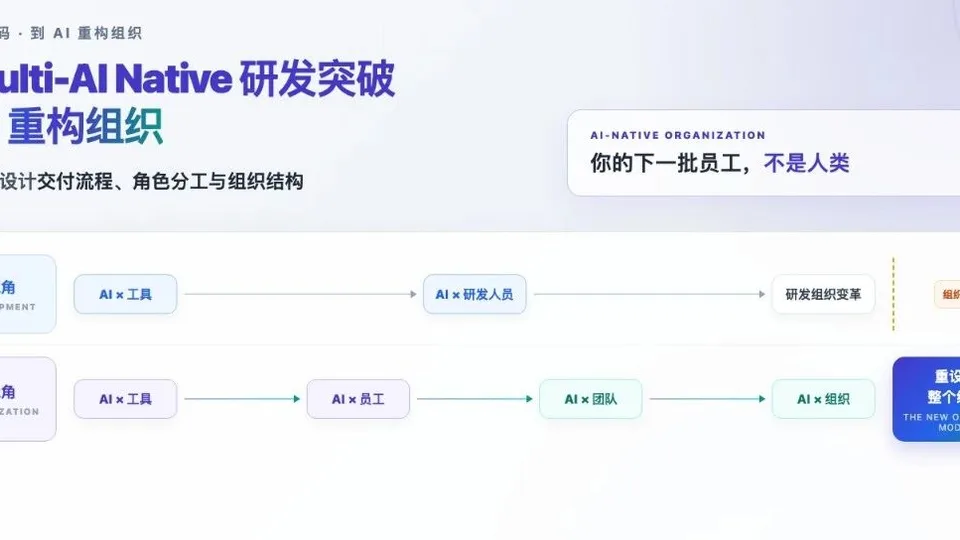
The article analyzes why AI coding tools haven't improved overall delivery speed, identifying organizational friction in alignment, handoffs, and skill gaps. It presents a platform (Multi AI Native) that redesigns roles as AI agents, uses Issues as single source of truth, and creates autonomous squads, showing scaled results with 64 workspaces and 120 squads.
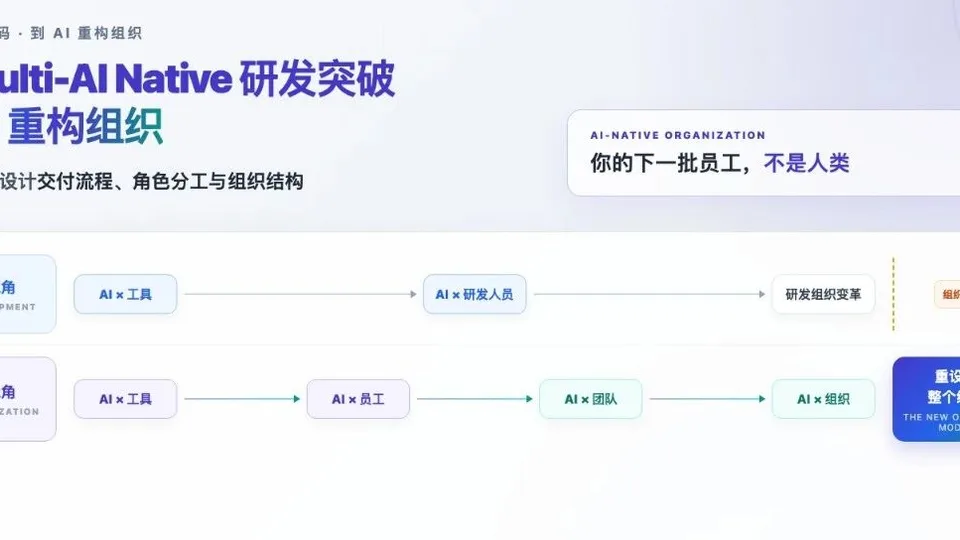
The article analyzes why AI coding tools haven't accelerated overall delivery speed, identifying organizational friction in processes, role specialization, and team structure as root causes. It presents a platform approach that redefines roles as AI agents, uses Issues as single source of truth, and structures autonomous squads, demonstrating scaled results with 64 workspaces, 931 agents, and 120 squads.