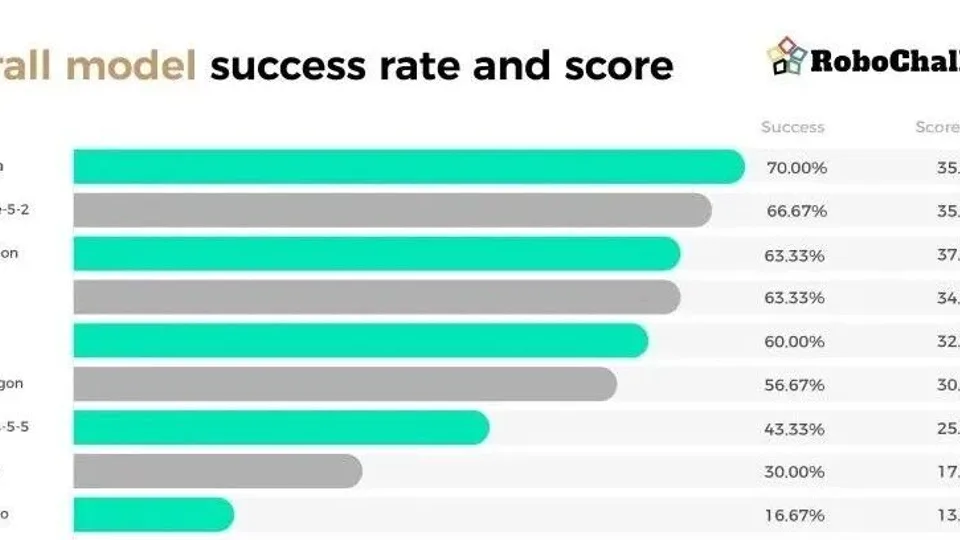
RoboChallenge Zero benchmarked 11 leading LLMs on six real-world robot manipulation tasks, achieving only 44.85% overall success; GPT-6.2 Astra led at 70%, but all models failed completely at flexible cable untangling, revealing a sharp capability gap between high-level planning and continuous low-level control, and suggesting a three-layer robot agent architecture.
Meta's Muse Wonder Full beats Claude Opus 5.5 on professional benchmarks, yet a real-world test building a 3D lawn mower simulator shows Muse producing low-poly graphics while Opus delivers near-AAA quality, despite Muse being 24x cheaper; however, API costs escalate quickly for complex tasks, and Muse Code lacks VS Code integration and struggles with large text inputs.
The article breaks down Kimi K3’s 2.8‑trillion‑parameter architecture, explains its 4‑bit MXFP4 quantization, calculates the ~1.4 TB memory requirement, shows that 8‑GPU clusters (e.g., NVIDIA B300 or AMD MI350X) are needed for self‑hosting, and compares these costs with the per‑token API pricing, highlighting when each option is economical.
When DeepSeek announced a large price increase, the author quickly benchmarked three alternatives—Tongyi Qianwen, Zhipu GLM‑4‑Flash, and a locally‑deployed model—comparing speed, accuracy, added features, and cost to devise a multi‑API strategy.