

RoboChallenge Zero: 11 LLMs on Real Robots – 44.85% Success, Zero on Flexible Objects
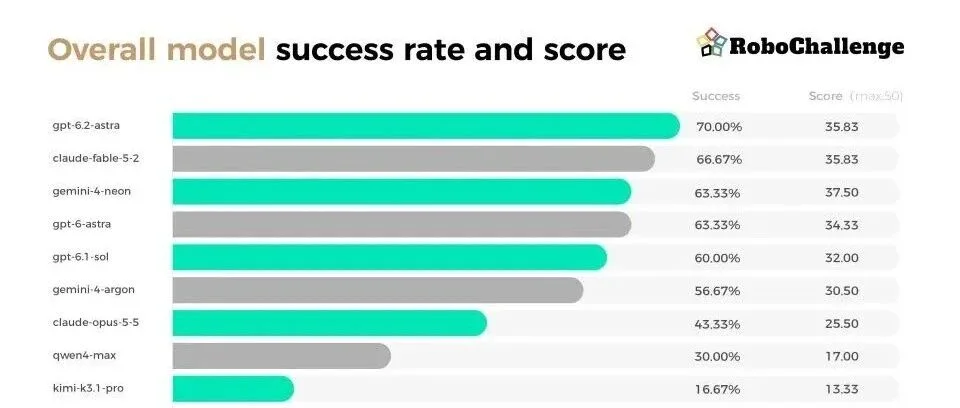
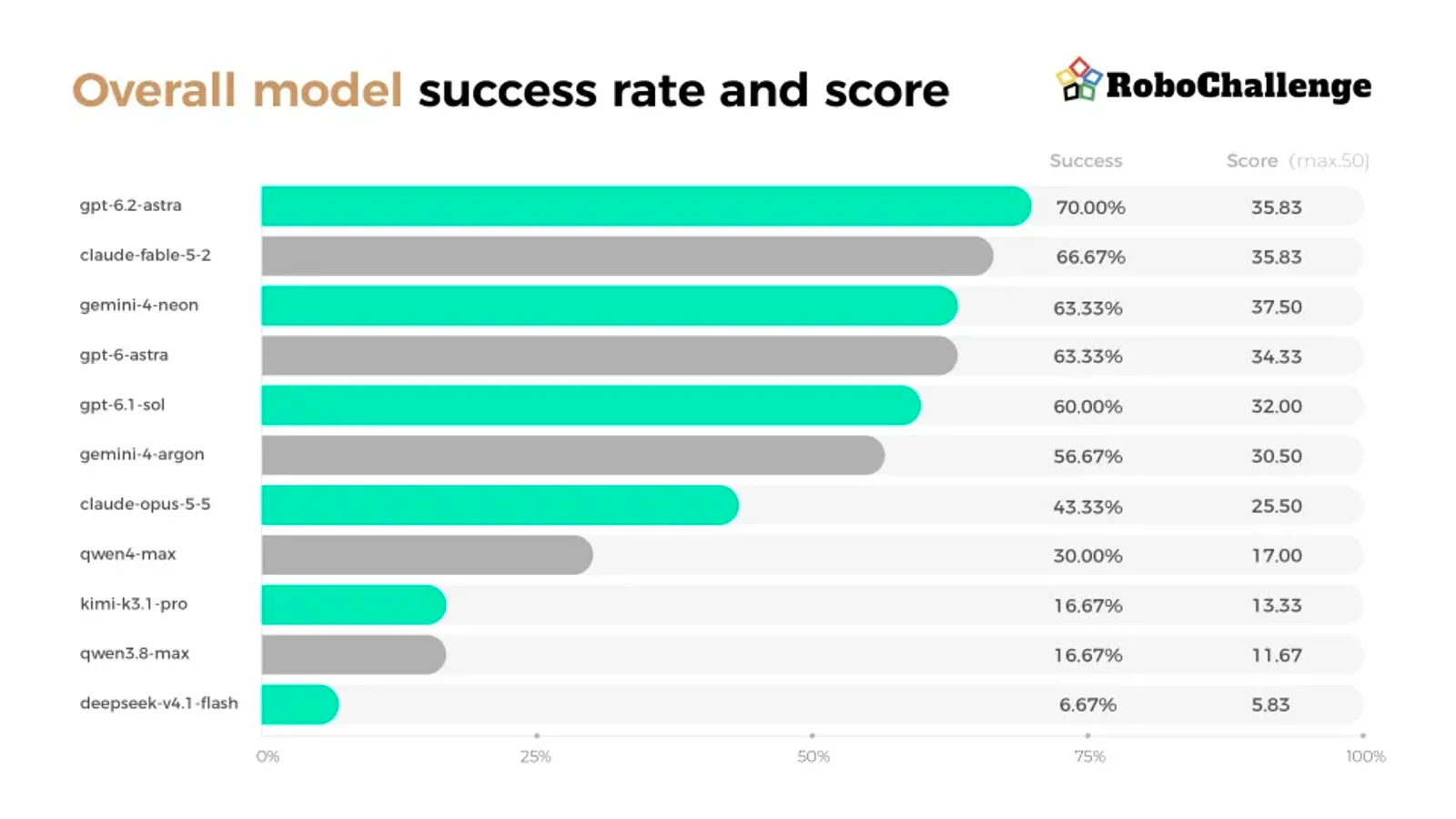
RoboChallenge Zero benchmarked 11 leading LLMs on six real-world robot manipulation tasks, achieving only 44.85% overall success; GPT-6.2 Astra led at 70%, but all models failed completely at flexible cable untangling, revealing a sharp capability gap between high-level planning and continuous low-level control, and suggesting a three-layer robot agent architecture.
Reading font
Introduction
General-purpose large models such as GPT, Claude, and Gemini are entering robotics, but a wide gap remains between "understanding a task" and "reliably controlling a robot." RoboChallenge Zero recently evaluated 11 mainstream models on six real-robot manipulation tasks, completing 330 real-robot trials. The overall success rate was only 44.85%. The top model, GPT-6.2 Astra, reached 70%, yet all 11 models scored zero on the most complex flexible-object task (cable untangling). This scorecard acts as a capability boundary map: general models can handle high-level understanding, action planning, and error detection, but fine-grained trajectory control, real-time feedback, continuous control, and low-cost operation still require dedicated embodied models and control systems.
What RoboChallenge Zero Tests
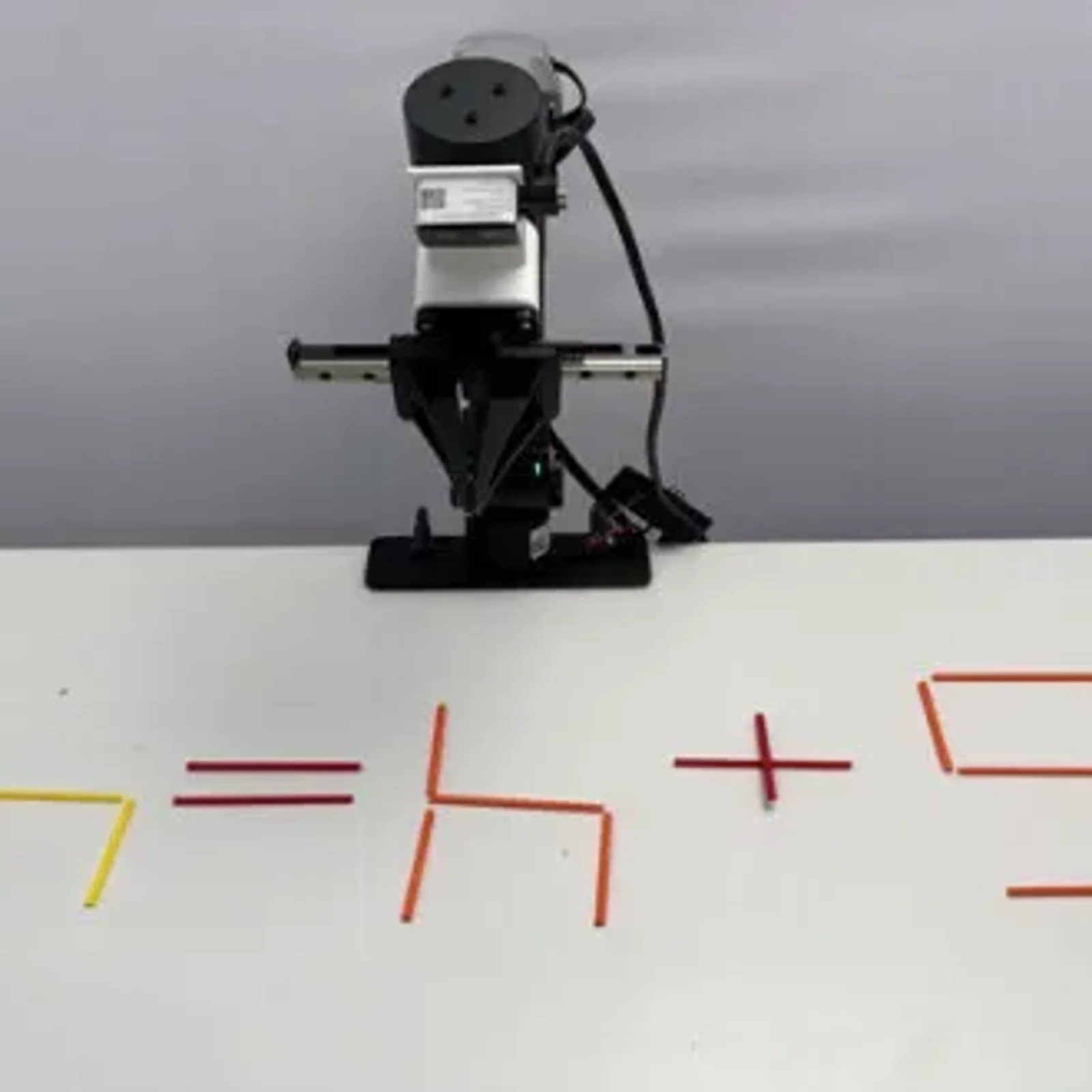
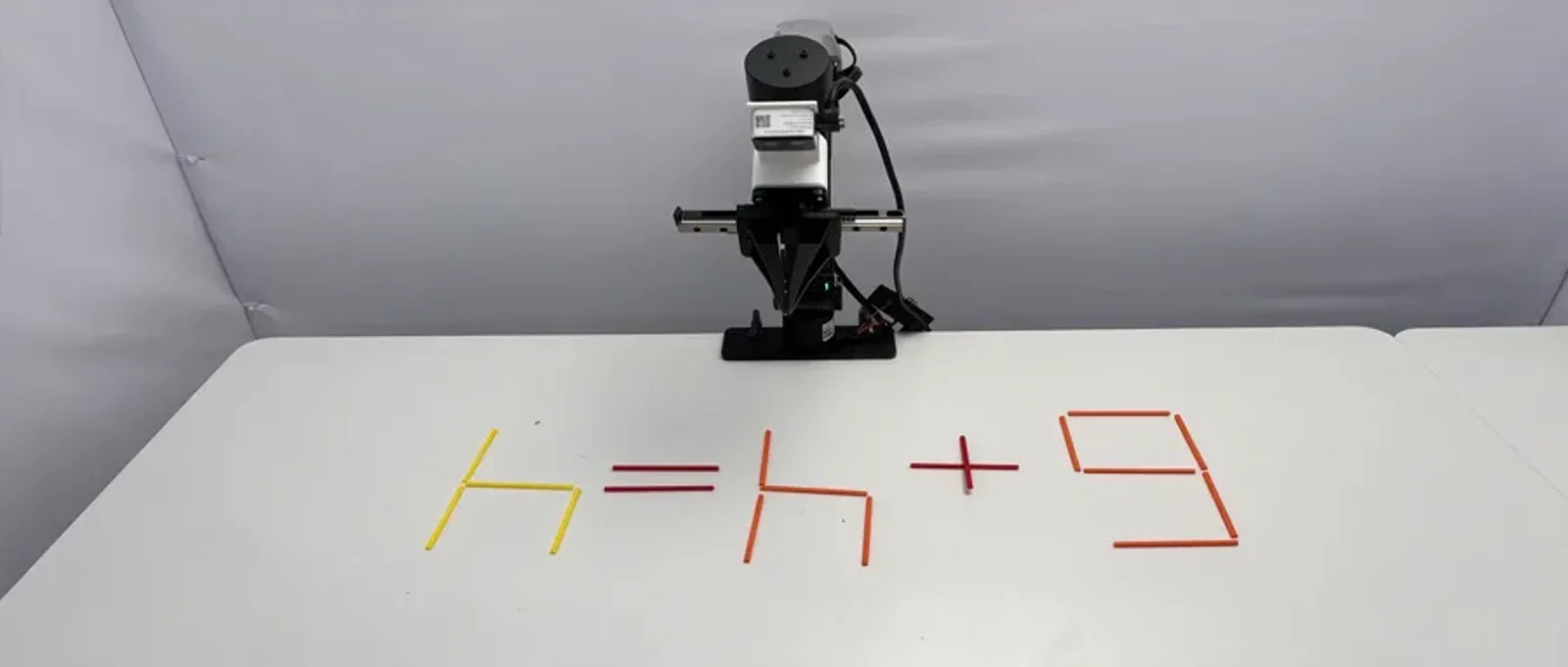
All models used the same prompt template and tool interface, with no task demonstrations, training, or fine-tuning allowed. Each model observed the environment via camera, read robot state, reasoned about the task, called tools to control the arm, then observed again and adjusted. The six tasks covered object recognition, pick-and-place, mathematical reasoning, dual-arm coordination, fine trajectory control, and flexible-object manipulation. Each model was tested independently five times per task; success rate was computed per task based on complete completion.
Overall Results
GPT-6.2 Astra – 70%
Claude Fable 5.2 – 66.67%
Gemini 4 Neon – 63.33%
GPT-6 Astra – 63.33%
DeepSeek-V4.1-Flash – 6.67%
The ranking reflects zero-shot comprehensive performance only and does not directly indicate suitability for all robot platforms; arm specifications, cameras, control interfaces, and task distribution all affect outcomes.
Simple Tasks Near 90%, Fine Manipulation Falls Off a Cliff
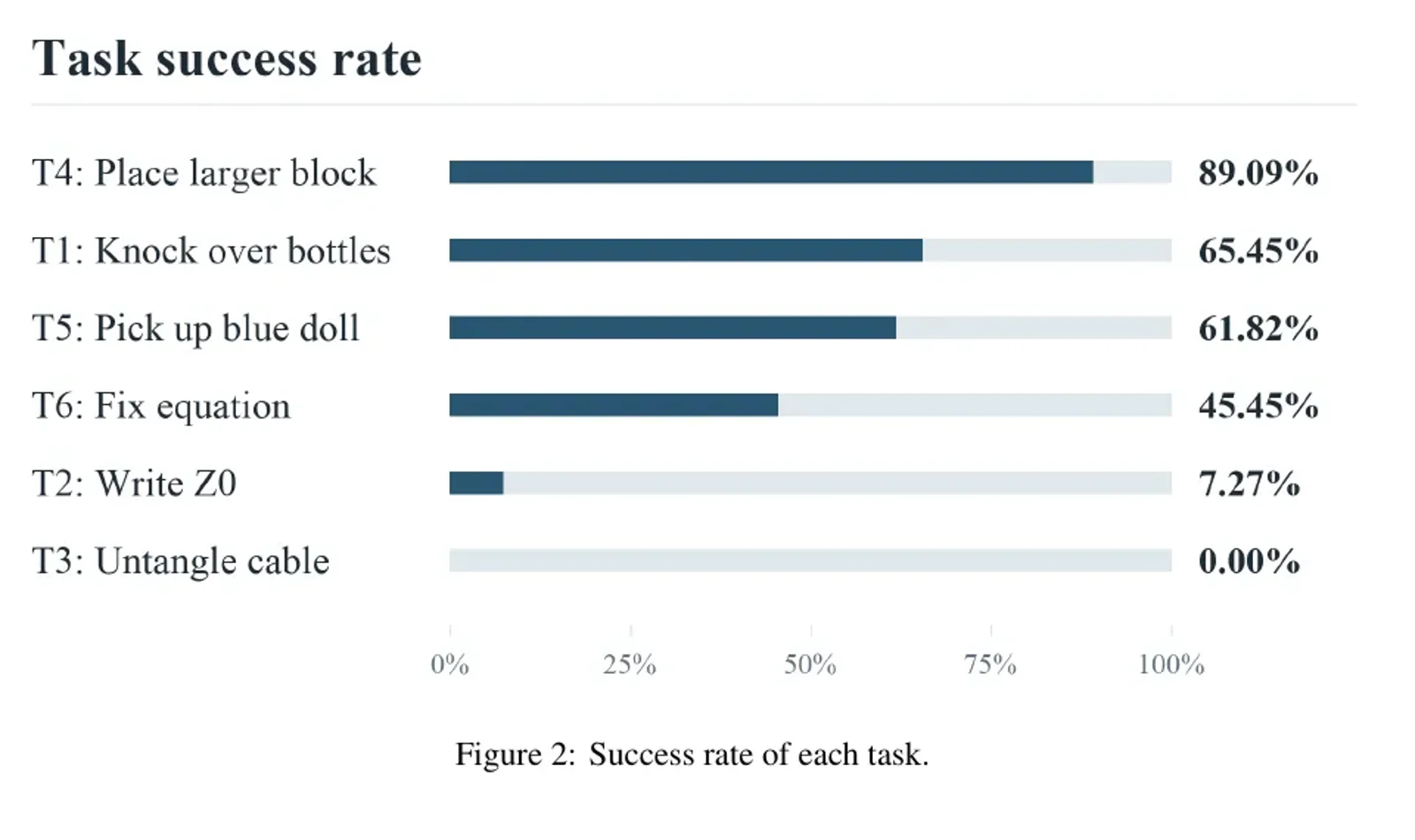
In the block placement task, the 11 models achieved an overall 89.09% success rate, with seven models succeeding in all five trials. Bottle knocking, doll grasping, and stick moving scored 65.45%, 61.82%, and 45.45% respectively. These tasks show that general models already possess visual understanding, spatial reasoning, and basic operation ability. However, dual-arm coordinated writing achieved only 7.27% overall success (4 successes out of 55 trials), and untangling and laying flat a tangled data cable scored 0%.
The gap stems from the nature of the actions. Recognition and pick-and-place resemble one-shot decisions, while flexible objects and fine trajectory control demand continuous handling of deformation, contact, friction, visual changes, and action errors. Getting every step right does not guarantee stability over dozens of consecutive steps.
Why General Models Are Slow and Expensive
When a large model controls a robot, it must repeatedly observe, reason, call tools, execute actions, and gather feedback. This suits complex understanding and high-level planning but is ill-suited for every motor action to undergo a round of remote inference.
Block placement and doll grasping averaged 13–14 minutes per trial.
Dual-arm writing (4 successful trials) averaged 23.8 minutes.
A successful dual-arm writing trial required an average of 43.8 model calls, nearing the 50-call limit.
Token consumption is similarly high: block placement ~479,800 tokens, doll grasping ~517,500 tokens, dual-arm writing ~1,735,600 tokens. Some models incurred API costs of several dollars per successful task, while production lines need to repeat large numbers of actions daily.
This creates a clear division of labor: general models handle goal understanding, step planning, and exception handling; embodied models handle low-latency action generation; low-level controllers handle trajectory, collision, speed, and torque constraints.
Robot Agent Should Be Split into Three Layers
A more realistic robot agent architecture can be divided into:
Task Layer: Understand natural language, identify goals, decompose tasks, and judge whether human confirmation is needed.
Skill Layer: Call verified skills such as grasping, moving, obstacle avoidance, visual localization, and dual-arm coordination.
Control Layer: Execute trajectory and feedback control at high frequency, ensuring actions stay within bounds, avoid collisions, and can stop at any time.
General large models should not directly touch the motor layer. They should output structured action intents (target object, grasp pose, allowed speed, failure fallback); the skill layer converts intents into executable actions, and the control layer performs real-time motion. This layering also reduces inference cost: routine actions are handled by the skill layer, escalating to the general model only for unknown objects, abnormal states, or task goal changes.
Evaluating Robot Models Requires More Than Success Rate
RoboChallenge Zero reminds developers that robot evaluation must record at least five metrics simultaneously: success rate, completion time, model call count, token/interface cost, and failure types. A model with 70% success but requiring 40 minutes and 1.7 million tokens per task may be inferior to a slightly lower-success system that finishes in 3 minutes. For production, continuous runtime stability, fault recovery, mechanical wear, and human intervention rates must also be considered.
Task difficulty must be stratified. Near-90% success on block placement does not mean the robot can handle cables, fabrics, insertions, or liquids. If the test set contains only rigid objects and short paths, model rankings will be significantly overestimated.
From Lab to Production: Missing Capabilities
Developers can start with low-risk tasks, using simulation and real-robot dual-track verification. Each trial should save visual input, robot state, model plan, tool calls, trajectory, and final result; failures must be replayable and attributable to perception, planning, skill, control, or hardware issues.
Production integration requires speed limits, torque limits, workspace boundaries, emergency stop, human takeover, and idempotent task IDs. The model may propose "grasp this object" but must not have permission to modify safety boundaries or bypass stop conditions.
General large models currently act more like a coach that understands tasks and formulates strategy. Embodied models and control systems turn that strategy into fast, precise, reliable actions. The two are not simple substitutes but must collaborate through clear interfaces.
Domestic teams wishing to access general models via API for robot experiments can explore channels like Code80 (https://code.ai80.vip/home), but real hardware, controllers, simulation verification, and safety responsibility remain the team's own.
Frequently Asked Questions
GPT-6.2 Astra 70% success – ready for production?
No. This result comes from a specific zero-shot real-robot evaluation; production must consider continuous operation, real-time performance, hardware wear, fault recovery, and safety boundaries.
Why are flexible-object tasks especially hard?
Cables, fabrics, and soft objects deform after every contact, requiring the model to continuously update grasp points and actions. A single correct visual recognition cannot guarantee continuous control success.
Should general models directly control the robot arm?
Not recommended. General models are better suited to output task intents and high-level plans; skill and control layers convert plans into safe, low-latency actions.
How to reduce robot agent cost?
Let the skill library handle repetitive actions; invoke the general model only for unknown states, task changes, and exception recovery; cache visual features, limit call rounds, and record task-level costs.
Does simulation success guarantee real-robot transfer?
No. Gaps in vision, friction, latency, and hardware error exist between sim and real; phased speed limits, human supervision, and real-robot regression are needed.
How can domestic teams access robot agent models?
API channels like Code80 can lower model access friction, but teams must still manage robot state, tool permissions, control interfaces, logging, and safety audits themselves.
For questions about attribution, corrections or content rights, please contactand we will review it promptly.