Researchers from Virginia Tech, UMD, and MBZUAI rewrote 60 ICLR 2026 papers 20 ways each using GPT-5.5 and Claude Opus 4.8, then evaluated 30 AI reviewer configurations on 1,200 rewrites, finding that prompt-based robustness often yields 'false robustness' with near-random discrimination, while their SciCore dual-branch method—combining full-paper review with a structured Science Core extraction—reduces score drift by 38% while preserving discrimination.
The article reviews Anthropic's newly released Claude Fable 5, compares its pricing, benchmark scores, and real‑world coding performance against Claude Opus 4.8 and GPT‑5.5, and concludes that while Fable 5 delivers the most reliable, out‑of‑the‑box results, its cost makes it suitable only for high‑value, complex projects.
Anthropic's Claude Opus 4.8 uncovered a four‑year‑old vulnerability in Zcash's Orchard privacy protocol that lets attackers mint unlimited fake ZEC, leading to a near‑50% price plunge, a rapid emergency fix, and a broader signal that AI‑assisted security audits are becoming a reality in blockchain.
Claude Opus 4.8 adds effort‑level control, a cheap fast mode, and a dynamic workflow that can run up to 1,000 sub‑agents, and by matching tasks to the appropriate effort and mode users can halve monthly token spend while keeping output quality unchanged.
Claude Opus 4.8, released just 43 days after 4.7, improves honesty, cuts code‑defect miss rates to a quarter, reduces over‑confident answers, outperforms Mythos on several benchmarks, and introduces Dynamic Workflows that let hundreds of sub‑agents run in parallel for complex tasks.
Claude Opus 4.8, released on May 28 2026, keeps the same 1 M‑token hybrid reasoning model and pricing but adds modest benchmark gains, stronger honesty in code‑summary reporting, Dynamic Workflows for multi‑agent orchestration, a more complex cost structure, and new security considerations, guiding engineers on when and how to adopt it for high‑value, long‑running tasks.
Anthropic released Claude Opus 4.8 only 41 days after Opus 4.7, delivering unprecedented 0 % lie‑rate and 0 % lazy‑answer rate, improving code‑defect silence by four‑fold, boosting SWE‑bench Pro to 69.2 % and GDPval‑AA to 1890 Elo, while adding Dynamic Workflows, Effort Control, a richer Messages API and a fast‑mode that runs 2.5× faster for a third of the cost.
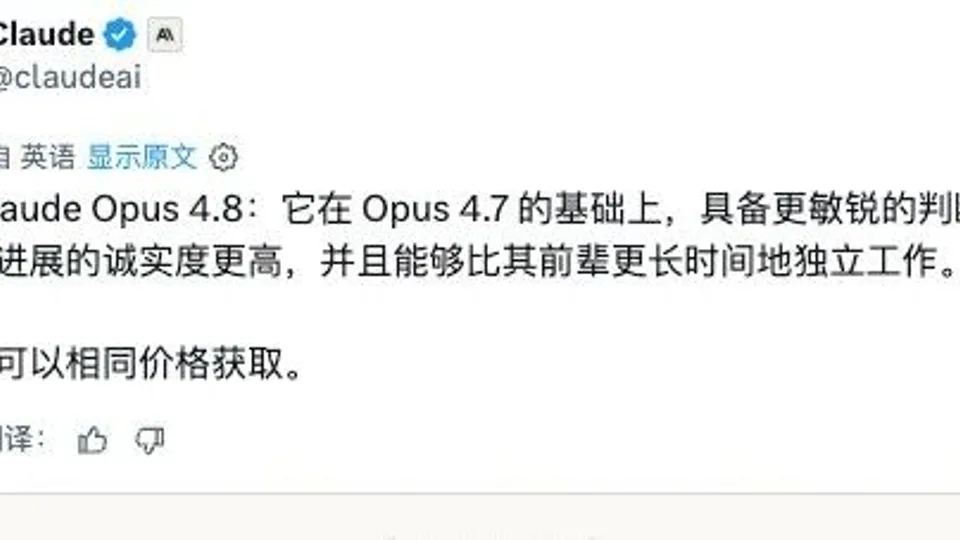
Claude Opus 4.8 improves judgment, honesty about progress, and long‑running autonomy while keeping the same price, outperforms rivals on code, reasoning and knowledge‑work benchmarks, introduces a 2.5× faster “Fast mode” and a research‑preview dynamic workflow that can orchestrate hundreds of sub‑agents in parallel.
Anthropic unveiled Claude Opus 4.8, a flagship LLM that improves benchmark scores, introduces honesty training and dynamic workflows, offers unchanged pricing with a cheaper fast mode, and announced a $65 billion financing round that lifted its valuation to $965 billion.
Anthropic released Claude Opus 4.8 with unchanged pricing, new inference‑strength controls, Dynamic Workflows for massive tasks, a fast mode 2.5× quicker and three‑times cheaper, and benchmark results showing its agent capabilities surpass GPT‑5.5 while improving honesty and alignment.
Anthropic simultaneously exposed three next‑gen AI models—Claude Opus 4.8 in Google Vertex AI, Sonnet 4.8 via a massive source‑map leak that skips version 4.7, and the first glimpse of the security‑focused Mythos 1—while outlining visual, coding, and inference upgrades, higher token costs, and a fast‑approaching commercial rollout amid fierce competition from OpenAI and Google.