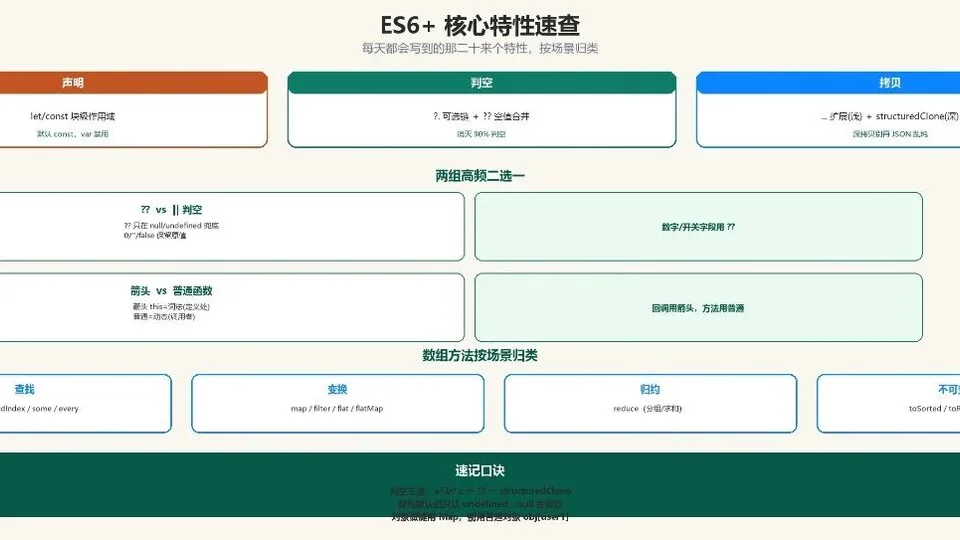
A practical cheat sheet grouping the 20+ most-used ES6+ features by daily coding scenarios — scope declarations, template strings, destructuring, arrow functions, spread operator, optional chaining, nullish coalescing, Map/Set, modern array methods, and dynamic imports — with code examples, common pitfalls, and decision guidelines.
This article explains how the optional‑chaining (?.) and nullish‑coalescing (??) operators simplify deep object access and default‑value handling in JavaScript, offering concise, safe alternatives to verbose if‑else checks, try‑catch blocks, and the logical‑or operator.
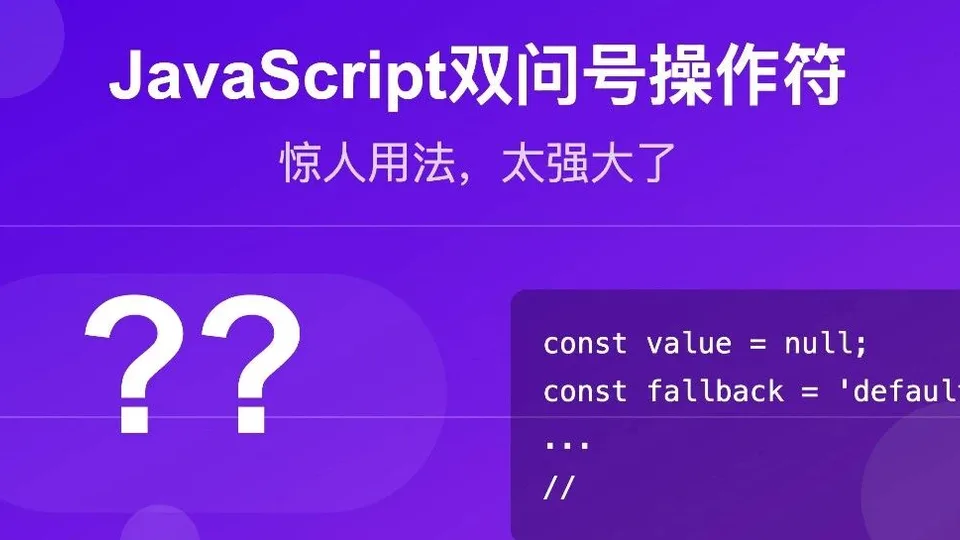
Learn how JavaScript’s nullish coalescing (??) operator works, its key differences from the logical OR (||) operator, and see practical examples—from handling default form values to chaining defaults and combining with optional chaining—plus performance considerations and advanced patterns.
An automatically applied Babel plugin scans JavaScript AST nodes and rewrites risky property accesses and logical‑AND chains into optional‑chaining expressions, letting developers prevent TypeError crashes without modifying source code, while offering include/exclude filters, optional short‑circuit optimization, and compatibility with older browsers via downstream transforms.
The article explains how to create a custom Babel plugin that automatically transforms risky member and call expressions into optional‑chaining equivalents during bundling, using configurable include/exclude patterns and short‑circuit optimizations, thereby preventing TypeError in large JavaScript codebases while noting a modest bundle‑size increase.
This article explains how JavaScript's optional chaining (?.) and nullish coalescing (??) operators simplify safe access to nested object properties and provide reliable default values, replacing older verbose patterns with concise, readable code.
This article explains the challenges of reading and writing deeply nested data in JavaScript, introduces native optional‑chaining and TypeScript solutions, and walks through the design and implementation of a reusable anypath library that supports objects, arrays, Maps and Sets.
This article examines the challenges of reading and writing deeply nested JavaScript data, explains why traditional defensive checks fail, introduces optional chaining and TypeScript strict null checks, and presents the anypath library with setany/getany functions that automatically create missing objects or arrays while supporting future extensions for Map and Set.
This article outlines eight practical JavaScript habits—using let/const, writing meaningful comments, preferring == over ===, leveraging optional chaining, avoiding magic values, handling async errors, passing multiple parameters instead of a single object, and using concise conditionals—to produce more maintainable, readable, and robust code.
This article explains the ES2020 optional chaining (?.) and dynamic import() features, showing their syntax, practical code examples, compatibility notes, and how they simplify JavaScript code while improving web application performance.