

Any2Act: Heterogeneous Data as Video Prompts for Robot In-Context Learning
Any2Act, a robot in-context learning model from Tsinghua, HKU, and Galaxy General, enables five types of heterogeneous demonstration data to serve as video prompts for a Galbot G1 robot, achieving 57.5% zero-shot success on novel tasks without fine-tuning, surpassing fine-tuned baselines.
Reading font
Introduction: The Fast-Slow System Bottleneck
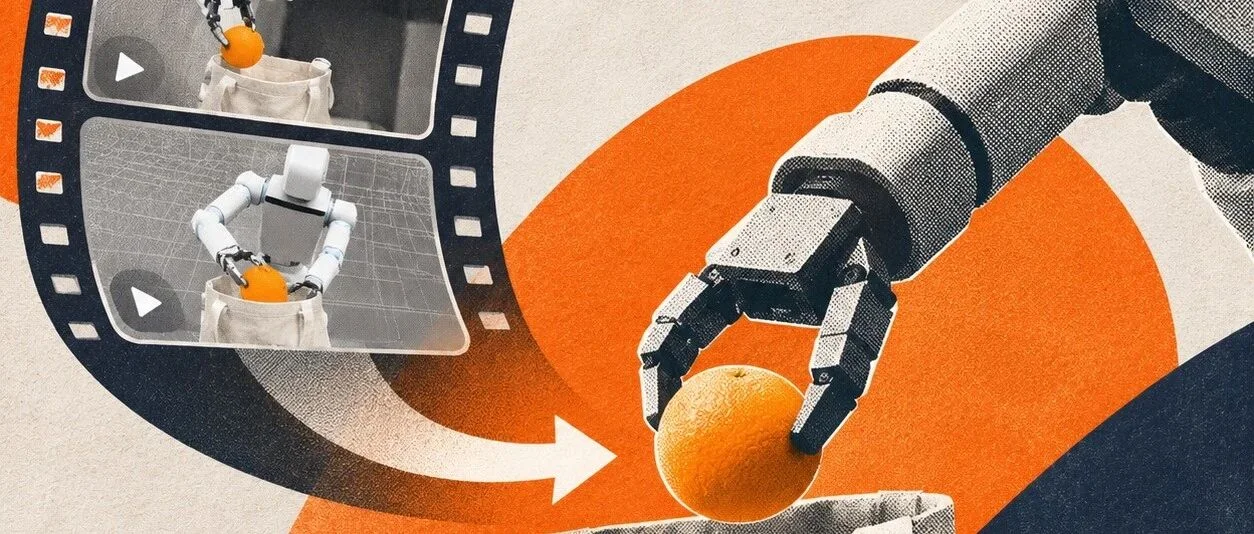
Embodied intelligence has converged on a fast-slow architecture: a general large model (System 2) handles understanding and planning, while an embodied policy (System 1) executes high-frequency control. A critical question emerges: what should the large model pass to the policy? Natural language conveys goals but loses physical details—grasping points, bag opening, bimanual coordination. Meanwhile, data collection is bottlenecked: real-robot teleoperation is expensive and slow. The field hopes to leverage human first-person videos, UMI handheld grippers, simulation, and other robots' data. The mainstream approach mixes these heterogeneous data into training, forcing the model to digest cross-embodiment differences in its weights. This incurs high engineering cost: each new data source requires format realignment and retraining, with uncertain transfer gains.
Tsinghua University, Hong Kong University, and Galaxy General jointly release Any2Act , a Robot In-Context Learning foundation model. Instead of training heterogeneous data into weights, Any2Act keeps them on the input side: a human video, a UMI recording, a simulation rollout, or another robot's trajectory becomes a Video Prompt placed in context, driving the real robot to perform unseen tasks without parameter updates.
Why Video Prompts Instead of Language?
Language expresses what to do but struggles to specify how . For tasks requiring bimanual coordination, fine grasping, or deformable object manipulation, enumerating spatiotemporal constraints in text is impractical. Recording a video, retrieving a reference clip, or letting a large model simulate in a simulator is far cheaper. For a World Action Model (WAM) that jointly predicts future frames and robot actions, video is the native modality. A text prompt activates LLM capabilities; a demonstration in context is essentially a Video Prompt: the model continues the current observation along the demonstration's logic and grounds the prediction into control actions.
Three practical barriers hinder demonstration-conditioned policies:
Scalable supervision is hard to obtain: Human-video methods rely on scarce human-robot paired data; human videos lack action labels and often occlude contact surfaces. Robot-demonstration methods stay in simulation or small-scale benchmarks with limited task breadth.
Data sources are tightly coupled: Existing in-context policies accept only one or two specific demonstration types; adding a new form requires large-scale paired data collection and retraining.
Cross-scene transfer and fault tolerance are difficult: Real execution faces object instance, layout, and lighting mismatches; the model must transfer operation logic, not replay. Long-horizon tasks demand recovery from misses or slips.
Unified Embodiment-Grounded Representation
Any2Act bypasses these barriers with a representation shift: demonstrations should not stay in a single head-mounted view nor retain each demonstrator's hardware format. Instead, they are unified into the executor's camera layout and action space. The team defines a Unified Embodiment-Grounded Representation using the executor's head plus dual-wrist three-view cameras and the dual-arm, gripper, and mobile-base action space. All demonstrations—human, UMI, simulation, other robots—are first translated into this unified space before the policy reads them.
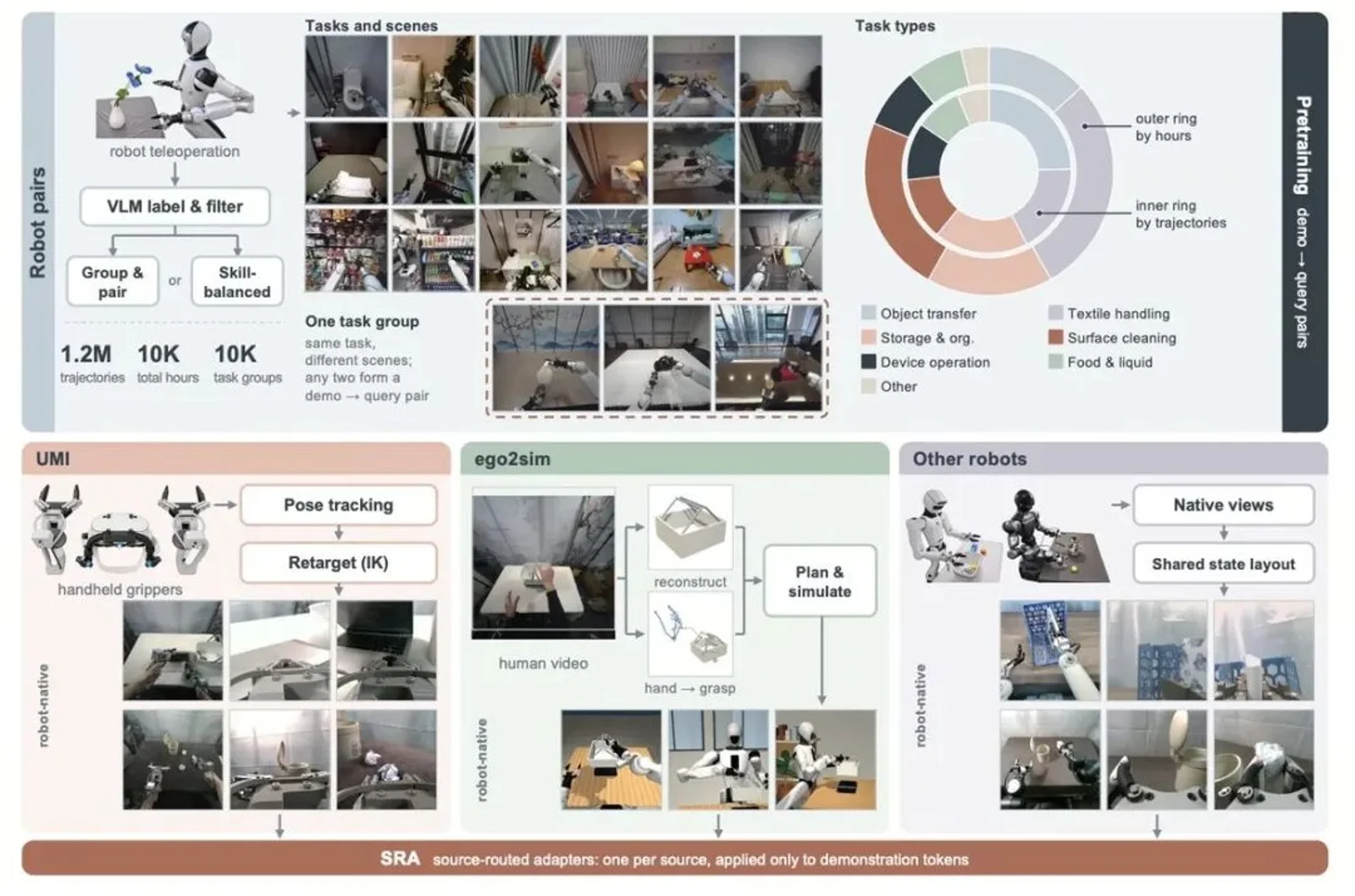
This shift also unlocks pre-training data scale. Since all demonstrations land in the executor's space, the model need not rely on scarce human-robot pairs to learn following. It can learn general following ability directly from the robot's own daily teleoperation data. In routine collection, the same task is repeatedly recorded across scenes, object instances, and placements. After VLM annotation and filtering, any two trajectories of the same task are paired, yielding naturally aligned training pairs with precise actions and three-view images. This builds a pre-training pool of 1.2 million real-robot trajectories, 10,000 hours, 10,000 tasks . Because paired trajectories differ in environment and object layout, the model cannot simply replay; it must learn to transfer demonstration logic to the current scene. External sources (human video, simulation) are later aligned into the same space via cross-source pipelines.
Cross-Source Alignment Pipeline + Lightweight Adapters
The base model masters Galbot G1's own demonstrations, but external sources differ greatly: human egocentric video lacks wrist views and action labels; simulation has visual domain gaps; other robots have different kinematics. The pipeline first completes missing modalities, then reduces residual domain shifts.
Human Egocentric Video
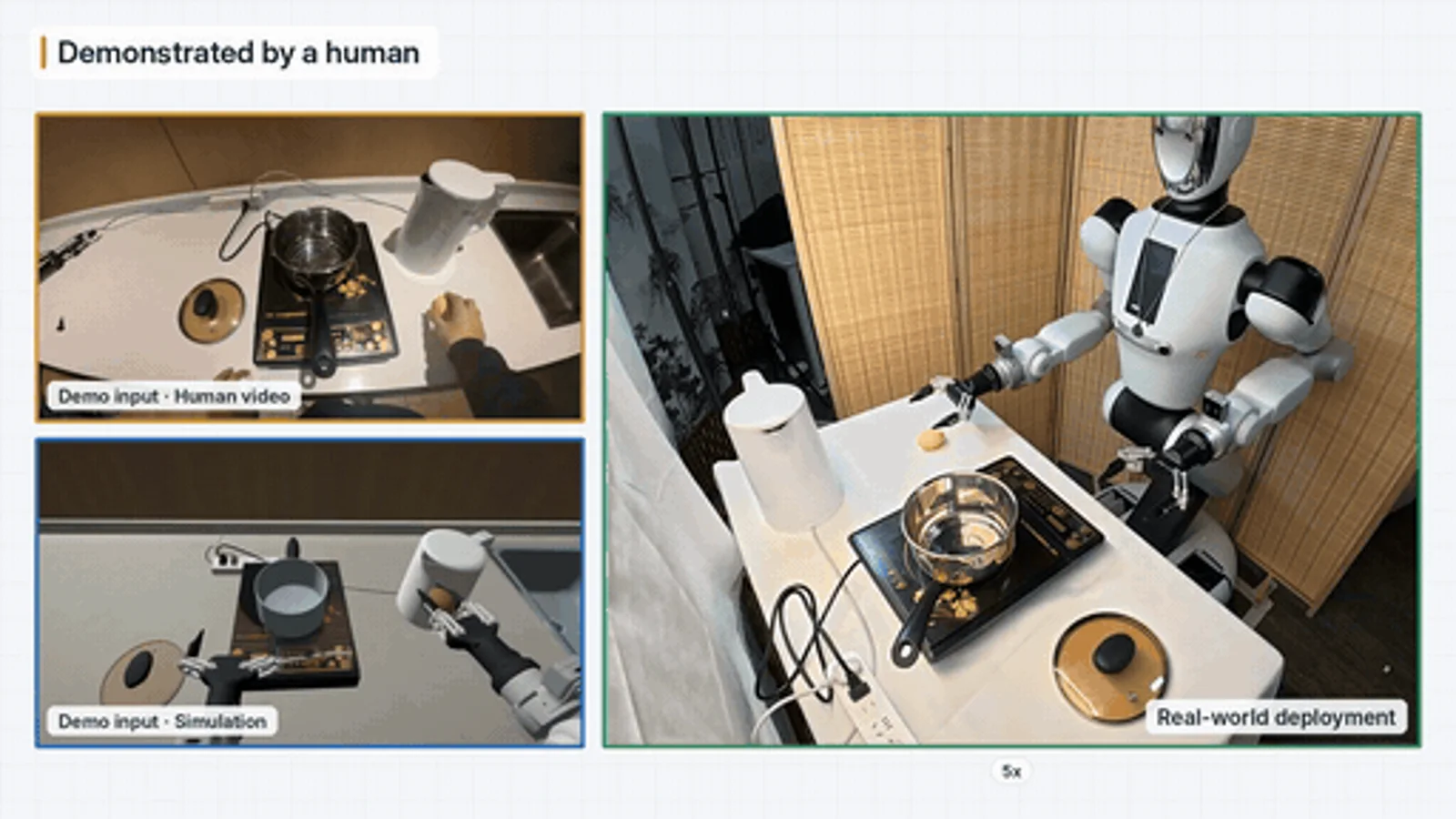
Humans wear only a head camera—no wrist views, no action labels. A minute-level agentic ego2sim pipeline estimates hand and object poses from video, reconstructs the scene in simulation, replaces human hand with robot gripper, and re-enacts the task with the simulated robot, yielding the missing dual-wrist views and precise actions.
Simulation Demonstrations
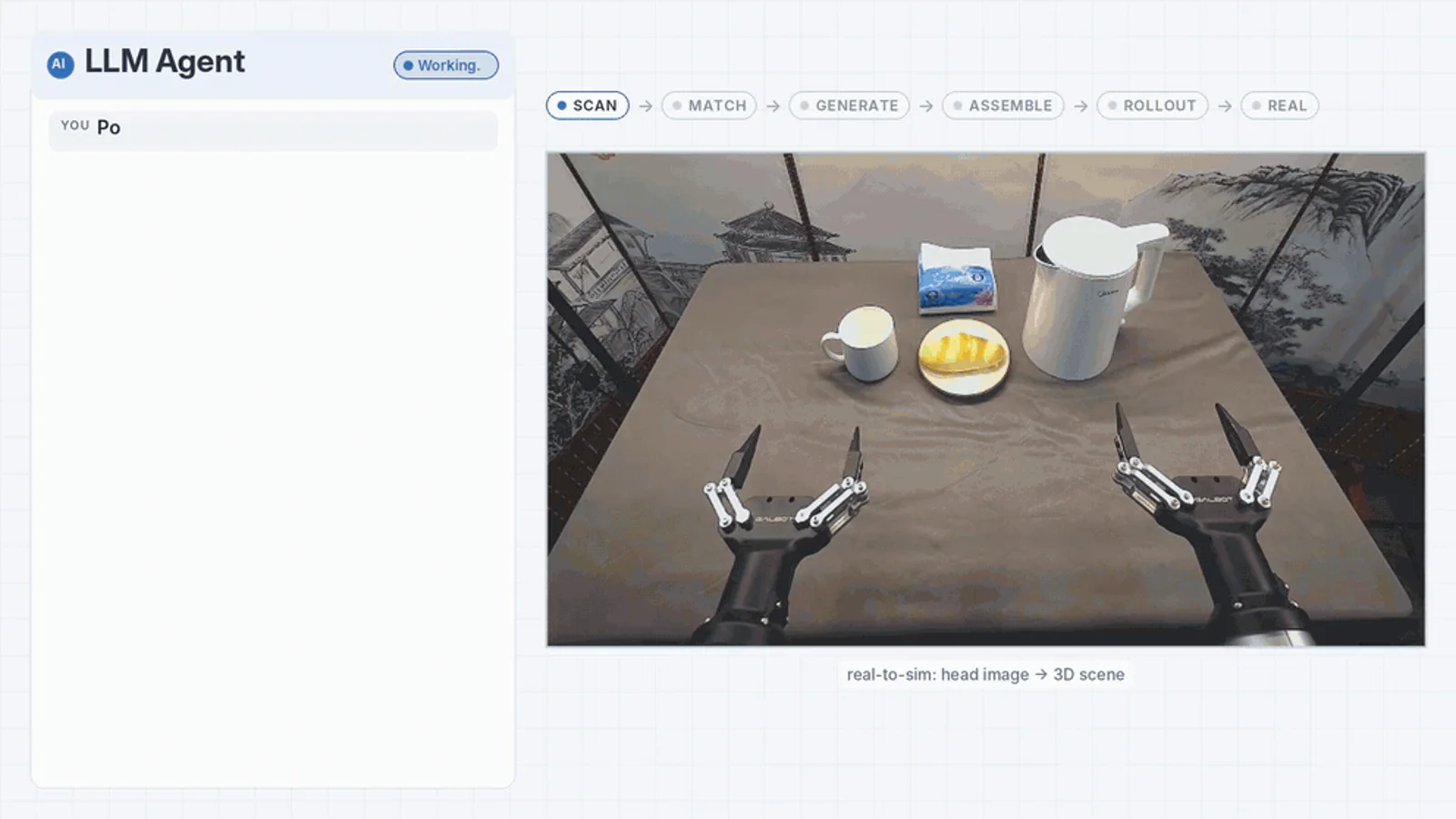
If no video exists, capture a single real-scene head image, quickly build the corresponding environment in simulation, and let a large-model agent drive the simulated robot to complete the task. Simulation trial-and-error is free; failures can be retried repeatedly, producing a verified demonstration within a minute.
UMI and Other Robots
These already provide head and dual-wrist views; only the end-effector poses need conversion into G1's action space.

After format alignment, visual and dynamic discrepancies remain: UMI shows a handheld gripper, simulation has rendering/physics artifacts, cross-embodiment conversion introduces kinematic errors. Fine-tuning the entire base model on a small cross-source dataset risks catastrophic forgetting of the 10,000-hour general capability. Any2Act freezes the pre-trained base and attaches a lightweight low-rank plugin per new source: a Source Routing Adapter (SRA) . SRA handles residual details uncovered by the alignment pipeline, ensuring source differences do not affect inference. It activates only when reading demonstrations from its source: human video triggers the human-video SRA, UMI triggers the UMI SRA, G1's own demonstrations bypass SRA entirely. Adapters are independent, can be added/removed without retraining the base. Integration cost is minimal: 200 paired samples from 20 tasks unrelated to evaluation, trained for 500 steps .
On 12 real-robot tasks, the SRA impact is stark:
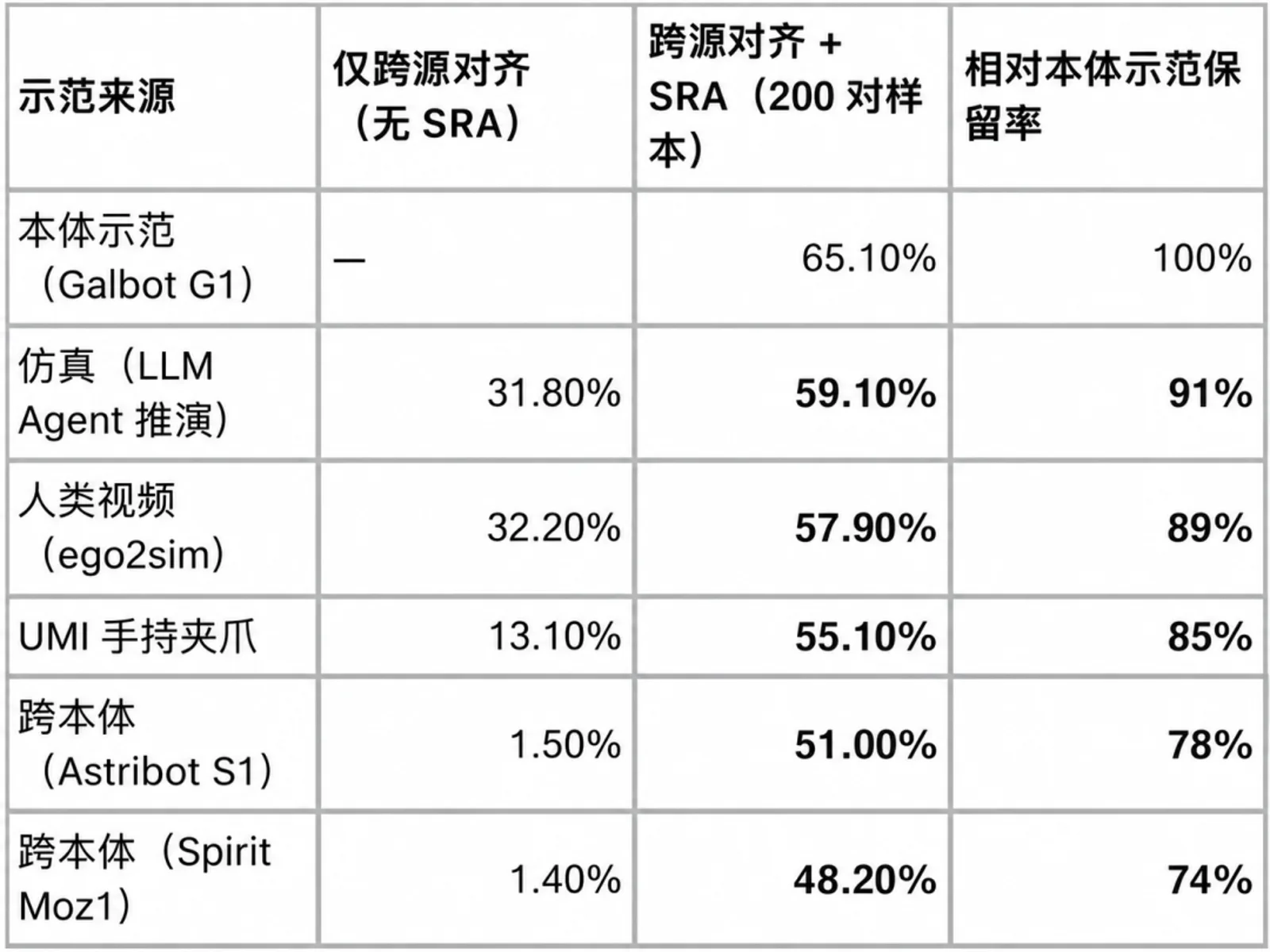
Without SRA, the frozen base understands some simulation and human video (~30% success), but fails almost completely on two kinematically distinct robots (Astribot S1, Spirit Moz1) at 1.5% and 1.4%. With SRA trained on 200 pairs, success jumps to 51.0% and 48.2%, retaining over 70% of own-demonstration performance; simulation, human video, and UMI reach 59.1%, 57.9%, 55.1%, retaining 85%-91%.
Sliding Window Progress Tracking: Long-Horizon Without Context Bloat
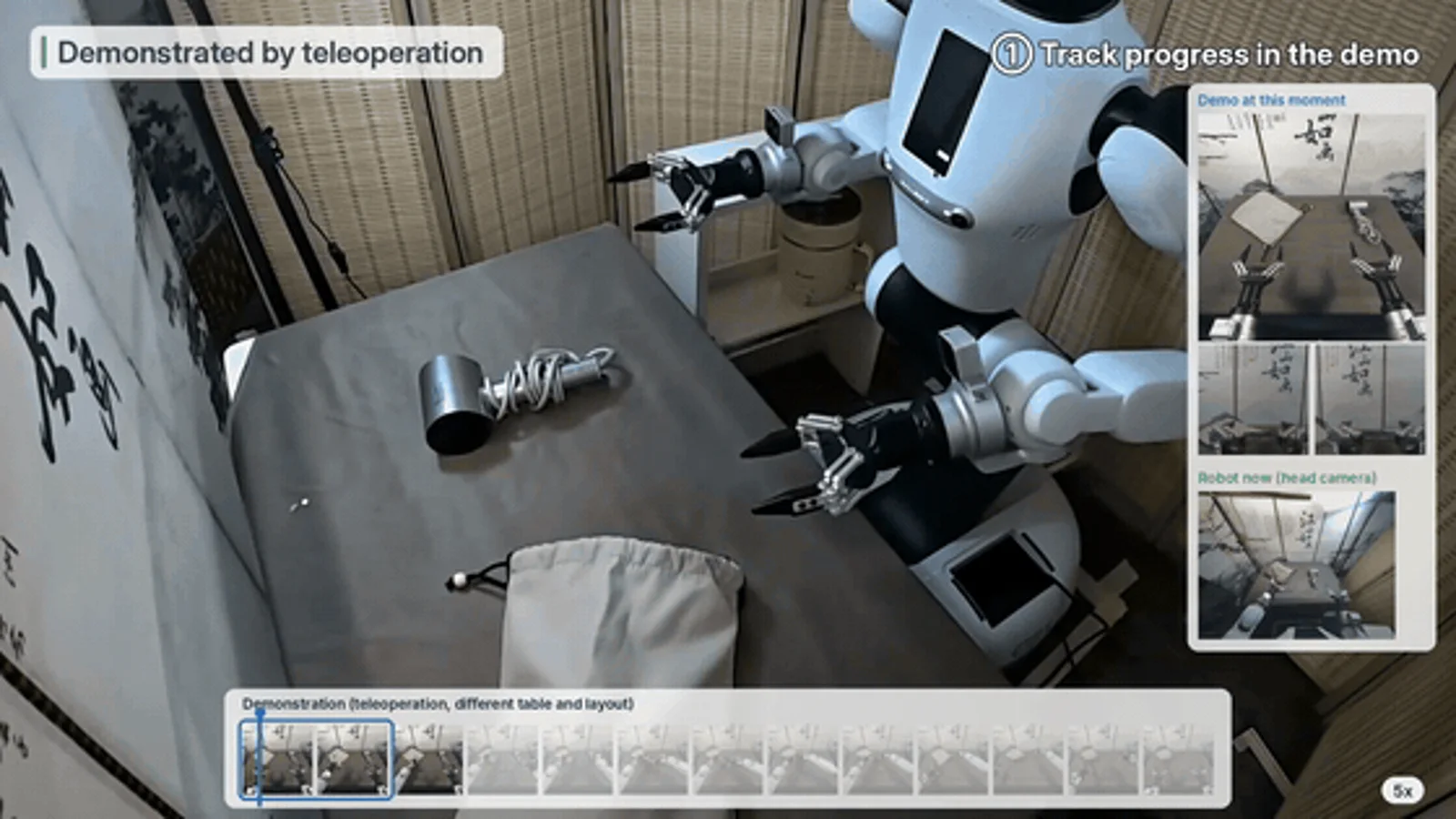
Encoding an entire long demonstration into context causes linear compute growth and focus loss. Any2Act reads only a small demonstration window around the current execution progress. Window position is determined by a training-free online tracker based on frozen DINOv3 visual features, comparing current observation with demonstration head and wrist views along a monotonic path. During training, random perturbations on window center and time-axis scaling teach the policy to precisely localize progress within a coarse window. This tracker aligns demonstrations across sources and enables error recovery via a rewind mechanism.
Real-World and Simulation Evaluation
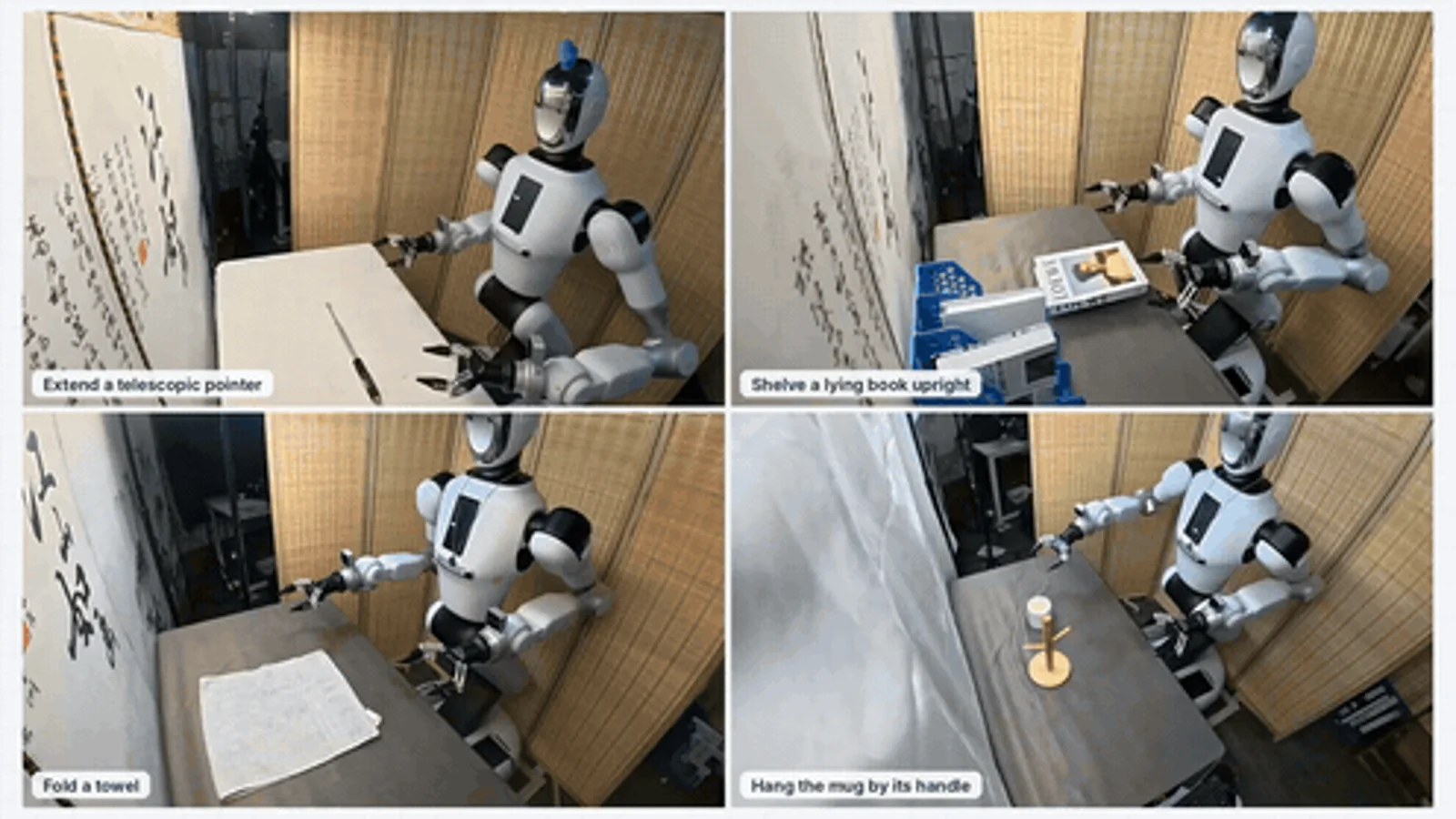
To thoroughly test generalization, the team built two sets of 6 tasks each (12 total) on Galbot G1, none seen during pre-training, each tested 100 times in novel scenes with shuffled layouts:
Task Generalization (novel task composition): Recombining pre-trained atomic skills into new goals and step orders. Any2Act without any fine-tuning, single demonstration achieves 57.5% average success. Fine-tuned baselines with 50 demonstrations per task: π0.5 43.0%, GR00T N1.7 47.5%. Open-source in-context learning baselines HOST and Zero-WAM on same robot paired data: 15.7% and 19.7%.
Skill Extension (novel physical skills): Soft-body bagging, book retrieval from shelf, bimanual pouring—skills absent from pre-training. After lightweight adaptation with 20 demonstrations per task, Any2Act reaches 72.7% average success, leading GR00T N1.7 (47.5%) and π0.5 (43.2%) with 50 demonstrations.
Simulation benchmark RoboTwin 2.0 (cross-task protocol): 7 unseen tasks, each given one simulation video. Any2Act scores 53.1% average success, above Zero-WAM (47.0%) and language-conditioned WAN-Action (11.0%). Deployment uses pre-computed demonstration latents; single inference takes 180 ms to generate a 2-second, 30 Hz action chunk.
Scaling Laws and Ablation: Generalization Comes from Reading Demonstrations
Scaling robot-paired pre-training data from 400 hours to 2,000 hours to 10,000 hours lifts zero-shot novel-task success from 13.3% to 32.3% to 57.5% —over 4x improvement. At equal data scale, removing demonstration input and keeping only language instruction drops success from 24.2% to 9.0%. This control directly rules out memorization, confirming that generalization gains stem from reading and transferring in-context demonstrations.
Conclusion
Efficiently leveraging human video, simulation, and cross-embodiment data has been a core scaling challenge in embodied intelligence. While the field tries to fuse heterogeneous data into a single model's weights during pre-training, Any2Act offers a clear, modular alternative: scale the follow-the-demonstration capability in the executor's own space using massive self-generated data, then keep heterogeneous data at inference time, translating them via unified representation and lightweight adapters into callable Video Prompts. This design also widens the fast-slow system interface: the slow system need not be limited by language precision; it only retrieves or generates a demonstration, while the fast system executes high-frequency, fault-tolerant physical control. As demonstration sources are no longer bound to a single hardware embodiment, the skill boundary of general robots gains a lower expansion threshold.
Paper: https://arxiv.org/abs/2611.32353 | Project page: https://any2act.github.io/
For questions about attribution, corrections or content rights, please contactand we will review it promptly.