

RLE Benchmark: Top LLMs Score Zero on Real Jobs When Embodied in Robots
The Robots' Last Exam (RLE) benchmark tests AI models on complete real-world job workflows like making drinks and cashiering; in disembodied Agent Mode Claude Fable 5.2 completes 31% of tasks, but all nine models including GPT-6.2 Astra and Fable 5.2 score zero when controlling a simulated robot body, revealing a critical embodiment gap.
Reading font
RLE Benchmark Overview
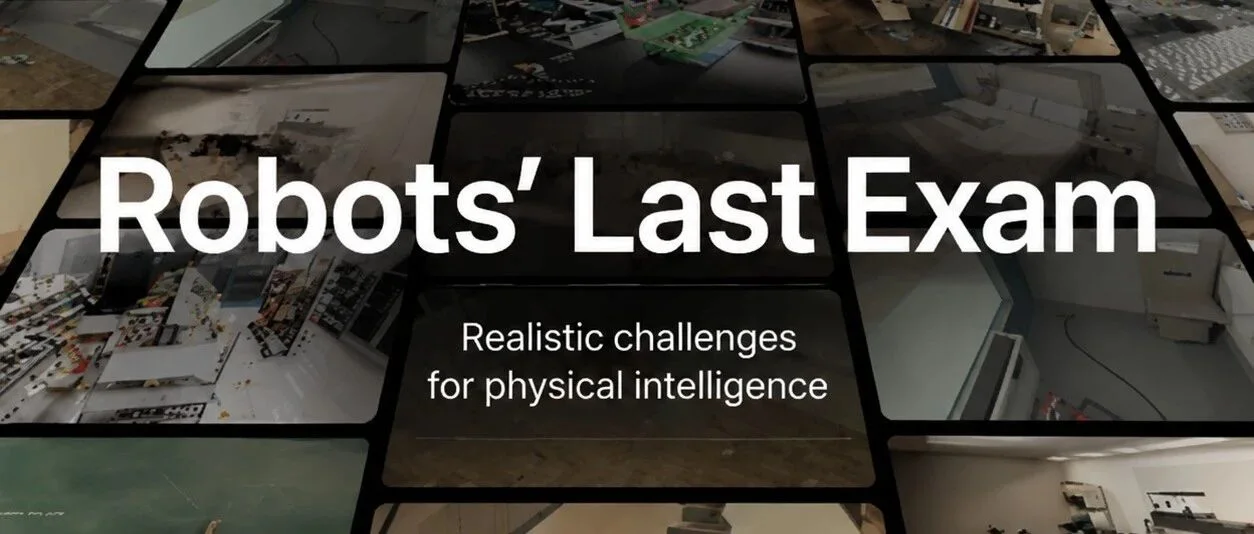
On November 28, 2024, Robots' Last Exam (RLE) was publicly released with 10 real-world job scenarios reconstructed in simulation. The benchmark evaluates whether frontier generalist models can autonomously execute full work shifts — such as making bubble tea, preparing coffee, and operating a cash register — without step-by-step instructions, judging only final delivery.
Two Evaluation Modes: Agent vs. Embodied
RLE tests each model in two modes:
Agent Mode : The model controls two independent floating grippers and a movable camera, removing joint and kinematic constraints. This isolates spatial reasoning and action planning.
Embodied Mode : The same model drives a simulated Astribot S1 mobile dual-arm robot with realistic joint limits, collision constraints, and sensor noise.
Agent Mode Results: Brains Can Plan Full Workflows
Without embodiment, top models show surprising competence on 16 complete workflows across 8 scenes:
Claude Fable 5.2 : 5/16 tasks succeeded (31.25%)
Claude Opus 5.5 : 2/16 tasks succeeded
GPT-6.2 Astra : 1/16 tasks succeeded
Other models (Gemini 4 Carbon, Qwen 4 Max, Kimi K3.1 Pro, MiniMax M3.1-Flash, etc.): 0/16
Fable 5.2's success came with high computational cost: ~5 hours per workflow, ~54 million input tokens, ~850k output tokens. It performed massive visual observation, state checking, and dynamic correction rather than one-shot planning.
Fable 5.2's Distinctive "Reprogramming" Strategy
In long-horizon tasks, Fable 5.2 allocated 38% of tool calls to coding and file operations (e.g., writing scripts to process observations, organize intermediate data), while only 60% went to robot motion. Other models spent 83–87% on direct motion commands and 13–17% on sensor queries, with 0% coding/file operations (except MiniMax M3.1-Flash at 14%). One observed behavior: Fable rewrites image-processing code to "see more clearly" before acting.
Sub-task vs. Full Workflow Gap
On 80 isolated sub-tasks (starting from correct intermediate states), performance was higher:
Claude Opus 5.5: 48.75% sub-task success, but only 2 full workflows
GPT-6.2 Astra, Gemini 4 Carbon, Qwen 4 Max: >20% sub-task success, yet 0 full workflows
The article explains the gap: in full workflows, each step starts from the physical outcome of the previous step. A tiny deviation — under-tamped coffee, slightly off-center cup, short pour — becomes a compounding error that cascades to final failure. Sub-tasks hide this accumulation because they begin from a clean, correct state.
Embodied Mode Results: Total Collapse
When the same nine models were placed in the Astribot S1 body with real joint constraints, all scored 0% on all 16 workflows . The coupling of perception, planning, and low-level control under kinematic limits proved insurmountable for every model tested.
Benchmark Construction: From Real Jobs to Executable Exams
Task Sourcing
RLE starts from Anthropic's economic study "What work can robots do?" and the O*NET occupational database, yielding 5,070 candidate tasks. Researchers expand each occupation using employee manuals, recipes, equipment specs, and worker videos into executable job specifications with materials, equipment, step norms, and acceptance criteria.
Acceptance Criteria (GDPval-inspired)
Each workflow defines concrete deliverables and verification conditions: drink matches recipe volume and ingredients; scanned items appear in correct transaction log. The evaluator checks outcome, process constraints, and result stability.
Step Dependencies
Workflows are decomposed into dependent sub-tasks (e.g., grind → tamp → extract → steam → pour). Stage boundaries have state checks; final acceptance is holistic. Sub-tasks can also be tested independently from preset intermediate states.
Simulation Fidelity: Physics, Devices, and Solvability
Scene Reconstruction
Scenes are built from real workplace photos/videos. An builder agent constructs layout, objects, and devices; a reviewer agent compares renders against references, correcting labels, affordances, and movable parts. Functional details matter: straw insertion direction, seamer tray travel, cabinet door range.
Multi-Physics Simulation
RLE uses Newton + Warp for coupled multi-material physics: liquids (surface rise), granules (coffee compaction), deformables (fabric, bags), and rigids. Physical consequences — pour volume, tamp density, grasp stability — become observable and verifiable.
Functional Device Simulation
Devices implement real operational logic per manuals. Example: barcode scanner reads codes from its current camera view; misalignment yields no transaction update. Seamer tray, coffee machine menus, and water dispensing programs all behave functionally.
Solvability Verification
Before release, a privileged reference agent with simulator-state access completes each workflow end-to-end, confirming all phases are achievable in dependency order.
Sim-to-Real Correlation Study
To address simulation fidelity doubts, researchers ran paired sim/real trials on an ARX dual-arm robot for three physically distinct tasks:
Pouring water (liquid dynamics)
Erasing whiteboard (sustained contact)
Lifting trash bag (deformable handling)
Policy: GPT-6 Astra generates Python Code-as-Policy; debugged in sim, then frozen (code + perception prompts). Execution uses RGB-D for 3D targets, IK + velocity-limited interpolation + joint feedback for motion. Same program runs both sides.
Results: 85.6% overall real-world success rate. Real success rates were 8–13 percentage points lower than sim. Beyond binary success, physical metrics (pour deviation, residual ink area, lift height) showed close quantitative correspondence, indicating RLE's physical consequences transfer meaningfully.
Community-Driven Expansion: Building Robots' World
RLE invites three contributor groups:
Frontline workers: contribute real workflows and delivery standards
Developers worldwide: build scenes, materials, functional devices
Robotics researchers: extend sim-real correlation validation
New content passes the same pipeline: scene/function check, reference execution, acceptance verification. Accepted tasks enter the unified evaluation protocol; new models are tested under identical rules with results continuously updated on the public leaderboard. The long-term goal is a comprehensive, diverse, ever-growing Robots' World that serves as a representative capability assessment before general-purpose robots enter shops, warehouses, and homes.
For questions about attribution, corrections or content rights, please contactand we will review it promptly.