

Loop4D: 1.3B Model Beats 14B/22B Rivals in 4D World Modeling
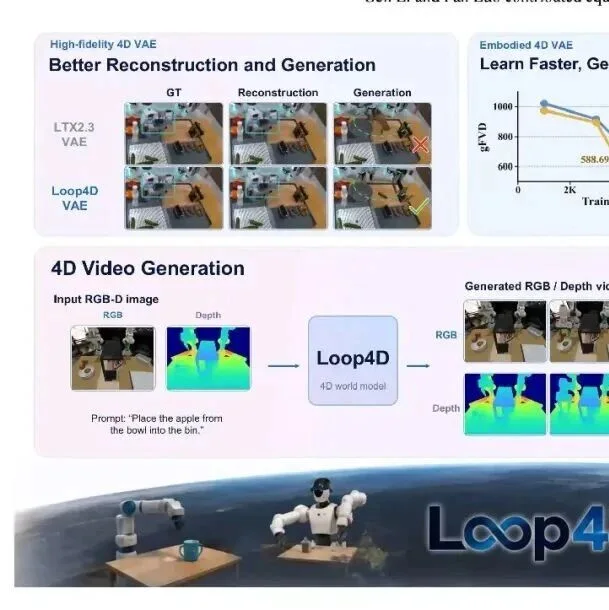
Tsinghua and Zhejiang University's Loop4D introduces a 4D VAE and dual-stream looped diffusion transformer for embodied world modeling, predicting RGB video and XYZ point clouds from RGB-D input and text. The 1.3B model outperforms 14B Wan2.1 and 22B LTX-2.3 on generation metrics, with two-loop iterations optimal, though compute and latency increase.
Reading font
Introduction
World models are shifting from video generation toward spatial understanding and action-result prediction for robot manipulation. Loop4D, from Tsinghua and Zhejiang University, targets this by learning a high-fidelity 4D representation that jointly predicts future RGB video and XYZ point clouds from a single RGB-D observation and a text instruction.
4D VAE: Preserving Motion and Geometry
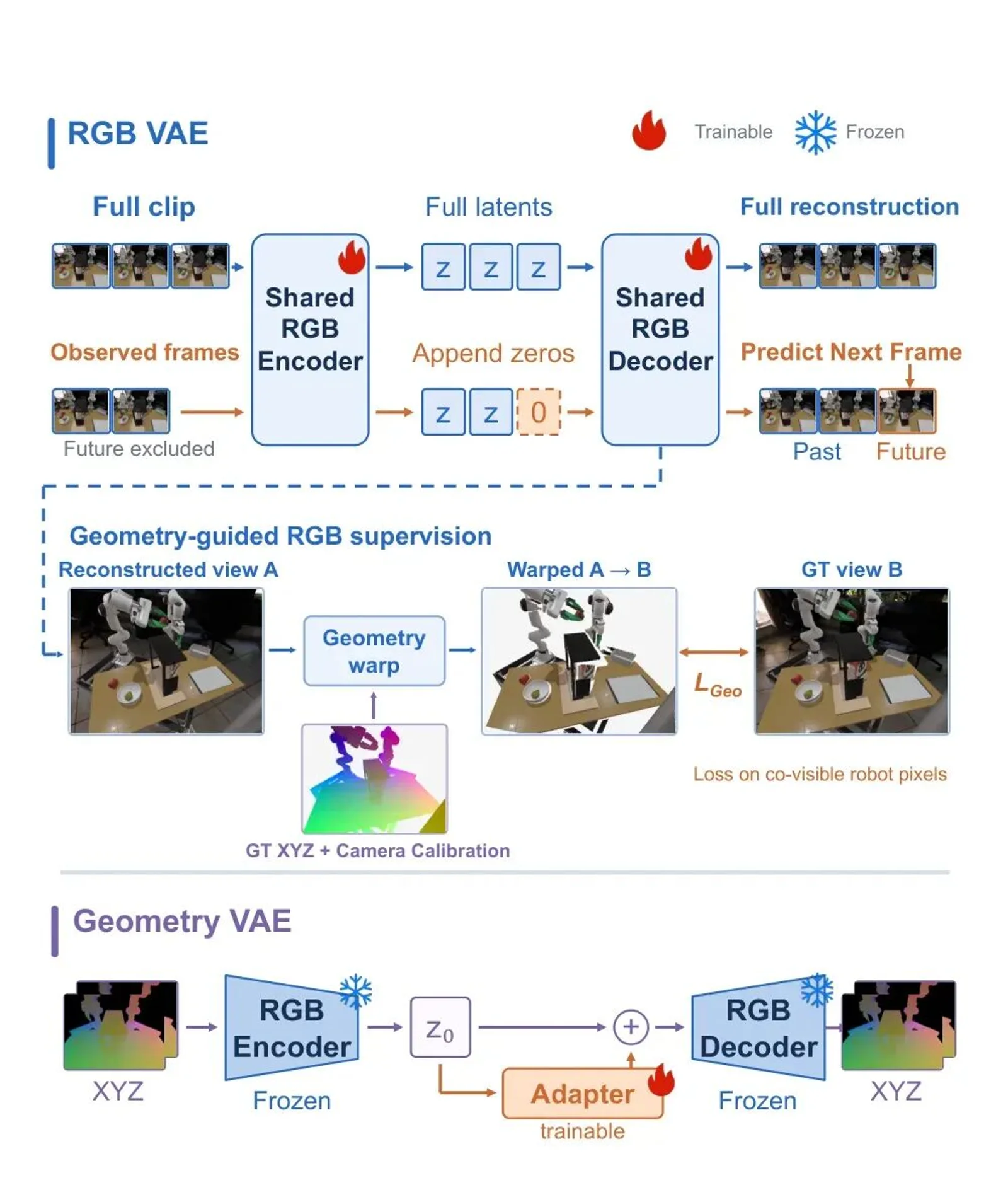
The 4D VAE compresses 4D information before generation. The RGB VAE adds two supervisions:
Predictive reconstruction : the encoder sees only observed frames; future latents are zero-padded, and the decoder must both reconstruct and predict future frames.
Geometry-guided supervision : using depth and camera parameters, cross-view alignment is enforced on commonly visible robot regions, specifically constraining the moving manipulator.
The geometry VAE initializes from the trained RGB VAE, freezing the main encoder and decoder while training only a lightweight residual adapter. This learns XYZ while preserving pretrained visual priors.
Quantitative reconstruction results show Loop4D achieves the best SSIM, PSNR, and depth AbsRel on both simulated and real tasks; real-world δ1 reaches 99.99% . However, rFVD is not optimal, indicating reconstruction evaluation needs per-metric inspection.
LoopDiT: Controlled Refinement via Looped Dual-Stream Diffusion Transformer
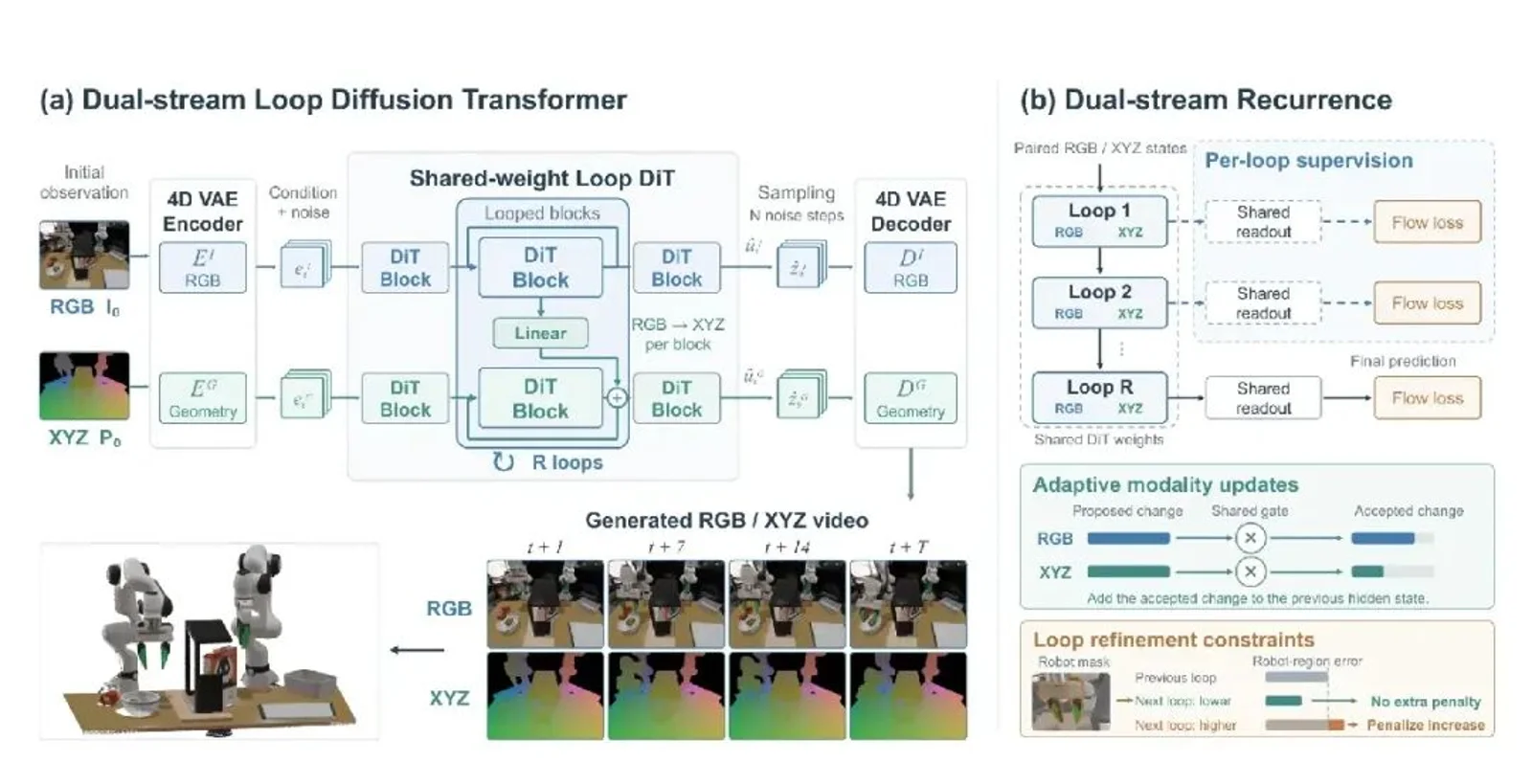
The second core component is the dual-stream looped diffusion transformer (LoopDiT). It repeats a shared middle transformer block within a single denoising call, increasing effective depth without replicating backbone parameters per loop.
Dual-stream interaction : RGB and XYZ streams keep separate states but share weights; RGB features are injected into the geometry stream block-by-block.
Per-round supervision : every loop round receives a prediction loss, preventing only the final round from being trained.
Robot-region non-degeneracy constraint : if the next round's error increases, a penalty is applied.
Adaptive modality gating : RGB and XYZ each decide how much update to accept, rather than forcing synchronous hard updates.
Experimental Results: 1.3B Model Outperforms Larger Baselines
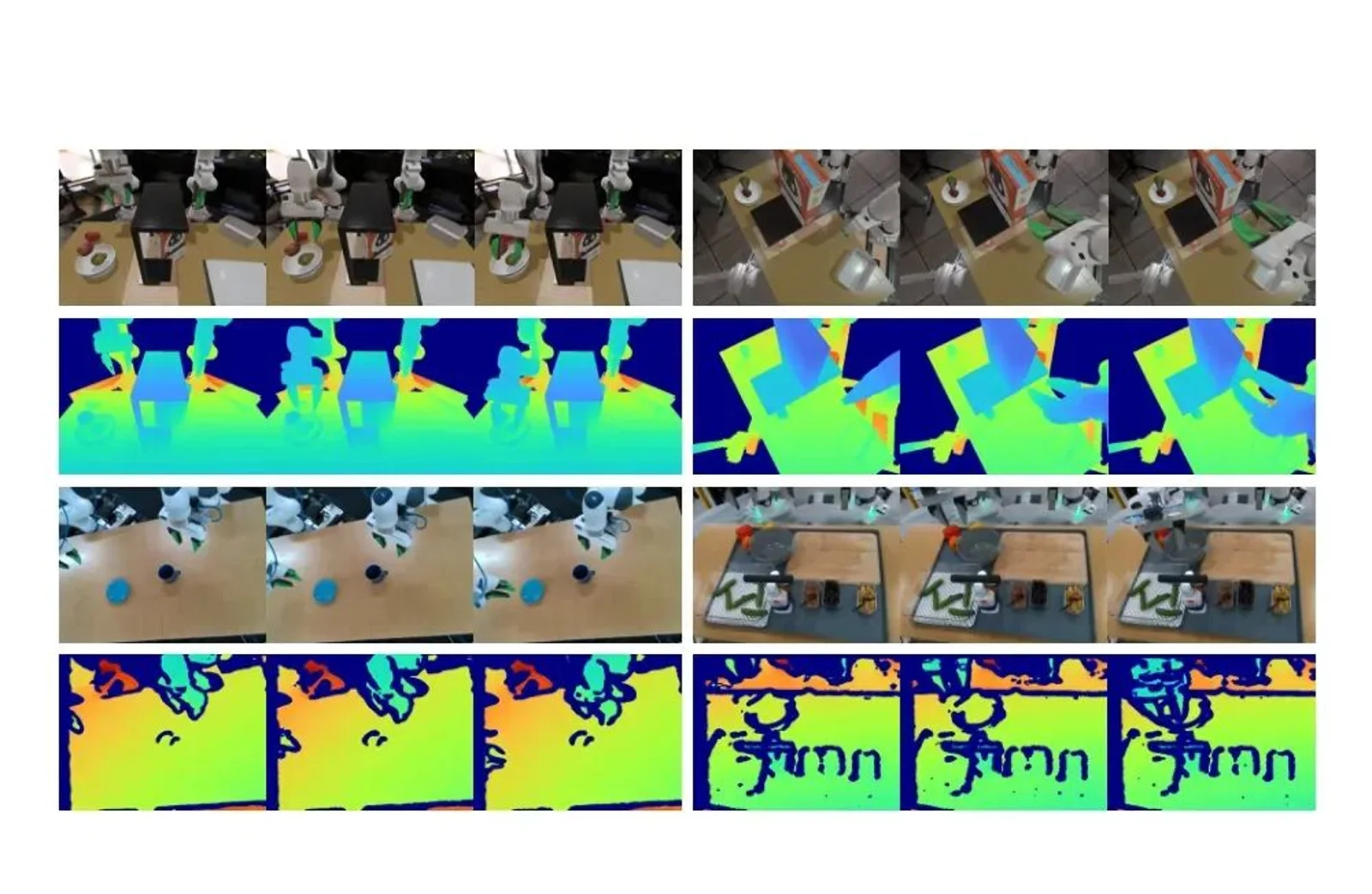
On the Robot4DGen simulation benchmark, Loop4D-1.3B achieves gFVD 449.33 and gFID 49.37 , beating 14B Wan2.1 (574.92 / 55.36) and 22B LTX-2.3 (502.82 / 60.46). Scaling to 5B further reduces simulation gFID to 41.96 and real-task gFID to 41.63 ; geometry AbsRel is also best in both settings. Generated output provides synchronized depth that changes with action, supplying geometric grounding for downstream trajectory recovery and control.
Ablation: Looping Is Not Monotonically Better
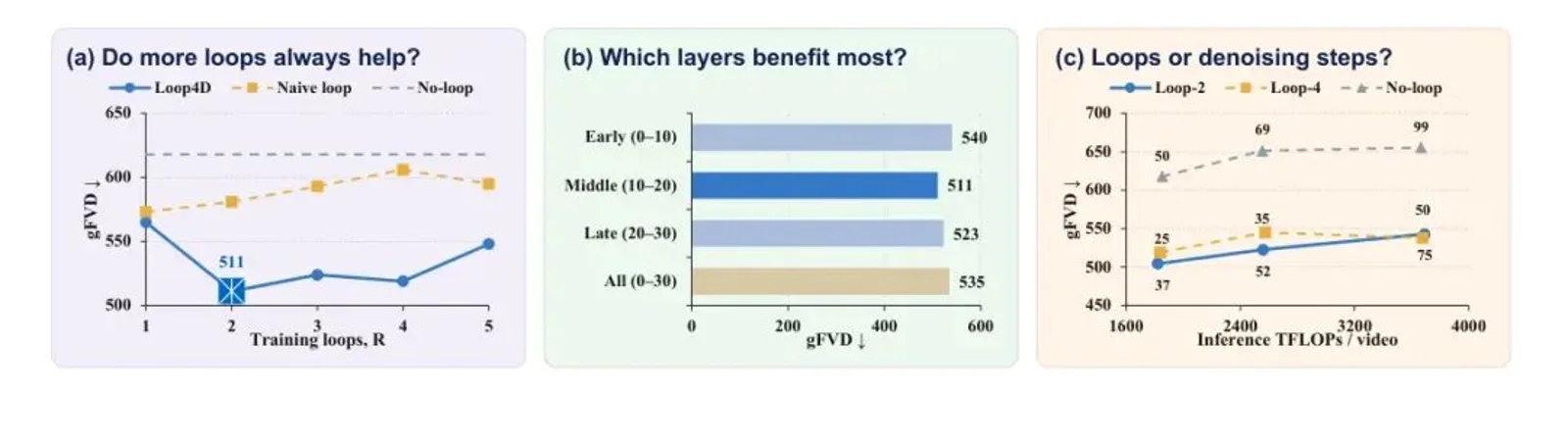
Two loops yield the best performance; further loops give no stable gains.
Naive looping without constraints and gating degrades with more iterations, proving those mechanisms are essential.
Looping only middle layers outperforms looping all layers; position matters more than sheer depth increase.
Under similar compute budgets, internal looping beats simply adding more denoising steps.
Compute Trade-offs
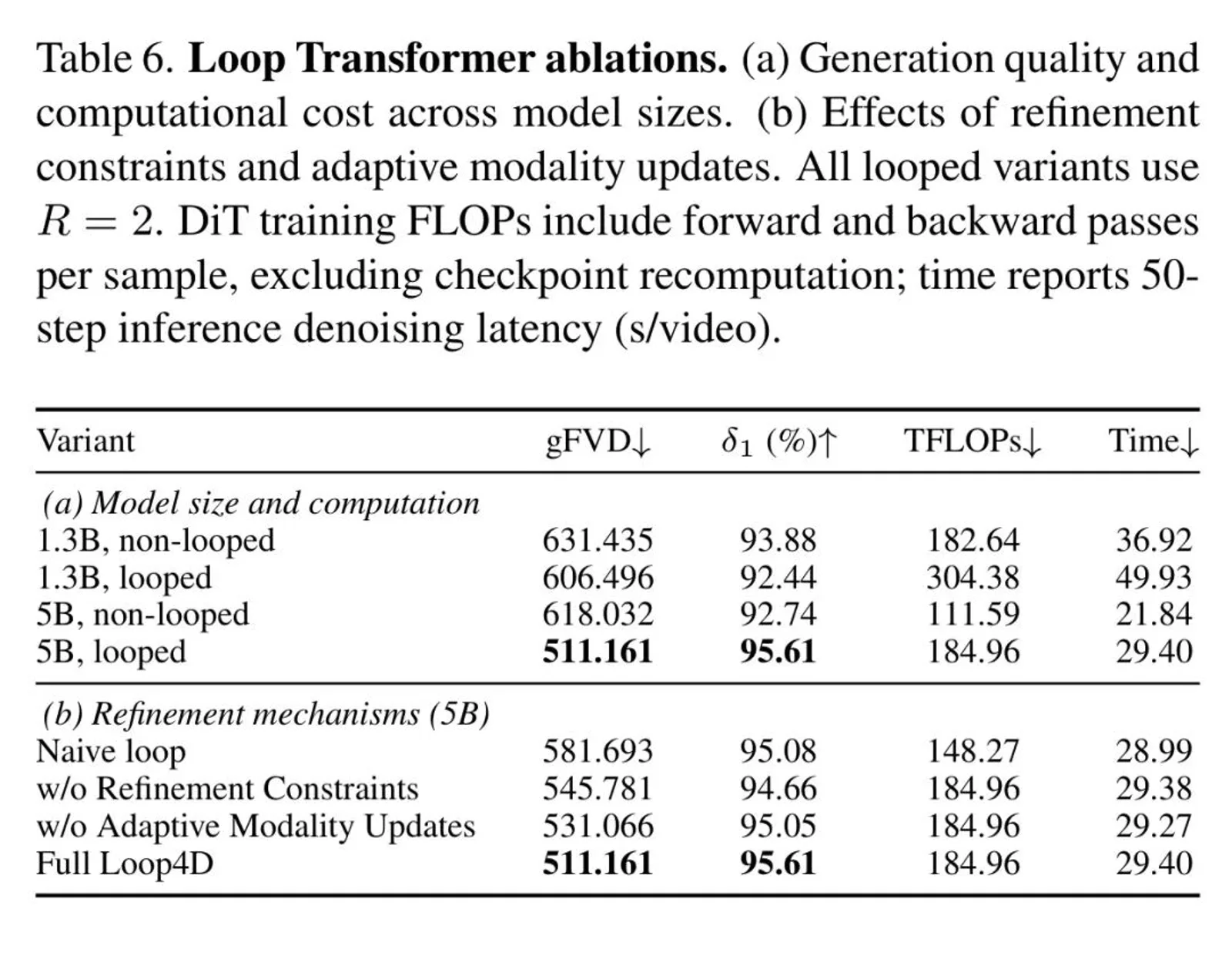
Adding loops to the 5B model reduces gFVD from 618.032 to 511.161 and raises δ1 from 92.74% to 95.61%. However, training FLOPs increase from 111.59 to 184.96 TFLOPs, and 50-step inference latency grows from 21.84s to 29.40s. The method saves parameters, not compute.
Reference
Loop4D: Embodied World Modeling with 4D VAEs and Looped Diffusion Transformers
arXiv: 2611.34199For questions about attribution, corrections or content rights, please contactand we will review it promptly.