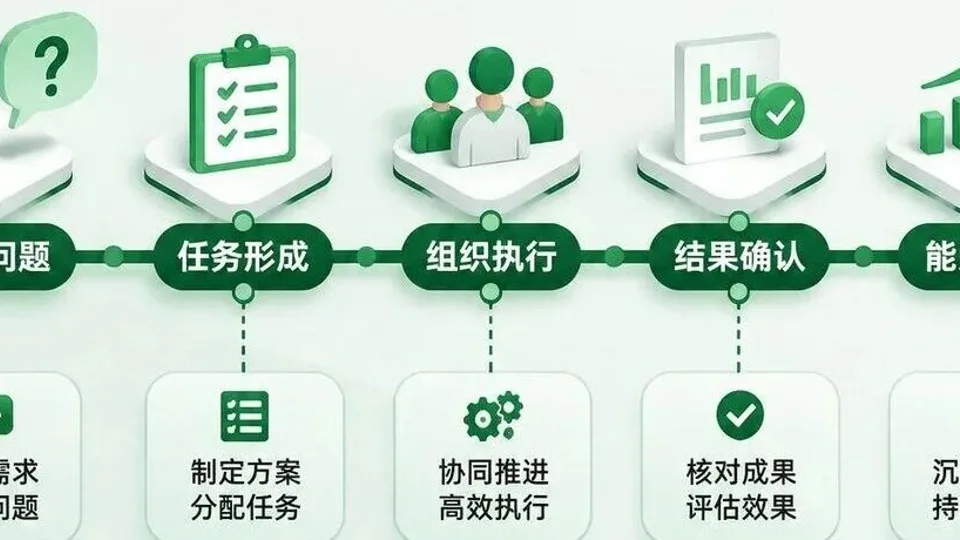
The article proposes a Task-Driven Accountability Network (TAN) with three roles — DRI, Owner, and Manager — to ensure responsibility extends beyond task completion to result ownership, change decisions, and capability maintenance, using a repair enterprise case to illustrate how organizations can connect one-time delivery with continuous improvement.
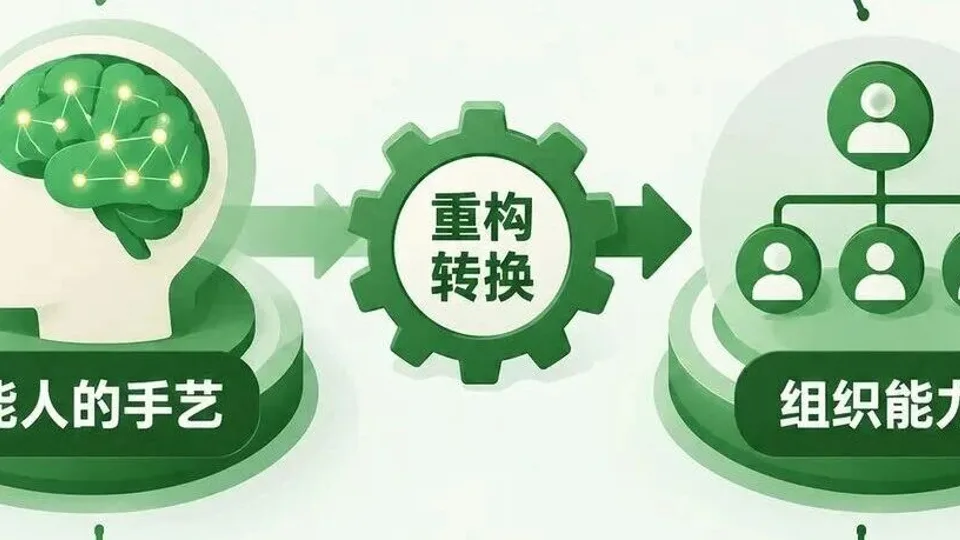
This article argues that AI completing tasks doesn't equal organizational capability retention, and outlines a framework for reconstructing knowledge work—like document drafting and business analysis—into repeatable organizational assets by decomposing capabilities, establishing authoritative information supply, separating judgment layers, assigning responsibilities via task contracts, and validating through personnel rotation tests.
This article argues that every task handoff implicitly carries a contract defining outcome, authority, and escalation, and that the AI era forces organizations to make these contracts explicit, machine-readable, and versioned to prevent accountability gaps when digital employees execute tasks at machine speed across systems.
This article analyzes why platforms like Meituan, Beike, and Haier only partially solve organizational accountability, and proposes a Task-Driven Accountability Network (TAN) where customer problems trigger tasks, named individuals hold authority and responsibility, and shared rules connect tasks so changes don't become unowned consequences.
The article argues technical taste differs from coding ability; it's about making appropriate trade-offs for specific project contexts rather than applying best practices blindly, illustrated by examples like over-engineering a small internal tool with microservices or over-designing urgent projects. Good taste comes from extensive project experience and amplifies effectiveness in the AI era.
The article argues that despite AI tools, solid fundamentals, the ability to verify AI outputs, and a systematic, output‑driven learning approach remain essential for deep technical competence and critical thinking.
The article argues that as AI lowers the barrier to building products, success now hinges on product "taste"—the ability to judge what to build, what adds value, what feels right, and what users will actually pay for—explained through historical analogies, concrete AI‑product examples, and a step‑by‑step training framework.
The essay examines how the low‑budget animated film 'Niu Lai' transformed from a box‑office flop into a participatory cultural phenomenon, questioning whether artistic value derives from production quality or the collective experience it generates, especially in an AI‑driven media landscape.
In the AI era, the premium skill shifts from writing code or building architectures to accurately defining the right problem, a capability that AI cannot replace and that dramatically amplifies the impact of subsequent AI‑driven solutions.
The article argues that traditional internet metrics like DAU and SaaS models are obsolete because AI agents have become the new software users, shifting value from attention to token consumption, and outlines six strategic "cuts" that illustrate how businesses must pivot to serve agents rather than humans.
In an age where AI can generate code, mastering C remains essential because it reveals the low‑level mechanisms of memory, pointers, and CPU behavior that high‑level languages hide, enabling developers to write high‑performance software and stay valuable in the job market.
In the AI era, developers who master big‑picture thinking, build automated delivery pipelines, quantify business impact, and use AI as a tool rather than a crutch become truly indispensable, outpacing those who rely solely on raw coding speed.
As AI automates coding and model tuning, technologists must shift from pure technical mastery to understanding business needs and user pain points, because AI lacks human insight and the real value lies in connecting technology to practical solutions.
In the age of AI, the article argues that the ultimate first metric for startups and organizations is the amount of time people spend on truly valuable, regret‑free experiences, urging data‑driven leaders to focus on deeper, multi‑level metrics beyond simple conversion rates.
Baidu Technical Salon on June 11 will host a forum on engineer development in the AI era, featuring senior engineer Zhang Miao and academic and industry experts discussing education, professional qualities, career paths, and talent cultivation to improve cost efficiency amid AI‑driven transformation.