This article explains how blockchain technology underpins Bitcoin, covering basic concepts such as distributed ledgers, cryptographic hash functions, digital signatures, hash pointers, Merkle trees, and the structure of Bitcoin's blockchain, while also highlighting broader applications and future considerations.
This article explains the fundamentals of blockchain technology, compares centralized and distributed systems with simple analogies, and details how Bitcoin and Ethereum operate, including their advantages, limitations, and the role of smart contracts and gas in decentralized applications.
This guide explains Ethereum's account types, how transactions and internal messages work, the role of gas and gas limits, fee calculation, and how network congestion can lead to DoS‑like conditions, providing a practical foundation for developers.
This article explains the fundamental concepts of blockchain—including distributed storage, peer‑to‑peer transmission, consensus mechanisms and cryptography—illustrates its advantages such as cost reduction and transparency, compares it with cloud computing, and discusses its impact across industries while noting upcoming events.
This article explains blockchain fundamentals, compares its distributed ledger to everyday examples like group chats, discusses how it solves trust crises, outlines the 1.0‑3.0 evolution stages, and explores emerging applications in finance, loyalty programs, voting, energy grids, and ride‑sharing.
The article argues that while mainstream media focuses on volatile crypto prices, the true breakthrough of blockchain lies in its decentralized, cryptographic architecture that can reshape governance, finance, and many complex systems, offering a vision far beyond speculative trading.
This article explores the rise of Ethereum, detailing Vitalik Buterin’s background, the technical innovations of smart contracts, market dynamics compared to Bitcoin and Ripple, and the broader implications of blockchain‑based virtual currencies.
This article provides a clear, beginner‑friendly explanation of blockchain, covering its nature as a decentralized database, the role of blocks and hashes, mining mechanics, difficulty adjustment, and how forks are resolved, while highlighting both strengths and limitations of the technology.
This article provides a clear, step‑by‑step explanation of blockchain fundamentals, covering its nature as a distributed database, key features like decentralization, block structure, hash immutability, mining processes, difficulty adjustment, forks, and practical limitations, all illustrated with diagrams.
This article provides a clear, beginner‑friendly explanation of blockchain technology, covering its nature as a decentralized database, block structure, hashing, mining difficulty, dynamic adjustment, forks, and practical limitations, while illustrating concepts with diagrams and real‑world examples.
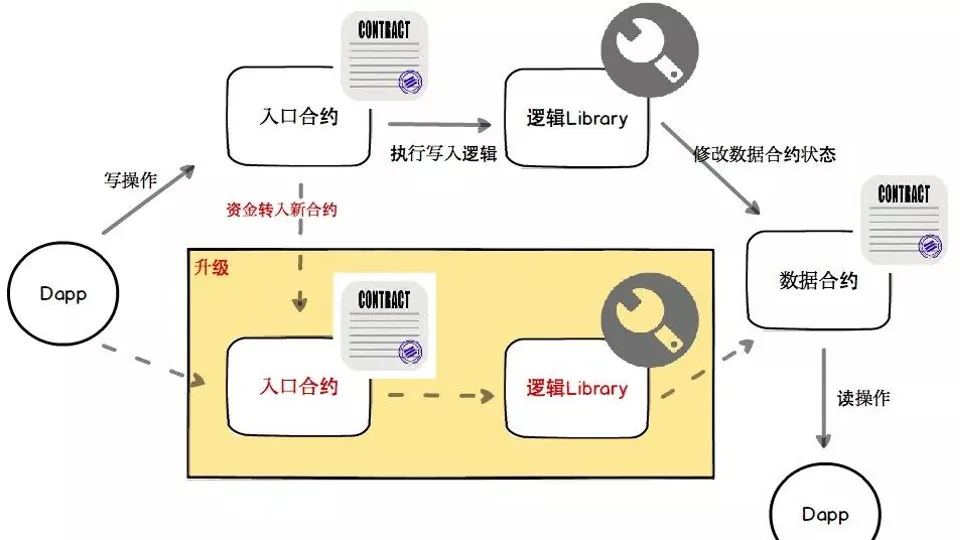
This article describes a practical approach to making Ethereum smart contracts upgradeable by separating business logic and data into distinct contracts, leveraging Solidity libraries, the using keyword, and an entry contract to manage funds and facilitate seamless contract upgrades.
This article breaks down the anatomy of a Bitcoin block, detailing its header, identifier, transaction list, and the Merkle tree construction with JavaScript code examples to illustrate how hashes are combined into a root hash.
This guide explains how to write Ethereum smart contracts in Solidity, Serpent, or LLL, compile them to bytecode, generate Java wrappers with Web3j, manage transactions and events, use filters, and operate the Web3j command‑line tool for wallet and contract tasks.
This guide explains how to link the Ethereum Wallet client with a local Geth node on both Windows and macOS, covering process inspection, IPC sharing, the attach command, and alternative launch options to avoid duplicate nodes and port conflicts.
The article outlines four enterprise blockchain applications—autonomous markets, reduced transaction friction, encrypted private records, and product provenance—illustrating how distributed ledger technology can add flexibility, security, and efficiency to B2B processes while hinting at Oracle's blockchain cloud service.
The article examines Bitcoin's explosive growth and profitability, details the NiceHash hack that stole thousands of BTC, explains the technology behind Bitcoin and mining, outlines why the cryptocurrency holds value, and discusses its future amid regulatory scrutiny.
When synchronizing an Ethereum geth node, the process may terminate unexpectedly due to memory exhaustion, and this guide explains how to identify the out‑of‑memory killer cause, examine system resources, and apply practical fixes such as upgrading RAM or adding swap space.
MIT professor and Turing Award laureate Silvio Micali outlines why blockchain is crucial for the global digital economy and identifies three key challenges—security, trust, and balance—while highlighting Ant Financial’s practical applications of the technology.
When using Geth, miner.start() may return null even though the node appears ready, often due to missing etherbase configuration, dev‑mode false positives, or version‑specific behavior that requires a transaction to trigger block creation.
This guide explains Geth's sync mode options—full, fast, and light—including their command‑line flags, how each mode downloads and validates blockchain data, and practical tips such as cache settings for optimal performance.