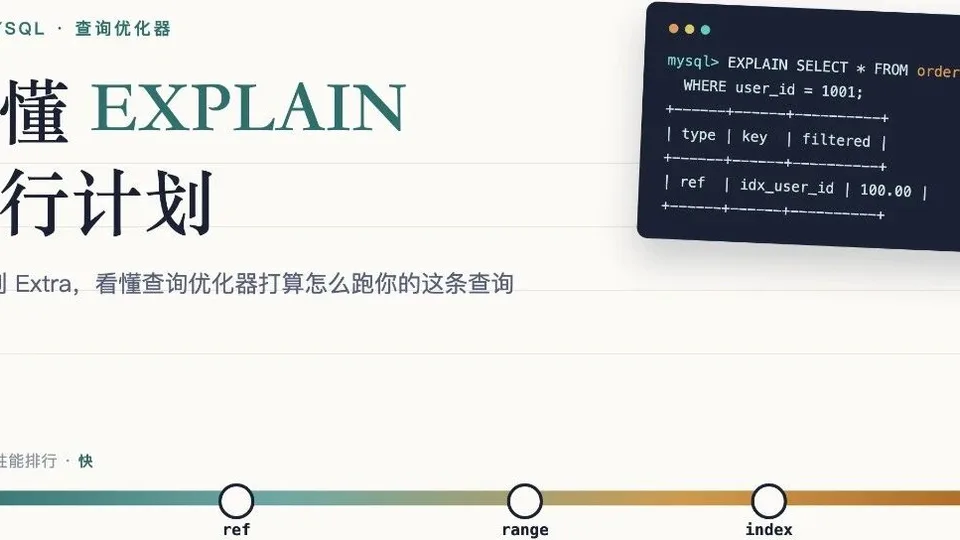
This article walks through MySQL's EXPLAIN output column by column, explaining id, table, select_type, type rankings, possible_keys, key, key_len, ref, rows, filtered, and Extra, while demonstrating each concept with concrete SQL examples, JSON‑formatted plans, and SHOW WARNINGS insights.
The article reviews dbx, a lightweight 20 MB open‑source database client built with Tauri 2 and Vue 3, which supports over 60 databases, AI‑assisted SQL, and both desktop and web deployments, and compares its performance and features against heavyweight tools like DataGrip, DBeaver and Navicat.
The article analyzes OceanBase’s newly released lake‑house AI database, focusing on its multimodal table feature that unifies storage, transaction, governance and hybrid search for images, PDFs, vectors and other non‑structured data, addressing the data‑consistency and latency challenges of Agent‑driven applications.
The article explains why MySQL may still report Using filesort despite a composite index that appears to satisfy both WHERE and ORDER BY clauses, covering index ordering rules, the impact of range conditions, mismatched ORDER BY field order, ASC/DESC mixing, and practical optimization techniques.
The article explains what SQL Server 2012 stored procedures are, outlines their core advantages, provides a reusable syntax template, walks through three practical examples (no‑parameter, parameterized, and default‑parameter procedures), and covers how to alter, drop, appropriate use cases, and common beginner mistakes.
The article explains Lance's stable_id (stable row ID) and address_id concepts, why stable IDs are needed, how they are encoded and mapped via RowIdIndex, the trade‑offs of this design, how to enable them, and how to convert between row address and stable ID.
The article explains why disaster‑recovery is essential for architects, defines backup versus DR, introduces RPO/RTO, examines key pitfalls such as sync‑async trade‑offs and split‑brain, compares cold, warm, hot and active‑active setups, and traces the technical evolution from manual tape copies to modern consensus‑based multi‑active geo‑replication.
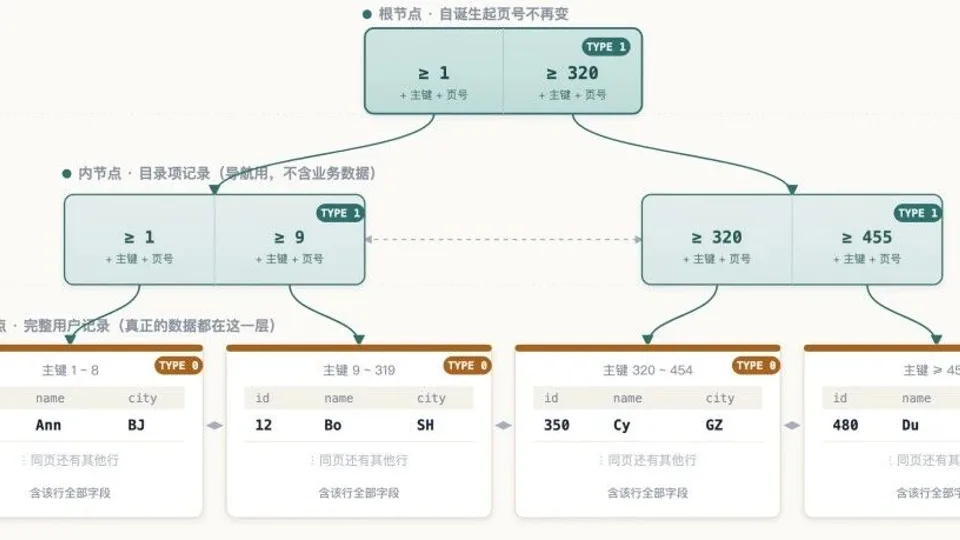
The article explains how InnoDB implements indexes as B+ trees, detailing their evolution from simple page directories, the differences between clustered and secondary indexes, the costs of indexing, and the specific query patterns and scenarios where such indexes are effective.
In a candid interview, database pioneer Mike Stonebraker recounts the academic and commercial journeys of Ingres and Postgres, critiques industry giants, explores his DebOS project that reimagines OS kernels as databases, and shares hard‑won insights on AI‑driven Text‑to‑SQL and career advice for the next generation.
The article walks through a real‑world order system that spikes to 300,000 QPS, explaining why the original single‑node MySQL design fails, and detailing a step‑by‑step evolution—index tuning, transaction fixes, read‑write splitting, vertical and horizontal sharding, plus data‑pipeline integration—to achieve stable low latency at massive scale.
The article examines the drawbacks of using Snowflake for generating short numeric user IDs, details a MySQL auto‑increment based approach, reveals deadlock problems with REPLACE INTO, evaluates alternative schemes, and presents a final sharding‑friendly short‑ID design that meets performance and usability requirements.
In a candid interview, PostgreSQL founder Michael Stonebraker recounts his journey from Ingres to Postgres, critiques Oracle’s sales tactics, denounces Google’s and Amazon’s database strategies, explains Postgres’s extensible type system, explores the DBOS research project, and highlights why current large‑language‑model‑to‑SQL solutions remain far from production‑ready.
Adding a column to a tens‑of‑millions‑row MySQL table may look trivial, but the real difficulty lies in the metadata‑lock timing and online traffic impact, requiring careful DDL type selection, pre‑flight checks, and often an online migration tool such as gh‑ost to avoid business‑level outages.
The pgrust project rewrites PostgreSQL's core in Rust, passes all 46,066 official regression tests, supports standard SQL and the psql client, but remains experimental, exploring a thread‑per‑connection model and showcasing how AI‑driven coding can lower the cost of large‑scale infrastructure rewrites.
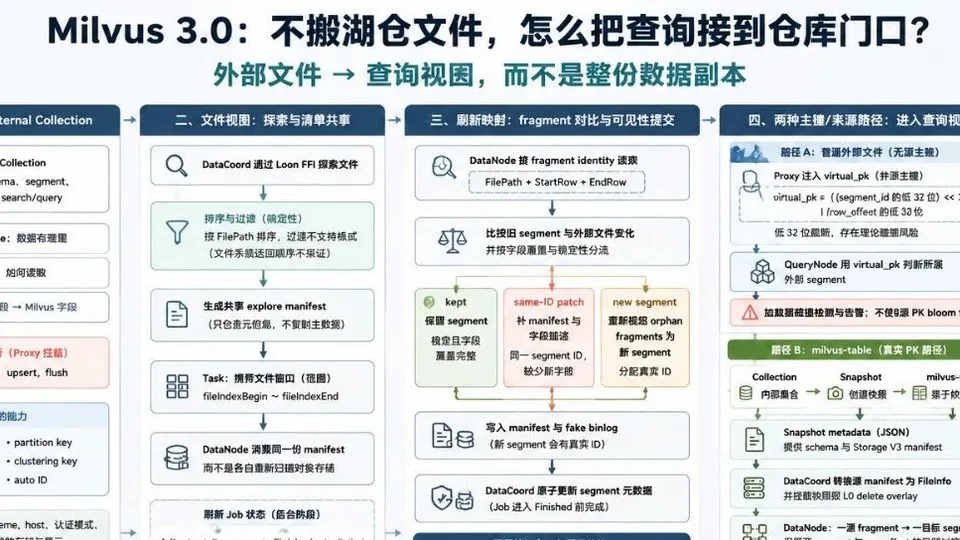
Milvus 3.0 introduces an External Collection that treats Parquet and other lakehouse files as a read‑only query view, detailing how external_source and external_spec are validated, how stable file lists are built, how the two‑stage refresh recomputes segment mappings, and how virtual primary keys and milvus‑table snapshots enable seamless querying without data duplication.
The article explains how MySQL determines whether a statement should be recorded in the binary log under ROW format, detailing the check_table_binlog_row_based function, the cached_row_logging_check flag, OPTION_BIN_LOG, and various scenarios—such as temporary tables, replication filters, no‑replicate tables, session settings, and internal operations—where binlog entries are omitted.
This article provides a comprehensive, hands‑on guide to MySQL master‑slave replication, covering the underlying architecture, binlog formats, GTID and semi‑synchronous modes, detailed configuration steps, thread workflows, common failure scenarios with step‑by‑step diagnostics, and practical monitoring and failover scripts.
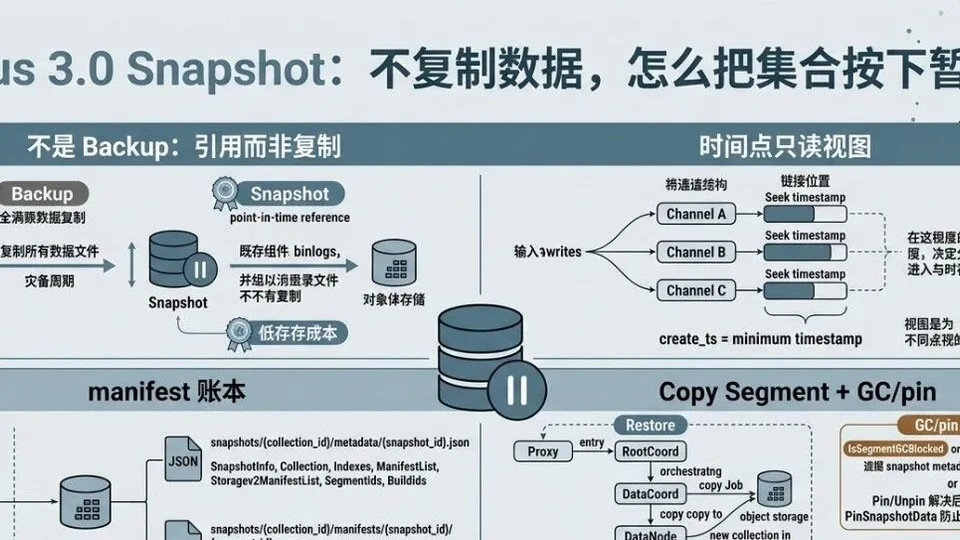
Milvus 3.0 introduces a lightweight Snapshot feature that creates a point‑in‑time, read‑only view of a collection by freezing metadata and segment manifests instead of copying data, and explains how restore, GC protection, and pin mechanisms work together to enable fast, safe rollbacks.
This article provides an in‑depth analysis of PostgreSQL's lock system, covering lock types, MVCC interaction, deadlock detection, advisory locks, monitoring scripts, and practical optimization techniques for production environments.
The article walks through the evolution of Redis leaderboard architectures, covering why ZSets are used, handling same‑score ordering, seasonal resets, access patterns, synchronous vs asynchronous updates, big‑key and hot‑key issues, sharding with buckets, and data durability strategies.