This article details how to evolve ad-hoc incident response into a standing war room mechanism for 10M QPS systems, covering six key roles, a full lifecycle with trigger/exit criteria, fixed 10-minute decision cadences, reversible mitigation constraints, evidence-linked tooling, and a three-phase rollout with drills and templates to build organizational muscle memory.
HuoLaLa details its three-phase journey to convert individual AI coding productivity into organizational gains, covering a unified workbench, spec-driven development pipelines, dual-agent code review, and measurable metrics like AI code ratio and first-pass yield.
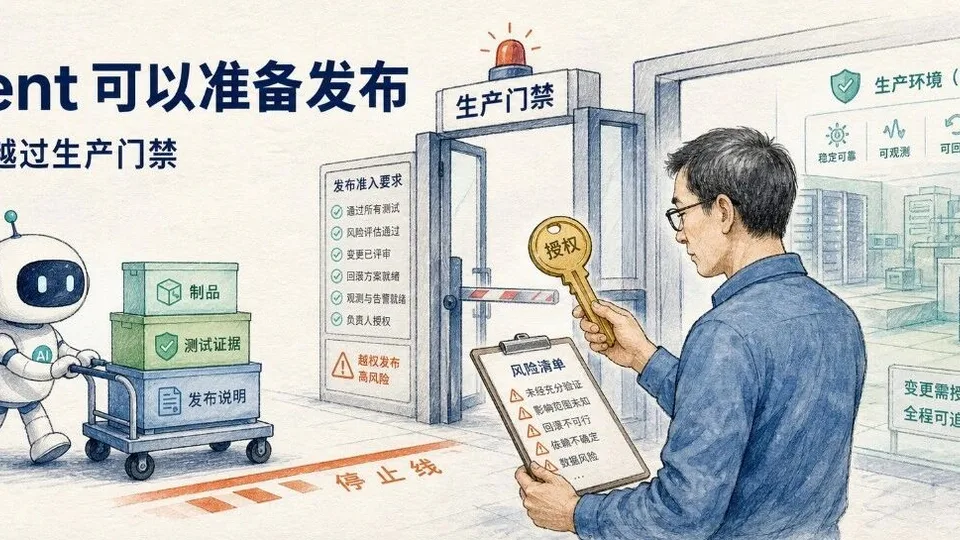
This article argues that while AI agents can accelerate code review, release preparation, and controlled deployment steps, they must never autonomously obtain production authorization or accept production risk; instead, different environments require tiered autonomy, production permissions must be short-lived, minimal, and auditable, pre-approved runbooks need strict scope and abort conditions, and version rollback does not equal business recovery.
This article argues AI's main impact is on the end-to-end development workflow rather than specific languages, and provides three practical steps: create a project prompt profile, use AI for pre-review checks, and build reusable prompt templates for tasks like API development and test generation, with a ready-to-use shell script.
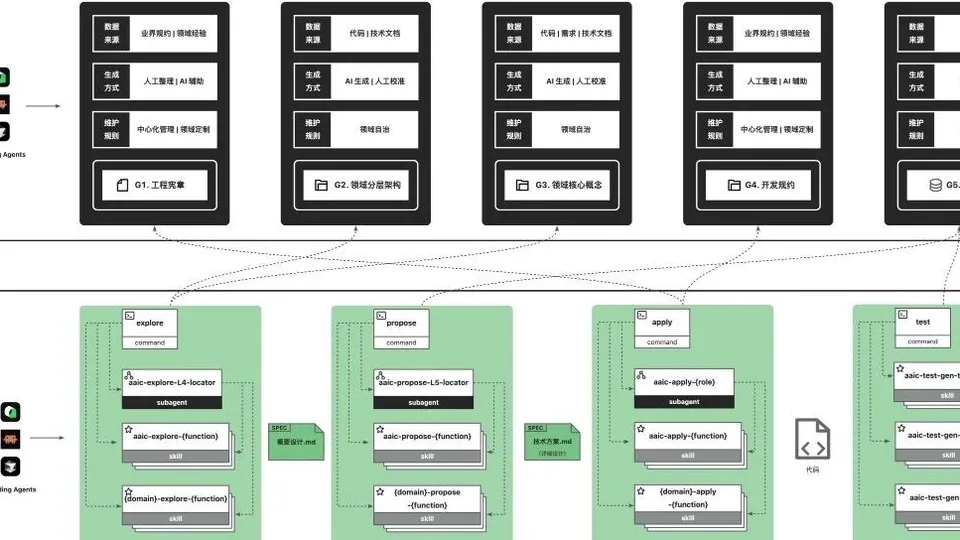
The article details how AliExpress's AAIC platform solves the mismatch between AI-generated technical proposals (dense with code-level details for code generation) and human review needs by introducing a separate, template-driven reviewable proposal generated via perspective-specific sub-agents orchestrated by a dedicated Skill.
This article analyzes why traditional regression testing fails, outlines four core capabilities of intelligent regression testing — smart test generation, adaptive execution, AI-powered root cause analysis, and closed-loop quality insights — and details an organizational transformation from test execution to quality engineering, achieving 11-minute feedback cycles and 2.8x release frequency.
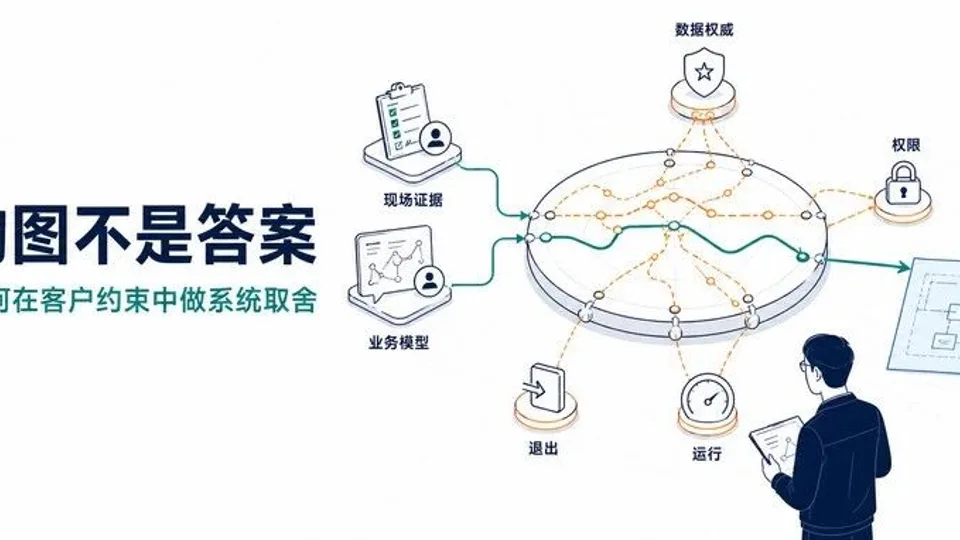
This article explains how Frontline Deployment Engineering (FDE) moves beyond architecture diagrams to make concrete trade-offs on system boundaries, capability placement, integration patterns, risk acceptance, and decision invalidation — using a synthetic manufacturing case to show how authority, contracts, and failure paths must be explicitly owned.
This article organizes 14 Claude Code commands into five practical development workflows—project context setup, session context management, execution mode selection, code review, and failure recovery—explaining when to use each command, common misuses, and why understanding workflows matters more than memorizing commands.
The author shares three practical techniques for correcting AI when it goes off course mid-task: checkpoint confirmation at each step, inspecting intermediate outputs, and replanning from scratch instead of patching, plus four signals indicating when to pause AI work.
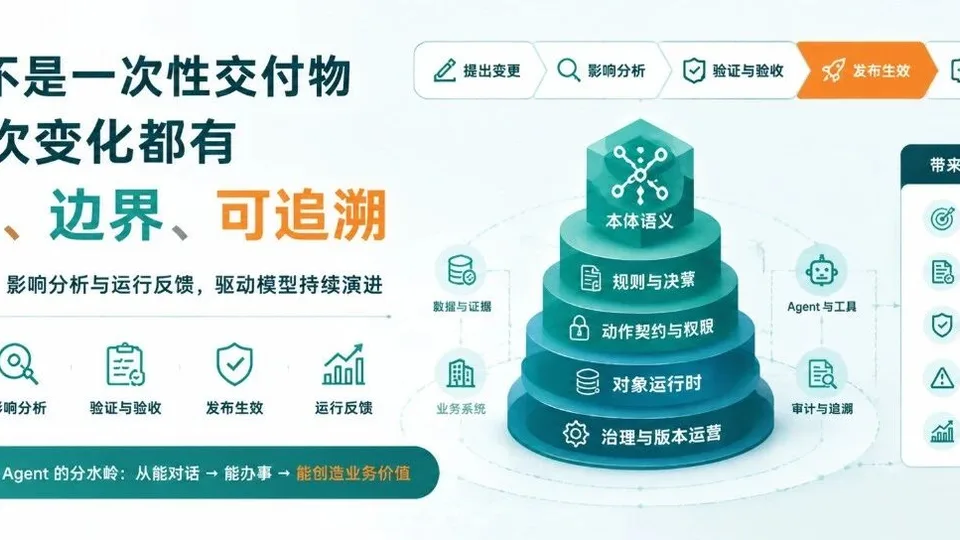
This article argues that ontology intelligence projects must be evaluated on end-to-end business outcomes rather than concept or triple counts, proposing a six-dimension framework—business value, semantic quality, decision reliability, action closure, security governance, and unit economics—with mandatory safety thresholds and phase-gated decisions to expand, optimize, restrict, or stop projects.
This article demonstrates using DeepSeek Harness to automatically generate 152 detailed test cases for login and registration modules, covering normal flows, boundary values, exception scenarios, security tests, and multi-condition combinations with verifiable expected results.
The article argues that technology selection should be driven by architectural constraints and long-term operational responsibility rather than feature comparisons, emphasizing total lifecycle costs, standardized Golden Paths to reduce duplicate effort, and requiring verifiable evidence for any exceptions.
Experts discuss why software architecture governance—not AI tools—is the key to sustainable development efficiency, illustrating with a case study where refactoring a 480k-line system's core module from 65k to 15k lines resolved persistent bugs and improved maintainability, arguing that deterministic platforms and human cognitive density outweigh AI-generated code.
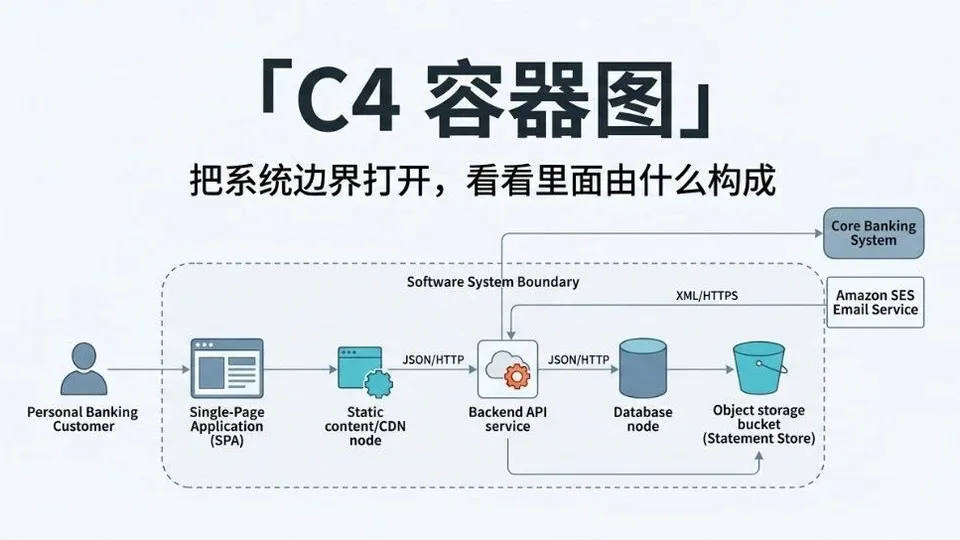
This article explains the C4 Container Diagram — its purpose, key attributes, notation, and a complete walkthrough using an Internet Banking System example to show how to decompose a system into applications, data stores, and their communication protocols.
The author details six iterations in building DxC, an agent-native WeChat writing system, revealing that 'AI taste' originates not from surface language patterns but from missing real materials, authorial choices, and accountability; the fix requires material-first drafting, structural editing, independent proofreading, and author confirmation.
Uber engineering manager Sendil Nellaiyapen shares 14 hard-won principles covering system design foundations, scaling from thousands to millions, MVP trade-offs, clarity over seniority, avoiding experience traps, hypothesis-driven culture, latency misconceptions, guardrails for autonomy, and the mindset shift from engineer to manager.
The article analyzes asymmetric leverage attacks where minor errors are inflated into character judgments, identifies three instinctive traps (over-explaining, confronting, over-apologizing), and presents a four-step surgical method: admit facts instantly, filter moral judgments, propose closed-loop solutions, and demand concrete behavioral standards to reclaim control.
This article outlines five actionable practices for leaders to develop strategic thinking: carving out dedicated thinking time, learning to say no through elimination and prioritization, challenging entrenched assumptions, aligning product strategy with talent strategy, and using AI as a thinking partner rather than a replacement.
This article details how engineering managers can evolve from reactive problem-solving to proactive problem discovery by questioning task origins, validating early signals, designing limited experiments, balancing delegation with intervention, and verifying post-launch outcomes, using concrete examples like latency optimization trade-offs and release risk management.
AI-generated meeting minutes create an illusion of completeness that obscures unresolved decisions, pending conditions, and disagreements, turning records into polished artifacts that hinder real progress by masking what still needs clarification before action can begin.