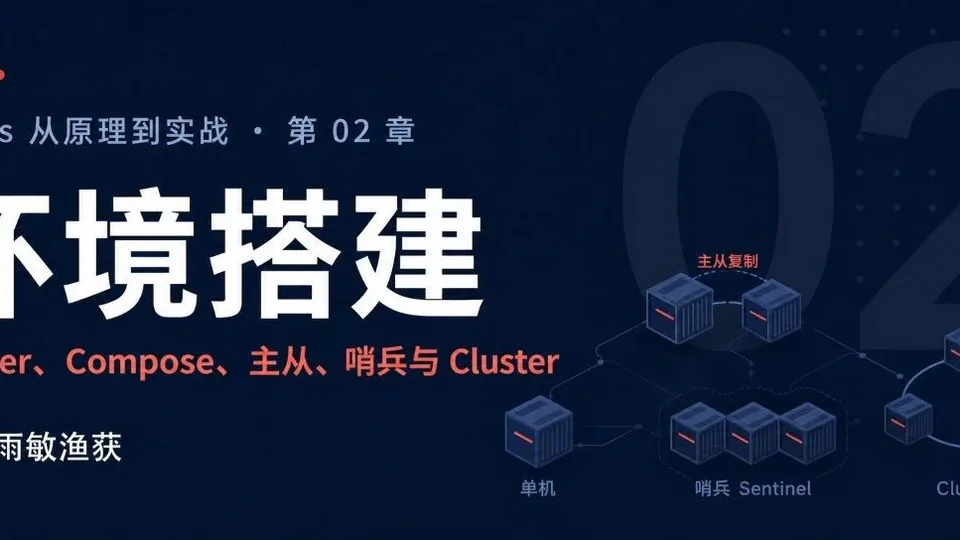
This tutorial walks a complete beginner through launching a Redis server with Docker, managing it with Docker Compose, adding master‑slave replication, configuring Sentinel for automatic failover, building a 3‑master‑3‑replica Redis Cluster, and provides production‑grade configuration templates and an online‑deployment checklist.
This article walks through switching a SpringBoot + MybatisPlus project from MySQL to PostgreSQL, covering driver addition, JDBC URL changes, schema differences, and a detailed list of SQL syntax mismatches and runtime errors with concrete code examples and remediation scripts.
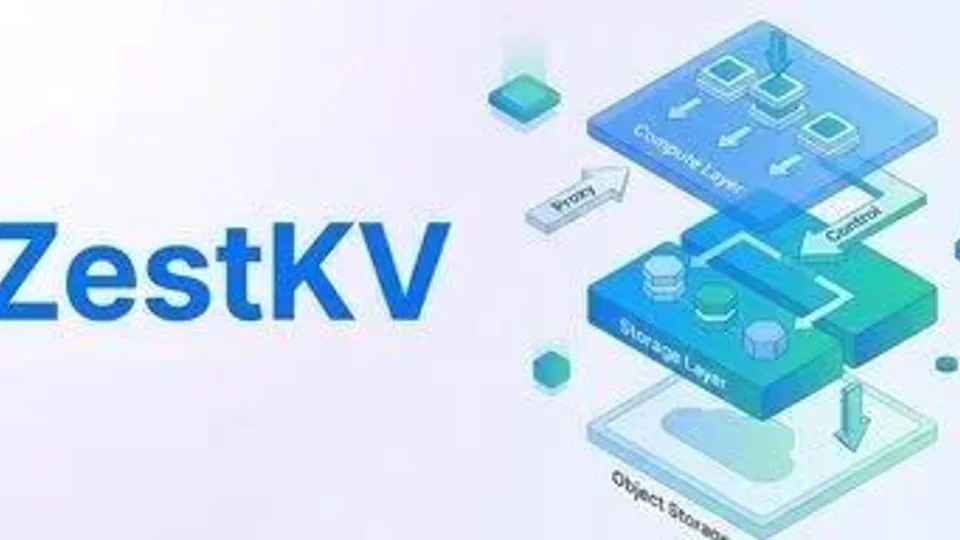
ZestKV is a Redis‑compatible distributed KV store that separates compute from storage, using a log service and object storage to lower hardware costs, guarantee data durability, and enable independent, elastic scaling of compute and storage resources.
The article re‑examines SQLite’s historic reputation as a test‑only database, showing how SSD‑backed WAL mode, tools like LibSQL/Turso, Litestream, and Cloudflare D1, plus modern JVM support, give SQLite production‑grade performance for read‑intensive, multi‑tenant and edge scenarios, while outlining when PostgreSQL remains necessary.
This article explains why running Elasticsearch in production is far more complex than a simple API tutorial, covering Lucene fundamentals, mapping design, shard planning, write‑path architecture, query optimization, hot‑warm‑cold tiering, ILM policies, capacity planning, monitoring, incident handling, and a step‑by‑step evolution roadmap for building a reliable, scalable search system.
This article walks through a systematic, step‑by‑step troubleshooting guide for MySQL "Too many connections" errors, showing how to verify the symptom, inspect server variables, analyze connection status, identify common root causes such as connection‑pool misconfiguration, leaked connections, and long‑running queries, and apply safe fixes and preventive measures.
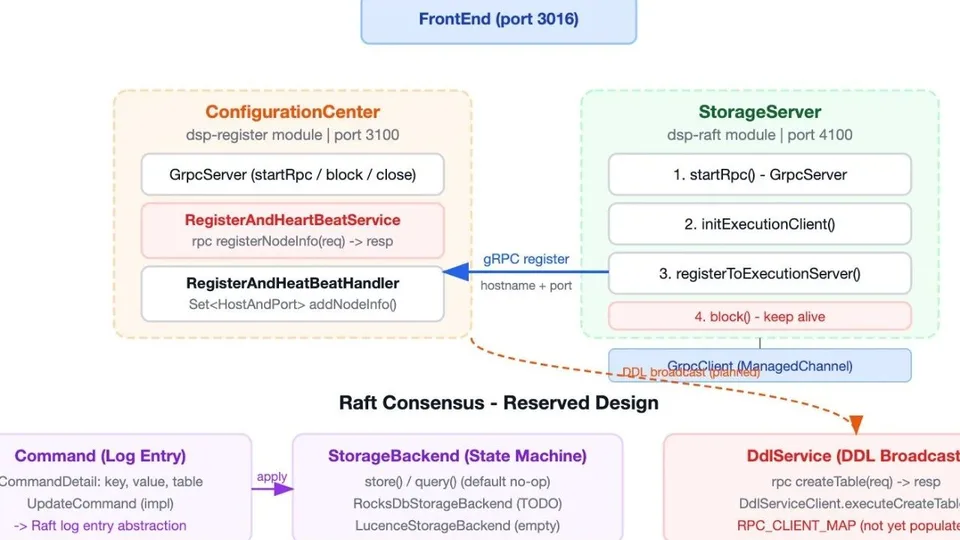
The article dissects DSP’s transition from a single‑node database to a distributed system, detailing the gRPC‑based cluster communication skeleton built in dsp‑raft and dsp‑register, the three node roles, GrpcServer/GrpcClient abstractions, proto services, the registration workflow, and the missing heartbeat, node‑discovery and Raft consensus components that must be added for a full‑featured distributed storage engine.
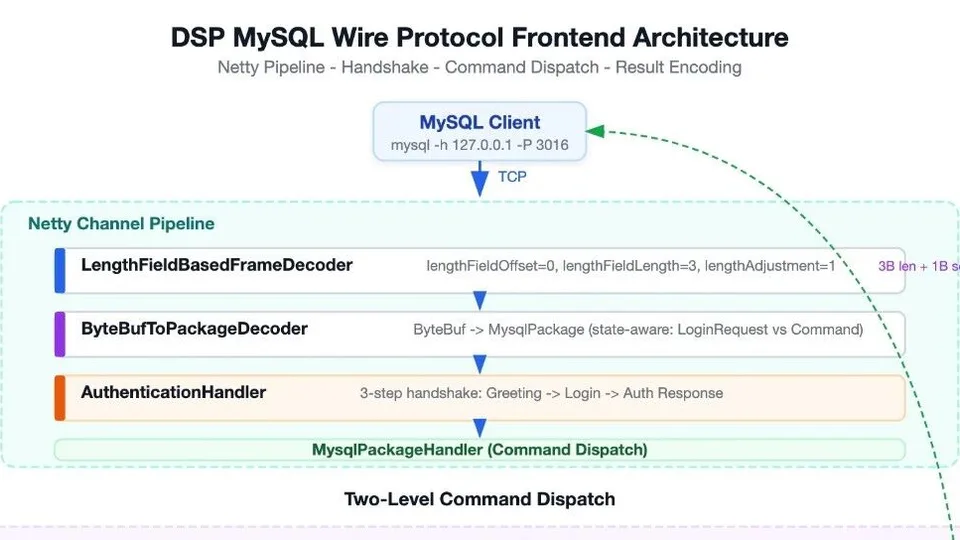
This article walks through the complete implementation of a MySQL‑compatible front‑end protocol in the DSP (Sloth) database, covering why MySQL compatibility matters, Netty pipeline design, packet framing, three‑step handshake, two‑level command routing, result‑set encoding, length‑encoded integers, variable substitution, and current limitations.
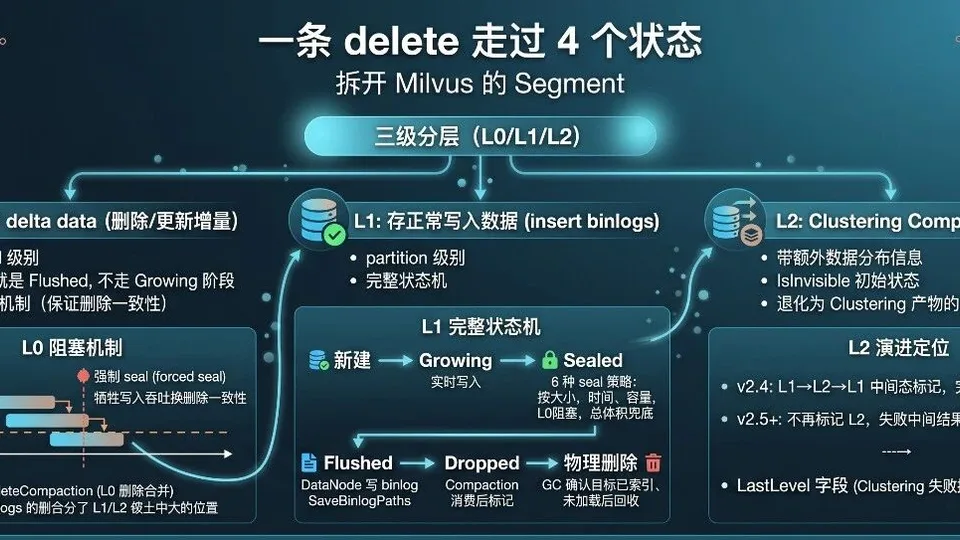
A Milvus delete command looks simple, but the primary key is first stored in an L0 delta segment, then triggers compaction that merges the delete mark into L1/L2 segments, passes through four distinct segment states, and involves multiple seal strategies, rollback fields, and version‑specific behaviours, illustrating why deletion is the system's most intricate operation.
A production incident showed Redis keys disappearing at 2 AM without any memory alarms; deep analysis revealed a short‑term memory spike caused by a surge in GET requests, client‑output‑buffer‑limit growth, and LRU eviction, leading to practical mitigation steps.
This article introduces four command‑line tools—MySQLTuner.pl, tuning‑primer.sh, pt‑variable‑advisor, and pt‑query‑digest—explaining how to download, run them, and interpret their reports to assess MySQL performance, configuration, and query efficiency.
The article argues that domestic databases are far from a joke, highlighting how building a database touches virtually every computer‑science discipline, and recounts Oracle’s early versions—lacking transactions, constraints, and reliable locking—to illustrate the long path from primitive systems to mature, world‑class databases.
The presentation at the Agentic AI Summit details the four core challenges of agent‑driven data analysis and introduces SelectDB’s Agent Native architecture—combining sub‑second query speed, unified multimodal search, semantic understanding, and cloud‑elastic observability, with reported storage savings of up to 88% and 5‑10× text‑search acceleration.
This article explains MySQL index fundamentals—from the B+‑tree storage engine and InnoDB’s clustered and secondary indexes to query execution, common index‑failure scenarios, and practical design principles for building effective indexes in interview settings.
The article analyzes how OceanBase’s new AI‑native database tackles the data‑layer challenges of autonomous agents by introducing logical tables, multi‑modal storage, Fork DB sandboxes and lake‑warehouse integration, arguing that the product’s value lies beyond simple vector retrieval.
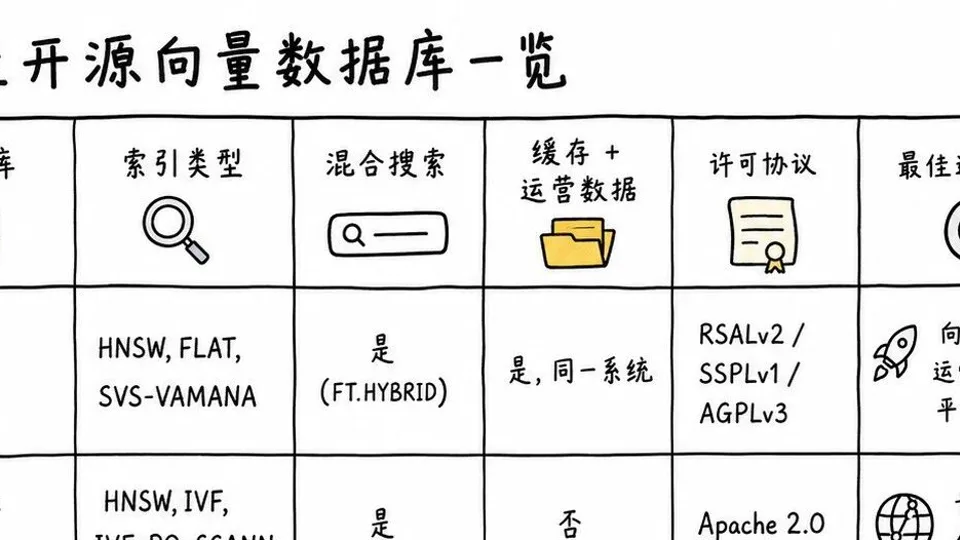
This article compares leading open‑source vector databases—including Redis, Milvus, Weaviate, Qdrant, Chroma, pgvector, and Faiss—by examining their architectures, performance benchmarks, deployment models, and suitability for production AI workloads, helping readers choose the right solution for their needs.
The article explains that the real challenge is not merely running MySQL but placing it in the right resource model, and it provides a four‑dimensional decision framework—performance ceiling, stability floor, automation level, and organizational maturity—to guide when to use host‑installed MySQL, single‑node containers, or full Kubernetes deployment, illustrated with concrete resource analyses, architecture diagrams, configuration examples, pitfalls, checklists, and an evolution roadmap.
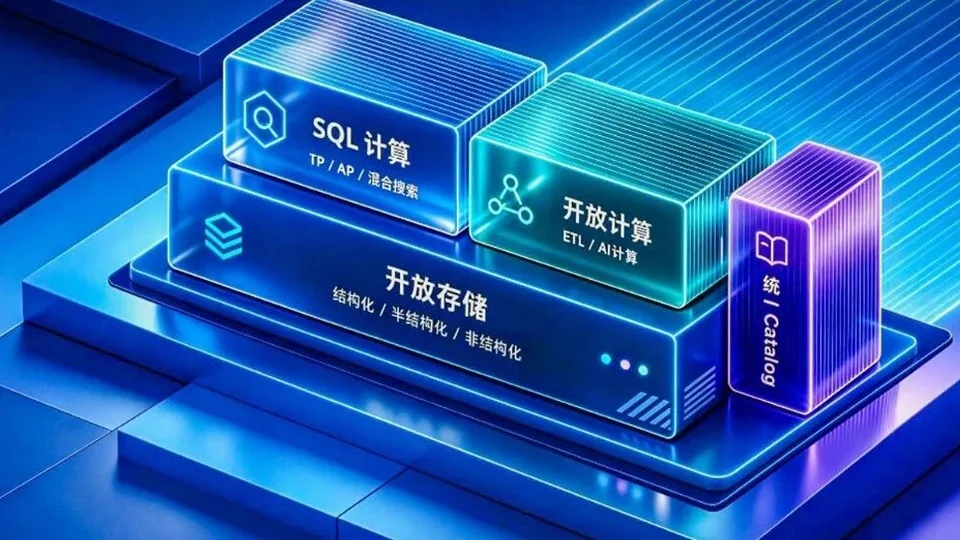
Lakebase, the core engine of OceanBase AI Database, unifies storage, management, computation and search for structured, unstructured and vector data, offering multimodal data capabilities, flexible deployment modes, and AI‑oriented use cases such as autonomous driving and financial document analytics.
The article details DeWu's three‑year evolution of its self‑built Redis platform—covering architecture, access method changes, version upgrades, proxy rate limiting, and automated operations—that together reduced request latency by over 90% while supporting more than 1,000 clusters, 160 TB of memory and near‑10‑million QPS.
This article breaks down Redis’s core mechanisms—including its single‑threaded performance tricks, AOF and RDB persistence designs, and the evolution of high‑availability from replication to Sentinel and Cluster—using four clear diagrams to help readers master the system.