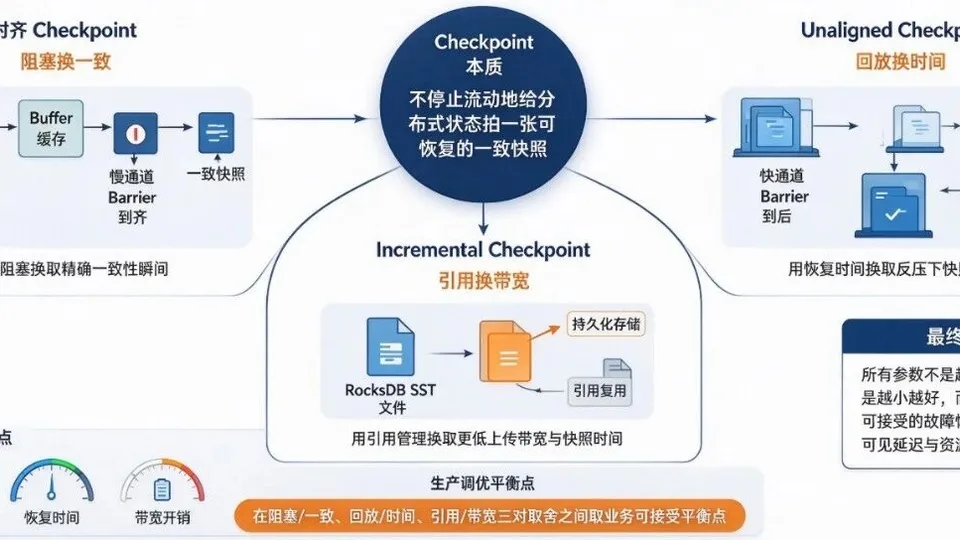
This article provides a deep technical analysis of Apache Flink's checkpoint mechanism, covering barrier alignment and unaligned snapshots, heap vs RocksDB state backends with incremental checkpoints, savepoint vs checkpoint differences, failure recovery flows, and practical troubleshooting for checkpoint timeouts, state bloat, and recovery slowness.
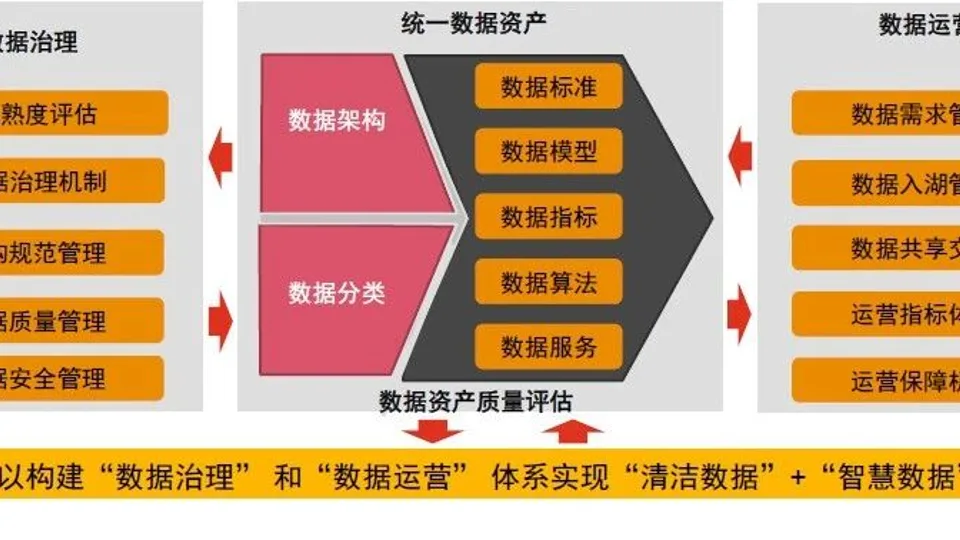
This article outlines a comprehensive data governance framework covering organizational awareness, metadata management, security, integration, services, and visualization to transform data into a strategic asset with a phased roadmap for enterprise value realization.
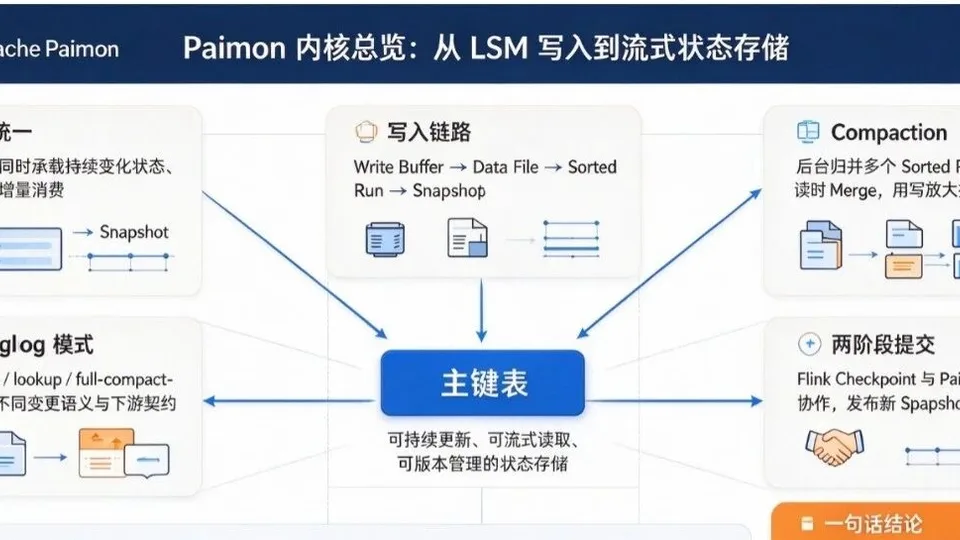
This article deep-dives into Apache Paimon's kernel source code, explaining the LSM write path from memory buffer to Sorted Runs, compaction scheduling trade-offs, four changelog production modes, and two-phase commit with Flink checkpoints, providing troubleshooting guidance for compaction backlog, changelog latency, and snapshot bloat.
The article details a unified data production platform where Forge Agent orchestrates the development lifecycle, Sindri translates domain DSL into executable plans with validation gates, and ADF manages DAG scheduling and multi-engine execution, while a quality system provides end-to-end verification, lineage, and monitoring to enable trustworthy automation.
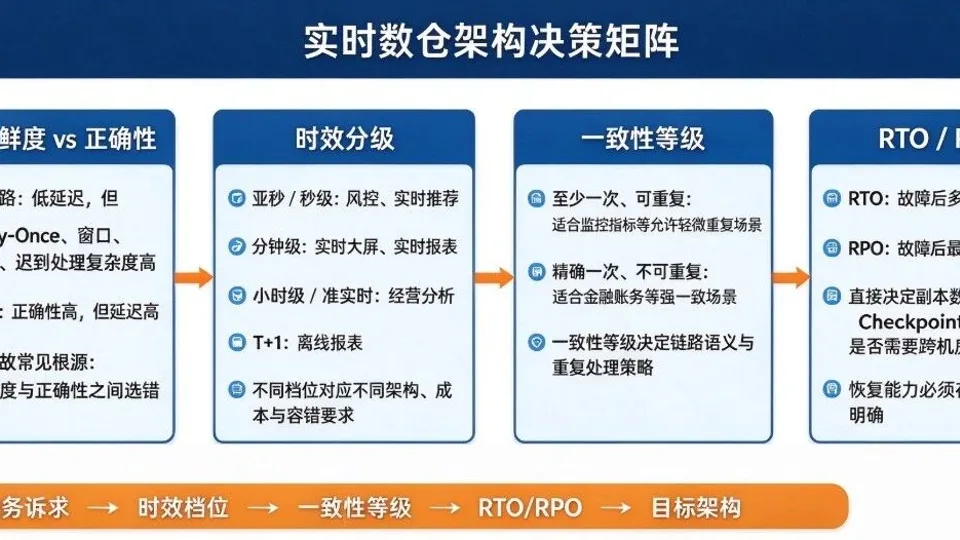
This article presents a comprehensive methodology for implementing real-time lakehouse architectures, covering requirements quantification, architecture selection, capacity planning, canary deployment, rollback strategies, and SLA decomposition with a six-stage pipeline, e-commerce case study, troubleshooting guides, and interview frameworks.
Alibaba Cloud unveiled a strategic upgrade to its ODPS big data platform at the 2026 Yunqi Conference, introducing AI-native, multimodal capabilities across MaxCompute, Hologres, and DataWorks to support Agentic AI workloads with vector search, heterogeneous compute, data sandboxes, and semantic knowledge graphs.
At Yunqi 2026, Alibaba Cloud unveiled its Agentic Lake + Agentic Streaming architecture, combining DLF, Flink, EMR Ray/Daft, StarRocks, and Milvus to provide a unified multimodal data infrastructure for AI agents in autonomous driving, embodied intelligence, and enterprise operations.
This article explores how Dataphin applies Spec-Driven Development (SDD) through a Plan mode to address the unreliability of vibe coding in production data development, detailing SDD principles, industry tool comparisons, and a structured workflow for requirement understanding, intent clarification, solution planning, task decomposition, and verified execution.
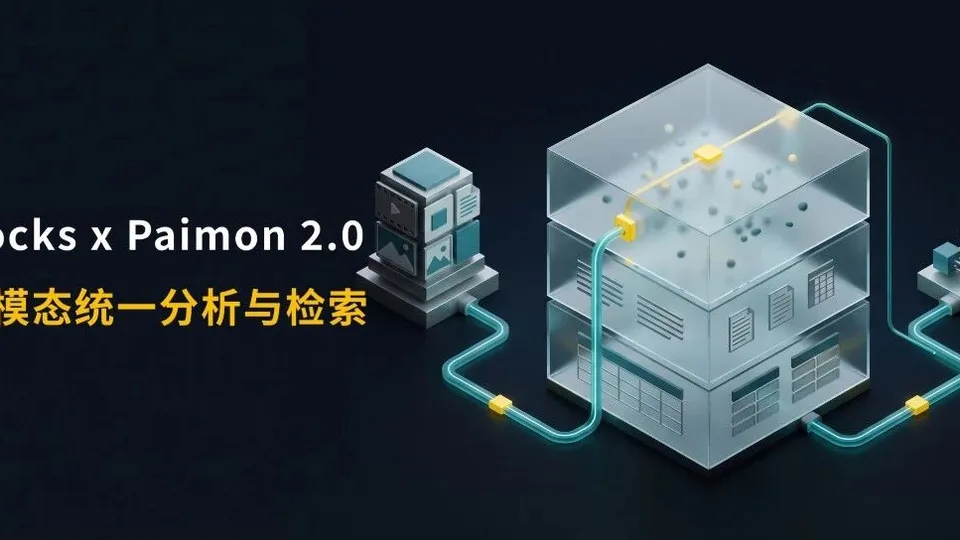
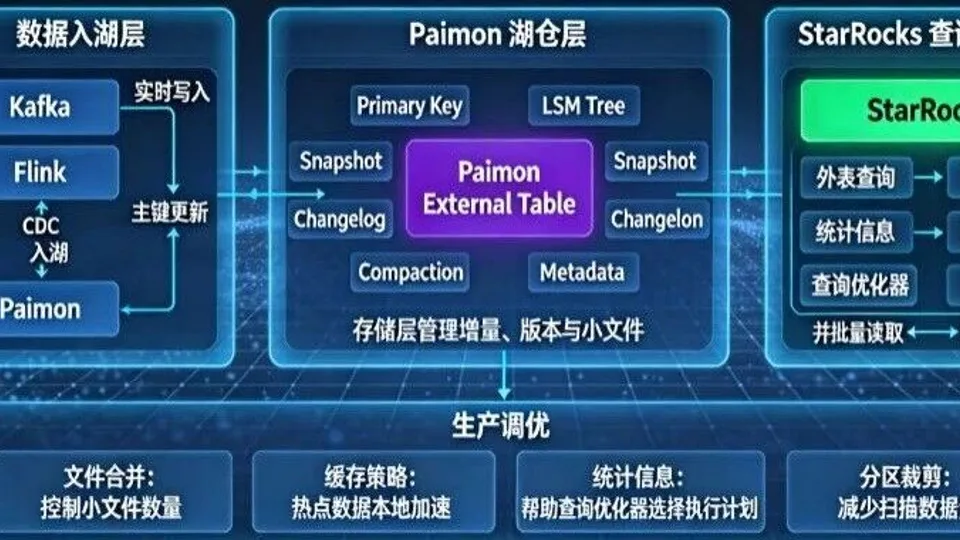
StarRocks now fully supports Paimon 2.0, integrating columnar analytics with vector, full-text, and scalar indexes into a single SQL execution framework for multimodal lakehouse workloads, enabling unified data management, retrieval, and relational analysis on object storage without data movement.
At Yunqi 2026, Alibaba Cloud unveiled a strategic upgrade to its ODPS big data platform, introducing agent-native architecture and multimodal computing across MaxCompute, Hologres, and DataWorks to support large model data refinement, embodied intelligence, and autonomous data operations with SQL AI, vector search, data sandboxes, and semantic knowledge graphs.
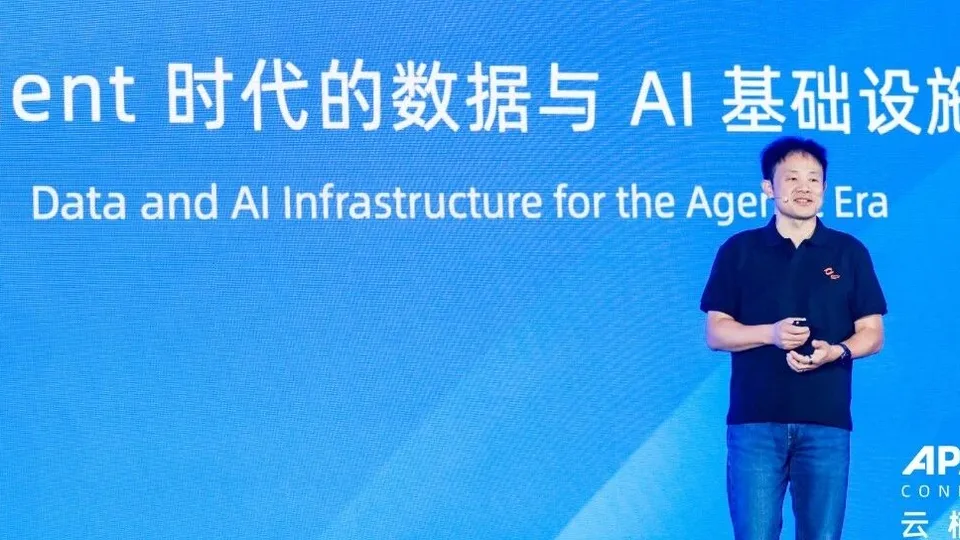
At Yunqi 2026, Alibaba Cloud unveiled a comprehensive data and AI infrastructure for the Agent era, spanning multi-modal training with MaxCompute and PAI-DLC 3.0, an Agentic Lake via OpenLake and ADA, real-time Flink Streaming Agent, and self-evolving systems like PAI-CrystalLLM and Hologres' autonomous optimizer, delivering 2.4x training speedups and 100% optimizer gains.
The article presents a unified data development platform where Forge Agent acts as an AI facade, Sindri handles deterministic planning via DSL, ADF manages execution and scheduling, and quality systems ensure trustworthiness, moving beyond chat interfaces to controlled, automated data production.
This article compares Flink CDC with traditional Canal-based architectures, explains Flink CDC's core principles including lock-free snapshots and exactly-once semantics, provides DataStream and SQL code examples for MySQL integration, and covers five high-frequency interview questions on DDL handling, DELETE capture, and large-table optimization.
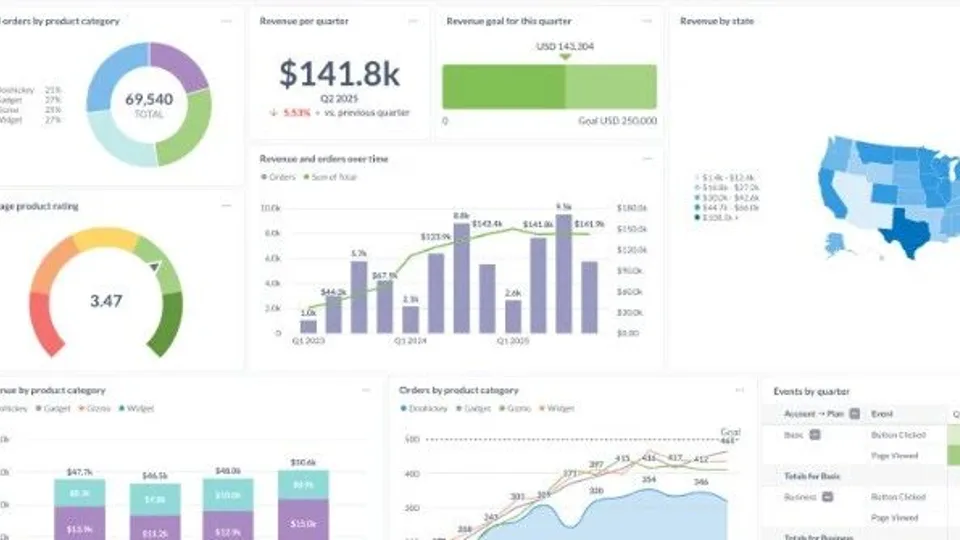
Metabase is an open-source business intelligence platform that empowers non-technical users with no-code visual querying and AI-assisted natural language analysis, while providing data professionals a full SQL editor, interactive dashboards, multi-database connectivity, and embeddable analytics with granular access controls.
Ant Group solves inconsistent business definitions across thousands of tables by building a financial data knowledge ontology using a six-node LangGraph state machine that automates schema perception, entity resolution, and conflict marking without forced merging, enabling a three-layer retrieval architecture that cuts cross-opportunity identification from days to hours and achieves 85% anomaly analysis accuracy.
This article outlines a comprehensive methodology for data planning, covering historical context, requirement analysis with subtractive thinking, Data Requirements Document (DRD) design, data flow diagrams, data dictionaries, and internal versus external data collection strategies including web scraping considerations.
iQIYI built a Big Data Assistant using an Agent Team architecture where a Coordinator delegates tasks to domain-specific Service Agents (Scheduling, Spark, Flink, ML, Data Lake, StarRocks) that collaborate via a shared blackboard to diagnose cross-service issues, evolving from rule-based workflows to LangGraph-based agents with Harness engineering for context management, tool control, and observability.
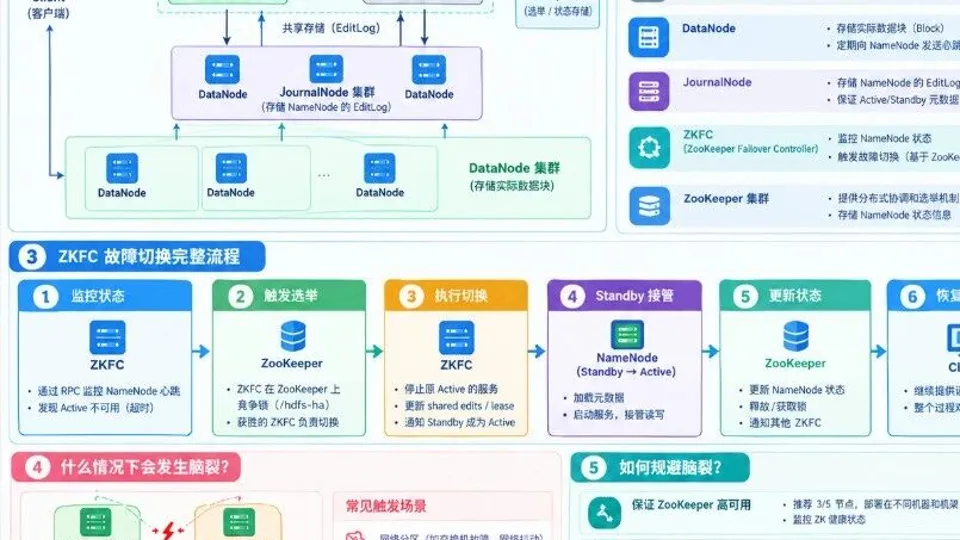
This article explains HDFS High Availability architecture, detailing core components, the ZKFC-driven automatic failover process, split-brain causes like network partitions and GC pauses, and prevention mechanisms including JournalNode quorum, ZooKeeper locks, and fencing, plus production best practices.
As data interfaces proliferate, quality issues shift from simple errors to semantic drift across systems; this article analyzes meaning, time, and responsibility drift, proposes a four-question lineage framework, and advocates lightweight change records to maintain trust in evolving data ecosystems.