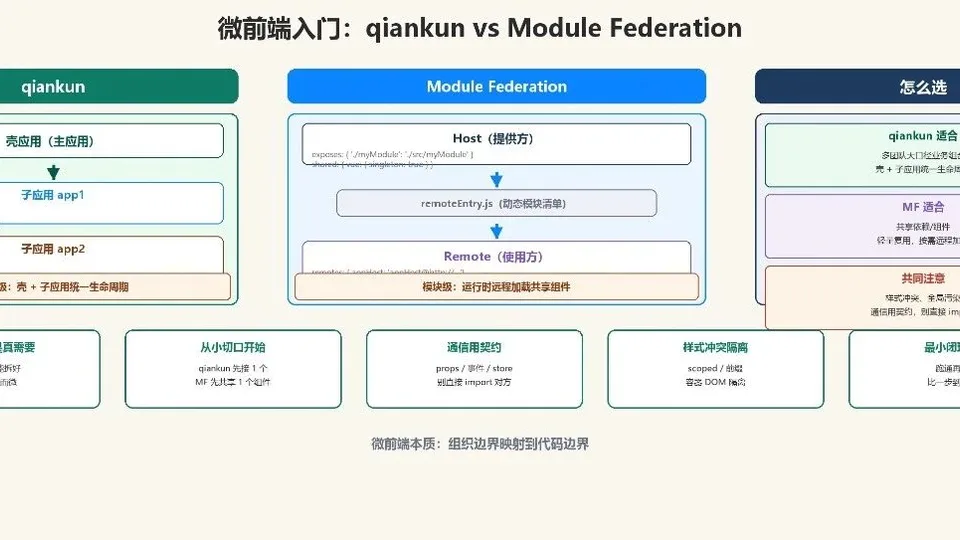
This article explains micro-frontend concepts, compares qiankun (application-level) and Webpack Module Federation (module-level), provides minimal working demos for both, and shares five practical adoption tips for teams considering micro-frontend architecture.
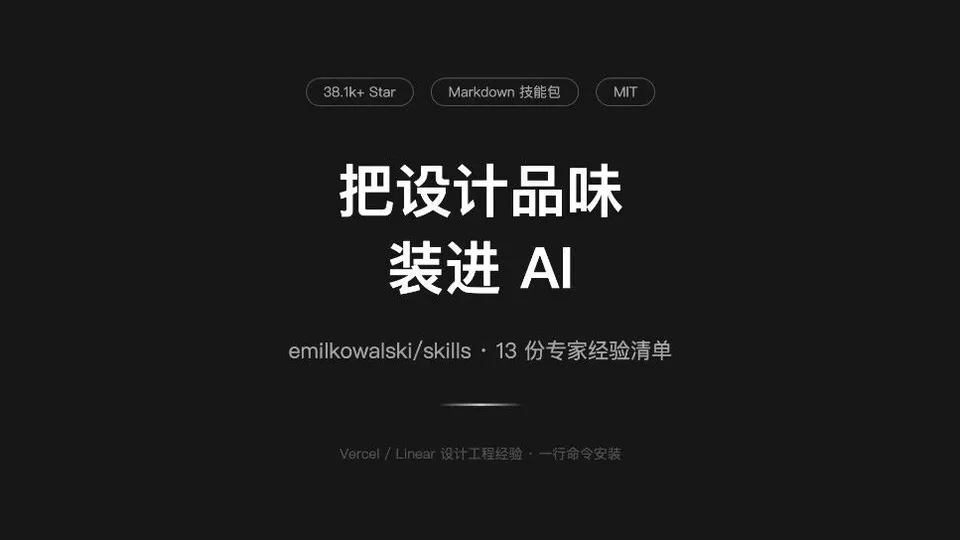
The emilkowalski/skills project (38.1k stars) distills a Vercel design engineer's decade of experience into 13 Markdown skill files that teach AI coding tools like Claude Code and Cursor concrete animation rules — easing curves, durations, performance pitfalls, and Apple's fluid interface principles — so AI-generated UIs gain polished, native-feeling interactions.
Open File Viewer v0.1.48 now supports legacy Office binary formats (doc, xls, ppt) alongside modern formats, offering a framework-agnostic file preview solution for Vue, React, Svelte, and Vanilla JS with 274 supported extensions and a plugin architecture that handles complex rendering fallbacks.
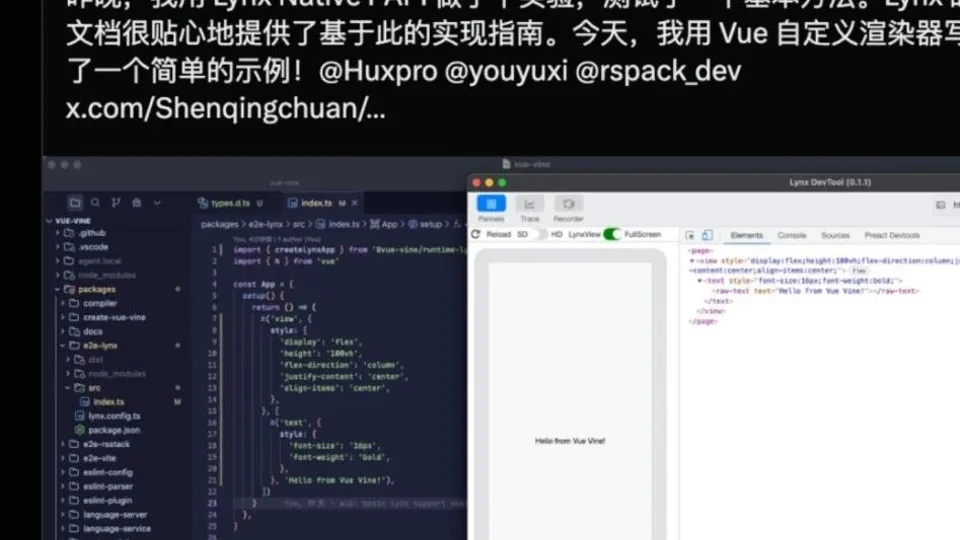
Vue Lynx is ByteDance's official Vue3 binding for the Lynx cross-platform engine, enabling standard Vue3 syntax to build native iOS/Android apps with dual-thread architecture, native rendering, and a growing component library, positioning it as a modern alternative to NativeScript-Vue and WebView-based solutions.
This article explains how Rspress makes documentation sites accessible to AI agents through llms.txt indexes, SSG-MD for generating Markdown alongside HTML, Accept: text/markdown content negotiation, AFDocs compliance checking, and injectLlmsHint for discoverability, achieving a perfect 100/100 AFDocs score.
As AI tools rapidly produce functional but often inconsistent interfaces, design engineers become essential for establishing taste, implementing judgment into maintainable components, codifying standards, automating quality checks, and preserving human oversight of brand and context.
TresJS v5 adds WebGPU support via Three.js's WebGPURenderer, a new CLI for project scaffolding, reactive resource loading composables, DOM-aligned event handling, Nuxt 4 compatibility, and enhanced Devtools, enabling Vue developers to build complex 3D applications with GPU compute shaders, particle systems, and physics simulations.
The author argues that AI can generate 90% of complex calendar UIs but the remaining 10-20% becomes a blind-box guessing game because developers cannot verify fixes; they propose four workflow gates (contract, main path, link, container) and executable skills to replace random patching with provable correctness.
This article compares Remotion and HyperFrames for AI-driven video generation, arguing that HyperFrames' HTML-based approach better aligns with LLM training data, enabling more creative, error-free output with simpler workflows and permissive licensing, while acknowledging Remotion's maturity for React-centric, data-driven batch production.
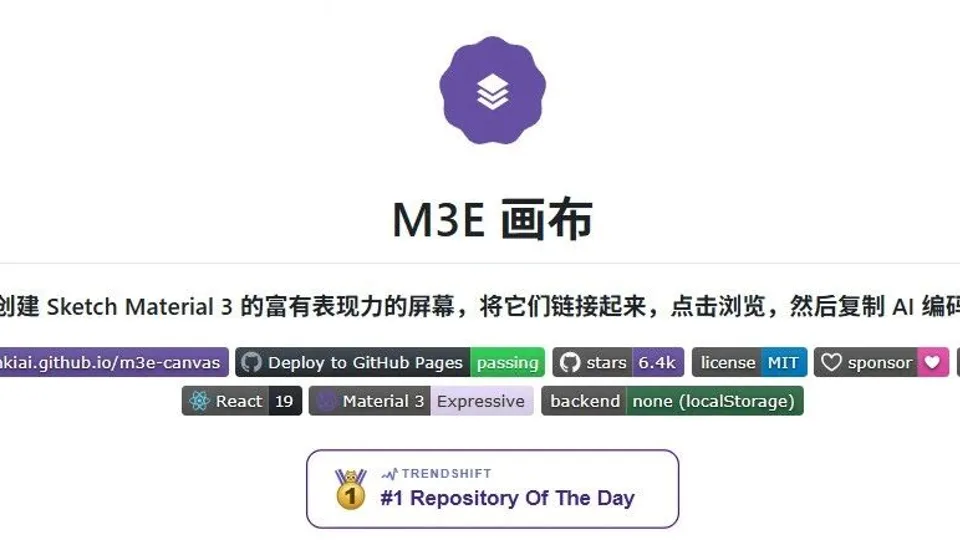
M3E Canvas is an open-source visual prototyping tool that lets developers drag-and-drop Material 3 Expressive components to build multi-page UI prototypes with transitions, then exports a standardized six-section prompt for AI coding assistants like Cursor, Claude Code, and Codex, eliminating ambiguous natural-language descriptions.
This tutorial walks through using the open-source AI Website Cloner Template, which leverages an AI coding assistant with browser automation to replicate any target website, covering prerequisites, installation, cloning commands, and result verification.
The article explains how Google Maps' 2005 decision to tile the world using a spherical Mercator projection cut at 85.05° latitude created the Web Mercator standard (EPSG:3857) that persists today because its angle-preserving property and square tile pyramid are essential for navigation and efficient rendering, making it irreplaceable despite UN advocacy for equal-area projections.
This article compares polling, WebSocket, and Server-Sent Events (SSE) for server-to-client real-time messaging, detailing SSE's lightweight HTTP-based design, automatic reconnection, and simpler server requirements, then provides a complete Node.js/Express and vanilla HTML/JavaScript demo.
The open-source God's Eye View project aggregates 13 layers of public geospatial data—flights, ships, satellites, earthquakes, cameras—into an interactive 3D globe with immersive cockpit views, sensor simulations, AI voice control, and shareable scenes, all deployable locally via Node.js and CesiumJS.
This article details a three-step workflow for building self-healing UI test scripts using SeleniumBase, covering declarative locator fallbacks, DOM context inference, audit logging, and observability integration, reducing locator failure rates from 31% to 4.7% in a financial app regression suite.
This article compares two open-source approaches to AI-powered design-to-code conversion: screenshot-to-code, a universal tool that turns any screenshot into runnable frontend code with self-correcting iteration, and lanhu-mcp, a team-focused MCP server integrating AI with the Lanhu design platform for shared context and knowledge.
This tutorial demonstrates CSS and JavaScript methods to disable text selection, right-click, copy, cut, and paste on web pages, along with three practical workarounds including saving as HTML, using print preview, and disabling JavaScript to bypass such restrictions.
Fallow is a Rust-based static analysis tool that builds a complete dependency graph of TypeScript and JavaScript projects to detect dead code, circular dependencies, code duplication, complexity hotspots, architecture violations, and style drift, offering zero-configuration setup, millisecond-speed scans, CI integration, and machine-readable output for AI coding assistants.
This article reviews ten must-have VSCode extensions for 2026, covering AI coding agents like Cline, Git history visualization with GitLens, code formatting via Prettier and ESLint, API testing with Thunder Client, bundle size analysis with Import Cost, inline error highlighting via Error Lens, semantic comment coloring with Better Comments, live reloading with Live Server, and spell checking with Code Spell Checker.
This guide walks through using OpenDesign v0.21.1 to build a booking tool homepage, interactive prototypes, and editable slides, emphasizing concrete content over vague prompts, saving design specs in DESIGN.md, and evaluating costs, privacy, and video export limitations before adopting the open-source design tool.