This article provides a comprehensive breakdown of COBIT 2019, the globally recognized IT governance framework that translates ISO 38500 principles into 40+ actionable processes across five domains, complete with maturity models, KPIs, and customization guidance for digital enterprises.
The article defines Architecture Rot as the gradual decay of system design, outlines its four stages—healthy, debt accumulation, degradation, and crisis—details code‑level symptoms, business and technical causes, quantitative detection metrics, and presents a step‑by‑step governance plan including prevention, regular health checks, and incremental refactoring using the strangler‑fig pattern.
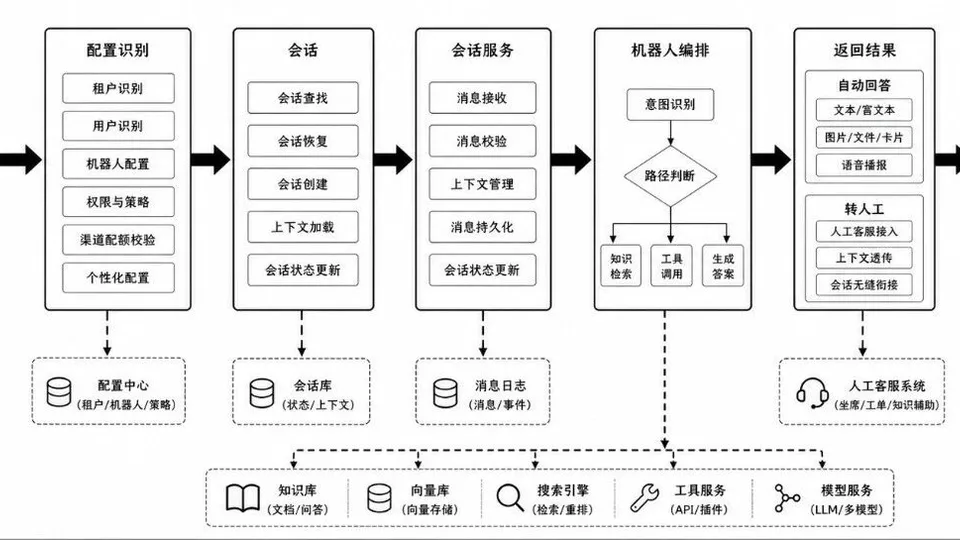
This article walks through a step‑by‑step method for creating a technical architecture diagram of an AI‑powered customer service system, covering how to identify the core business flow, map states and data ownership, decide sync/async boundaries, place modules, and annotate risks and support capabilities.
The article explains how a system architect resolves conflicting stakeholder demands—such as simplicity for patients, strict security, rapid delivery, low cost, and high reliability—by translating them into documented, reviewable, implementable and evolvable architecture decisions and by continuously balancing business goals, quality attributes, technical constraints and cost.
The article argues that 'business-led, IT-enabled' digital transformation fails due to misinterpretation: companies delegate strategy to individual departments instead of top-level governance, avoid top-driven change, expect business to specify technical details, and keep IT detached from business. Success requires top leadership, a bridging transformation office, and clear accountability: business owns value, IT owns delivery.
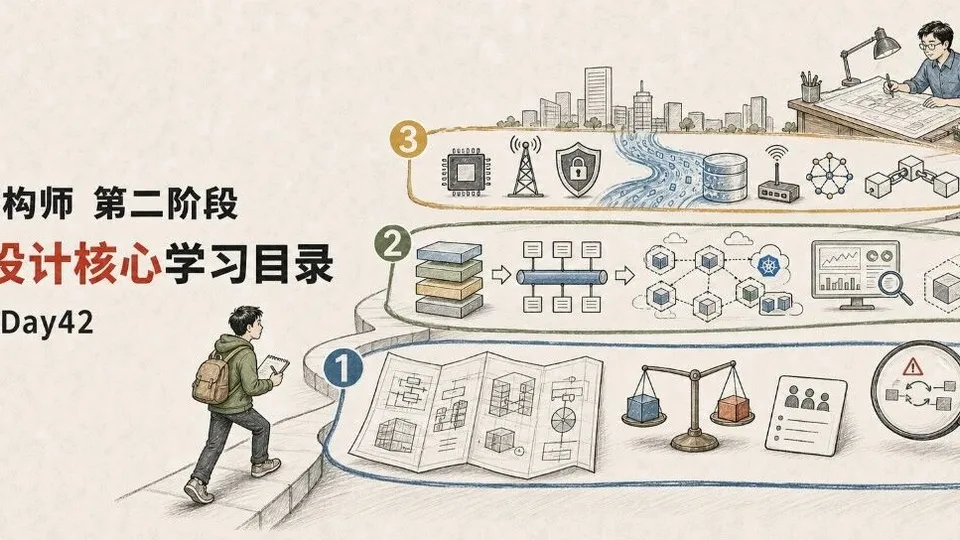
After completing the first 21 days of foundational topics, the second stage (Day22‑Day42) shifts focus to core architecture design, covering stakeholders, requirements, trade‑offs, evaluation methods, and a detailed daily syllabus that guides learners from theory to practical system design.
The author argues that genuine reflection goes beyond simple post‑mortems, requiring a deep examination of one’s thinking model and the creation of new action rules, illustrated by a personal case where re‑thinking task‑assignment shifted focus from short‑term efficiency to long‑term team capability.
The article examines why AI‑assisted coding speeds up individual developers yet fails to shorten end‑to‑end delivery, proposes an issue‑driven automation platform called IssueOps, outlines four AI coding maturity levels, discusses risk boundaries, tool choices, and evaluates how far organizations are from achieving a fully autonomous L4 development pipeline.
The author explains that a performance “A” is awarded only when an engineer exceeds expectations, illustrating this with two projects—a store scheduling system and a semi‑finished product dashboard—showing how independent handling of large‑scale work reduces management overhead and builds trust.
This guide teaches a vivid memory‑palace method to recall CMMI’s five maturity levels—Initial, Managed, Defined, Quantitatively Managed, and Optimizing—explaining each level’s characteristics, key practices, common confusions, and how continuous improvement cycles like PDCA transform software processes from ad‑hoc heroics to data‑driven optimization.
This article explains why IT governance—not technology—is the true differentiator in digital transformation, detailing ISO 38500's Evaluate-Direct-Monitor model, four governance pillars, the governance-vs-management distinction, common governance failures in Chinese firms, and why upgrading decision structures matters more than upgrading tech stacks.
This article explains why Architecture Decision Records (ADRs) are essential, defines them as a “black box” for recording decisions, outlines their value, formats, lifecycle, creation process, management tools, and provides concrete ADR examples such as using JWT for authentication and Kafka for messaging.
The author recounts spending over two years trying to mentor a struggling developer, explains why endless training hurts the whole team, and concludes that while nurturing talent is essential, it must be bounded by a clear deadline.
The article argues that many technical managers fail because they rely on engineering skills instead of developing true management capabilities, illustrating common pitfalls such as micromanaging code, ignoring people, and neglecting upward communication, and offers concrete advice for becoming a competent leader.
The article analyzes how AI coding dramatically boosts individual output but fails to improve organizational delivery, exposing hidden communication bottlenecks and proposing an AI‑Native redesign—three core design principles, a multi‑layered Harness system, and AI Agents—to transform engineering teams into high‑throughput, low‑friction production pipelines.
This article explains what an Architecture Committee is, why enterprises need one, its typical composition, decision processes, daily operations, common pitfalls, and key success factors for effective enterprise‑level architecture governance.
The author argues that embracing team members who are more capable than the leader boosts responsibility, value creation, and personal growth, provided the leader remains strong; a team’s overall throughput, not a single leader’s capacity, determines its ultimate success.
This article explains what an architecture review is, outlines its types and value, details the preparation of documents and participants, provides a step‑by‑step review agenda—including opening, solution presentation, Q&A, and summary—offers tactics for handling challenges, supplies template materials, and defines acceptance criteria for a successful review.
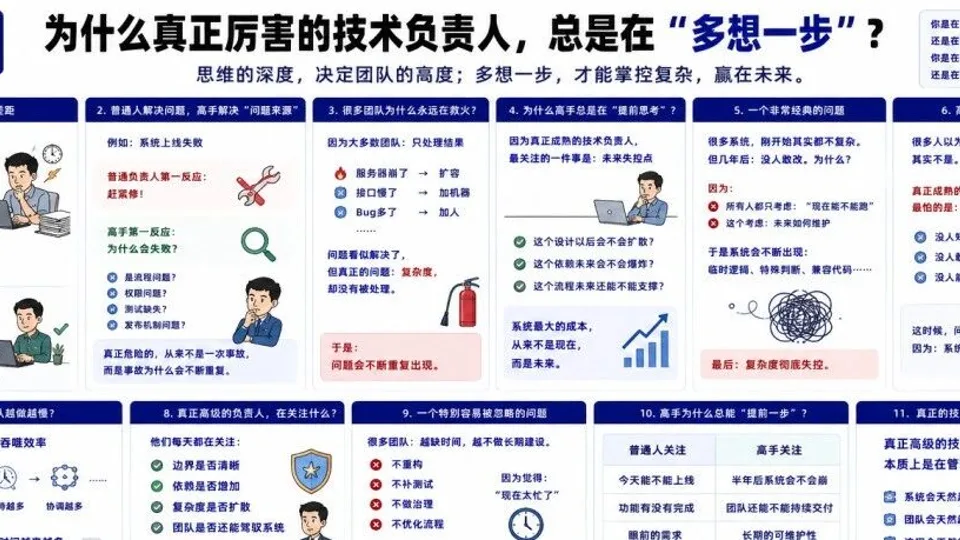
The article explains that truly great technical leaders appear less busy because they focus on anticipating future failure points and controlling system complexity, rather than merely reacting to immediate issues, which leads to more stable systems, smoother teams, and faster project delivery.
The article explains that effective management creates value beyond coding, illustrating with a tech director who, despite outdated technical knowledge, succeeds by delegating authority, securing resources, resolving conflicts, and taking responsibility, and outlines four criteria to assess a manager’s worth.