Baidu Canghai Storage’s unified technology stack—comprising a meta‑aware distributed metadata layer, a hybrid single‑node‑distributed namespace, and an online erasure‑coding data layer—delivers AI‑driven, high‑performance, low‑cost, ZB‑scale cloud storage by modularizing metadata, namespace, and data services for object, file, and block workloads.
This article introduces cloud computing fundamentals, explaining its core concept and detailing the three service models—Infrastructure as a Service, Platform as a Service, and Software as a Service—along with examples, benefits, and how they together form modern cloud solutions.
Baidu’s Canghai Storage unifies metadata, hierarchical namespace, and data layers into a Meta‑Aware, three‑generation architecture that scales to trillions of metadata items and zettabyte‑scale data, using a distributed transactional KV store, single‑machine‑distributed namespace, and online erasure‑coding micro‑services to deliver high performance, low cost, and seamless scalability.
This article uses everyday scenarios such as making pizza, building a house, running a pig farm, and playing on a computer to clearly explain the differences between IaaS, PaaS, and SaaS service models in cloud computing.
This article details Baidu’s unified storage architecture—covering its metadata, hierarchical namespace, and data layers—explaining how meta‑aware design, custom partitioning, flexible engines, and micro‑service based erasure coding together meet the scalability, performance, and cost demands of modern AI‑driven cloud storage workloads.
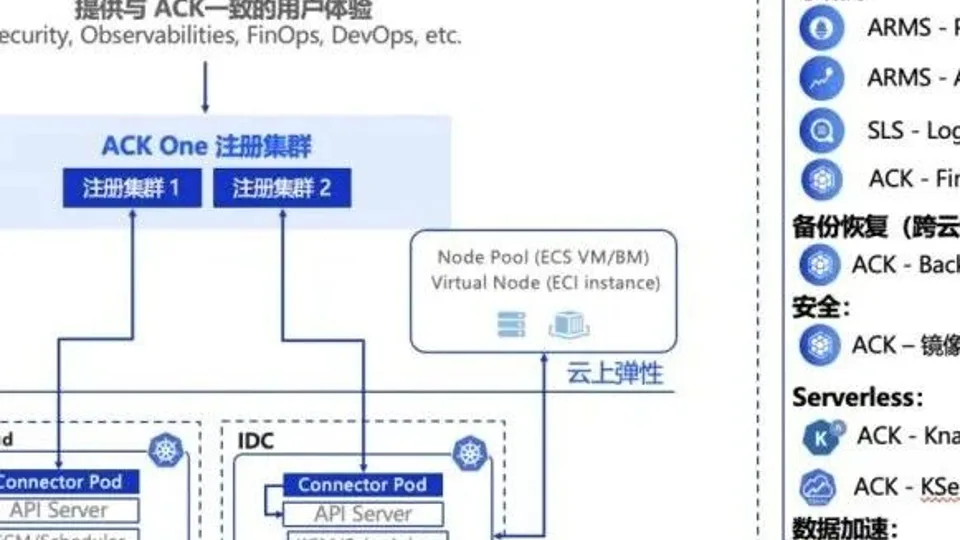
This article explains how Alibaba Cloud's ACK Backup Center helps enterprises overcome data security, service interruption, compatibility, and complexity challenges when migrating container platforms across clouds, detailing step-by-step procedures, real‑world case challenges, and concrete solutions.
Baidu Intelligent Cloud outlines how its evolving, high-performance infrastructure—featuring rapid 3-minute instance provisioning, over 200 GB bandwidth, elastic computing, specialized storage, and AI-driven MLOps tools—enables AI-native model training and deployment across booming sectors such as automotive and finance, supporting the industry’s shift to AI-centric cloud services.
This article details the design, implementation, and results of migrating over 16,000 virtual machine disks from an aging Ceph Luminous cluster to a high‑performance mixed‑flash Ceph cluster using QEMU QMP hot‑swap, achieving a 47.65% reduction in IO latency and enabling cost‑saving decommissioning of legacy storage.
This article explains GPU virtualization, comparing NVIDIA's software‑based vGPU and AMD's hardware‑based MxGPU, detailing their architecture, required hardware, licensing, performance indicators, resource scheduling strategies, slicing limits, and the advantages and drawbacks of each approach for virtualized workloads.
This article explains the network interruption issues of VM live migration in 360's VPC overlay (V1), analyzes the root causes, and presents a V2 redesign that eliminates downtime through pre‑loaded forwarding policies, traffic redirection, and streamlined component collaboration.
This article explains how 360’s cloud platform uses a three‑layer architecture and Nova‑scheduler to manage thousands of servers and tens of thousands of VMs across multiple OpenStack clusters, detailing scheduling policies, resource‑pool handling, current challenges, and future improvement plans.
This article provides a comprehensive overview of SaaS, covering cloud service models (PaaS, IaaS, SaaS), the two main characteristics of SaaS systems, differences from traditional software, various SaaS classifications, steps to SaaS-ify a product, core components, and multi‑tenant architectures with deployment models.
This article details how a solo engineer built and operated a SaaS platform on AWS using Kubernetes, covering infrastructure overview, automatic DNS, TLS, load balancing, CI/CD rollouts, autoscaling, caching, secret management, monitoring, logging, error tracking, and cost‑effective operations.
Soul's container cluster cost governance case study details their approach to optimizing resource utilization through Kubernetes-based solutions, addressing challenges like resource fragmentation and implementing strategies such as SNAS for elastic scaling and HPA+CronHPA coordination to achieve significant cost reductions.
This article provides a detailed, beginner‑friendly tutorial on purchasing an Alibaba Cloud ECS instance, configuring the operating system, and installing JDK 8, Redis, and MySQL 8.0—including necessary firewall and security‑group settings—to launch a functional web‑site environment.
Learn the differences between physical servers, VPS, Elastic Compute Service (ECS), and Docker containers, how they’re built, their use cases, and practical tips for choosing the right server solution—whether you’re a solo developer, a small business, or just curious about cloud infrastructure.
This article examines Unity's cloud rendering technology, detailing its distributed architecture, workflow steps, key innovations such as low‑latency transmission and real‑time rendering, and explores how these capabilities enable large‑scale, immersive experiences in the emerging metaverse.
This article provides a comprehensive overview of cloud computing, covering its definition, core design principles such as resource pooling, virtualization, containerization, on‑demand services, elasticity, and the three main service models—IaaS, PaaS, and SaaS—while illustrating each concept with clear diagrams.