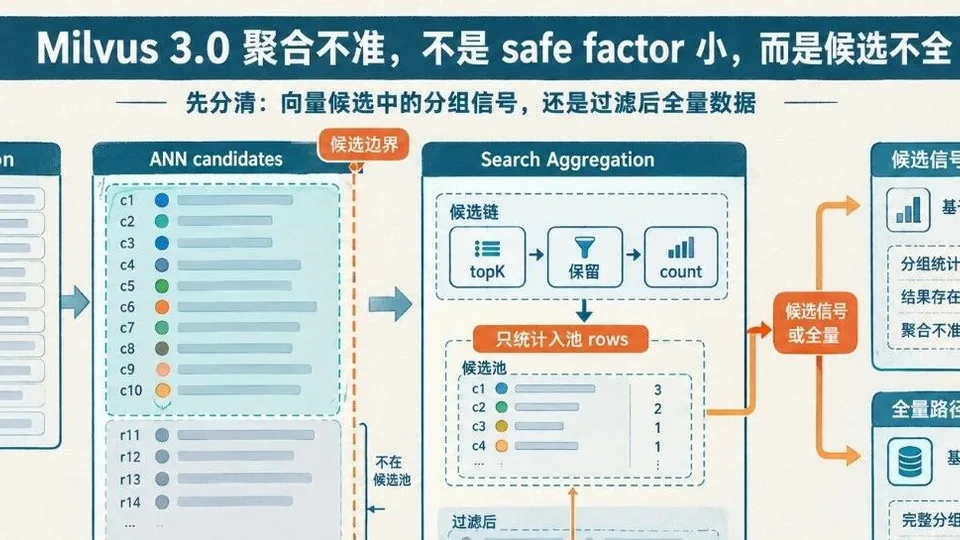
The article explains that Milvus 3.0 search aggregation operates on ANN candidates, not full collections, so missing buckets stem from candidate budget limits (topK and TopHits.size), not the safe_factor parameter; it distinguishes candidate-signal counts from exact filtered counts and advises choosing the right query path for each need.
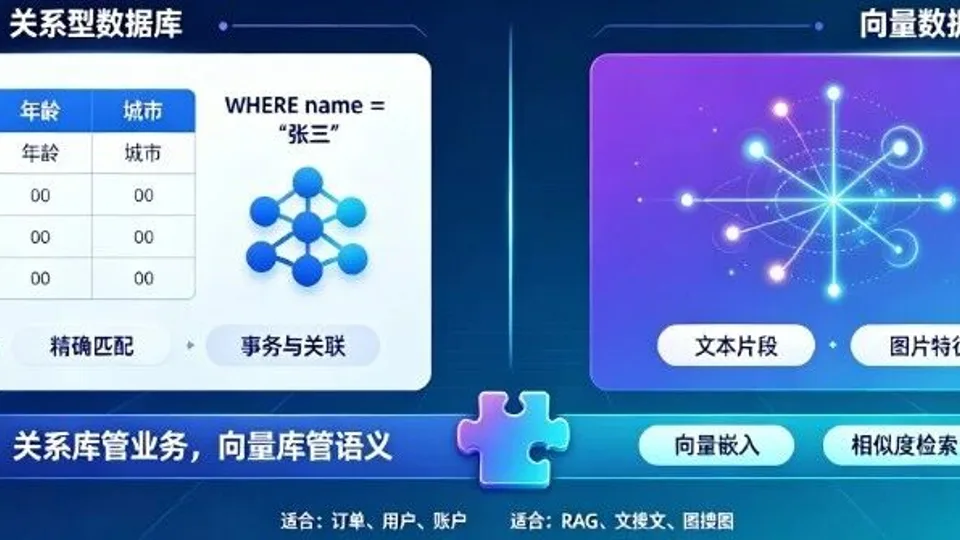
This article explains why vector databases like Milvus and Qdrant are necessary for AI applications despite the existence of relational databases like MySQL, detailing differences in indexing (ANN vs B+ trees), query logic (similarity vs exact match), consistency models, data structures, and ideal use cases such as RAG and recommendation systems.
This report validates a read-write separation architecture using Dameng DM8 for transactions and Easysearch for full-text search, syncing 1 million Chinese documents via Logstash; full sync completes in 5.5 minutes, incremental changes propagate within 30 seconds, and search latency drops 12x compared to SQL LIKE while maintaining identical recall.
This article details integrating Dameng DM8 database with Easysearch 2.4.0 via Logstash 9.0 for full-text search, covering version compatibility fixes, JDBC driver configuration, logical deletion handling, timestamp boundary issues, IK analyzer alignment for Chinese text, and benchmark results showing 17x faster queries with consistent recall versus LIKE.
This article details eight common SQL anti-patterns — including OFFSET pagination, implicit type conversion, correlated subqueries in updates, mixed sorting, EXISTS clauses, blocked condition pushdown, late filtering, and unoptimized intermediate results — with execution plans and rewrites that reduce query times from seconds to milliseconds.
In an 80-minute interview, Turing Award winner Mike Stonebraker argues that relational databases will absorb AI workloads, explains why Text-to-SQL fails on real enterprise data due to schema corruption and access controls, details DBOS's persistent workflow approach for AI agents, and discusses saga patterns for compensating transactions, graph database limitations, and the future of open-source AI.
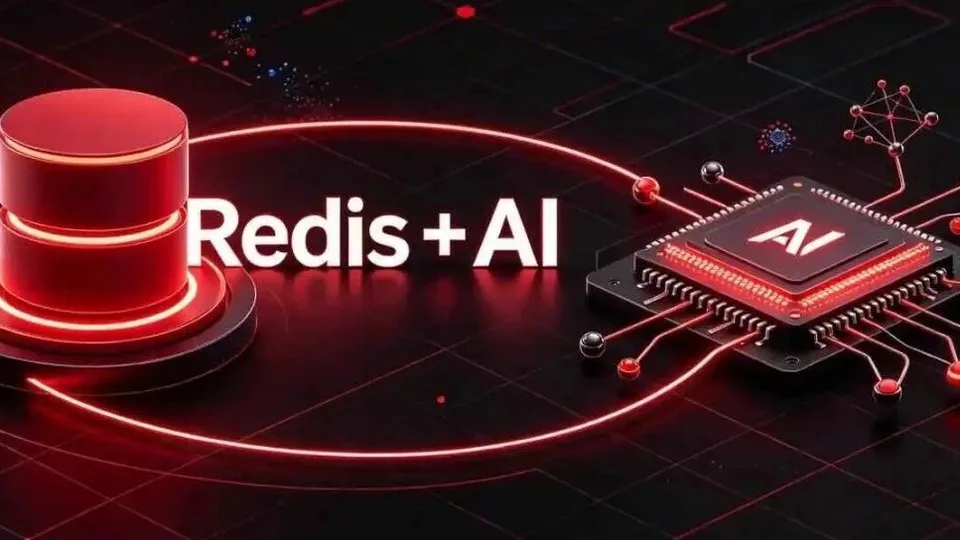
Redis 8.0 introduces native vector search with Vector Set data type, HNSW indexing, quantization, and the Iris platform for agent memory and context retrieval, enabling semantic caching that cuts LLM costs by 70% and integrates with LangChain4j and Spring AI.
The article argues that manual database sharding is shifting from a default scaling strategy to a fallback option, as native distributed databases like TiDB and OceanBase internalize sharding, routing, and distributed transactions, reducing application complexity, though they introduce higher latency, operational overhead, and cost, making single-node MySQL with proper indexing preferable for smaller datasets.
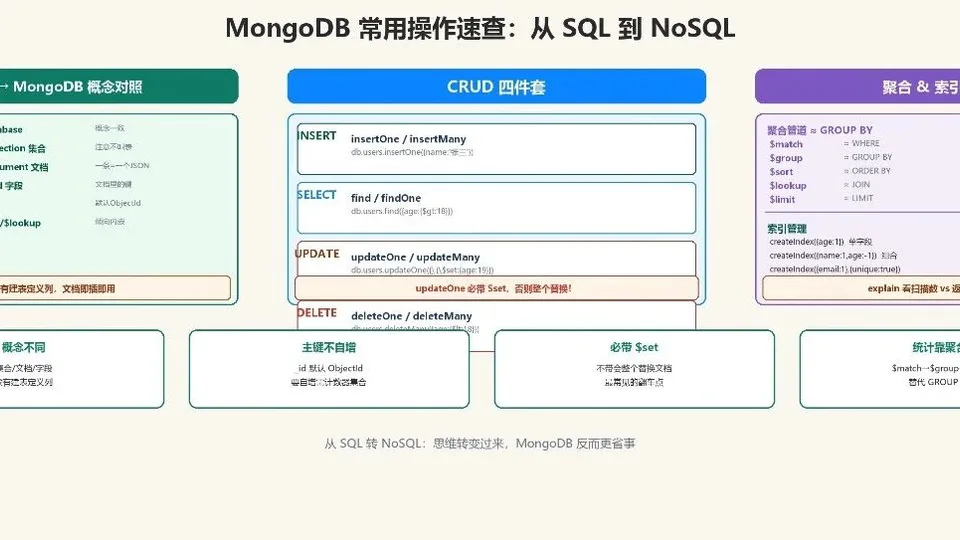
This MongoDB cheat sheet guides SQL developers through the mindset shift to NoSQL, covering concept mappings, CRUD operations, indexing, aggregation pipelines, and execution plan analysis with practical code examples for each operation and key pitfalls to avoid.
This article benchmarks PostgreSQL JSON and JSONB types on 1 million rows, revealing JSONB delivers 6-9x faster queries and 26% less storage despite 31% slower writes, with practical guidance on when to choose each type and how to leverage GIN indexes for optimal performance.
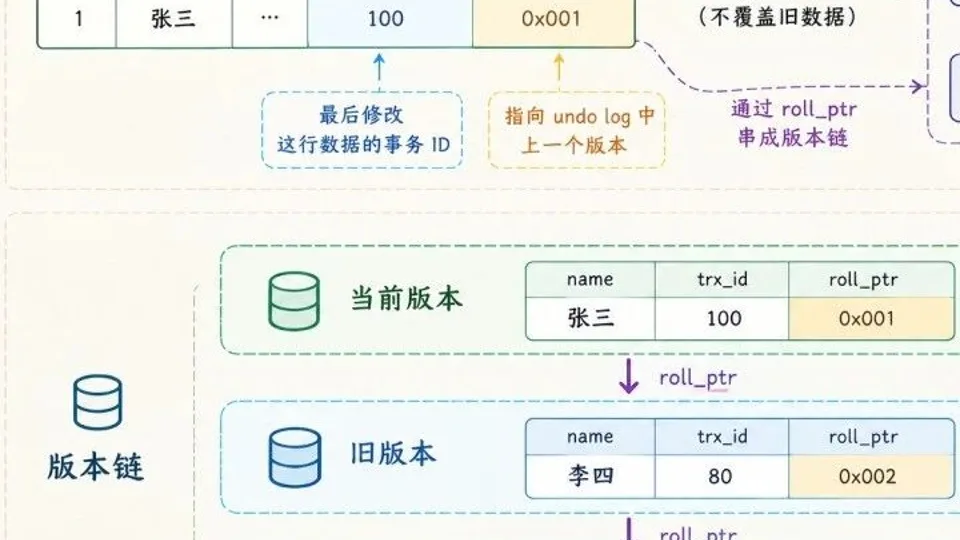
This article explains how MySQL's MVCC uses version chains and ReadViews to enable lock-free snapshot reads, why isolation levels control ReadView creation timing (per-statement vs per-transaction), and why READ UNCOMMITTED and SERIALIZABLE bypass MVCC entirely, while writes still require row locks.
The author benchmarks MariaDB 10.3, MySQL 8.0, and PostgreSQL 12 using a real Turkish motorcycle classifieds app with many simple queries, finding MariaDB 5% faster on average and 7% faster at p95 with lower CPU usage, though MySQL handles tail latency better and memory differences stem from default performance_schema settings.
StarRocks now fully supports Paimon 2.0, enabling multimodal lakehouse workloads where columnar scans, scalar/vector/full-text indexes, and BLOB fetches coexist in one SQL execution framework, backed by Row Tracking and Data Evolution for incremental feature backfill.
Baidu's Canghai storage evolves from siloed per-product systems to a unified architecture with MetaDB (distributed transactional metadata database) and Aries (scalable Blob KV data plane with online EC), using directory-aware sharding, conflict merging, Mantle path resolution, and hybrid EC/three-replica adaptation to support object, file, and block storage on one foundation.
This article details seven common MySQL index failure scenarios—including leftmost prefix violations, function usage on indexed columns, implicit type conversion, leading wildcards in LIKE, OR with non-indexed columns, IS NOT NULL, and NOT IN/EXISTS—with concrete SQL examples showing both failing and optimized queries.
This guide details MySQL scheduled backup using mysqldump commands for full, structural, and data-only exports, a Bash script that retains 31 days of rotating backups with logging, and crontab configuration for automated execution, including restore procedures and practical scheduling examples.
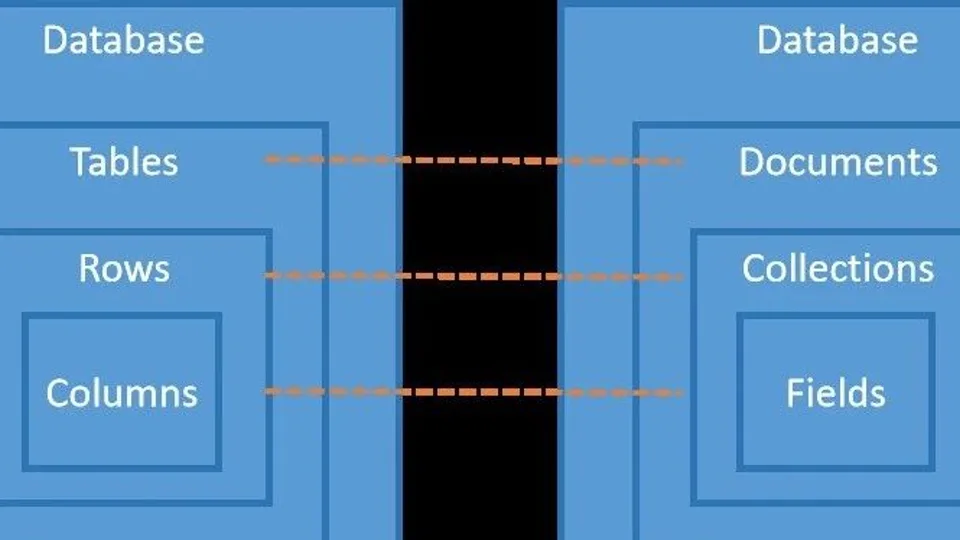
This article introduces MongoDB as an open-source document database, explains NoSQL categories, details MongoDB's data model (fields, documents, collections, databases) with relational database analogies, and provides step-by-step installation instructions for MongoDB 7.0 on CentOS 7 via yum and manual RPM.
This guide covers integrating Cassandra with Spring Boot for high-write scenarios, detailing data modeling with partition/clustering keys, consistency level selection (LOCAL_QUORUM), query best practices, performance tuning (compaction, compression, JVM), and production pitfalls like hot partitions and tombstone storms.